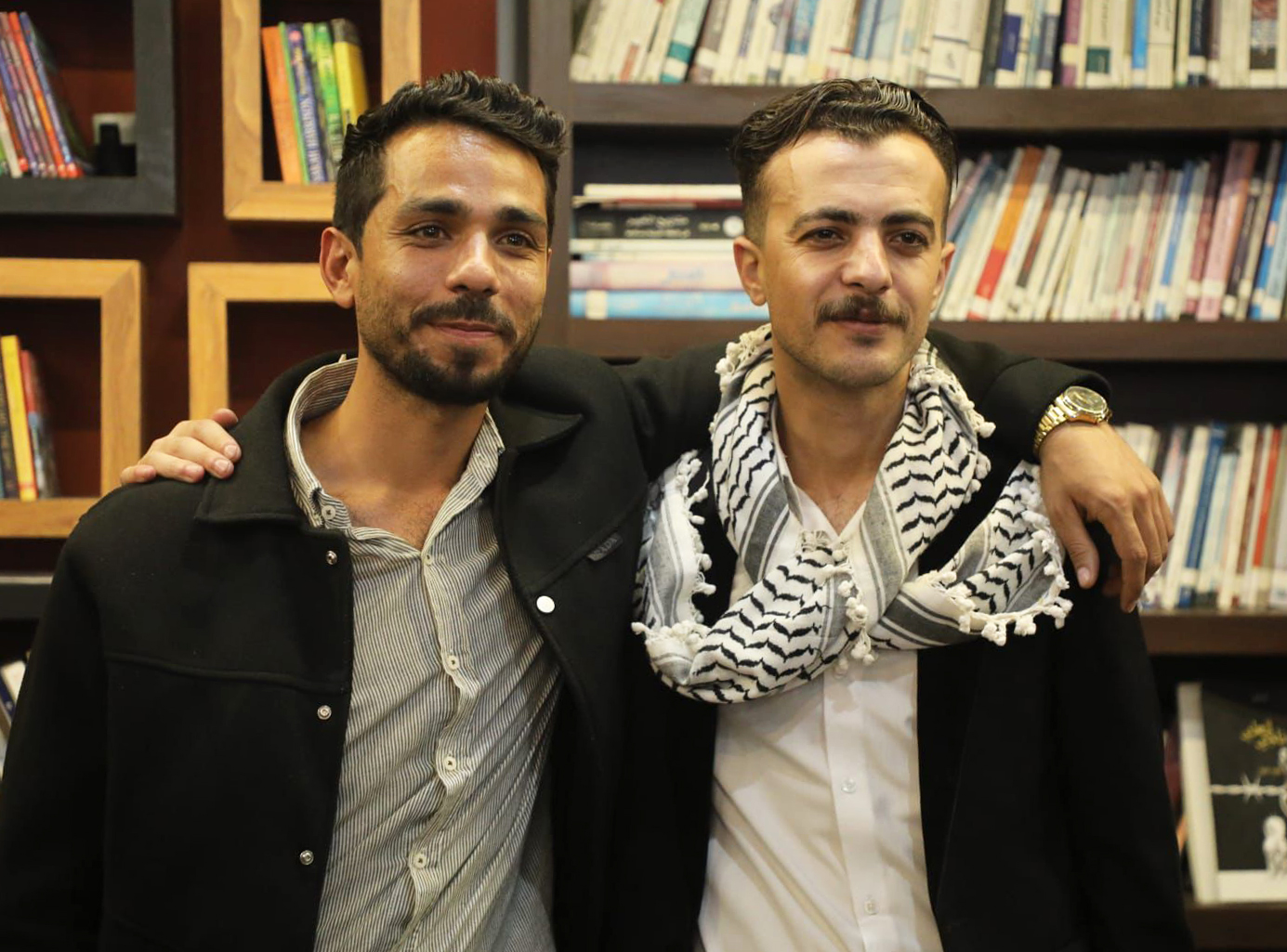
More than a year ago, a donkey cart wound its way through heaps of rubble in Gaza. Three young men brushed ash from burned book covers and stacked salvaged volumes onto the cart, racing to save them from Israeli airstrikes and neighbors trying to burn them for fuel, unable to access cooking fuel due to the Israeli blockade.
Omar Hamad, 30, is a pharmacy graduate who never stopped being a reader. He has helped collect and preserve more than 5,500 books since 2025. Recently, his war-torn book drive has materialized into an unlikely new library in the Gaza Strip, where he and his friends have been organizing the books into a library management system, still being completed.
He gathered these volumes along with his friends, Hussam Hamad, 42 and Ibrahim al-Masri, 31, for what they’ve dubbed the Phoenix Library. The books were gathered by any means possible: pulled from rubble, purchased, or reprinted. The library opened on April 21st.


Israeli airstrikes have buried Gaza under 61.5 million tons of rubble, or the equivalent of roughly 170 Empire State Buildings. It amounts to more than 169 kilograms of debris per square meter of the Strip’s surface.

Buy a physical copy of the Library of Things Toolkit
This 250-page book will walk you through the process to start (or grow) a thriving sharing hub in your community. By ordering direct from Shareable, you’ll automatically get 25% off!
Libraries, personal collections, and vast institutional archives lie under that mass—including the books these three young men raced to rescue before they could be burned for cooking fuel, the tragic result of a blockade that has made traditional cooking gas canisters critically short and prohibitively expensive.
The name of the library speaks for itself, O. Hamad told Shareable: “The Phoenix, rising from the ash.” Their efforts are part of a larger, community-driven pattern spreading across the Strip to save books and public libraries from the destruction of the US/Israeli genocidal war on Gaza.
The genocide’s toll on books and other valuable written materials has been catastrophic.
Since October 2023, at least 87 libraries in Gaza have been damaged or destroyed.
“Their efforts are part of a larger, community-driven pattern spreading across the Strip to save books and public libraries from the destruction of the U.S./Israeli genocidal war on Gaza.”
Gaza’s Central Archives, containing 150 years of historical records, was completely decimated by Israeli airstrikes early in the genocide, in November 2023. Later, in May 2024, Israeli soldiers burned Al-Aqsa University’s library, a pillar of the Strip’s higher education that housed one of Gaza’s largest academic collections.
Ahlam al-Sha’er, Director of Libraries and Heritage at Gaza’s Ministry of Culture, told Shareable that Gaza had more than 200 million books before the genocide. “In 2012 alone, the Union of Arab Publishers donated half a million books to the territory,” she said.
From the ash: the Phoenix Library
Whenever Israeli attacks forced O. Hamad to flee, he refused to part with his books.
On ten separate occasions, he was displaced from Beit Hanoun, on Gaza’s northeastern border with occupied Palestine. Each time he loaded his books into the front of a truck, nestled between luggage and food, his family was left baffled.
The quest to save books began in January 2025, prompted by the request of a prominent author who, like O. Hamad, wanted his precious books to survive the war. “We set out toward a private library belonging to Pulitzer Prize-winning Palestinian poet Mosab Abu Toha in Beit Lahiya, after agreeing with him to retrieve his books and protect them from damage or theft,” O. Hamad said.
Then, at a displacement shelter, the team found people burning books from the Islamic University of Gaza’s library—one of the largest academic libraries in the Strip—for heat and cooking. “I tried to buy what I could, especially from young boys who were selling books by the kilogram for one shekel (less than 30 cents) each,” he said. “I gathered hundreds of valuable books that way.”
The price of cooking gas in Gaza had risen by 4,000% as compared to before the genocide, and by 600% compared to the so-called ceasefire period, according to a March 2025 OCHA report. The price surge has left Gazans scrabbling for anything to cook over, even books.
To secure a physical space for the Phoenix Library, the three men rented a 180-square-meter apartment in central Gaza, and they created double-layered sliding shelves to maximize space. They began filling it with books physically rescued from rubble. Others, they digitally recovered and reprinted at five times their normal cost.

Since last December, the team has crowdfunded the project via Chuffed, a platform for socially-conscious projects, under the title “Building the First Library in Gaza During the Genocide.” They raised over $100,000 to cover rent, electricity via a generator, water, and furnishings. The fundraising efforts are ongoing, as the team hopes to expand their book collection and create a podcast recording space in the library to share stories from Gaza.
Al-Masri, an English literature graduate, displayed some of the recovered books with visible pride. Volumes pierced by bullets, burned at their edges, pages torn. “Among those we pulled from the rubble are books over a hundred years old: a fifth edition of ‘Kalila and Demna,’ a Holy Bible, [and] an edition of Ibn Khaldun’s ‘Muqaddima,’” he told Shareable. The finds span centuries of Arab literary and intellectual heritage. “Kalila and Dimna” is a beloved collection of animal fables that has traveled across cultures since ancient India, while Ibn Khaldun’s “Muqaddima,” written in the 14th century, is widely regarded as one of the founding texts of sociology and historiography.
“Al-Masri, an English literature graduate, displayed some of the recovered books with visible pride. Volumes pierced by bullets, burned at their edges, pages torn … The finds span centuries of Arab literary and intellectual heritage.”
The library is organized into sections: Islamic jurisprudence and history, Palestinian studies, world literature including Nobel laureates, Russian and English classics, alongside Palestinian and Arab fiction, political books, and academic texts. A quarter of the collection is dedicated to children.
“Knowledge is the most important weapon against the occupation,” said H. Hamad, a management Ph.D. Though he doesn’t conceal his anxiety: “I fear the war will resume. But we will protect these books as we protect our lives. They are part of our families, not just paper.”
Restoring the manuscripts of Al-Omari
One kilometer from the yellow buffer line stands what was once the oldest library in Gaza: the library of the Great Omari Mosque, until it was bombed by Israeli forces on December 8, 2023. Much of its roughly 20,000 rare books were reduced to ashes, including manuscripts spanning from the Mamluk to the late Ottoman period, some dating back 700 years.
The mosque itself is a historic landmark. It was originally a fifth-century Byzantine church built over a still more ancient temple, then converted to a mosque in the seventh century, a Crusader church in the eleventh, and back to a mosque in the thirteenth.

Al-Sha’er describes such loss as “cultural erasure.” Other catastrophic examples include the personal library of Abdel Latif Abu Hashim, which held 14,000 books of unique cultural, scientific, and heritage value, and the National House for Books in Gaza, which contained 5,000 titles by Gazan authors with no copies outside the territory.
“They are gone entirely,” said al-Sha’er. “The same applies to the Omari Mosque library, which held the rarest and most precious books and manuscripts in Gaza.”
Haneen al-Omsi, 33, is a coordinator for “Eyes on Heritage,” a group of volunteers working to preserve Gaza’s cultural memory. The group began working at the Omari Mosque library in January 2025. She described to Shareable what they do not as restoration, but as “triage.”
“What’s happened to the libraries cannot be described as mere losses or damages. The consequences extend for decades into the future.” —Ahlam al-Sha’er, Director of Libraries and Heritage, Gaza Ministry of Culture
The team includes five young women from different disciplines, supported by volunteer doctors, nurses, engineers, teachers, and homemakers, working with whatever materials are available—including things like alcohol and traditional surgical instruments normally used in medical procedures. “Even these tools are hard to come by,” said al-Omsi.
Despite the group’s strenuous efforts, much cannot be recovered.
“From that entire collection, we found only 3,000 damaged books. They were affected by mold, burning, and tearing. Even those can barely be partially treated,” she said. “As for the rare manuscripts, we found only 147 of the original 228. They require enormous effort to fix even partially.” Eighty-one manuscripts have not been found at all.
Al-Omsi’s own home was destroyed during her displacement. She did not visit it until two weeks after returning to Gaza City. Meanwhile, she devoted that time entirely to the library.
For Al-Sha’er, the grassroots efforts underway to restore Gaza’s books and libraries are commendable, but not nearly enough—it ultimately requires more local and international attention given the enormous task at hand.


“What’s happened to the libraries cannot be described as mere losses or damages. The consequences extend for decades into the future,” said al-Sha’er. She called on UNESCO “to treat Gaza’s libraries as a priority before what little remains is lost for good.”
And yet, writing has not stopped.
Al-Sha’er said that she receives calls from Gazan writers requesting national deposit numbers for new books and publications. Authorship also continues amid the rubble.
This article is published in collaboration with Egab.