
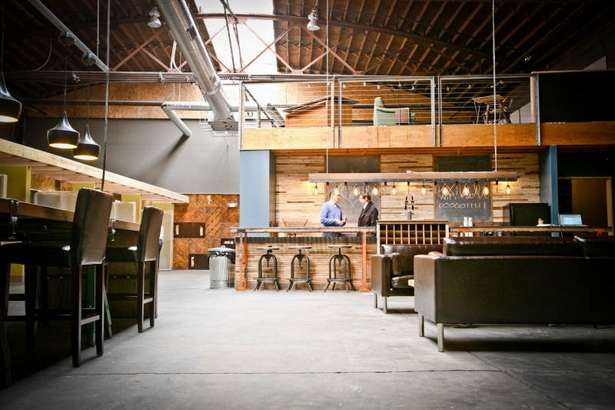
While the definition of “coworking” may be hard to pin down, across nearly all attempted explanations of the term is the common theme of connecting. Yet, for as many people who are a part of my coworking community, there are also a multitude of individuals, companies and organizations that try as they might, simply don’t fit into that particular community, and never will. They do not accept or share the particular responsibilities, and obligations of coworking as it is being practiced in my community.
The Speak Easy’s Approach to Membership
The Speak Easy, like several coworking spaces, is a member’s only organization. The coworking space takes special care in selecting members that meet our entrepreneurial-startup criteria. Joining requires an application, an open house and direct and active engagement with our current membership base. Members are asked not only to work in the space, but to embrace conversations and collaboration, as well as to aid in the creative process for others. The willingness of members to participate in each of these activities is a reflection of the community’s health. These are some of the benefits, but also requirements, of our coworking community.
This year, we’ve seen Mutual Aid in Motion.
From scaling sharing hubs to Mutual Aid 101 trainings, we’re helping communities build the tools they need.
Every dollar fuels lasting resilience – proving that when we move together, we all move forward.
By vetting applicants for membership, we strive to retain an established common denominator between members: they are ready to accept the benefits and responsibilities of membership, and we believe they will relate to the conversations taking place within our shared space and will make meaningful contributions to the creative work of other members and the membership as a whole. For the community at large, we would never find our members without bystander insight. Sure, there are networking groups and MeetUps, but word of mouth is always the greatest referral engine. Public feedback on our community helps shape our community.
But our organization and members do not function in isolation from the larger community. Just as we ask our members to participate in conversations within the organization, we equally ask members to help educate the greater community, and we ask nonmembers to speak with us and to learn about our group. The relationship between members and nonmembers should not be hostile or elitist; it is a product of a needs-based curve. You may not be a member of our organization today, but you may be in the future. When we do not offer an applicant membership, it is not because we do not value their insights or thoughts, but rather, that we sense our respective goals and mission are misaligned.
Considerations for Adopting a Membership Model
A person’s thinking about environments often defaults to positive relationships: what we have in common, how we can co-create, the ways we can collectively work together to produce a better result more efficiently, collaboratively and socially. However, in doing so, we often fail to consider directly those who, for one reason or another, do not meet our criteria: the people who do not want to commit to our requirements or want to take a different approach and are not a part of our community. While these people may not be participants, they are still part of the conversation that will enable – or hinder – the success of coworking communities.
In choosing to charter an organization as a member-based group, one needs to take special care in understanding the inter-relationship between the members and the greater community at large. To be clear, a member is not inherently better than a nonmember, and vice versa: one has chosen to accept and abide by an established set of criteria, while others have chosen to use their strengths and pursue their goals elsewhere. Educating the entire community to understand and accept the differences between the two groups (or work models) provides benefits both for members and nonmembers alike.
For members, joining a selective – or even exclusive – group provides the traditional facets of community. With implied or stated similarities, members experience the warm-fuzzy feeling of being surrounded by others who “just get it,” whatever the “it” may be. In comparison, nonmembers share the commonality of not being members and, therefore, not being constrained by the requirements and standards of a membership organization. Trivial as that may sound, recognizing you might not be a good fit for one organization can facilitate conversations around what grouping, organization or structure, if any, existing or imagined may be a good fit. In being a nonmember, you can uncover new commonalities, potentially forming additional unique communities.
Contributing to the City
Card-carrying member or not, beyond the walls of a single coworking space, our ultimate shared goal with the community at large is to advance our home city, the City of Indianapolis. Our shared space’s success contributes directly to our neighborhood’s successes. We partner our creative strengths to complement the efforts of our neighbors: we hold brainstorming sessions with other organizations, we host “outside” speakers and facilitate roundtable discussion on focused topics. If the goal of coworking is to connect, we are certainly working towards connecting the city within itself and outwardly with the country and the world.
In Indianapolis, coworking does not have a long history of triumphs. It’s a fairly new concept for many, and our education curve is still steep. In many ways, it is an uphill, two front battle – explaining the value of coworking and simultaneously building a strong community base for workers. While not everyone will become, or want to become, a member of our community, everyone has something to gain from our success, just as we gain from the successes of our neighbors, individually and collectively. Creativity has never been contained within four walls: the conversations, collaboration and connections we actively facilitate at The Speak Easy spill into the streets and, hopefully, with our community’s help and openness, into a lasting impact and positive change for us all.
