
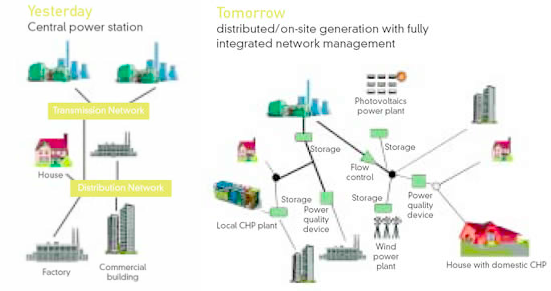
The Institute for Local Self-Reliance (ILSR) recently published an e-book (PDF) advocating complete democratization of the electric grid by abandoning a system that is dominated by large, centralized utilities for a 21st century grid made of independently-owned and widely-dispersed renewable energy generators
A democratized system for creating and distributing electric power ensures that the economic benefits of electricity generation are as widely dispersed as the ownership.
Why Now?
As long as communities still rely on centralized, fossil-fuel powered energy plants to generate power, democratization of the electrical grid will remain a dream. But the past 10 years have seen an exponential growth in the adoption of renewable energy alternatives, namely home solar and wind power, which presents an unprecedented opportunity for transformation.
 As the technology and installation of these systems continues to drop in price, more private property owners are able to take advantage of their pollution and money-saving benefits. This increased accessibility makes it possible to turn any rooftop or open field into a mini-power plant. It is this level playing field that makes the dream of a locally-owned and managed electrical grid into a reality.
Examples of Democratic Energy
The key to democratizing the electrical grid is convincing municipal governments that distributed power generation is every bit as robust as centralized distribution. One way to visualize differences between a distributed and centralized grid is to think about the way that the internet is made up of files that live on millions of servers and computers around the world instead of one central server.
Power companies claim that home power plants creating more than 5-10 percent of local grid electricity would cause major technical problems, but in communities around the world, this has not proven to be true.

Germany has installed over 10,000 MW of distributed solar photovoltaics (PV) – mostly on rooftops – in the past two years and renewable energy now constitutes 17 percent of overall electricity generation. Half of Germany's wind power and three-quarters of its solar is locally owned.
The city of Kona, Hawaii, uses a 700 kilowatt (kW) solar array provides 35 percent of the capacity of the local distribution feeder. In Las Vegas, 10 MW of commercial solar PV on a distribution line provides 50 percent of capacity (and up to 100 percent during periods of low load).
California plans to add 12,000 MW of distributed electricity power by 2020, and 16 additional states have added a distributed generation mandate on top of their renewable electricity requirements.
“The battle for the future control and ownership of our energy system is on,” ILSR senior researcher Farrell maintains. “Utilities are fighting back by encouraging policy makers to put up roadblocks to a democratic energy future and by belittling renewable energy’s potential. The major barriers are not technical, but political.”
Creating a Shareable Grid

Farrell and other renewable energy advocates say that policy changes are necessary to overcome barriers to a democratic grid.
Those barriers include federal regulatory agencies that provide significant financial incentives for centralized energy projects and new high-voltage transmission; incentives that are unavailable to distributed electricity generation. In fact, many federal and state energy incentives discriminate against locally owned distributed energy generation in favor of centralized, absentee owned power plants.
But bureaucracy, industry lobbyists, and economic woes make it unlikely that we’ll see these barriers removed in a timely fashion. So encouraging a distributed grid may fall to entrepreneurs and community organizers instead.
In Canada, residents of Ontario can invest in local solar power projects by buying SolarShare bonds. The $1,000 bond provides a 5 percent annual return over five years and the money is invested in solar power projects across the province.
Investors also become voting members of the SolarShare cooperative, a project of the TREC Renewable Energy Cooperative that both develops community-owned renewable energy projects and educates Ontarians about renewable energy, energy conservation and the community power model.
In a similar effort, U.S.-based Solar Mosaic brings the popular crowdfunding technique to the clean tech industry by developing a way for communities to create their own renewable energy without going into debt.
Solar Mosaic members increase solar financing options in their neighborhood by purchasing "tiles" a $100 share of a community solar project. Participating property owners get to enjoy the low cost of clean energy without huge up-front costs or high interest rates from banks. Individual investors are paid back over time from the revenue the Tile generates while earning some fun goodies along the way.
Take Action
We may not be able to convince Congress that it’s time to throw the full weight of the U.S. economy behind the renewable energy industry and the formation of a democratic, distributed electrical grid, but it is possible to advocate important change in your own community.
Consider contacting your state representatives about the need for CLEAN Contracts (i.e. feed-in tariffs) and regulations that would require local utilities to share data about the current distribution network, allowing distributed generators to locate the best opportunities for developing new projects.
Also, look for opportunities to educate local officials about passing solar access laws that grant everyone the right to capture sunshine on their property for solar electricity and by changing building codes to encourage or require more on-site power generation.
