
By Sam Walby, April Doner, Jack Becher, Tchiyiwe Chihana, Sam Gregory, and Peter Pula
This story was originally published in Nonprofit Quarterly on September 22, 2025: nonprofitquarterly.org/what-is-a-just-transition-and-how-can-we-pursue-it/
State of the Movements is a recurring NPQ column dedicated to tracking the pulse of social movements and the solidarity economy in 2025.
Celebrate the new toolkit
Limited time only! Help us celebrate version 2.0 of the Library of Things Toolkit by chipping in $100 and receive an advance print edition.

In our movements, we often focus on actions—the next protest or next policy initiative. But building a theoretical framework for what we want is an equally important part of movement work.
So, what is a “just transition”? As a framing term, just transition offers a critical awareness of the historical context of colonialism and extraction, as well as the baked-in systemic violence of our current systems and the necessary personal transformations required for tangible, meaningful change.
Like any term, “just transition” is at risk of being co-opted or sanitized. There is also no consensus on what a just transition is. From the personal to the planetary, justice means different things in different settings. But at its heart, the notion of a just transition speaks to the importance of centering human dignity and democratic control.
From trade union organizing to environmental movements, from global reparations to local adaptations, there is an abundance of ideas and a rich history behind the term. Through a set of possibility-oriented interviews—what we at Generative Journalism Alliance (GJA) call an “inquiry”—we’ve discovered deeply personal perspectives on what just transition means to people working in the field.
In the spirit of the GJA’s shared commitment to story as a tool for healing, truth-telling, and transformation, our inquiry on just transition is rooted in the possibility that humanity can transition to livable, sustainable, and equitable systems that prioritize basic needs and human thriving while being grounded in the material realities and constraints that we face as a species.
What Do We Mean by “Just Transition”?
Very early in our inquiry, we realized that we were likely to hear as many definitions of “just transition” as the number of conversations we hosted.
“It means so many things to so many people, and a bit of a dangerous phrase for that reason. I’ve come to, in a way, hate the term,” said Jenny Patient, an experienced climate campaigner based in Sheffield, United Kingdom (near Manchester), who specializes in trade unions. Patient thinks there is a risk of it becoming an empty catchphrase and often uses “climate justice” as an alternative.
At its heart, the notion of a just transition speaks to the importance of centering human dignity and democratic control.
Several interviewees note that the concept of just transition is rooted in historic labor organizing, particularly Latin American workers’ relationship to land.
“The spirit of our work stems from there, and for us the conception of it is the strategic interventions that we need to make as communities who are most marginalized by the extractive economy to move towards regeneration,” says Guppi Bola of the British-based solidarity economy group, Decolonising Economics.
Bola points to the work of Movement Generation, based in Oakland, CA, and their just transition framework as a vital resource for anyone working in the space. Their original framing, published in 2017, still holds true: “An economy based on extracting from a finite system faster than the capacity of the system to regenerate will eventually come to an end—either through collapse or through our intentional re-organization. Transition is inevitable. Justice is not.”
Aghilah Nadaraj of the Kheprw Institute and the Climate Justice Alliance, both based in the United States, also sees just transition as a grassroots, frontline-rooted framework that was created to communicate and provide a vision for how we can move from an exploitive, extractive economy to a regenerative economy that’s rooted in Indigenous, community-led, community-driven principles of reciprocation, wholeness, and healing. “It’s not about domination—it’s about interdependence,” she said.
Clare Attwell of Regenerate Cascadia—based in Victoria, BC, Canada; and Seattle, WA—and a contributor to the Design School for Regenerating Earth, agreed that this connection, or reconnection, to land and place is vital for just transition: “When we realize how much intelligence the land holds, how much connection the land holds, reconnecting to place, and then reconnecting to all of the relationships that are there, there is something deeply healing in that.”
University of Sheffield urbanist Emre Akbil considered just transition as the construction of an “ethical common ground,” but viewed justice as simply the bare minimum: “Justice is the starting point. We should strive for more.”
Centering Relationships
“What does it mean for my life if we take the climate and nature crisis seriously? What will that mean for where I live, the work that I do? What will happen to my family? What will happen to my neighborhood?” asked Roshan Lal, a musician and community organizer. Like Patient, Lal is based in Sheffield.
Lal sees several layers to the concept of just transition, each with its own problem frames and reckonings: at the international level, a reckoning with the history of colonialism and reparations; at the domestic level, with transitions in housing, food and other systems within our foundational economy; and at the personal and interpersonal level, with what all of this means for us as people and communities.
Everybody we spoke to told us relationships and reconnections were critical to the work of just transition—relationships with each other, with the world around us, and with ourselves.
“There needs to be an inner transformation, just as much as the technological implementation and land-based solutions and all the other kinds of outer transitions. Because if we don’t decolonize our inner world and shift the way that we were thinking, we will just continue to make and remake the same injustices or cultures,” said Lauren Uba of Climate Action Community, a group based in Berlin, Germany.
The bridge between the local and the global…is meaningful personal relationships.
“What is necessary, I believe, is cross-sector collaboration, getting out of our silos, bridging, finding the shared value in the inner dimension that’s necessary,” she noted.
Bola agreed: “There is a mind, soul, and body shift that is necessary within communities around our conception of the way that we are.”
For José Bravo of Just Transition Alliance—based in San Diego, CA—our relationship with future generations is also a critical factor, “We have to think out of the box….What we make today has impact for seven generations.” This reality, he says, must inform our work.
Linking the Local to the Global
Inquiry participants trace many links between local and global levels. The bridge between the local and the global, for Nadaraj, is meaningful personal relationships. She noted the words of [the late] Grace Lee Boggs, a prolific activist and writer from Detroit: “It’s never a question of ‘critical mass.’ It’s always about critical connections.”
Reframing how we think about just transition work that is often characterized as small because it is locally focused is a critical part of how we can have real impact across the globe, said Lou Byng of CIVIC SQUARE, based in the English city of Birmingham.
“Rewiring that ‘smallness’ is speaking to wealth holders and our government to say: This is where people have the most agency, where they understand challenges most directly….This is not small work—it is everything.”
The challenges ahead are daunting, but the possibilities of transformation are enticing.
Bravo concurred: “The way we always say it is that we want to support local to regional economies to scale. A global economy has not paid off for us. In the Suez Canal, a ship got sideways a few years ago. Because that ship was blocking the Suez Canal, 14 percent of all globalized products were slowed down. Globalized products, but it was one ship. We can’t put all our eggs in that basket, not as a society of humans that depend on each other.”
Patient added that a sense of place is important for fostering ownership and agency, while geographical abstraction and distant decision-making can erode our ability, or perceived ability, to act. “[We need] more homegrown economic development, rather than this idea that somebody will come and save us. It would also give us more control and has the potential to reduce energy, reduce waste, and to have more security and skills.”
But divesting from an extractive economy “is only possible at a planetary level if we have these powerful, resourced, and well-skilled communities,” Bola cautioned. “The more that we distract ourselves from the necessary relational organizing, the longer it’s going to take.”
What a Just Transition Can Achieve
The challenges ahead are daunting, but the possibilities of transformation are enticing. Uba told us she is seeking what writer Charles Eisenstein calls “the more beautiful world our hearts know is possible.”
“Sometimes I step outside, and I’m met with existential despair,” she conceded. “What I think is my highest hope is that this level of peace and joy and compassion and shared humanity is not like a drop in the bucket, but the bucket itself.”
Akbil emphasized the importance of building a diverse world. “Diversity here is key, because biodiversity, cultural diversity, these are entangled.”
He pointed to the Diverse Economies iceberg visualisation, which illustrates that advocates of a just transition are not starting from zero, but that in fact current capitalist economies rely on many nonmarket mechanisms—such as bartering, community volunteering, and self-provisioning. Lifting these mechanisms up and making primary what is currently secondary is core to building an ecologically sustainable economy, a central goal of many just transition advocates.
Byng envisioned that neighborhood civic entities located on street corners could play a critical role in supporting a just transition process.
Lal, the musician and community organizer, concluded that, “The best thing that could happen is a world where all of us can thrive, where there is possibility for everyone and no one has to be exempt.”
As he put it, “What could be more soulful and purposeful work than a world where we’re trying to repair ourselves and each other?”
A heartfelt thank you to our interviewees for sharing such rich stories about just transition with us; we encourage you to read the individual long-form interviews. Generative conversations were hosted by Jack Becher, April Doner, Sam Gregory, and Sam Walby.
To learn more about generative journalism, read our introductory article and subscribe to our Substack. To connect with GJA, please drop us a line. We’d love to hear from you.
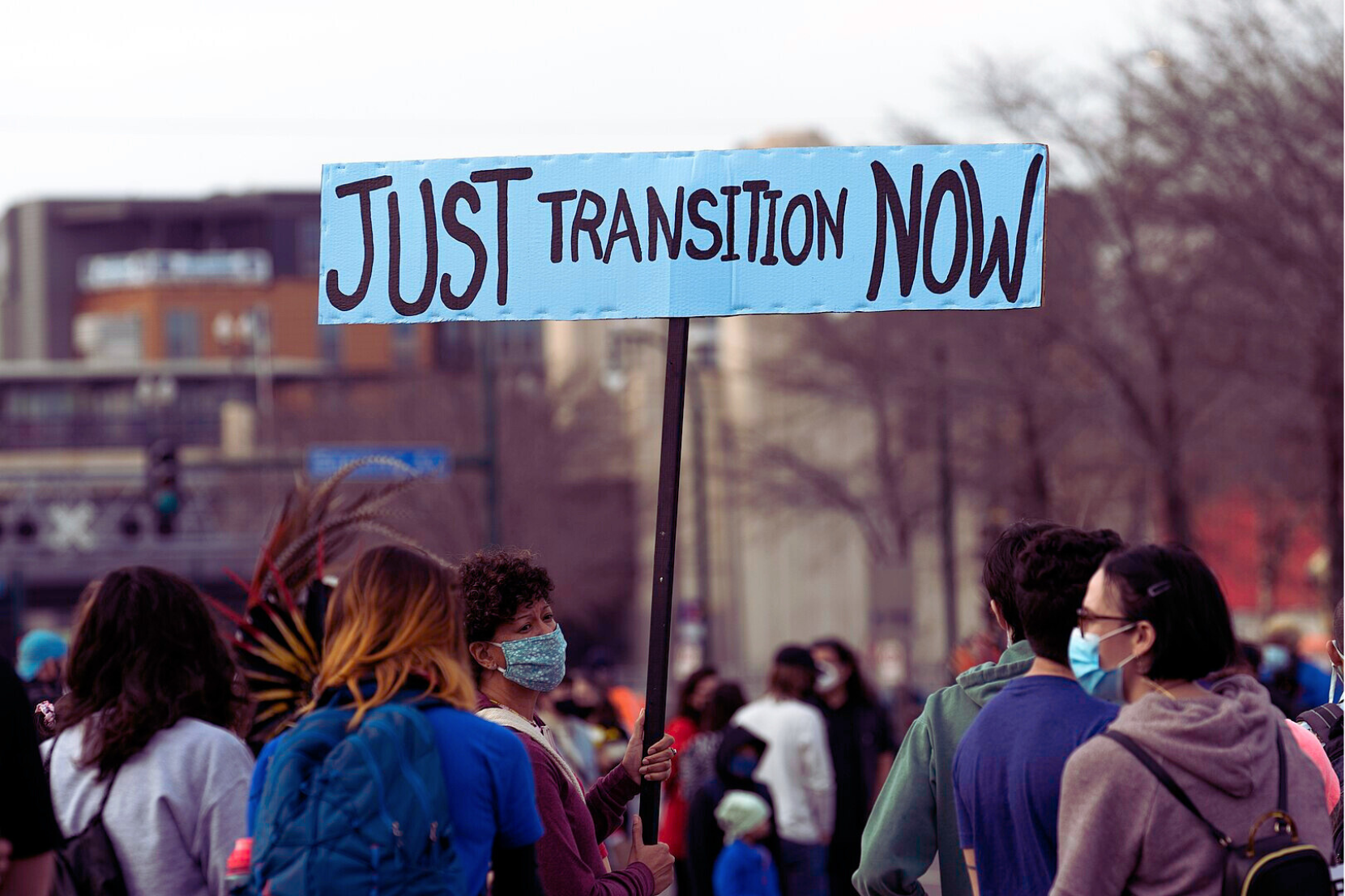
Featured photo credit: Lorie Shaull from St Paul, United States – A woman holds a Just Transition Now sign at a rally in Minneapolis, Minnesota


