
Introduction
Welcome to the second edition of the Library of Things Toolkit.
This expanded guide will help you plan, start, and grow a Library of Things in your community.
Libraries of Things (often called LoTs) are community-based systems that allow people to borrow, share, and collectively steward physical resources. LoTs follow the traditional mechanics of a public library while pushing the boundaries of what can be borrowed: tools, kitchen equipment, camping gear, event supplies, emergency supplies, and much more!
There are roughly 2,000 formal LoTs worldwide, along with countless informal ones. Modern LoTs have been in operation since 1978 (the longest-running, since 1979, is a tool library that’s part of the Berkeley Public Library system in California, U.S.), but communal resource sharing has always been an essential part of the human experience.
In the U.S. and around the world, households are expected to purchase and maintain tools, equipment, and other expensive, rarely used items. The result is financial strain, wasted resources, and neighborhoods that are less resilient and prepared for disruption. Shared resource infrastructure like LoTs builds systems for accessing physical items, turning underused goods into community assets.
LoTs and other shared resource infrastructure can help address:
- Household financial fragility and equitable access: Affordable shared access reduces the need for large, infrequent purchases and high-interest debt. For the cost of buying or even renting a single tool at a big-box store, a member can access hundreds or thousands of tools for an entire year. In affordable housing communities like Connect Highstar in Houston, Texas, U.S., integrated LoTs expand access to essential equipment without increasing household debt.
- Economic opportunity and small business development: Shared tools lower barriers to entry for tradespeople, landscapers, and entrepreneurs. The Minneapolis Tool Library was launched with Community Development Block Grant (CDBG) funds to support homeowners maintaining properties in blighted neighborhoods and has operated a robust trades program. In the City of Oakland, the public tool library stocks dozens of professional-grade string trimmers and other equipment, often borrowed by people starting a new yard care or construction business, allowing them to save money on upstart costs like equipment purchases without relying on costly credit.
- Sustainability and waste reduction: Reporting has estimated that the average power drill is used for only about 15 minutes over its lifetime. Sharing dramatically increases utilization rates, reducing material consumption and waste. LoTs like the Buffalo Tool Library have paired access with environmental initiatives such as Lead Safe mitigation programs, showing how shared tools can support both public health and climate goals.
- Emergency preparedness and climate resilience: Communities with an LoT can mobilize resources more quickly during crises because tools are collectively stewarded and relationships already exist. The Asheville Tool Library played a critical role alongside the WNC Repair Café in response to Hurricane Helene, while the Central Florida Mutual Aid Tool Library was established as a central tool hub for post-hurricane repairs.
- Community cohesion and social infrastructure: LoTs function as trusted “third places” (neither home nor work) where neighbors meet, volunteer, share skills, and practice collective governance. They counter isolation, strengthen networks of mutual aid and care, and build habits of cooperation that extend beyond borrowing items.
By shifting from isolated ownership to shared infrastructure, LoTs help communities become more affordable, economically vibrant, sustainable, connected, and resilient—often with lower start-up costs than many traditional community development practices.

Free Download: “The Library of Things Toolkit”
In addition to the web toolkit, there is also an interactive PDF (print edition coming soon!).
In addition to Shareable’s regular reporting over the past 17 years (including the publication of a free e-book, “Library of Things: A Cornerstone of the Real Sharing Economy,” in 2020), we have directly supported the development of LoTs across several sectors. Projects have included an official advisory role to the former mayor of Seoul, South Korea, as they developed a pilot program with32 lending libraries in apartment buildings; an inspiration and advisory role on thecreation of La BOM, a three-story community center and sharing hub in Montreuil, France; and our program director, Tom Llewellyn, was a co-founder of the Asheville Tool Library, in North Carolina, U.S.
We began our current multi-year focus on Library of Things by first surveying 82 LoTs in 11 countries to produce the State of Libraries of Things 2024 Report. Key findings include:
- Many LoTs are making a difference in their communities with just a handful of volunteers and a small space like a storage unit or garage.
- The vast majority of LoTs are fully volunteer-run with annual budgets of less than $10,000 per year, limited inventory, and average memberships of less than 200 people.
- Larger independent LoTs typically include a storefront, significant annual budget, and at least one paid staff person (often a volunteer coordinator).
- For financial sustainability, LoTs rely most heavily on a combination of membership fees, grants, and donations.
- Most LoTs have been operating for less than five years and are open one to three days per week when they have capacity (with limited hours).
A key takeaway from our research is that most LoTs are very small and don’t require much space, inventory, or cost to begin operating. The most important thing is to just get started and then consider growth later.
Later in 2024, we hosted the Library of Things Co-Lab to train organizers to start (or grow) an LoT in their communities. Over the course of three months, 200 people from around the world participated in the training, proving a universal need for LoTs (and the support to launch them). Following the conclusion of the Co-Lab:
- The initial 12 live presentations were adapted into the first edition of this toolkit, which has now been downloaded in over 50 countries.
- Shareable became a fiscal sponsor and incubator for the Tool Library Alliance (TLA), a newly formed network of established LoTs in the U.S. The TLA is playing a pivotal role in the continued development of the field.
- We supported 10 local organizers from communities across the U.S. in our SolidarityWorks Fellowship program. Fellows received a stipend, individualized coaching, and seed funding to launch five pilot projects. Among these is a campus LoT at the University of North Florida in Jacksonville, Florida, and the Connect Highstar LoT at an affordable housing development in Houston, Texas [see Chapters 6 and 7 in Section 3]. Replicating these models across university campuses and housing developments is now a key component of our strategy to rapidly scale LoTs worldwide.
We believe that shared resource infrastructure, such as Libraries of Things, should be a core, scalable solution for affordability, resilience, and sustainability. We envision a world where every community has access to some form of shared resource infrastructure—whether that is a lending kiosk, a decentralized library app, a public library with a collection of things, or a full-scale, independent LoT.
These aren’t one-off programs or charity giveaways. LoTs are rooted in Solidarity Economy and mutual aid practices. Crucially, though, they are mutual aid in the form of durable, everyday infrastructure, just like public libraries, parks, or transit, created to meet both daily needs and moments of crisis. When thoughtfully designed and rooted in trusted local institutions, LoTs can help reduce household financial shock, increase access to new opportunities and skills, improve disaster resilience, and help support circular and solidarity economies.
Rather than launching isolated projects, Shareable focuses on building the connective tissue that allows LoTs to thrive across different settings. That means:
- Identifying what successful sharing systems have in common
- Supporting real-world pilots embedded in housing developments, public libraries, campuses, and community organizations
- Translating on-the-ground learning into clear models, tools, and evidence
- Making shared resources legible and investable for institutions, funders, and public systems
Our goal is not just to launch more LoTs, but rather to build a recognized field of shared resource infrastructure that communities can adopt, adapt, and sustain.
We hope this expanded second edition of the Library of Things Toolkit will provide organizers (like you!) with best practices, inspiration, and tools for making your LoT a reality.
How to use this toolkit
This toolkit is a comprehensive roadmap, but you aren’t expected to travel the entire distance at once. Because every Library of Things (LoT) is shaped by its unique local context, your journey will be non-linear. Use this document as an active reference rather than a manual to be memorized.
A resource for every stage
We recommend a three-step approach:
- The Big Picture: Not every chapter will be relevant to you today. Start by skimming the section headers and summaries to understand the full landscape of LoT management.
- The Planning Phase: Focus deeply on the sections regarding governance, legal structures, and initial funding. These are your foundational building blocks.
- The Reference Library: Keep the more technical sections—such as advanced inventory tracking, staff scaling, or large-scale fundraisers—on hand for the future. When you hit a logistical “pinch point,” return to these chapters for specific, tested solutions.
Capacity over perfection
The information gathered here comes from dozens of successful LoTs, yet none of them did everything “right” from the start. Most began with a handful of tools and a small group of dedicated neighbors.
Be honest with yourself and your team about your current capacity. It is far better to start small and grow sustainably than to burn out trying to implement every “best practice” in year one. As long as you prioritize community trust and clear communication, you have everything you need to begin!
Please let us know if this Toolkit is a useful resource by sending a note to info@shareable.net or tagging us on social media.
Together, we can build a movement to ensure everyone has access to shared resources to meet their needs!
If you find this to be a valuable resource, please consider donating to help cover the cost of producing it. There were well over 3,000 hours that went into research, convening the Library of Things Co-Lab, and producing the toolkit. We appreciate your support.
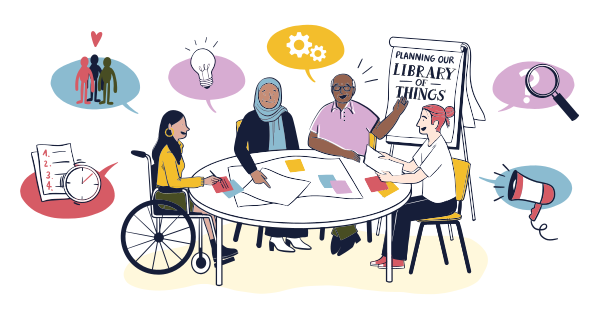
It’s easy to want to jump right into acquiring items for your Library of Things, but it’s important to spend time planning and answering some foundational questions—and getting community input! By investing in this planning stage, you can save yourself time and avoid miscommunications, ambiguities, and a loss of momentum later.
Chapter 1: Guiding questions
While some of these questions might seem simple, taking the time to write down your vision will help you inspire others who share it and keep you and your collaborators motivated during challenging moments.
Why
It is important to articulate why you are starting an LoT. The answers to these questions can be the north star for other decisions you have to make, and should be revisited as your organization develops, grows, adapts, or changes. This will also help you explain the value of your LoT when it comes time to build financial and volunteer support.
Some key “why” questions to consider include:
- What is your primary motivation?
- What personal strengths are you bringing to the table?
- What strengths and motivations are others bringing?
- What community challenges will your LoT help address?
Who
The most successful LoTs are built and maintained by a team of people with complementary skills as well as shared purpose and vision. It can be daunting at the beginning to think about widening your circle, but when any single person becomes too essential, the whole project is in jeopardy. Practice embracing shared responsibility from the start, and you’ll build a more sustainable, functional library of shared things.
Key questions to ask yourself include:
- Start with you! What are your strengths or superpowers? Where will you need help?
- Who are the people you hope will be members of your LoT?
- Who are the people that will help you launch and lead it?
- Who will your inventory items come from?
- Who has the skills to help with specialized tasks (e.g. maintenance of power tools and managing social media)?
- Who are the people that will help you fund it?
- Who are your inspirations, advisors, and the people you can tap for short-term help?
- Who are the other community leaders who will help build your network?
- Who is not at the table? When possible, it is best to bring together diverse stakeholders in the planning stages that are representative of the community your LoT will serve. When in doubt, remember the maxim “nothing about us without us” and pause to include the people who will be affected by your decisions.
What
In an LoT, the “things” themselves are not the only “what” to consider! You are setting out to build an organization and a community. Spend some time thinking about what you want it to be. Consider:
- What kinds of things will your library need? (This is a great time for a community survey—look for guidance below.)
- What will your LoT do? There are many activities, services, and programs that LoTs offer in addition to lending. Consider whether now or in the future you may want to also provide repair, education, sales of things, or other events to your LoT planning. Some LoTs have community gardens, makerspaces, seed banks, and more!
- What kind of legal business structures are available or permissible for LoTs in your community?
- What is the culture you hope to build within your LoT?
When
We all know good things usually take longer to create than expected, but creating a timeline now will help you identify key milestones and dependencies (what has to happen first). If you can’t yet make firm plans, try to prepare by outlining the steps needed to get to a point. Having specificity from the onset, while knowing things will change along the way, will help other collaborators get on board and stay. Consider:
- How much time do you have to dedicate to the project?
- How much time do collaborators have?
- How much time will different leadership roles take?
- How much time are you asking others to give?
Sketch out a project timeline:
- When will you begin spreading the word to find other organizers?
- When do you need a space?
- When will you start collecting inventory? (Hopefully, after you have
space to store it!) - When will you start recruiting volunteers?
- When will you start signing up your first members/borrowers and loaning
things to them? - When do you plan to open your LoT to everyone?
- Which days and times of day will your LoT be regularly open? (You may not
know the answer yet, but you can set a goal.)
Where
One of the greatest defining factors for an LoT is the neighborhood and physical space it’s situated in. Oftentimes, we end up going with the most affordable or soonest available location, but it’s worthwhile to identify your ideal neighborhood and type of space. [Learn more about space types in Section 3.] You never know what might be out there if you make your needs known! Consider:
- What other programs and structures exist around you? Are there some that align with your plans?
- Where are like-minded groups in your community located?
- Where are your future members?
- Where are the people who will be volunteers, staff, or leaders?
- What are your community’s accessibility needs and regulations? (Note: There may be legal obligations for your LoT to meet accessibility standards, including if you’re a nonprofit in the U.S. Be sure to research this!)
- Where is space available? (Many independent LoTs start in church basements or community centers.)
- Given all of this, is there a specific area in your community that makes the most sense for your LoT?
How
Thinking about how you’ll start your LoT includes how you’ll approach all of the work involved. Consider how you will go about:
- Forming the team
- Making decisions
- Raising funds
- Staying accountable
- Moving through failures
- Celebrating successes
- Growing
- Developing shared leadership
- Planning for succession
This toolkit is designed to help you think through many of these “how” questions, but there are almost infinite questions to ask and answer in the process. It’s up to you and your team to find more opportunities to slow down, ask each other hard questions, and find the best answers together.
Chapter 2: Needs assessment and engagement
Needs assessment
Many of the foundational questions above depend on what your community actually needs! Conducting a survey or assessment doesn’t have to be complicated. Here are some techniques to get information from your community about what they want in an LoT:
Design a short online survey (no more than four questions). Try to keep answers in either yes/no or checkbox formats and limit open-ended responses. Here are some considerations and sample survey questions:
- “Would you be interested in borrowing everyday items from a Library of Things the way you do books and DVDs at a public library?
- “What kinds of things would be most useful to you?” (Can include a multi-choice list of examples and a fill-in-the-blank “other” option.)
- “What are some things you’ve borrowed from friends, neighbors, or family recently?” (This can include a multi-choice list of examples and a fill-in-the-blank “other” option as well.)
- Create a list of relevant items and ask respondents to rank them on how likely they are to borrow them. You can refer to the most popular items in Shareable’s Library of Things report to help generate this list.
- It’s always good to leave room for other questions, ideas, or requests at the end!
- Include an interest sign-up for those wanting to learn about volunteering with your LoT.
Connect with friendly organizations (environmental groups, public libraries, local hardware stores) and public gathering places (street festivals, churches, and farmers’ markets) and ask to survey people at those venues or events.
If there is a nearby university or college, see if there are students, classes, or programs that can help you with this project. [Learn about the University of North Florida Library of Things in Chapter 6 of Section 3.]
Reach out to your local government. Some LoTs (and many repair programs) are associated with governmental ‘waste reduction’ and/or ‘environmental quality’ efforts. And don’t forget to reach out to your local public library!
Employ multiple methods to get the survey out there. You could:
- Hand out stickers, candy, or flyers at an event and ask people your survey question when they stop by.
- Create a flyer with a QR code that links to your survey.
- Send a short blurb and a link to the survey to friendly organizations and ask them to include it in their e-newsletters or bulletins.
- Post your survey on social media and send it to friendly organizations to re-post.
- Ask for 10 minutes on the agenda of upcoming neighborhood association meetings. Ask your questions live or leave flyers with the survey for people to fill out later.
- If there are specific groups of people you hope will use your library, go to where they are (e.g. senior centers, colleges, hobbyist groups, or immigrant services nonprofits) and ask for advice from organizational leaders about soliciting input.
Assessing community needs is an ongoing effort! As you continue to move forward, be sure to incorporate opportunities for feedback into your member check-out process, website, and any other community “touch” you have. This Stakeholder Mapping Exercise can help you consider who is included in your community to get the most accurate survey results possible.
Engagement
At all stages of LoT development, who? is the most crucial question. Engaging others is critical for success, but can also be difficult. Some best practices for community engagement include:
- Consider what you’re asking people to engage in before reaching out.
- What do you want from them? This could be input, time, money, space, leadership skills, help spreading the word, etc.
- What are you offering? Hopefully, it’s something they want, too!
- Remember that if you ask for more than you offer, you will likely burn people out.
If you’re interested in engaging people outside of your cultural experience, make sure someone in your leadership group (or at least one of your collaborators) reflects them and their experience. Ask for advice in creating the right approach.
Meet people where they are (literally and figuratively). If you are interested in input from a specific neighborhood, reach out to their local neighborhood group and ask for time on an upcoming agenda. Find relevant events in your community, like a street or resource fair, and table there. Or table at faith-based community events, community centers, and parks. Find places where people are gathering—and where you can tell them about your LoT!
Anytime you show up with information, also ask questions. Outreach is most successful when it’s part of a dialogue. For example, if you are trying to build membership, ask people what kinds of project goals or needs they have that your LoT inventory could potentially help accomplish and fulfill. If you’re looking for volunteers, start by asking people what kinds of skills they have to offer or what other kinds of volunteering they’ve enjoyed.
Consider the commonly spoken languages in your region. If many people are native Spanish speakers, make sure you have people involved who also speak Spanish, and then translate your flyers, website, etc. Be careful of indicating accessibility (e.g. including images of people in wheelchairs) if you’re not prepared to follow through, even if your intent is to be inclusive.
To prepare for potential reluctance and opposition—and to deal with those obstacles in a positive way—create talking points with your team and practice having conversations together. Some common misconceptions about LoTs include:
- “Won’t everything get broken?”
Sure, some things will. We plan for repair and replacement, but everything breaks eventually. We’d rather it get more use before it dies.
“Won’t things get stolen?”
Actually, theft is rare among LoTs! While it does happen from time to time, other LoTs have found that creating a trusting community inspires people to do their best to return things. - “Will people really use it?”
What would make you want to use this library? (Take notes!)
Getting started: Resources, templates, and videos
Resources and templates
- Start-up reflection guide
- Stakeholder Mapping Exercise
- Community Needs Assessment Guide
- Recommended reading:
- Earth for All: A Survival Guide for Humanity, Sandrine Dixson-Declève, Owen Gaffney, Jayati Ghosh, Jørgen Randers, Johan Rockström, and Per Espen Stoknes.
- Palaces for the People, Eric Klinenberg
- A Brief History of Equality, Thomas Piketty
- Creative Confidence, Tom Kelley & David Kelley
- Emergent Strategy: Shaping Change, Changing Worlds, adrienne maree brown
LoT Co-Lab: Getting started
Video recordings
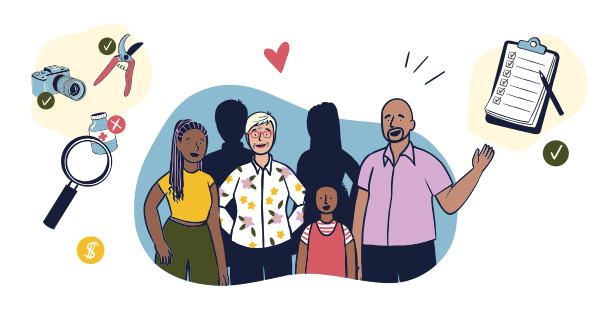
It seems simple, right? Get a bunch of things and then loan them out! But choosing the right items for your community’s needs, storing them, insuring them, maintaining them, and helping people find and check them out can present many unknowns. This section will help you think ahead and make plans to keep your inventory thriving.
It seems simple, right? Get a bunch of things and then loan them out! But choosing the right items for your community’s needs, storing them, insuring them, maintaining them, and helping people find and check them out can present many unknowns. This section will help you think ahead and make plans to keep your inventory thriving.
Chapter 1: Sourcing items
Selection of things
Cast a wide net
The most important principle of this stage (and many others) is to get enough representative input. It’s essential to broaden and test your understanding of what items are needed at the beginning, especially from people who run in different circles or have different social networks and cultural norms. It’s okay to start with a really big list of dreams—you don’t have to fulfill all of them! Get out and ask people, share your contact info, and ask them to ask other people. You cannot gather all of this input alone. All ideas are worth considering at this stage, as some of them may become very important later when you need to plan for funding.
Start by finding out what resources and networks already exist in your community. Consider:
- Are there other organizations helping people share things like food emergency support, or other forms of mutual aid?
- Are there informal groups on Nextdoor or within schools that facilitate sharing of things like baby gear?
- Do you have local manufacturers or distributors of the kinds of items you’ll want to loan out? They may be willing to partner with you.
Then, identify what your community needs. You might have a clear idea of what you’d have in your ideal LoT, but your neighbors (or people in a different neighborhood) might have very different ideas. What kinds of things aren’t equally distributed right now? If there are areas without public green space or yards, will they be as excited about yard equipment? Enlist friends to connect with a diverse range of incomes, genders, cultural or ethnic backgrounds, and age ranges. Without promising anything, invite people to tell you about their hopes and dreams. Neighbors who feel buy-in at early stages of development can become some of your strongest advocates.
Consider your community’s existing interests. Are there supplies needed for neighborhood block parties or recreational equipment that could be used at a nearby park? Consider how your LoT could help create local environmental solutions, like enabling people to create pollinator habitats or reduce stormwater runoff. If you have a lot of nearby community gardens, find out if they already have gardening tools to lend or if they need to borrow more. If there is a craft or mending group, poll them for the kinds of craft tools they’d like to have access to. If there is a workforce development group or pre-apprenticeship program in your town, ask them what kinds of things might help their clients that your LoT could help fill.
Narrow it down. Once you’ve settled on the categories of items you want to prioritize, think about the requirements and limitations of each of them. Some common considerations include:
Durability
- Will these kinds of items withstand a lot of use?
- Are there very delicate pieces likely to get broken in transit or by an inexperienced user?
- Do these items have many components that may get easily lost?
- Keep in mind that many things, like sewing machines and drills, have cheaper brands designed for infrequent hobbyist use and more expensive brands designed for daily, professional use. When possible, source the most durable version of an item.
Cleaning
- Will these things come back to you clean or will your volunteers need to clean them?
- How clean will the things need to be? Imagine kitchen tools or kids’ toys versus wheelbarrows or saws.
- What about drying out camping equipment, like tents that may be used in the rain?
- If you’re lending items for babies or toddlers, do you have a plan to sanitize them?
Maintenance
- When something does break, is it repairable, and does your LoT have someone who can fix it?
- Consider cost, availability of parts, required time, and expertise.
- Think about items like air compressors that need to be drained occasionally to prevent rust.
- Do you have a plan for scheduled inspections and maintenance?
- What repair businesses, organizations, or volunteers can reliably support your needs, and what would each cost in terms of time, money, and coordination efforts?
Cost
- If you buy or get a donation of an expensive item, it will eventually wear out or break irreparably. Can you afford to replace it? If not, will that leave a hole in your community’s LoT resources?
- What member expectations are you setting by adding an expensive item to your inventory, and how can you sustainably fulfill those expectations over time?
Transportation
- Can people get this item to and from your LoT successfully?
- Will the item fit in a car? Will it fit on the bus, on a bicycle, or in a bike trailer?
- Think about size, weight, ease of carrying or reassembly, and also whether an item has lots of little pieces that could get lost in transit.
Storage
- Do you have the space to store a particular thing?
- Is storing the item going to create a mess or danger in your LoT if it sits for a while? Many LoTs choose not to stock gas-powered tools for this reason.
- Think about how you’ll store items with multiple pieces to keep them from getting separated (zip ties, carabiners, drawstring cloth bags, tool boxes, things in their original cases, and tool bags can be handy here).
Liability
- Can you get liability insurance for lending this item? [See Chapter 2 in Section 5 for more on this.]
- Keep in mind that things like scaffolding, chain saws, and many brands of table saws are often a red flag for insurers, and try to double-check before purchasing or accepting a donation of those items.
Ease of use
- Can the item be used successfully and safely by a non-expert?
- Does it require referencing a manual that people might not be able to read?
- Is the item dangerous and/or easy to break if you aren’t sure what you’re doing? Some LoTs require a specific training or a signed agreement before borrowing certain items to make sure the user and item both stay safe, but it can also raise your liability insurance risk if you take on the role of safety training.
Consumables
- Do you need to buy something specialized (like carpet cleaning solution or sandpaper) to use this thing? Can borrowers easily get that, or should you consider keeping it in stock?
- Will you charge for the consumables that you stock?
Chapter 2: Establishing policies and systems
Establishing policies
Ideally, you’ll have a lot of people interacting with a lot of items on a regular basis! Creating clear processes and policies can help reduce friction, confusion, loss, and mess. Here are some areas to keep in mind early:
Usage
- Be sure you have usage policies and liability waivers that your borrowers must agree to before using your things.
- How will you prioritize adding and replacing items?
- How can people request or vote on additions so you have a better idea of what’s missing? Who gets to vote?
- Are there any items you want to add to your inventory in the future?
- Planning ahead can keep you from ending up with items you haven’t fully considered and vetted (e.g. asking the questions above) and can also help you raise funds for your next phase.
- Consider asking all new members to fill out a survey with their requests and then surveying all established members on a regular basis (quarterly, semi-annually, or annually).
Donations
- How are donations accepted and assessed?
- What kinds of things are you looking for, and what can you not accept?
- Do you accept consumable items like nails or diapers?
- You might also choose to take donations for recycling or parts, but be cautious and selective to avoid clutter and hazardous materials, like flammable and potentially toxic fuels.
- If you have space to store items you can’t use, there’s an opportunity to earn extra money and attract new members through yard sales! [See our Tool Sale Case Study in Chapter 1 of Section 7 for more details.]
- Creating a donation policy then being specific and transparent about it can help you get the donations you want and avoid getting things you don’t want dumped on you.
Borrowing
- What are you asking people to agree to when they borrow a thing from you? If you expect it to come back clean, full, re-set, etc. or if there are ways you want your members to not use your items, make that explicit before it goes home with someone.
- Think about balancing the length of a loan and possibility of renewals to make sure people have enough time to use it without keeping others waiting too long. For example, lawn mowers are generally only used for an hour or two at a time, but sewing machines may be part of a multi-day sewing project.
Operator support
- Will you keep paper user manuals when you buy things, and make those available to borrowers?
- Can you provide access via your online presence to the manufacturers’ digital manuals for the items you lend?
- Are there things that need “quickstart” info kept with them?
- You will probably make decisions about these things on a case-by-case basis.
Maintenance
- What’s the process for how members report problems with an item?
- How does it get flagged for repair, and then repaired? (More about this below!)
- Are there costs involved with repair? What is the borrower’s responsibility?
- Consider the difference between regular wear and tear versus damage from accidental or intentional misuse.
A note on interchangeability: Many items use external rechargeable batteries, especially hand power tools. It can quickly get unmanageable to track, charge, and replace these. Similarly, items like vacuums all use different filters, and string trimmers have a variety of replacement heads. For this reason, many LoTs choose to stock items with interchangeable parts, for example, most companies (Craftsman, Dewalt, Makita, Milwaukee, Riobi, etc.) make batteries that are compatible with 10’s and even 100’s of their branded tools. Moreover, even exterior housing and internal components of individual items can be reused to repair other items when your inventory is consistent. While it’s not always feasible to be picky, especially at the beginning, it’s smart to choose one common brand, model, or style for items whenever possible. You’ll be glad later!
Acquisition of things
Many LoTs rely heavily or entirely on donated items (per The State of Library of Things 2024 Report, about 60% of respondents’ items were donated) but there are many ways to build your ideal inventory. When you accept donations from anyone, but especially from individuals, here are a few factors to keep in mind:
Testing and repairability
- Do you have the capacity to accept and repair broken things?
- Make sure you are set up to test a donated item on-site before accepting it. If a broken item is left with you, you’re assuming full responsibility for disposing of it responsibly (see below).
Lifespan
- If a donated item is older, it may have a shorter useful life than other items. Though, of course, some older models are more durable!
- Be sure to consider how many uses are left before investing in adding an item to your systems.
- Are repair parts for an item still being manufactured or sold?
Disposal
- When an item reaches its final use, and can’t be practically repaired, how will you dispose of it?
- Are there any hazardous or recyclable materials in the item? You may choose to accept donated items for parts or their recycling value (either to your organization or for overall global sustainability).
- Make sure you have a process or a partner in place to get items recycled or disposed of properly!
Donations from, and to, other community organizations
You may be able to form a relationship with other organizations to share donated items and find the right home for them. Consider finding your closest Habitat for Humanity ReStore or another resale shop like Goodwill to build a process for donating unneeded items back and forth.
Bulk donations can take a long time to inspect. Be sure to set clear expectations with your donation partners for who will be inspecting and disposing of unwanted items.
Donations and discounts from corporations
It may be counterintuitive to approach a company trying to sell things to donate items for shared use, but brand loyalty is a strong motivator! You can make the case that your LoT will help people acquire skills or test out products, as they may end up purchasing their own for home use in the future.
Some manufacturers, especially smaller brands, may also be open to sharing “friends and family” sale codes or offering a nonprofit discount.
If you are connected with other LoTs, consider making the pitch together! Regional and larger companies often want to make a big impact, so it can be more appealing to benefit multiple communities at once.
Remember, the worst they can say is no. Take a swing and make your best case—you might get lucky!
Purchases (new and used)
When you decide to spend money on new items, keep durability in mind the same way you would with a donated item. It may be worth spending more money upfront to buy an item that lasts twice as long.
If you’re set up as a nonprofit or if you are fiscally sponsored by one [this is explained in the next section on Operations], be sure to ask about tax exemption and the possibility of buying in bulk. Some brands have “Pro” accounts that offer discounts, which you might qualify for, too. Spend a little time with customer service to see what you can arrange.
Sometimes you can buy items refurbished through big box stores or manufacturer websites. See what kinds of retailers you have locally that offer warranties on refurbished items. Buying refurbished or used has the added benefit of reducing environmental impact.
Finally, you can buy things used just like anyone else! Be aware that there is some risk in buying items from sellers via Facebook Marketplace, eBay, or Craigslist that may or may not work as expected. When possible, buy in person and test the item yourself. Organizations like Habitat for Humanity ReStores will often provide in-kind donations in the form of store credit, which can quickly build your inventory.
Chapter 3: Organizing and lending items
Designing your space and storage systems can be a fun project for a group of creative people! Just know that you’ll never get it right the first time, and try to keep your storage and labeling systems flexible as your LoT grows and changes.
Consider the layout of your space and how people will navigate it. Consider keeping big or bulky items near the door so they don’t have to be maneuvered through aisles. Similarly, keep important add-on items like extension cords and ladders visible since people might think of them on their way out.
Signage is key! While you might be used to your space and where to find things, try to imagine entering for the first time. How will new visitors feel welcomed and be able to find what they’re looking for? Most LoTs have category signs visible from the door to help people orient. Consider which languages are most common in your area and translate your signage as needed. Use recognizable icons in addition to words wherever possible.
Get as granular as you reasonably can with labeling the “home” for each type of item. If you have one large shelf labeled “Bike Tools” it can be hard to find the chain breaker in a sea of wrenches and to put things back appropriately. Consider using labeled bins to corral similar items. Magnetic sheets, velcro dots, duct tape, and wet-erase boards or chalkboards can be useful in creating adaptable labels. Tip: acrylic sheets, glass, and even fiberboard ‘shower backer’ can be used with wipe-off markers! (Note: expect your adaptable labels to need maintenance and cleanup in highly trafficked situations.)
Consider color coordination between items and shelves to help people find and return items to the right place. This can help, especially if you have many disparate item categories, such as tools, cooking equipment, camping gear, etc.
Create a map of your space. It’s useful as a guide for visitors and as part of librarian training! It’s also a great way to ensure people responsible for your inventory know what’s there and where it goes.
Consider ways to store things safely by securing power cords, spooling extension cords, and containing parts in bags or boxes. Store heavy items on low shelves and be sure to consider other potential injury risks (it’s extremely dangerous to store heavy things above head level!). If you attach user manuals in pouches or laminated “quickstart” guides, make sure they are secure and will last, and that they don’t interfere with storing or using the item. Is there “off-season” storage you can use, like a shed? Would your core volunteers have space to store things at their homes when there’s no demand for them during the year?
Software
There are many ways to track your items, including several turnkey software options. If you have a small inventory, you could start with a spreadsheet—just be sure you have a method for tracking who is borrowing and returning what. With that said, we have found that even small LoTs benefit from using LoT-specific software. Consider these questions to help you determine your software needs:
- Will you be allowing reservations of your things?
- Is there a possibility of decentralized self-serve kiosks in your future? [Learn more about this in Chapter 4 of Section 3.]
- Will it be important to track carbon offsets?
- Do you want to have a borrower’s credit or debit card linked to their account?
- If your software has a public site, what is the user experience like for members/borrowers? And what is it like for librarians?
- Changing software later is a major undertaking. How flexible is the software for your changing needs, and how responsive is the support team to adding features or resolving issues? Look through their support portals and see what the response times and resolution rates have been.
Software generally prioritizes certain features more than others. Check out some options below to compare:
- myTurn (myTurn is an in-kind sponsor of Shareable)
- LendEngine
- Circulate webapp (open source, homegrown in Chicago, Illinois, U.S.)
- Tool Librarian (homegrown in Portland, Oregon, U.S.—restricted to Portland region libraries)
Managing demand
Some items in your LoT will be in higher demand than others. LoTs use a number of strategies to keep these items circulating smoothly.
Keep track of what’s being used most frequently, and add more versions if possible. Some demand, like for yard equipment, is seasonal and can be swapped out with other items on a schedule.
Consider keeping a wait list, but be sure you can manage it and communicate with people consistently. Some software offers holds or reservations functionality, which can help with this.
Adjust your return policy for high-demand items. You might disallow renewals, increase late fees, and prioritize reminder calls for things you want to get back more quickly. Similarly, you might find that some items rarely or never get used! Create a schedule for reviewing your loans seasonally and/or annually to remove unnecessary items and make more room for those that get used all the time.
Helping people select an item
Your members will have a wide range of experience and expertise, so practice (and train your librarians to practice) gentle questioning to make sure a borrower has the right item and training to use it. Simply asking about someone’s project can help illuminate what they might need to accomplish it. Asking someone whether they’d like help can also feel a lot better than asking if they know what they’re looking for or how to use it. Practicing culturally sensitive language and considering implicit biases is very important here for building a supportive, collaborative relationship with your member community.
Be cautious of offering formal instruction on how to use items. This can put the LoT in jeopardy if someone hurts themselves, and unless you have a professional behind the desk, instruction can be more or less reliable. Instead, try to direct borrowers to user manuals or instructional videos online.
You may have items that are particularly delicate, complicated, or otherwise require a higher threshold for use. Some LoTs require taking a class before borrowing specific items and/or signing an additional waiver. At minimum, be sure to provide written instructions for items that need them. A laminated sheet zip-tied through a hole can be a simple solution for reminders for use and care, but make sure these instruction cards do not interfere with safe operation of the item or require frequent replacement. Also, remember to consider the language needs of your community.
Loss and recovery
While lost and missing items are rare, and often accidental, it’s worth planning for what to do when something doesn’t come back:
Create a compassionate but consistent reminder system that notifies people when an item is due back.
- As soon as you recognize that an item has not come back on time, communicate politely and be forgiving of the mistake. Understand that people’s lives are busy and complicated, so try to be patient and respectful. Focus on returning an item to community use rather than punishing the borrower.
Consider a late returns fee (either per day or per week). It can create an additional revenue stream, but may put disproportionate pressure on low-income members. Make sure any imposed fee structure aligns with your stated mission, values, and capacity of your intended membership.
Create a policy for what you’ll do if a borrower doesn’t return an item, and make sure borrowers know it before taking an item home.
- Will you suspend their membership? Offer to pick it up? Charge a credit card on file for the item’s value? Be sure to specify time frames and other parameters.
- If you are asking the member to replace a lost item, be specific about either the replacement value or acceptable donated replacements.
Consider a limit on the number of items one person can borrow at a time, including a smaller number for their first borrow, to make sure you limit losses. If you are accepting donations and experience a high volume of certain items, consider a low/no-accountability lending program for these abundant items that can absorb a higher loss rate. Or just give them away!
Chapter 4: Maintaining items
All things break eventually! Many of them also need preemptive maintenance to extend their lives and keep them working properly. Repair is an essential part of all LoTs.
Start with plans and practices to keep your inventory in good shape. Document necessary steps for regular maintenance and come up with a schedule for reminders. Will your check-out/check-in and inventory management software help you log notes about maintenance?
Recruit fixers before you have broken items. This is often a “gateway” role to get volunteers involved in your organization, since it can be largely self-directed and flexible. Some LoTs even have a policy that volunteers or members can check out broken items to take home and fix. You may want to find someone who can authoritatively judge the quality of all repairs.
Reach out to local repair shops to see if they are willing to partner with you on more technical or in-depth repairs. People love to have their expertise recognized!
Come up with a tracking system for items in repair and make sure things are removed from your inventory system if they can’t be checked out at the moment. It’s even better to have details in this system for recording what was broken, the cost of replacement parts, who did the repair, etc. This data can be very helpful in evaluating future inventory additions and creating budgets.
Establish a system for evaluating whether an item should be repaired or recycled. Sometimes, the cost of a replacement part is close to that of a new item, or the time required to fix it could be better spent returning multiple other items to good condition. Try to come up with a standard ratio of item demand, cost, and effort to save your fixers from having to make the call each time.
Make sure someone is designated to do the administrative work of approving parts purchases, tracking them down, ordering, and matching them to the item. Similarly, make sure you have enough space for broken items to hang out for weeks to months while waiting for parts or repair. It’s often a slower process than you hope!
Consider designing and 3D printing your own repair parts if you can’t find replacements online. You might run into a scenario when ordering replacement parts for an item and find they are unavailable, usually because the item is too old or the manufacturer simply doesn’t make them. Consider tapping your community of volunteers or reaching out to a local makerspace to see if they have 3D printing capabilities to design and print your own replacement parts. Here’s an example from the Buffalo Tool library, where a volunteer designed a replacement Trigger for Mantis Cultivator/Rototiller.
Members of The Tool Library Alliance are working on a database of replacement part designs, so reach out if you need support!
Disposal
Sadly, not every item can be repaired. Where do they go in the Things Afterlife?
Salvaging for parts can be fruitful if you have a lot of similar items, like pressure washers that have specialty hoses and valves that can be swapped back and forth. Be cautious about using up valuable space with something that may or may not end up being valuable itself.
You can also break down and recycle many items, especially those with electronic components and motors. Check with your local facilities (including private recyclers) to see what materials with higher value (like copper) can be salvaged and sold. Often, municipal recycling programs accept electronics and appliances for disassembly and disposal. Material recovery can be another gateway volunteer role for members looking to proactively make an environmental impact, learn about repair or engineering through free-form deconstruction, or for those who prefer a less social way to participate.
Repair outside your LoT
Because LoTs all do some amount of repairs themselves, many become hubs for repair and reuse events. Repair Cafés and Fix-It Fairs can attract new members, cultivate new volunteers, and contribute to building your community! Repair events can also serve as volunteer development seminars through skill sharing, strengthening your community’s ability to maintain your LoT’s inventory. [See Chapter 2 in Section 10 to learn more about repair events.]
Getting things: Resources, templates, and videos
- Green Lents Tool Repair Procedural – Who, Where, & How to Maintain
- Toolbox Project Inventory Development Policy
- What is a Collection Development Policy?
- Repair Workflow
- Most Popular Tool Library Items
- MAP-Tool Hospital
LoT Co-Lab: How to get Things
Video recordings
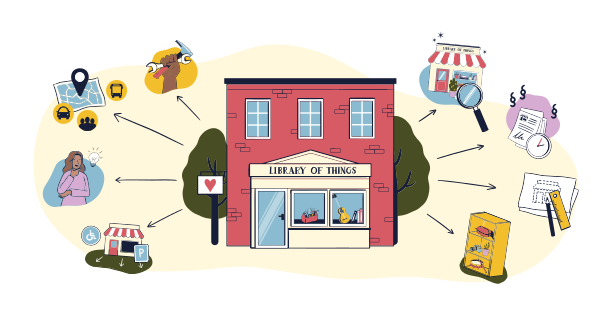
Finding space to host your Library of Things is one of the biggest challenges you’ll face, and paying for it might be your most significant expense—at least in the beginning. While many LoTs make do with whatever is available, it’s worth doing some planning at the outset to narrow down and prioritize options.
Housing your LoT in a traditional ‘brick-and-mortar’ building isn’t the only way to create a thriving sharing hub! There are mobile LoTs, kiosk LoTs, campus LoTs, and more. This section includes several case studies to inspire how you will bring your LoT to life.
Note: This section features several examples of what a Library of Things can look like in practice and the kinds of space they can operate out of. The case studies are taken from various sources, from toolkits to articles, so you may notice a variety of the styles and tone!
Shareable has been directly involved in launching or growing several of the examples in this Section, including La BOM (as a co-initiator/consultant) and University of North Florida, Connect Highstar, and Central Florida Mutual Aid Tool Library [Chapter 2 of Section 11] (developed during Shareable’s 2024 Library of Things Fellowship and Co-Lab).
Chapter 1: How to find, acquire, and design a space
Space considerations
Here are some questions and considerations to help guide finding the best space for your Library of Things:
Location
- Where would you most like to be in your city or community and why?
- Who are the people closest to your LoT or who can most easily get there?
- Who needs you? Who will use your things?
- Consider centrality and neighborhood, as well all transportation options including public transit, bicycling, etc.
Building layout
- How easy is it to get in and out of the space?
- Is it accessible for people using wheelchairs and other mobility devices?
- Is there parking for cars near the door?
- Will people be able to securely lock bicycles?
- If you lend large or heavy items, you’ll want to be sure there is enough room to get them in and out easily—perhaps a ramp or other way to wheel them in and out.
- Consider outdoor space as well; it’s often useful to have a place to host cookouts, clean bulky items, lay items out for sales, etc.
Lease flexibility (or longevity)
- Note that there is a wide spectrum of lease agreement structures out there.
- Before you approach a potential landlord, agree as a team about how long you ideally want to stay in the space. If you love it and think you’ll never want to move, make sure you’re protected from being kicked out. If you know it’s just a stepping stone, don’t sign a longer lease than you’ll want.
- If possible (and if needed), find a pro-bono lawyer or law center to discuss options with you for exit clauses, renewals, and other terms that can give you either the stability or flexibility you want.
- Even if you find a space that doesn’t require a formal lease, be sure you have a clear agreement in place, with documented expectations, to help protect you from a sudden need to move.
Finding a home
Once you’ve figured out what your ideal LoT home is, there are several options depending on your available resources.
If money is very tight:
- Start small—even with less space or a less ideal location than you’d like to find eventually. As long as you have a flexible occupancy agreement, you can always move to a larger space after raising or earning the money you need. Keep in mind that a move carries its own costs—both directly and in a potential loss of income—while you’re closed for transition. Check out the Asheville Tool Library case study for an example of an expansion move.
- Talk to community centers, churches, and mission-aligned nonprofits that might have available space you can activate as an LoT. By sharing a building, and amenities like restrooms and break rooms, you might need less of your own space. Sometimes, you can even get these spaces free or at a significantly reduced rate.
- Remember that lease rates and terms are often negotiable, especially in buildings owned by nonprofits, community development corporations, and other landlords who might recognize the community value of your new LoT.
If you have money or can raise it:
- Look for commercial leases in transitional industrial areas that might have former warehouses, factories, and garages for rent at low costs. A broker can help you identify and tour buildings and may volunteer or reduce their fee to help you out. Check out the Auburn Tool Library case study, where they activated an unoccupied mall storefront.
- Buying a building is also an option! Depending on your community, there may be storefronts or other affordable options. You can look for cheaper properties needing renovation, but be sure to recruit professional help to assess the building and work on budgets and project management plans. And if you’re looking for a model to follow, Buffalo Tool Library raised $500,000(!) with their capital campaign in 2024.
- Building your ‘dream home’ is an ambitious (but possible!) option. Check out the Eugene ToolBox Project case study for how a community accomplished this. There are many building options, some more accessible than others. Check out the Federal Way Tool Library’s use of reclaimed shipping containers as one example.
Build out
Whether you’re starting from scratch or just filling out a modern storefront, there is plenty of work to do after you sign your lease! Planning out your new space can be fun, especially if you have team members fluent in Sketchup or other design software to help you visualize options.
Inventory storage
Every LoT will need different types of storage, but there are some common best practices:
- Make sure there is enough space to move between shelves or racks, especially if you’re storing large or bulky items. It is important to comply with laws for ADA accessibility (in the U.S.). Accessibility compliance and considerations also help ensure the safety of staff, volunteers, and guests. Most LoTs standardize on a minimum aisle of about 3 feet/1 meter.
- Try not to rely too much on vertical storage. Ladders and step-stools add to the risk of injury when people have to retrieve things above head-height. If you do need to store things high up, try to put the lightest and least fragile things on the top shelf and/or items that don’t get checked out as often.
- Consider moving/rotating seasonal items (like lawnmowers and snow shovels) at times when they’re in less demand. Think about storage alternatives if your primary space is crowded. Can volunteers store things at home? Can you add a shed?
- There are lots of shelving types to consider. Many LoTs start with deep warehouse shelving. Repurposed bookcases are also common. Some LoTs are lucky to have gondola shelving. Smaller things get lost in deeper shelves, whereas bigger, heavier things sometimes can’t fit in or on shallower shelves. Before acquiring shelving, be sure to consider the sizes and weights of the things you will have in inventory.
- Don’t forget you may be using the floor and walls. Leave space under warehouse shelves for heavier items and things on wheels or rollers. Consider what kinds of hangers will work best if you can hang some of your things. Peg boards on walls can also work well to store smaller tools or items.
- Utilize “dead” space like undersides of shelves or non-enclosed areas, with chains, locks, and cables. Be sure to consider weather degradation and security.
Interior design
It’s unlikely that you’ll have all the available space you could want, so think about how you’ll prioritize items. In addition to inventory storage, make sure you think about:
- A primary place to conduct business (e.g. a desk or counter) for checking-in/out, signing up new members, etc.
- An area to store items waiting for repairs and the parts/materials you need for common fixes
- An area for volunteers and staff to hang outerwear and stash their belongings, get snacks and drinks, and take breaks
Other programming
Many LoTs also offer workshops, Repair Cafés, and other public events to increase visibility and generate income. While this might be a “down the road” step, start thinking about how to create space for this or make your LoT space multi-purpose with moveable shelves and other furniture. [Learn more about workshops and repair events in Chapter 1 of Section 10.]
Primary considerations for other programing could be: areas for repair and project use, makerspaces, meeting/eventspaces, gardens, temporary storage, or long term storage.
Mobile and distributed LoTs
Getting to and from an LoT is often one of the biggest barriers for potential members. When expanding to additional locations is not an option, some LoTs choose to get to where they’re needed in other ways, including traveling in box trucks, trailers, and vans.
Mobile benefits include:
- Reaching more people who need your items, especially those who don’t have cars or easy transit access
- Getting more neighborhoods and towns involved in the solidarity/circular/sharing economies and spreading the model
- Customizing the items available to the communities who will use them
Mobile and self-serve kiosk LoTs also come with challenges to plan for. Here are some common considerations before going mobile with your LoT:
- You must be even more selective about which items to prioritize when your space and storage are limited. Data collection and analysis of usage and needs become critical in the tight confines of a mobile LoT.
- Nontraditional spaces, including vehicles, may have higher risks for damage or theft to plan for, including different kinds of insurance.
- You may lack important infrastructure like running water for toilets or cleaning inventory items if you don’t have a ‘brick-and-mortar’ facility. Consider how you’ll manage maintenance and repair (maybe at another location).
- Traveling or distributed inventories require careful tracking to ensure things are where they should be. Overflow storage can add a layer of location management.
Chapter 2: Brick-and-mortar
This chapter explores tips for finding and securing a brick-and-mortar Library of Things, using the Asheville Tool Library (ATL) as a case study.
ATL is currently located in a large warehouse in an old greenhouse complex, operated by Smith Mill Works in Asheville, North Carolina, U.S.
Shareable program director, Tom Llewellyn, was co-founder of the Asheville Tool Library.
Lessons learned from the Asheville Tool Library
Finding the right space takes a community! Building a network of like-minded people who are passionate about the project makes it easier to overcome hurdles and problem-solve.
It may take a few tries to find the right space. Be patient and resilient in the search. The team that founded the ATL originally planned to house it in the basement of a local food co-op. It turned out the space wasn’t accessible enough to serve as an appropriate space. After the food co-op didn’t work out, they partnered with a community center and spent three months remodeling a section of the center to serve as the LoT. Unfortunately, the building was unexpectedly sold during the remodel, and a new location was again needed.
The team was not thwarted by this setback and went back to the drawing board. They were finally able to open on the ground floor of a co-working office before moving to a larger location right down the street. All told, they operated in the center of town for four years before moving to a larger space that could accommodate their needs on the outskirts of town. Starting in a central location helped them build community awareness and a devoted membership that stuck around long after they moved.
When possible, try to find a permanent space. Permanence decreases the likelihood of unexpected challenges, such as a landlord deciding to sell the building and having to find a new space in a short time frame.
A supportive landlord is an added benefit. For example, ATL felt more confident renting a space from a specific landlord because other folks they knew had positive experiences. Their landlord is also enthusiastic about their mission and offered perks to the team, such as free use of an adjacent greenhouse.
Creating 3-D mockups of a space is helpful in the planning process. The first location ATL rented was a relatively small space, so using architectural design software, like SketchUp, to pre-plan the design allowed the team to maximize every inch available and experiment with different layouts without the hassle and labor of moving heavy objects.
Extra space is always a benefit. Having more space for maintenance and repair is always helpful for any LoT. Flexible space is also a bonus when hosting programming and accommodating new projects as your LoT grows.
Ensure proper storage for flammable objects. If you offer tools that require fuel, make sure that all necessary safety protocols are followed, such as having a proper fuel cabinet for safe storage. ATL also recommends providing the fuel for tools that require it, as proper refueling keeps tools in good shape and reduces maintenance needs.
See NFPA 30 and NFPA 30A, Flammable and Combustible Liquids Code Handbook (2018) (previous edition from 2012 available for free on Archive.org) for more information about storing fuel safely.
Since they have a large permanent location, ATL also offers:
- Community art space that hosts skillshares, workshops, and open craft nights
- Days when people can come in and use some of the bigger machines
- Seeds of Solidarity group that is working on a community garden and seed library
- Workshop and skillshare programs
- All-volunteer maintenance department that services tools under the guidance of part-time staff
- Community firewood program that processes firewood and drops it off at hubs around town so people can heat their homes [Learn more about ATL’s resilience work in Chapter 2 of Section 11.]
Chapter 3: Mobile
This chapter focuses on how to reach more communities with a mobile Library of Things.
Share Shed
The Share Shed (SS) is a traveling LoT that started in a small garage in 2017 in Totnes, England. After obtaining grant money in 2019 from the National Lottery Grant, SS was able to begin creating its mobilized LoT in a van to reach nearby communities that faced high levels of poverty.
SS started by serving three communities and now supports seven, three of which have established their own Repair Cafés. Currently, they have about 350 items and 2,700 members, and they have completed around 5,000 loans and saved people 400,000£. To support their efforts, they have two part-time staff members and rely on volunteers to ensure at least two people are supporting the space at all times.
How it works
SS goes to seven locations once a week, which were identified based on practicality, interest, and needs. They visit up to two locations each day, spending two or three hours at each. Tool loans work on a weekly basis, and there is an opportunity to renew if someone else has not reserved that item. While there are rules and prices in place, they are flexible with their boundaries in hopes of encouraging more people to utilize their resources.
Challenges and opportunities
- The van was broken into after it was not parked in its usual location, which has lockable gates and CCTV cameras. After SS posted about this online, they received an outpour of support through social media and local news outlets, where they were given the platform to share their story and field donations.
- In the beginning, there was only one person who was comfortable with driving the van, so they had to look outward for willing volunteers. Now, they have a resilient team of drivers to support each other when one of them becomes unavailable.
- Maintaining the SS has several costs, from van upkeep to operations, and they heavily rely on grants. They also use online crowdfunding.
- Communities initially mistrusted SS, but they have earned their communities’ respect and praise over time by consistently upholding their values of accessibility through their work. They have also made several efforts to create meaningful relationships with different heads of each community.
- Supporting people with the SS requires a large physical space for the van and patrons to park. That kind of space can be difficult to find in the more urban areas where their community of LoT users are concentrated.
- There is a very short window for LoT users to borrow tools and bring them back, so SS is currently also experimenting with kiosks.
Chapter 4: Kiosks
A distributed or kiosk Library of Things offers a low-lift and affordable start-up model to create more sharing hubs in new places.
Circular Library Network: Providing infrastructure for sharing automation
The Circular Library Network (CLN) is a self-checkout LoT that was created in 2020 after Anna De Matos, founder of Reykjavik Tool Library in Iceland, wanted to automate sharing during the pandemic. She enlisted the help of Gene Homicki, founder of myTurn, who had an existing API (Application Programming Interface which lets different software communicate and integrate) that could provide the foundation for an automated self-checkout system.
Model
- It is a modular interactive, software that enables users to check out a limited set of tools through a computerized interface. It was designed for people around the world to personalize it for their respective needs.
- Everyone who is a partner of CLN is involved in a peer-to-peer support network that collaborates to learn best practices, bug test, and help grow CLN as a company together.
- The software uses a modified version of myTurn, and an app allows people to borrow through a central tool from any CLN location.
- The “standard” system licensing agreement currently costs €2,700 euros ($3,200 U.S. dollars), includes 16 electronic locks, and comes with a one year software subscription. They offer plans for building the kiosks or modifying existing cabinets. The entire system is meant to be customizable and user-friendly for those who do not have prior experience.
- Items available inside the CLN kiosks can be easily changed based on seasonality and availability.
- Partnering with libraries has been incredibly impactful. CLN offers a discount if folks have a library card, and this location increases foot traffic and membership numbers.
- Memberships are charged per year, but myTurn allows you to update those settings, among others, like borrowing and late fees.
- When an item is returned and needs maintenance, users can click a button to take it out of circulation. CLN receives an email alert and does weekly tours to review flagged items. This asynchronous process increased repair reports since people felt more comfortable reporting damage without doing so face-to-face.
After piloting their system in Iceland, CLN’s hardware and software has been licensed by LoTs across Europe and North America and is available all over the world.
Chapter 5: Shipping containers
Creating a Library of Things out of shipping containers comes with its own unique challenges and benefits. This chapter dives into the process of using recycled shipping containers to build an LoT in the Pacific Northwest, U.S.
South King Tool Library
The South King Tool Library (SKTL) in Washington State, U.S., is made out of recycled shipping containers, a highly abundant resource that was donated to SKTL. Its LoT design was inspired by King County mobile camping facilities, and the design was further developed by structural engineers, architects, and fellow community members, who made an effort to be conscientious about the materials, footprint, and impact of the structure.
Considerations
SKTL faced several challenges that were unique to the building being made out of shipping containers, consideration included:
- Appropriate shipping containers: In planning, SKTL had to navigate more than a dozen different structure shipping container types, with considerations like toxic elements and grade.
- Spatial planning: SKTL learned that shipping containers can fill up fast—space can be limited and awkward.
- Structural challenges: Unlike a traditional brick-and-mortar space, using shipping containers requires considerations for things like connecting wood to metal, integrity and reinforcement, creating permanent holes, rusting, attaching a roof, and adding contact points between containers.
- Certifications: Only certified welders could perform overhead welding.
- Transportability: Usually, once shipping containers have been dropped, they remain stationary—moving them requires access to a crane, forklift, and/or tilt trailers, which can be expensive.
- Inspections and permits: SKTL is officially recognized as a shed. To meet those standards, they had to remove a deck and follow specific electrical installation methods. But being a shed also allowed them to be exempt from some otherwise costly regulations.
- Break-ins: While under construction, SKTL was broken into numerous times. They found that off-site storage minimized the number of items stolen. Barring their windows helped prevent people from fitting through and getting inside.
- Floors: SKTL painted over hardwood floors on top of marine-grade tar, which makes it difficult to remove the floors.
- Drilling alternatives: SKTL found that magnets, hooks, and travel chests can help replace the need to drill into walls.
Chapter 6: University campus
This chapter is an abridged version of the how-to guide, “Starting a campus Library of Things” by the Center for Biological Diversity (the Center). We encourage you to check out the full guide, which includes examples of how the team at the University of North Florida carried out each step to create their campus LoT.
About this guide
The Center for Biological Diversity fights to protect wildlife and wild lands and to address the underlying causes of the extinction crisis, including the excessive production and consumption of new products. Libraries of Things (LoT) reduce the demand to produce new goods that destroy habitats, generate greenhouse gases, create pollution, and harm wildlife.
In a year-long collaboration, the Center and Shareable worked with University of North Florida’s (UNF) Department of Housing and Residence Life to establish a new LoT. This effort was led by Chandler Poole, who served as both a Center intern and a Shareable fellow during the project’s development in Jacksonville, Florida, U.S.
Chandler and the Center created this guide for other campuses interested in starting their own LoT to provide resources to their campus community, lessen environmental impacts, and introduce students to the sharing economy. It was developed in consultation with Breadvolution, Florida Rising, Period Poverty Jax, Post Landfill Action Network, Shareable, and The Yellow House.
Why start an LoT on campus?
There are many benefits to starting an LoT on a college campus. They strengthen community and connection through borrowing; some host classes where people share ideas and skills. They provide access to items that some may not be able to afford and can make a residence hall or apartment feel more spacious through the removal of stuff that is used infrequently.
With the rising costs of everyday items, providing for students’ basic needs is more important than ever. LoTs can play a role by supplying items that everyone can use without needing to purchase them. Finally, they reduce waste and greenhouse gas emissions.
Creating an LoT is integral to avoiding rampant consumerism and waste that comes with the initial move into college. Instead of purchasing new items, students can participate in the communal sharing of stuff. For example, instead of 20 students purchasing their own vacuum, a single vacuum from the LoT can be used by everyone through sharing. For students, this provides both environmental and financial relief, preventing the waste of money and resources.
For universities seeking recognition from the Sustainability, Tracking, Assessment and Rating System (STARS) from the Association for the Advancement of Sustainability in Higher Education (AASHE) or for those setting consumption-related Scope 3 emissions targets, starting an LoT is a good way to meet these goals. Success in a STARS assessment provides educational institutions with a ranking showing knowledge and leadership in sustainability. A campus LoT can also be used to further zero-waste behavior research that can be applied outside of higher education.
How to create an LoT on campus
Create a list of campus officials, organizations, and others who may be interested in creating an LoT or whose approval or assistance is needed to establish one. This may include the sustainability office, the main library, student government, housing and residence life, relevant student groups, and facilities. Reach out to contacts to discuss the benefits of an LoT, how one might be implemented on campus, and how they can help the project succeed. Consider:
- What are the strengths of your organizing group? Who are like-minded groups on campus?
- Where will the group need help? Who is not part of the organizing group but should be?
- Who will help launch the LoT and keep it running day to day?
- How will you acquire inventory and help fund the LoT?
- What permissions are needed to build and open an LoT?
Conduct a needs assessment
A needs assessment is integral to providing useful items and to determine the best locations for new LoTs to serve the student community. Create and conduct a survey or interview students to learn which items would be most useful to include. After conducting interviews and surveys, analyze the data to pick priority items as well as identify potential locations. Consider:
- Who will the LoT serve?
- What kinds of items will it lend? What is most needed by the campus community?
- Think about how you’ll store items with multiple pieces to keep them from getting separated (zip ties, carabiners, drawstring cloth bags, and toolboxes can be handy here).
- Think about how someone will transport the items from the library, be that by car, bus, bike, etc.
- Will your LoT do more than lend items? Consider whether you want to also sell used items, provide repair, or host educational events.
Identify location(s)
Create a list of potential campus LoT locations. This could be at a residence hall, with the sustainability office, in different academic departments, at the campus activities office/student union, at the gym, or in the main campus library.
Consider hours of operation, staffing, and security. Consider the sharing opportunities already available on campus to understand where they already exist and where there are potential gaps. Once a location is identified, prepare the space so you can keep the items well organized and in good condition as soon as you start collecting them. Consider:
- What other sharing programs and mutual aid structures exist on campus?
- Where will volunteers, staff, or leaders be coming from?
- Where is space available on campus to store items? Is it suited for the type of items you want to loan (i.e. temperature controlled)? Where will check-ins and returns happen? How central is the location?
- How easy is it to get in and out of the LoT space? Is it accessible for people using wheelchairs and other mobility devices?
Gather items and people to manage inventory
Create a detailed list of items requested via the needs assessment and make sure to check with university staff that requested items are allowed (e.g. no air fryers are allowed in residence halls). If items are already provided via another campus borrowing system (e.g. graphing calculators available through the main library), decide whether it adds any value or just takes up space to also offer those items through the LoT. Once you have your final list, begin collecting inventory.
Look for nonperishable items that can be used and reused by other people. It’s important that these items can be cleaned, repaired, recycled, or replaced with relative ease. Items can be acquired through gently used donations via a university move-out program, local businesses, or an email sent out to the campus community. If funding is available, used items could be purchased through online marketplaces like Etsy, Ebay, Craigslist, or Facebook Marketplace.
And if organizers purchase new items, make sure the products are long-lasting and durable.
Decide who will manage the inventory, operating hours, and how items will be checked in and out. This could involve current paid staff already based in an office where the items will be stored or volunteers who agree to staff the LoT during certain hours. The borrowing system could be low-tech or digital, utilizing myTurn or another LoT software. Consider:
- Are there local retailers, manufacturers, or distributors that might donate items to the LoT?
- Will the items withstand heavy use? When possible, source the most durable version.
- Check with the university that the LoT doesn’t need any type of additional liability insurance.
- In what condition should the item be returned (e.g. clean, full, reset, etc.)?
- Who will manage the LoT inventory? How will items be checked in/out?
- When will the LoT be open?
Once you know what items to include in your LoT, an online wishlist is a great way to collect donations and get the community invested in the new LoT.
The Center’s SoKind is a customizable alternative wishlist and registry site that allows you to register for any kind of gift you might want—new, secondhand, handmade, experiential gifts, donations, or gifts of time or service.
Communicate your launch
Brainstorm ways to advertise the opening of the campus LoT to create excitement, gather more library donations (if needed and space allows), and raise awareness about the sharing economy via social media, flyers, student media outlets, or classroom announcements. Host a creative launch party like an inaugural board game tournament, a residence hall room floor dinner, or a repair night to build excitement about and showcase the new resources that will be available. Consider:
- When and how will the launch of the LoT be advertised?
- What are some ways to generate excitement for these resources?
- How will you communicate with borrowers regarding LoT processes? Is signage needed to help facilitate the logistics?
Track performance
Keep track of all LoT items to make sure things are returned in working order. Have a plan for replacing items when they are broken or need to be repaired. Keep track of what’s used most frequently and potentially adjust your return policy for high-demand items. [See Chapters 3 and 4 in Section 2 for more information] Consider:
- How will the inventory be tracked?
- How will broken items be noted and repaired/replaced? What repair businesses, organizations, or volunteers can reliably support your needs?
- How will you measure success?
Library of Things campus project award
The UNF Library of Things was chosen to receive a Keep Jacksonville Beautiful award on November 21, 2025, to UNF’s Housing and Residence Life and the Center’s student fellow, Chandler Poole, who led the effort to establish the LoT. This is more than just an achievement for the Center and Shareable—it recognizes the role LoTs play in reducing environmental harm, protecting habitats, and decreasing people’s consumption while helping students borrow items that they may not have been able to afford to buy.
Resources and credit
- Association for the Advancement of Sustainability in Higher Education, Sustainability, Tracking, Assessment and Rating System (STARS)
- Center for Biological Diversity Library of Things webpage
The University guide was edited by:
- Stephanie Feldstein, Kim Dinan, Lydia Millet – Center for Biological Diversity
- Tom Llewellyn, program director — Shareable
- Preston Motil, coordinator of facilities; Sheresa Divens, assistant director of Residential Academic Initiatives; Amy Lorenz, director of residence life – University of North Florida
Chapter 7: Apartment building
This chapter tells the story of the Connect Highstar Library of Things in Houston, Texas, U.S., which was created by My Connect Community with support from Shareable and Purpose Built Communities. As one of the first (if not THE first) public-facing apartment-based LoTs, it has created a blueprint for community and property developers across the U.S.
Libraries of Things as social infrastructure for refugees, immigrants—and everyone
In Houston, Texas, U.S., a new LoT is serving a neighborhood with a large immigrant community. The Connect Highstar Library of Things sits on the ground floor of the Connect Highstar apartment building in one of its six street-level, micro-entrepreneurial spaces, making it accessible to others in the surrounding community. The apartment building itself is home to residents from more than two dozen countries, and is situated in the Gulfton neighborhood of Southwest Houston, where a high concentration of immigrants reside.
The Connect Highstar LoT opened in the summer of 2025, after two staff members of My Connect Community (MCC), the organization that manages the Connect Highstar apartment building, participated in Shareable’s Library of Things Fellowship.
How does it work?
Neema Kiza, MCC’s associate director of health & wellness, and Caleb Kurowski, MCC’s director of education conducted a series of needs assessments with community members and residents to determine what items to stock.
The LoT’s location is no accident. Immigrants starting over in a new country lack the informal resource networks that longer-established residents take for granted—a neighbor’s ladder, a relative’s power drill, a friend’s carpet cleaner. The LoT fills that gap directly.
One of the most in-demand items illustrates this well: carpet cleaners. Many immigrant families in the community practice floor seating, making clean carpets a genuine household priority. It’s a reminder that inventory decisions must reflect the specific culture and needs of the community being served, something the Connect Highstar team learned through trial and careful listening.
Inventory and membership are tracked with the myTurn software platform, which has helped streamline the process of checking items in and out.
Membership is structured on a sliding scale, with a suggested fee of $1 for every $1,000 of annual income (with no one turned away for lack of funds), so a member earning $40,000 a year is encouraged to contribute $40.
Kiza coordinates the LoT and supervises a team of nine volunteers. Together, they manage inventory and help folks find what they need, both in the LoT and broader community.
Open hours have been adjusted over time to serve different community members, from stay-at-home parents available in the mornings to working residents who can only visit in the evenings.
Social infrastructure
Beyond the multiple benefits of being able to access items that are shared rather than owned, there is a deeper sense of community being woven by the Connect Highstar LoT, as well. The LoT is an investment in what author Eric Klinenberg calls “social infrastructure.” In Palaces for the People, Klinenberg writes, “When social infrastructure is robust, it fosters contact, mutual support, and collaboration among friends and neighbors; when degraded, it inhibits social activity, leaving families and individuals to fend for themselves.”
For a neighborhood of immigrants and refugees building new lives in an unfamiliar place, that distinction is profound. An LoT offers more than access to items—it creates repeated, low-barrier opportunities for face-to-face interaction. Borrowing an item or simply stopping by to ask a question becomes a small act of connection. Over time, those everyday encounters build trust, shared norms, and a sense of belonging—strengthening the kind of social fabric that helps communities not only survive, but thrive.
Outreach to neighboring apartment complexes is now an increasing priority as the library gains its footing.
Shareable has launched a training program to equip community developers with the tools, skills, and support to successfully launch LoTs in apartment and other community centers. Interested organizations or residents should contact Shareable at info@shareable.net for more information.
Chapter 8: Sharing hubs
This chapter is an abridged version of the Shareable article, “The making of La BOM: Montreuil’s new Library of Things and Sharing Hub.” La BOM is one of the marquee examples of how LoTs can grow into multifaceted Sharing Hubs.
The making of La BOM
La BOM (Bibliothèque d’Objets de Montreuil) was born from a simple dinner conversation. In 2019, Shareable program director Tom Llewellyn and La BOM founder Sylvain Mustaki were challenged by Montreuil Mayor Patrice Bessac to create a lasting project rooted in the sharing economy. Llewellyn, who had co-founded a tool library in Asheville, North Carolina, U.S., proposed a Library of Things (LoT)—a place where community members could borrow everyday items rather than buy them. Mustaki agreed it was the right fit for Montreuil, a city of 110,000 known for its cooperative spirit and 2,500 active community associations.
Delayed by COVID-19 for nearly three years, La BOM finally opened with 500 lendable items, 665 members, and a 600-square-meter space that hosted not just a lending library, but a full Sharing Hub with photography, music, sewing, and woodworking studios, a permanent Repair Café that’s open twice a week, and an alkaline battery recharging and exchange program.
Membership model pivot
At first, La BOM charged a low annual membership fee and a small per-loan charge. Initial sign-ups were strong, but members proved reluctant to actively borrow items. Recognizing the friction this created, both financially and psychologically, La BOM made a pivotal change at the end of 2024: a higher annual membership fee with all loans, workshops, and services included at no additional cost.
The results were immediate. Loan volume tripled in 2025 compared to 2024. As Mustaki noted, the new model “invites our members to borrow more objects since it does not cost them more.” It also simplified operations by eliminating per-transaction accounting. Today, memberships are priced at €29/year (approximately $33 USD), with a reduced rate of €12/year for those with limited income, ensuring equitable access.
By the numbers
In less than 4 years of operation, La BOM has grown to approximately 2,000 members, expanded its inventory to 1,127 items, and processes nearly 1,000 loans per month. They also host an average of 18 workshops, repair 60 items through their twice-weekly Repair Café, and regenerate 200 alkaline batteries that would otherwise end up in landfill every month! [To learn more about Repair Cafés, see Chapter 2 in Section 10.]
Scaling LoTs across France
La BOM’s local success has attracted national attention. In 2025, the organization entered a partnership with Est Ensemble (a consortium of nine cities with a combined population of 410,000) to open 20 new locations over the next three years, the first of which launched in January 2026.
La BOM is also a co-founder of a national Library of Things Network to support LoT development across France, welcomed over 40 delegations from cities, universities, and associations seeking to replicate its model in a single year, and even received a visit from former French President François Hollande who came to celebrate what they have achieved over the past few years and encourage them to keep it going!
Space: Resources, templates, and videos
Resources and templates
LoT Co-Lab: Space
Video recordings
- Part 1: Asheville Tool Library case study + Q&A [15:00]
- Part 2: Eugene ToolBox case study + Q&A [17:44]
- Part 3: South King Tool Libraries case study Q&A [22:38]
Going mobile resources and templates
- Share Shed Toolkit
- Share Shed website
- Share Shed promo video
- The Circular Library Network website
- Circular Library Network kiosk hardware
- Circular Library Network kiosk promo video
- The Digital Kiosks Resource Hub
- Lending and community building at The Thingery – Shareable article
- Discover Containers
LoT Co-Lab: Going mobile
Video recordings

Marketing your Library of Things is an ongoing need, but it can also be fun and energizing. From building your brand to evolving campaigns, this is your opportunity to tell your story to the world—and inspire others.
Chapter 1: Building a brand
As with so many plans, begin with your organizational mission and values. Make a list of keywords or ideas that capture the most important parts of what you’re trying to accomplish with your Library of Things.
Consider the voice and tone you want to reflect in your communications:
- Who are you as an organization?
- How do you want people to feel about you?
- How do you want to make those people feel?
- How would you describe your LoT as a person with traits and personality? Again, a list of keywords can help focus you.
Building a visual identity
Logo
Once you have a foundational understanding of your LoT’s brand, begin translating those words and feelings into graphics. Your logo is the most important visual asset and the image most people will associate with your LoT. Here are some elements you might consider including in your logo.
- Your LoT’s name: (Of course!) but also consider using your initials or nickname, if your LoT is commonly known by a shorter version.
- Color(s): Commit to one or two recognizable colors that will help people identify you quickly. Keep in mind that you’ll also want a one-color version of your logo for printing in black and white, so make sure it still reads well that way.
- Typeface: Balance readability with recognizability. You want something unique, but not difficult to quickly understand. The typeface you choose will probably find its way into many other graphic elements on your website, t-shirts, flyers, etc., so make sure it’s easily available and versatile.
- Icons and images: You may choose to include simple icons or incorporate silhouettes of the kinds of things you lend, or even local landmarks. Just remember that in graphic design, simpler is usually better.
Brand guidelines
Once you have a logo draft, use its elements to build a simple set of brand guidelines. This ensures consistency as you delegate tasks, builds brand recognition with your audience, and saves time by reducing repetitive design decisions. Your guide should include:
- Standard logo variations: When possible, logo variations should include full color, all-white or all-black, a transparent background, vertical and horizontal versions, and with or without a tagline.
- Core color palette: In addition to the color(s) in your logo, choose two to three additional complementary colors that you can carry through other designs. Go for contrast, and refer to the keywords in your brand development process to choose. For example, if one of your goals is to feel “energetic,” think about choosing bright yellows and oranges.
- Standard typefaces for use in marketing materials. Try to find a general unified look for the first three, e.g. sans serif, and make sure you don’t choose anything too expensive or hard to find. Once you determine your typefaces, there are four general categories to think about.
- Headline: Usually your logo typeface
- Subheading: Can be the same typeface, or a similar feeling
- Body text: Should be simple, readable, and widely available
- Accents: Can be totally different from the other typefaces, either in style or color
- Images/photographs you intend to use frequently. This can include icons, textures, and other visual assets. You can start a shared folder of your 10–15 favorite photos and link it in your guide, then update it as you find or take great shots. If you don’t have them already, consider finding a paid or volunteer photographer to take some basic photos of your space that capture your LoT and mission in simple ways. You can always take photos yourself using your phone camera (just be sure to clean your lens before and brighten up any photos if needed). Pictures of spaces with people in them are much more interesting than just…the space! When using images that are not your own, be sure to consider copyright and permissions. Also, be sure to get media release forms from people in the photos.
- Mascots and nicknames are sometimes incorporated into an LoT’s brand. It’s not necessary, of course, but it can be fun! The Tool Library in Buffalo, New York, has a cute mascot named “Toolie.”
Chapter 2: Communications and marketing
Creating an online home
Your website doesn’t need to be complicated to be effective. Choose a platform that is user-friendly for updating, and a template that you can easily navigate to make changes. Popular providers include Google, Squarespace, and WordPress. (WordPress parent company, Automattic, is an in-kind sponsor of Shareable.)
Choose a URL that’s easily remembered and spoken. Try to avoid long or hard-to-pronounce combinations, since it will likely become part of an email address for your organization. Record web-hosting and renewal information so you don’t accidentally let it lapse. And register your URL for 5+ years at a time.
The more information you provide on your website (as long as it’s easy to find), the fewer questions you’ll have to answer repeatedly. Keep your most-requested information front and center. (The Chicago Tool Library does a great job of this.)
Be sure your website includes:
- A brief overview of what your LoT does, with images
- Operating hours (keep them current!)
- Location, phone number, and an email that someone is checking
- A way for people to sign up for emails
- A calendar of events, if you have them
- A searchable inventory, if possible
Building an audience
Once you have created a beautiful and compelling identity and case for support messaging, it’s time to build your audience! Here are a few ways to get and stay in touch with people.
Always have an RSVP link to events, even if they’re free. Capture people’s email, and consider asking for things like zip codes and relevant interests so you can send targeted messages later.
Create an easy email signup form (many email marketing platforms do this for you, or use a Google form) and put it everywhere you can—on your website, on signs via a QR code, on flyers, at events, etc.
Make sign-in and waiver forms digital whenever possible so you don’t have to transcribe contact information. Be sure to import contacts regularly into your email platform.
Include social media handles/links on your materials. Some people are into email, while others are more into social media platforms like Facebook, Instagram, and TikTok.
Emails, e-newsletters, and social media
Once people have signed up for emails from you, make sure you contact them! Monthly or quarterly e-newsletters are the most common way to stay in touch, since they build brand recognition and a consistent sense of connection with your audience.
Similarly, a consistent social media presence goes a long way. You don’t have to be active on every possible social media platform, but choose the ones you think will most effectively reach the people you want to. Some paid tools (e.g. Buffer) allow you to cross-post to multiple platforms simultaneously.
Emails and social media can take a lot of time and energy, especially if you’re new to communications work. Consider recruiting a few skilled volunteers to form a committee and divide the tasks among them, for example, taking photos, creating short videos, posting to social media, sending monthly newsletters, and keeping up with email and social inboxes.
A regular email and social media posting schedule helps your team get into a pattern of planning and preparing for events and news, and gives your audience an expectation of when they’ll hear from you.
Encourage members to submit stories and photos of things they’ve done with LoT items. Members want to hear from each other, and this will save you time developing content.
Recycle and repurpose content across platforms. You can reuse social media graphics and photos in your newsletter (and vice-versa) as long as they’re still timely; people will often only see one or the other. Event flyers can be easily adapted to simpler email graphics with a little pre-planning.
Keep an internal calendar at least a few months out so you don’t miss or forget events you want to promote. This forward planning helps in so many ways.
Engagement
Try to vary the kind of content you send out. A mix of opportunities to respond or sign up, feel-good member stories, internal updates, and links to partner events will encourage people to open an email or check your feed.
Stay consistent! Only commit to the communication channels you can regularly keep up with and plan for a cadence you can maintain. You can always add frequency or platforms later.
Developing marketing materials
It’s still true that a picture is worth 1,000 words. Especially on social media, the image or video is the real content. Always be ready to take photos during events and while your LoT is open (don’t forget media releases!) and encourage your volunteers to do so as well. Remember, a cell phone camera with a clean lens will work fine for most photo needs.
Social media
Social media is a constantly changing game, but the more engagement you have, the more people will see your post. You can fine-tune which kinds of posts you focus on for yourself by keeping track of post stats, but here are some of the most popular categories from other LoTs:
- Member projects and other real-world examples of your LoT’s inventory in action. People love inspiration and often engage with these!
- Photos and descriptions of new inventory items can get people excited to come in and borrow them, and often prompt comments and likes. Even better are short how-to videos about using the new item.
- Photos and videos of your physical space can help new and curious people get a sense of what your LoT is like and encourage them to visit. Clean, well-organized shelves and racks are great eye candy.
- Games and contests like “Comment with your guess about what this unusual thing is used for” encourage more two-way dialogue than passive informational posts.
Print materials
Analog marketing materials are still useful, even in the digital age. Here are some types you might want to invest in.
An “about us” flyer or postcard that summarizes everything you do, how to get in touch, and where to find you. This limited space forces you to focus on the most important things, but don’t forget to include links to email sign-up, social media, and other “next steps.”
Business cards are still useful for place-based entities like LoTs! Their small size makes them easy to pick up and hang on to. You can get creative and format these as a magnet or even the backing of a sticker. Or, you can use the back of your business card to highlight key information points about your LoT and how to get involved.
Door hangers are a great tool for on-the-ground outreach since you can leave them at houses in neighborhoods where you want to build awareness and membership. People are used to being sold things, so information about a community service is generally very welcome.
Event and campaign flyers can be posted in local businesses and on community bulletin boards (and reused for digital communications!). If you have recurring events like monthly service days, include all the upcoming dates on the same flyer to save yourself a lot of work. Flyers are a good outlet to include event sponsors, too.
Annual reports
Annual reports provide a regular opportunity for transparent communication about your LoT’s finances as well as the impact of your work. They can be a big lift, but annual reports are a great way to showcase the accomplishments of the prior year and build support for the next one. Plus, they can be useful tools for donor stewardship.
To save yourself effort at the end of the year, keep a running list of accomplishments, milestones, events, and news as they happen. You can also look back at your social media feeds and newsletters to remember all the best headlines. (Many of these things are part of grant reporting, too!)
Consider how you want to distribute the annual report. You can choose whether or not to print the report, depending on who your audience is and how you want to deliver it to people. You can also house the report on your website and send it out via email or newsletter.
Merchandise
“Merch” can be a great way to get your logo out in the world while raising a little bit of money, too. You can just go with your logo or work with a designer to develop standalone designs that incorporate your brand identity and key messaging.
Merch examples include t-shirts and other garments or accessories associated with your things (branded aprons, toque blanche, tote bags, etc.), mugs or glassware, pens, and pencils.
Think about where and how to source merch so its origin and history reflect your organizational values.
Branding and communications: Resources, templates, and videos
Resources and templates
- Materials examples from Co-Lab presentation
- TL_Brand Guidelines_Jan 2023
- TL_Annual Report_2022
- Media release form (template)
- Marketing tools and resources
- Canva offers free nonprofit subscriptions for easy graphic design. You can store your brand colors, logos, and templates here as well. It also includes integrated QR codes.
- Through TechSoup, you can access discounted graphic design software, including Adobe products
- The Noun Project provides icons and other resources for infographics
LoT Co-Lab live session: Communications, branding, and marketing
Video recordings
Chapter 1: Operations
Operations can feel like a maze, but it’s the complex foundation that supports all the other work you do. Setting up your structures, systems, and processes in advance means you’re free to thrive in the day-to-day. This section reviews just some of the critical operational systems you’ll need to think about.
Values and mission
How can your structure and choices reflect your values? Before you start thinking about the structures you’ll use, consider the intentions you set when you began to plan your Library of Things. What are the values you want to see reflected in your daily operations?
Consider how your values shape the way you spend money. Establishing operations often requires making tough decisions about who and what you prioritize, including staff.
Take a moment to reflect on your mission statement and re-ground in why you’re doing this before you dive into how.
Business structures
You likely started as an informal group of friends, neighbors, or even strangers with a shared vision – but there are advantages and disadvantages to every business structure, including not having a formal one.
Staying informal
Advantages:
- Flexible and easy!
- A good way to get started before any money starts moving.
Disadvantages:
- All income and expenses must be tied to an individual. (And taxed!)
- There’s no business entity to purchase insurance or a web domain, sign a lease, etc. This means that an individual is responsible for all of these agreements.
- There is no formal structure for succession planning or handing off any financial and legal entanglements.
Registering as a nonprofit
Most LoTs are organized as nonprofits or charities. In the U.S., this is a 501(c)3 designation, but the legal terminology and determination vary widely by country.
Advantages:
- Can receive grants and tax-deductible donations.
- Generally seen as trustworthy.
- Industry discounts and resources.
- Exempt from paying income tax.
- Contrary to popular belief, a nonprofit can make a “profit” i.e. carry a surplus and pay people – it just can’t have shareholders who profit from that surplus.
Disadvantages:
- Requires filed bylaws and a board of directors.
- Must first register as a corporation.
- Requires application and fee to the IRS for designation.
- Requires annual 990 federal tax filing (in the U.S.).
- Most U.S. states require additional registration for fundraising and sales tax exemption.
- Larger budgets require a costly financial audit.
In the U.S., securing and keeping 501(c)3 status is somewhat complicated and expensive. While nonprofits aren’t required to pay income tax, they are still required to file returns that become more complex as the dollar value of the organization increases.
Note: This guide includes mostly U.S. based information, but the general idea of incorporating and getting a special tax status is common in many other countries. Here are a few additional country-specific guides that may be helpful: United Kingdom, Scotland, Australia, Canada, and Mexico.
Fiscal sponsorship
Because of the possible complications that come with being a nonprofit, many new U.S.-based groups choose to pursue fiscal sponsorship under another nonprofit. This makes their LoT a “project” of that nonprofit, and any employees are technically employed by their fiscal sponsor. The sponsor is involved with all expenses and generally takes a percentage of income in exchange for the labor and liability involved in being a fiscal sponsor.
Advantages:
- Operating under the 501(c)3 designation of an established nonprofit means you don’t have to worry about getting and maintaining your own legal nonprofit status.
- The sponsor files all necessary tax forms.
- May provide additional business services, like benefits administration, liability insurance, postage meter, etc.
- Any employees are legally employees of the sponsor, meaning the sponsor manages all legal filings and payroll taxes.
- It can be a good first step toward independent nonprofit status.
Disadvantages:
- All finances go through the sponsor.
- The sponsor typically charges 5–15% of income to your LoT as a fee.
- Your LoT is technically governed by the sponsor’s board.
- Less autonomy and transparency.
- Can make day-to-day operations slower and more cumbersome.
For-profit or traditional corporation
Another option is to set up your LoT as a “for-profit” or traditional corporation. This doesn’t fit the mission and values of many LoTs, but it is an option. In the U.S., there are also newer options for “social benefit” corporations (B Corps), but the general structure is the same.
Advantages:
- Individuals are allowed to profit (be shareholders).
- Less IRS oversight (in the U.S.).
Disadvantages:
- Pay sales and property taxes. (B corps have some exemptions.)
- Must file business income taxes annually.
- Generally can’t receive grants.
- Fundraising is often more difficult and less successful.
- Donors to your LoT cannot receive tax benefits.
Other structural considerations
Incorporation. Whether you decide to pursue an individual nonprofit structure (501(c)3 designation) or establish a traditional business in the U.S., you first need to set up your organization as a corporation. Incorporation is state-based, so each state will have its own fees, paperwork, and requirements. You’ll want to incorporate in the state where your LoT is located. If you’re considering anything else, get a business lawyer on board!
If you don’t plan to file as a nonprofit, most are LLCs, and all are Non-Stock Corporations.
When you draft your articles of incorporation, you’ll need to choose three incorporators and a resident agent (who handles official mail). This is also a great time to tackle your bylaws, since you’ll need them for the next step.
Getting help. Filing for 501(c)3 or other protected tax status is time-consuming and can be overwhelming for the average person. The required form, a 1023, requires some technical know-how and decisions about your governance structures (bylaws). It’s very helpful to have a nonprofit professional involved, either as a volunteer member of your team or as an outside consultant. Many cities and university law schools have low and no-cost public law clinics to help people and groups with challenges like this. And for those who start with fiscal sponsorship before applying for independent nonprofit status, your fiscal sponsor can often provide consultation as part of your arrangement.
Staffing
You might think the biggest barrier to hiring staff is the money to pay them – but it’s always more complicated than that!
In the U.S., the two main categories of employment to consider are W2 staff members and 1099 contractors. Both refer to the kind of income tax document they receive.
1099 contractors:
- Do one specific task, (e.g. marketing consultant, workshop instructor).
- Can be paid by the job or hourly.
- Generally carry their own insurance, if necessary.
- May be included in your workers’ compensation policy.
- Are a carefully regulated category with restrictions to protect workers. Be sure to get some legal advice if you think a role might be legally considered an employee rather than a contractor.
W2 staff:
- May be full- or part-time.
- Can be paid a salary or an hourly rate subject to Fair Labor Standards Act guidelines and other regulations.
- Are subject to payroll taxes and workers’ compensation insurance.
- Are typically covered by the organization’s liability insurance.
- May be exempt or non-exempt from overtime pay. This is determined both by job responsibilities and pay rate. Be sure to consult a professional if you’re not sure about this.
You can also pay stipends to volunteers, including board members! In the U.S., total annual stipend payments under a certain amount ($600 as of 2024) do not need to be reported to the federal government as 1099 income. Check your state income tax laws.
Adding a paid member of a LoT is a big shift in both responsibility and power dynamics.
Before you decide to hire anyone, ask your team:
- Are we ready to provide staff members with a positive, well-supported experience?
- Can we sustain this expense long-term? If not, does this person understand the potential risk?
- Do we know exactly what we expect this person to do, and is it a reasonable expectation?
- Are we creating a role that another person can fill for the benefit of the organization? Or are we paying this person for something they can do and it might be hard to find someone to fill their shoes if they leave?
- If this specific person were to leave, could we rehire someone at this rate? (If not, make a contingency plan! When just getting established, many LoTs rely on people who can work for below-market pay.)
Chapter 2: Insurance
While it can be a substantial expense, insurance goes a long way toward putting your mind at ease and protecting the future of your library. There are two primary kinds of insurance you’ll want to get:
Property
- Covers loss of things you own (items and building).
- Generally, it does not cover damage to leased property.
- Requires valued inventory. (How much is your inventory worth? What would it cost to replace?)
- Typically, it does not cover the loss of items that borrowers do not return.
Liability
- Covers damage to people and things they own.
- It can be tricky to get coverage for some high-risk lendable items (e.g. ladders and scaffolding).
- A strong user waiver helps a lot! Your insurance agent may want to review your waivers and adjust language.
- Be careful about the level of instruction you offer for using borrowable items. Ironically, if you provide training in safe use, your insurer may see more risk in your organization because you are assuming more responsibility for the users’ safety.
- If you imagine instruction/classes will be a less frequent occurrence for your LoT, consider getting riders for events as needed rather than paying for ongoing insurance for classes.
Other kinds of insurance you may need:
- Directors and Officers (D&O) Insurance: Protects board members from personal liability in the event of a lawsuit or other major problem. D&O insurance is standard for nonprofit organizations.
- Event Insurance: Specialized policies that cover liability and property damage for special events like parties.
- Workers’ Compensation Insurance: If you employ anyone, you will need this coverage for potential workplace injuries. Note that workers’ comp insurance is a legal requirement, and administration varies widely from state to state.
Getting Insured
Insurance policy costs vary, but our The State of Library of Things 2024 Report showed that the most common value is between $1,000 and $2,000 per year.
After cost, the biggest challenge in securing insurance coverage is getting your agent to understand what a Library of Things is and how to insure it. In the U.S., you will likely be asked to report your NAICS (North American Industry Classification) Code. These codes are determined by the U.S. Census Bureau and are used to categorize businesses for insurance (and other things).
Some NAICS codes to consider:
- 81341 Civic and Social Organizations
- 532210 Appliance rental
- 532289 Tool rental or leasing for home use
- 532310 Home and garden equipment rental centers
- 611513 Vocational apprenticeship training
Insurance providers are quite varied. In our Report, the top three companies chosen by LoTs in the US were Nonprofit Insurance Alliance, Philadelphia Insurance Company, and Hiscox. You may want to work with a broker who has existing relationships with insurance companies and can shop around for the best rates. With that said, it’s best to suggest companies to a broker that are already covering LoTs in your country. Here are the companies that we identified in our report:
- United States: Nonprofit Insurance Alliance, Philadelphia Insurance Company, Hiscox, State Farm, Great American, Philadelphia for Tool Library property and liability, Great American for Board policy, Auto Owners (Liability), Superior Point (Workers Comp) in Saint Paul, Cincinnati, Markel, and Auto-Owners, Risk Placement Services, LLC, Solomon Insurance, Meaders, Adams & Lee (local provider in Little Rock), Mesa Underwriters Specialty
- United Kingdom: Naturesave, Keegan & Pennykid, Victor – Third Sector Policy, Mid Cornwall Brokers Ltd, Wessex Insurance, Aviva
- Australia: QBE, LGIS, Aon, Keystone, LCIS Australia – Insurance For Nonprofits
- Canada: Co-operators, Intact, SGI
- France: Maif
Risk management
Insurance helps when things go wrong, but it’s best practice to do what you can to prevent things from happening in the first place!
Developing a code of conduct can help your community understand and follow expectations. Be sure that it includes:
- Harassment and discrimination policies.
- Response and consequences.
- Roles in reporting and responding to incidents.
You’ll also want to set up an incident reporting system and ensure every team member understands how to use it. This should cover physical injuries but can also apply to things breaking, people having a conflict, etc.
Chapter 3: General governance
As you have probably determined by now, running a Library of Things requires people power! How those people (members, the board, staff, and beyond) are organized and work together can be complicated, even for a small group. This chapter will cover some possible governance structures.
Depending on where you start governance planning, you may or may not already have a group of people involved in your LoT. You may be thinking about board members and staff—the people who are doing the day-to-day work of keeping the doors open. But there are probably more people involved (or will be soon) to consider.
The full cast of governance players might include:
- Volunteers
- Members
- Donors and funders
- Larger community (your neighbors, including “future members” you don’t know yet)
[Section 6 will dive into the full cast of governance players in greater detail.]
As with operations, your governance is also influenced by the structures and context around you, including:
- Your organizational structure
- Values, mission, and vision statements
- Strategic (action) plans (what you are planning to do, whether it’s
explicit or not) - Your community size and culture
If you are setting out to establish or change your governance structures, it’s important to take time to identify all of these participants and factors before you start making decisions.
Governance models
There are many options for how you can structure your LoT’s governance, with almost infinite variations of each. Every community, group of people, and organization will have different values and needs—feel free to adjust as you go to respond to new understandings of how things could work better. Below are a few models to consider:
Traditional “bigger” nonprofit: In most nonprofit organizations, a single executive director (E.D.) reports to a volunteer board of directors. The E.D. then manages any other staff, and is responsible for making many day-to-day decisions about the organization, hiring and firing, and operations. The relative power and roles of the E.D. and board vary among organizations, but generally, this top-down approach places a lot of power with the E.D.
Co-directed nonprofit: In this model, instead of a single E.D., the organization’s day-to-day operations, staffing, and other decisions are managed by two or more co-directors (either paid staff or volunteers). This provides some division of responsibility and power, and can provide a better quality of life and more accountable decision-making. However, it can also be more challenging to define roles, hire, and ensure accountability.
Member-owned/governed: For-profit membership-based businesses can be set up as formal co-ops where members own the company and split any remaining profits at the end of the year. They can also be member-governed nonprofits, in which board members are typically drawn from the general membership and elected by the member body. In this model, profits get reinvested into the organization rather than split among the members. Staff structure can take any form, but staff are ultimately accountable to the board and, thus, to the members.
Worker-directed nonprofit: In a for-profit worker-ownership (co-op) model, workers are usually the only shareholders and the profits are equally distributed. Because nonprofits are community-owned rather than shareholder-owned, a nonprofit cooperative model is more about the organization’s staff holding collective responsibility for governance and decision-making, especially when it comes to setting employment policies and compensation. Check out the Nonprofit Democracy Network for more information on worker-directed nonprofits.
[The next Chapter in this Section goes deeper into community governance models.]
Role clarity: Authority, autonomy, and administration
Once you understand who’s involved in your LoT, it’s important to start defining their roles. Leadership, like engagement, is a word that can mean a lot of different things.
One way to start creating role clarity is by creating a “RACI” chart defining who is Responsible, Accountable, Consulted, and Informed in various projects and tasks. By thinking through all the various responsibilities and then naming who is involved, you might realize that there are opportunities for people to contribute more to key decisions, to share work more equitably, or that there are core responsibilities with no clear person holding the bottom line.

When you are planning how decisions get made, it helps to break down the different roles people can have. This is all about making sure things get done and that everyone knows what part they play. Consider:
- Who has the authority to make this decision?
- Who is responsible for doing the work?
- Who provides leadership or coordination?
- Who is a key contributor whose input really matters?
- Who can influence whether this actually happens?
- How will this work be supported, checked, and followed up on?
Often, we think of a single leader, or even a leadership group, as the beginning and end of power. As you consider leadership in various areas of the organization, consider that there are different types of leadership you can plan for:
- Authority: Making decisions that affect others within the organization or the organization itself
- Autonomy: Making decisions that affect one’s own work or experience
- Administration: Getting the work done, implementing decisions
You might also want to consider where the “soft” power in your organization lies, and how leadership decisions can affect others in ways that aren’t always obvious. Consider:
- Who is making the decisions? Who has to implement them?
- Whose voices are loudest?
- Who is the most comfortable speaking up?
- Who has been explicitly empowered to lead?
- Who is being affected by choices they can’t influence?
How to change models
If down the road you decide that a different—either slightly or wildly—governance structure would be better for your LoT, don’t worry! Change is possible. It’s easy to get stuck on who makes the decisions about who makes the decisions. What a paradox! Remember, small shifts and first drafts are okay. There’s a difference between administrative leadership and authority. No one should be afraid to make a proposal.
Specificity is the soul of good governance planning. Try to think through situations, decisions, and conflicts that haven’t happened yet. Work together to document how they’ll be handled and by whom.
Spend time documenting all the decisions and work involved in running your LoT. Share this with your team (either publicly or privately) and think about who does them.
Be patient, listen to feedback, and be willing to try something imperfect.
Chapter 4: Community governance
Community governance naturally fits a Library of Things because they are both centered on sharing. This includes resources, space, skills, and decision-making power. While there are many ways to approach it, the importance of shared power and authority remains the same. If your group shares resources, it is worth asking who decides what gets shared, how, and with whom. [If you missed it, we recommend reviewing the member-owned/governed and worker-directed nonprofit governance models in the previous Chapter of this Section.]
Why community governance?
Your LoT’s mission or values might already support a community governance approach. If your LoT focuses on equity, empowerment, or collaboration, then your structure should reflect those principles. Community governance helps align how you operate with what you stand for. It is about making decisions with the people they affect, rather than for them.
Representation matters
Although an advisory group or board cannot include everyone in the community, representation still matters. You want a diversity of as many voices in the room so you and your team can make decisions that are as representative of the community as possible. This makes your organization more responsive and ensures your LoT is better able to meet the needs of the people it serves.
“Nothing about us without us” became a guiding principle of the disability rights movement in the 1990s (dates back to Poland’s constitution in the 1500s). It means that if a decision affects you, you should have a say and be able to participate in it. Representative power is an essential part of community governance.
Movement building
An LoT is a part of a growing movement for a Solidarity Economy, a culture of sharing and community-based alternatives to capitalism. The more people who take part and help lead, the stronger the movement becomes. Building an LoT is not only about borrowing and lending. It’s about spreading an idea, sharing power, and working together for long-term change.
Key community governance considerations
Before implementing a community governance model, reflect on the specific roles and decisions you want participants to take on. Consider the following levels of engagement:
- Outreach: How will you inform participants and members of decisions that have been made?
- Polling: Will you ask for input on specific, predetermined options?
- Voting: Will you invite members to choose between predetermined options?
- Inclusion and equity: How will you involve people in the conversations where options are chosen and plans are made? How will you ensure those shaping the process are truly representative of the community?
Defining roles and decision-making processes
When people understand the role they are responsible for, they are generally more successful in it. This is connected to the idea of procedural justice, where people are more likely to happily support the process if they have been a part of developing and executing it. This broad participation in the process also helps highlight how everyone’s roles fit into the bigger picture. This gives them the opportunity to opt into roles requiring a deeper level of engagement or responsibility with their eyes wide open.
Along with role clarity, clear decision-making processes are crucial to having a successful community governance model. Consider:
- Who has the authority to decide something?
- Who’s responsible for accomplishing it?
- Who has administrative leadership?
- Who is the key contributor to this decision?
- Whose opinion could make or break whether you do something?
- How is this being supported and evaluated?
- How is it ensured that it is happening?
Who actually has power?
Once you have your structures and roles in place, it can get messy. People are not predictable, and communities do not stay perfectly organized. It helps to keep in mind some guiding questions:
- Who makes decisions versus who has to implement them? This is a prominent question in workplaces. Sometimes decisions are made without thinking through what it really takes to carry them out.
- Whose voices are the loudest? Who is the most comfortable speaking up? This often has to do with social identity, where there is one representative group (commonly, white folks, men, and older individuals) that is speaking up the most and gets listened to the most. Pay attention to who is heard and who might feel left out.
- Who has been explicitly versus implicitly empowered? Some people have official roles, and others naturally take the lead or have people’s trust.
- Who is being affected by choices that they can’t influence? Make sure the people most affected by a decision have real ways to shape it.
Minnesota Tool Library
The Minnesota Tool Library (MTL) in Minneapolis and St Paul, Minnesota, U.S. is a traditional 501(c)3 nonprofit and a membership-based organization. Members provide a significant portion of revenue through member dues and play an active role in governance. While MTL is highly cooperative and volunteer-driven, it is not legally incorporated as a formal co-op.
It’s important to note that how you run your organization does not have to perfectly match your legal classification. You can adopt elements of community governance no matter your structure, whether that means member ownership, member-driven governance, or team-based leadership (like worker self-directed nonprofit). Developing community governance is a continuous process, and reevaluating is key.
Minnesota Tool Library hierarchy
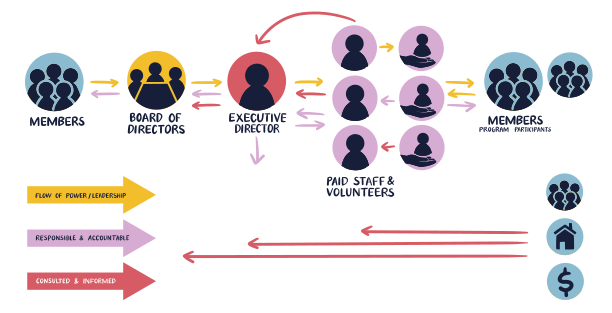
Diagram key:
- Yellow arrows: The flow of power, that idea of a kind of hierarchical leadership, and how that works throughout all of our key stakeholders
- Purplpe arrows: Where people are responsible and who has accountability for doing individual tasks
- Red arrows: Who is consulted and informed
Here is a further breakdown/explanation of the roles and responsibilities at MTL:
Active member households: Members select the board, set organizational goals, and provide input to ensure the organization serves their needs. For member-based organizations, these are the everyday users and the biggest group to consider.
Board of directors: A self-perpetuating board of 7–11 members with traditional roles (e.g. president, treasurer, and secretary) with two-year, renewable terms. Rather than holding annual open elections (which often result in low participation) the sitting board ratifies new members. This working board provides fiscal oversight, strategic direction, and regulatory compliance in addition to directly participating in the daily operations of the tool library.
The board meets monthly in a hybrid format for about 90–120 minutes. Half of that time is dedicated to the status of the LoT and programming, along with reporting from each leadership committee. The other half is reserved for more active discussion. These meetings are open to the members, who are encouraged to participate in discussions and vote on motions, not just sit in. The number of non-board members in attendance varies widely depending on the discussion items on the meeting agenda.
There is also an annual strategic planning retreat. Depending on capacity, there may be social/professional development activities.
Executive director (E.D.): The E.D. reports to the board, which evaluates performance, sets compensation, and provides oversight. The E.D. is responsible for ensuring that the organization meets its goals, enforces policies, and keeps communication open in all directions. The E.D. also has full authority to make staffing decisions.
Paid staff: MTL has nine part-time staff, including E.D., branch managers, a volunteer coordinator, a programming coordinator, and an operations coordinator. The organization has intentionally kept pay rates within a $10/hour difference between the lowest and highest paid staff members. Authority is shared across the team, so no single person is solely responsible for a program or location. This approach prevents burnout, reduces participation silos, and allows staff to focus on their strengths.
Leadership committees
The MTL staff is supported and enhanced by volunteer leadership committees that handle core management tasks in place of traditional paid departments. MTL utilizes four primary committees:
- Advancement: Secures funding through grant writing and annual fundraising campaigns
- Programming: Manages LoT operations, including inventory and workshop logistics
- Engagement: Handles member correspondence, data tracking, and event planning
- Finance: Oversees accounting, budgeting, and fiscal tracking
To ensure consistent integration, each committee includes at least one staff member and one board representative, alongside community volunteers.
The cadence of meeting schedules varies by need: task forces for specific events may meet bi-weekly, while the Finance Committee may meet quarterly. Standard committees typically meet monthly.
These meetings are open to the public, and stakeholders are encouraged to attend. Committees are the engine of the organization; they are where policy begins to form from logistical “pinch points,” strategic goals are measured, and budget implications are set for the fiscal year.
Example stakeholders
MTL recognizes the following primary stakeholder groups that influence governance and operations.
- Daily operation volunteers: The “face” of the organization. Roles include tool librarians, shop mentors, and instructors. Participation ranges from weekly shifts to quarterly support.
- Member and program participants: While members have active accounts and participants engage more casually, MTL values both perspectives equally in governance discussions.
- Partners from the larger community: Donors, partner organizations, and local neighbors. MTL proactively seeks their input to ensure collaborations are rooted in mutual benefit rather than assumptions.
- Founders: Usually serving on the board or as inaugural staff, founders provide vital institutional memory. However, MTL intentionally limits “founder influence” to their active responsibilities to allow new leadership room to grow.
- Local advisory board (LAB): Utilized during the startup phase of new sites to serve as “mini-boards.” MTL recommends merging LABs into the permanent committee structure after the launch phase to avoid role confusion.
Reflection activity
Think about a traditional hierarchical governance model versus a community governance model. Use the RACI chart (a tool to clarify roles) to consider five very common governance decisions that have to be made and think about how that governance decision might play out in each model.
The goal of this activity is to get you thinking about how the logistical details of making that governance decision might be different between those two models. The governance decisions for this activity are:
- Buying new tools for the inventory
- Hiring a new staff member to manage volunteers
- Building and ratifying the budget for the next fiscal year
- Setting strategic goals and the associated work plan
- Deciding whether or not to pursue a grant/project
Operations and governance: Resources, templates, and videos
Operations resources and templates
- SNTL Articles of Incorporation
- SNTL Bylaws
- SNTL Code of Conduct
- SNTL Emergency Procedures
- SNTL Employee Handbook
- SNTL Sample Liability Insurance Application
- SNTL 1023 Filing
- SNTL Waiver
- Nonprofit Public Document Checklist
- Fiscal Sponsorship Agreement
- Nonprofit software discounts:
- TechSoup – a clearinghouse for free and discounted software and hardware, including Adobe, QuickBooks, Microsoft, and other major brands.
- Canva – free cloud-based graphic design software.
- Google Business for Nonprofits – free email and other Google apps.
- Google Ad Grants – free credits for 501c3’s toward paid targeted ads.
- Asana – discounted project management software for nonprofits.
- Salesforce – “free” client resource management database (requires a lot of setup and maintenance, usually from someone who has extensive experience with Salesforce for nonprofits)
LoT Co-Lab: Operations
Video recordings
- Part 1: Values and Mission [3:29]
- Part 2: Business Structures [10:09]
- Part 3: Staffing [2:28]
- Part 4: Insurance [4:40]
- Part 5: Risk Management [3:45]
- Part 6: Q&A [11:26]
General governance resources
LoT Co-Lab:Governance
Video recordings
- Part 1: Understanding the now [4:13]
- Part 2: Role clarity [3:05]
- Part 3: Governance models [6:13]
- Part 4: Reflection [6:41]
- Part 5: How to shift [9:15]
- Part 6: Q&A [13:06]
Community governance resources
- Board Support Goals
- Board Annual Business Calendar (Public)
- Strategic Planning Goals/Metrics
- Strategic Plan Progress Dashboard_REconomy (Public)
- Staff Feedback/Input
- Cooperative Governance Primer (UW Center for Cooperatives)
- Co-Leadership (Oxford HR Report)
- NP Governance Resources (Twin Jett)
- Minnesota Tool Library Get Involved
- “Do-Acracy” at the Asheville Tool Library (Public)
LoT Co-Lab:Community governance
Video recordings

People are the heart of any Library of Things. Creating an accessible membership structure, an effective volunteer program, and a healthy workplace for staff are all critical for creating a thriving LoT.
Chapter 1: Membership (costs, benefits, privileges, and access)
Membership structures are one of the most varied practices among Libraries of Things. There is no right way to set up your memberships, but here are some common ways LoTs have approached it.
Strategies (you can mix and match!)
There isn’t a one-size-fits-all membership practice for LoTs! Here are different practices to consider:
Free: While it’s less common, some Libraries of Things don’t charge anything for membership. These generally rely heavily on volunteer labor and tend to remain small, which isn’t always a bad thing. [Check out the Portland case study in this Section for more on how this works.]
Sliding scale: Members choose an amount that fits their budget and usage level. This can be totally open-ended or a set of designated levels. Some examples of how to approach a sliding scale:
- Start at $100 per year, and go up or down from there.
- Pay $1 for every $1,000 of your annual income.
- Choose from a set of predetermined amounts based on ability to pay. Higher levels subsidize lower levels.
Tiered benefits: Members choose a fee level based on the benefits they want to take advantage of. This may include paying more for a membership that allows more items to be borrowed at a time or for a longer time. It can come with discounted classes, allow access to multiple locations, or include access for multiple household members.
Work-trade: Many LoTs provide free memberships and other benefits to volunteers. If you have significant staffing needs to fill, consider offering work-trade arrangements to allow people free access in exchange for their time spent staffing the desk, repairing items, etc.
Scholarships: LoTs without sliding-scale or free membership options may offer application-based scholarships or other subsidies for community members in need. [See the Asheville Case Study later in this Section for examples of this system.]
Length: While many choose to pay for an annual membership upfront, many LoT members pay for their membership with monthly auto-payments, with or without an annual commitment. Some LoTs offer lifetime memberships for purchase as part of a start-up funding campaign.
Additional costs: On top of membership fees, a few LoTs also charge a small amount for each item that’s borrowed to supplement maintenance and replacement costs—often charged for higher cost and/or higher demand inventory items. Some LoTs charge a late fee when an item is kept past its due date. Though several LoTs have reported that late fees don’t necessarily encourage items to come back on time, and may put disproportionate pressure on low-income members.
Member definitions: Most LoTs define membership borrowing privileges as belonging to a single individual. If your liability insurance policy allows it, you may also offer household memberships or even organizational memberships that allow anyone from a business or nonprofit to borrow items. Be sure to consider your waiver policy in these cases.
While the options might feel overwhelming, there are some early considerations that can help you choose the right structures and costs:
- Make membership income projections part of a comprehensive budget plan. Memberships probably won’t cover all of your costs, so know where the rest of your funding will come from.
- The membership levels you set at the beginning can increase over time. Plan to keep up with inflation, and communicate that fees and structures are subject to change. [The Toronto case study provides more about how an LoT changed tactics below.]
- Communicate! As you increase prices, be sure to track and communicate to your membership the changes and improvements that the additional fees are helping to fund.
Toronto Tool Library membership
This case study covers the Toronto Tool Library’s (TTL) tiered membership system. It focuses on the drawbacks of a tiered system and why/how TTL plans to implement changes.
Tiers
Toronto Tool Library (TTH) has about 900 active members from a pool of 5,000 who come and go, which fall under three tiers (prices in CAD):
- Basic: $55/year. 3-day loan periods, plus $2–$10 borrowing fees on select items
- Twice Fund: $85/year. 7-day loan periods, plus $2–$10 borrowing fees on select items
- High Five: $110/year. 14-day loan periods, no additional borrowing fees, but late fees still apply when applicable
All membership tiers also include no limits on the number of items checked out, monthly hands-on workshops, project mentoring, and educational materials.
Changes and lessons
In late 2017, TTL adopted its multi-tier membership structure in response to financial difficulties. The switch came with several learning curves, including:
- Confusion: Different tiers are harder to manage for staff and more difficult to understand for the public.
- Storage: Four to five Basic members could use a tool during the same time that one High Five member would have it. In turn, that created the need to stock more inventory, which meant more display/storage space needed, as well as more repair parts, brands, and trim levels.
- Mission creep: Unintentionally, the tiered model created an “equity trap” that contradicted their mission. While the higher tier appeared to bring in more revenue, those members effectively paid less per use because their flat membership fee covered unlimited borrowing. Meanwhile, basic members—who often had less disposable income— with per-item fees were covering a higher percentage of TTL’s operating costs, as they often paid more over time for less access.
- Borrowing time: People with longer borrowing terms are more likely to procrastinate and hold onto the item for a significant amount of time before actually putting it to use.
Advice
- Keep good data: Review inventory and be wary of hard costs (e.g. removing items that are rarely/never borrowed).
- Plan for the effects of inflation: Include logical, small membership price increases rated against inflation.
- Invest in your organization: Put some of what you make back into tangible improvements.
- Plan for some level of staffing: This can start after the initial years of operation.
- Avoid complicated membership systems: They can be difficult to understand.
- Plan for evolution: What works in year one or two may be less effective in year four, five, and beyond.
- Communicate clearly: Communicate improvements, changes, etc., transparently with your community.
Moving away from the tiered system
After 2 years of planning and communication with their members, TTL has moved away from the tiered system. Instead, they now only have a single membership plan that mirrors their previous middle tier at a slightly increased price of $90 CAD/yr. Before making this change, they spent the time building up other parts of their organization (e.g. Makerspace) to ensure they wouldn’t be heavily financially impacted by a potential dip in membership.
Asheville Tool Library membership
This case study covers Asheville Tool Library’s (ATL) paid membership policy, including a scholarship program that covers the cost of membership. At ATL, members choose to pay between $50–$250 for an annual membership.
About
ATL was created with three core tenets in mind:
- Supporting professional development and business work
- Environmental impact
- Access to goods and reducing financial barriers
Membership
Members get access to all tools for up to seven days at a time with possible renewal, and there is no limit to the number of tools that someone can check out. Member registration can be done online or at their location. ATL tries to make it clear to the community that scholarships are available.
There are three different types of memberships:
- Sliding scale: $50–$250/year with a $150 preset. It was originally $50 to $150 with a $100 preset, but when several people went for the middle amount, they adjusted the upper range to increase income slightly without excluding those needing a price point.
- Scholarships: ATL’s scholarship application is a Google Form with four questions: Full name, email, whether this is their first membership, and what they plan to do with the tools. Although ATL generally accepts whoever applies, a board member does review responses because some people who don’t require a scholarship mistakenly/needlessly fill out the form and need support getting redirected to the general sign-up form.
- Lifetime membership: When ATL first opened, they offered lifetime memberships for $500 to gauge community interest and receive financial support to seed early operational costs.
Other fees
- Usage fees: Usually $10 on items that have high consumable costs (e.g. concrete saw, chipper, gas MIG welder).
- Late fees: $1 per day, even on closed days. Batteries, chargers, and tools are separate items, which helps with tracking and accrues the $1 per day late fee. Most people are understanding of this policy, and it contributes to around 20% of ATL’s annual income.
Credit card requirement
ATL began requiring members to have valid credit cards on file to help combat late and unreturned tools. This policy authorizes ATL to charge up to a maximum of the tool’s fair market value for items that are not returned after a set number of weeks of communication attempts. While there is pushback from other LoTs to implement a similar policy based on accessibility issues, ATL has determined that requiring a credit card is the simplest solution. They have not received any local backlash, and they are flexible with this policy if folks do not have a credit card or if it may cause undue financial hardship.
Volunteer perks
ATL is heavily reliant on volunteers, so they have created several perks for active volunteers who contribute more than 15 hours per quarter:
- At the end of each quarter, the tool library manager checks hours and picks a small gift for each volunteer, which can be tool library swag or sometimes gift cards.
- Volunteers get invited to quarterly volunteer socials and potluck events.
- Volunteers can come in 24/7 to borrow tools for their personal use.
Green Lents and Rockwood Common membership
This case study covers the free membership structure of Green Lents, Rockwood Common, and six other Portland, Oregon, U.S.-based LoTs. It focuses on the benefits and challenges of a free membership system and alternative funding streams.
Membership structure
The Portland Tool Libraries (PTL) are an ecosystem of seven tool libraries that serve independent geographic areas with a free membership structure. This payment standard was set in 2004, and each local tool library created since has continued to utilize that model. While that generous policy has been widely appreciated by members, there have also been downfalls.
Benefits
- General support: Different organizations, community members, and volunteers are appreciative that these services are accessible.
- Equitable enrollment: There are no questions about income, and volunteers are not put into uncomfortable situations where they have to impose a charge. Everyone is also invited to financially donate to the organization at a later time, but there is no pressuring expectation.
- Community support reputation: Civic partners intentionally seek out connections, and promotion of services is easy to find and often free.
- Rent assistance: Churches, civic partners, and others are likely to offer some sort of rent assistance for LoT locations and events.
Challenges
- No resources for program expansion: There is little room for workshops or other programming ideas.
- Reservations: Not enough infrastructure to maintain a reservation system, which can be complex and requires time to manage.
- Personnel loss: When someone leaves, so can their institutional knowledge. Roles and procedures are also left to at-will individuals (e.g. volunteers and board members).
- Financially dependent: Funding relies on grants and soliciting donations. This means funding can be less stable, and a lot of volunteer time is spent raising money instead of managing the LoT.
- Mission creep: The central mission can be forced to change over time to qualify for grants.
Alternative funding streams
PTL is fortunate to be in a progressive area where there are several opportunities to partner with supportive organizations like planning and sustainability departments, environmental service programs, and business partner sponsorships.
Late fines
- PTL has a clear late fine policy to avoid implicit biases.
- Late fees vary from site to site based on high-volume/high-value tools available at a particular location.
Member management
PTL does automatic annual check-ups for people to update their information. This ensures that people are using the tool library that is closest to them, which helps with tool recovery and maintaining a supply of tools that’s sustainable for the community size.
While PTL is flexible and willing to work with the individuals, they may revoke membership privileges. This comes up very rarely, and only when members consistently do not return tools, refuse communication, and/or show a lack of remorse when tools are returned broken. In short, if someone is not willing to even have an initial conversation about what happened, then PTL will no longer serve that member.
Volunteers
A low overhead heavily relies on a dedicated community of volunteers. PTL has created these benefits to better support their volunteer base:
- 24/7 access to the space
- Discount codes for business partners
- Lifetime membership
Chapter 2: Volunteers
Most Libraries of Things rely heavily on volunteers to provide LoT staffing, repair items, raise funds, and lead the organization. It really does take a village! Volunteers can contribute an amazing amount, but having a successful volunteer program takes planning, intention, and work.
The power of volunteers
Besides donated labor, volunteers provide many additional benefits to your organization. Here are some of the reasons to recruit and retain volunteers:
Vibrant community: The positive, fun energy brought to LoTs by volunteers is a core part of what makes them vibrant community hubs. As local residents who are volunteering to make their own community a better place, they are the heart of your LoT and your most powerful ambassadors within that community.
Cost savings: This is the most obvious impact of volunteers. Paying staff is expensive (see the previous section for some of why this is!), and volunteer labor can reduce your annual budget significantly.
Diversified expertise: Often, volunteers bring a skillset you don’t already have. Whether it’s fixing small electronics or leading community meetings. They also have relationships that they may be willing to lean on on behalf of the LoT.
Built-in users and advocates: Volunteers often know your organization very well and, in addition to being active members, will help spread the word and recruit others to join. Their experience and different perspectives also provide great feedback about what could be improved.
Shared power: People generally want to volunteer and find it extremely rewarding! Offering the opportunity to get involved and donate time and skills increases your organization’s impact on the overall sharing culture. Sharing responsibility among a diverse group of volunteers can also increase your organization’s representation of and responsiveness to your community.
Common volunteer roles
Anywhere there’s a need for work and someone interested in doing it, there is a potential volunteer role! While the examples below are some of the most common ways that people volunteer time, try to stay open to people who can offer specific skills for one-time projects or unseen needs.
- Librarian: Helps members check in and check out
- Donation intake: Engages with the donation of goods and in-kind services
- Inventory control: Enters information about new things into the LoT’s management systems
- Instructors: Teach workshops and classes
- Fixers: Maintain and repair broken items
- Maintenance: Helps keep the building and space in good order
- Software: Manages and maintains software and digital systems
- Fundraising: Writes grants and manages fundraising events and campaigns
- Special events: Plans, sets up, serves, and cleans up for events
- Communications: Designs and maintains any online presence, creates flyers and digital art, manages social media accounts and posts to social media channels, sends mass emails and newsletters, and responds to questions
- Volunteer management: Wrangles all the other volunteers; makes sure they are happy and that they’re available to staff the LoT when it is open for lending
- Subcommittees: Creating subcommittees for ongoing needs and ad hoc work groups for one-off projects is a great way to organize and communicate with volunteers. Subcommittees may include workshop stewards, beautification, safety, inclusion, tool fixers, outreach, marketing, and fundraising.
- Board or leadership: Regularly works on the management and strategy of the organization
Many volunteers also start in one role (e.g. librarian) and become increasingly involved, either taking on additional program roles or advancing to organizational leadership. Remember that someone’s role within the organization will likely change over time. Encourage deeper involvement from people who may want to contribute more!
Common issues with volunteer management
There are many reasons you might be wary about recruiting volunteers. Some common hesitations are:
- “I don’t have time.”
- “It’s uncomfortable to ask.”
- “I already know how to do it.”
- “I don’t trust anyone else to do it.”
- “Sharing ownership is risky—what if people disagree?”
It’s true that without a solid recruitment and training plan and the right people, managing volunteers can be more work (or more risk) than it’s worth. Here are some things to be on the lookout for.
Increased organizational risk: Be sure your volunteers know when and how to represent your LoT, and especially when not to, both in-person and digitally. Coach your volunteers about appropriate online behavior, including on social media.
Variability in member experience: You’ll want to focus on early training and screening to be sure volunteers who interact with the public, like librarians, have the social skills and tools they need to provide a consistent, friendly experience to everyone and be able to defuse any unexpected conflicts.
Reliability: Remember, volunteers aren’t paid employees! While many volunteers can become cornerstones of the organization, their volunteer role is typically not their first priority. Work and family obligations can keep them from following through as consistently as you’d like, and some volunteers have a looser sense of obligation than others. Make your expectations clear, including follow-through and how volunteers handle needing to miss a shift or drop a commitment.
Boundaries: If you’re a staff or board member, think of volunteers as your employees, even though they’re not paid. Be careful about the personal relationships you form, and keep personal/professional boundaries in mind. While you might naturally hit it off with some people more than others, as an organizational leader, it’s important to make sure everyone feels they’re being treated equally.
Recruitment
A long, successful tenure for a volunteer starts with finding the right match for your organization. When recruiting, take your time and be conscientious about inviting people. It’s worth waiting for the right long-term fit! Here are some factors you might consider in evaluating volunteers.
Values alignment
- Does this person share your organization’s core values and purpose?
Communication style
- Are they easy to communicate with?
- Do they regularly use the methods of communication you use most (e-mail, texting, etc.)?
Capacity and available time
- This can be tricky! Sometimes, enthusiasm can lead people to over-commit. Be specific about the time commitment you ask for and ask for their real availability.
Skills and experience
- Are they a natural fit for your needs? Or, are they excited to learn the skills needed?
- Consider your capacity for training relative to the benefit of having a new person in the role. Some skills, like Spanish fluency, might be harder to come by and worth training someone as a librarian with little experience with your inventory.
Community connections
- Depending on the role, it might be helpful to have someone with a strong network involved. This is especially important for roles in fundraising and membership development.
If you’re having trouble getting started or finding the right people, try some of these resources:
- Members! Your membership is the best place to find people who know the value of the LoT and want to see it grow.
- Social media
- Your newsletter
- Sustainability groups/clubs
- Skilled volunteer placement organizations (often retirees)
- Makerspaces, community bike shops, commissary kitchens, etc.
- Word of mouth—ask your volunteers and members to spread the word.
Making the ask
Even when you’ve found the right person and you have a job in mind, it can be intimidating to take the leap of reaching out. Here are some recommended steps to success:
Be direct. State your needs clearly and concretely, and don’t be ashamed of asking. You are offering them an opportunity to be part of something great!
Offer an easy entry point. Identify a low-barrier volunteer role to get folks going and evaluate their skills and style. It can be easier to say “yes” to something simple or time-bound than to make a long-term, vague commitment.
Be okay with ‘no.’ It might not be the right time, or your dream volunteer might prefer to do something else with their time. Ask if you can come back to them in the future, or come back with a different role in mind. You can also ask if they might know someone else in their network who might be a good fit for your volunteer needs.
Communication and ongoing management
Intentional and consistent communication is vital to successful volunteer experiences! Think carefully about when, how much, and in what style you communicate with your volunteers. Striking the right balance will ensure that people are informed and energized without being overwhelmed. Here are some tips for successful communication and management:
- Make a plan for onboarding and orientation to ensure no critical information is missed. This is a great time for your new volunteer to sign up for future shifts to keep up the momentum.
- Create systems for updating and re-training volunteers as your LoT evolves and changes. Try to cultivate a habit of giving and receiving feedback, both formally (shift reports, surveys, etc.) and informally (checking in casually), to see how things are going and make adjustments.
- Organize your training documents and other durable resources and make sure they’re available as references on an ongoing basis.
Volunteer management tools and software
There is no standard method or software that LoTs are currently using to manage volunteers. The Station North Tool Library in Baltimore uses a shared Google calendar and Airtable to schedule and track volunteers. The REconomy Tool Libraries in Seattle use a customized Google spreadsheet and Neon One CRM to track shifts and communicate with volunteers. Other LoTs use specific volunteer management software. SignUp and Point are common “free” scheduling platforms for volunteers. While there are many options, some charge fees to use them or for specific features.
Purpose
Finding and keeping the right volunteer depends on understanding their purpose. Everyone might have a slightly different motivation for volunteering, but here are some common reasons people volunteer:
- Believe in the mission of the LoT
- Like to feel useful and have a sense of purpose
- Want to learn more about the things you lend or the Solidarity Economy
- Want to make friends or build community (especially if they are new to town)
Understanding your volunteers’ motivations can help you shape their role to feed that passion. While some people want to flex their established skills, others want to learn and try new things. Offering multiple role options (the “choose your own adventure” model) can help them explore and find what feels most meaningful to them.
Building community
A healthy volunteer community also builds its own purpose through strong connections and a shared identity. Encouraging volunteers to build relationships increases accountability to one another, makes it more fun to come in when they’re needed, and keeps people sticking around longer. A dedicated, happy volunteer will feel like the LoT is a “third place” between work and home where they have a sense of belonging and ownership.
You can encourage community building through:
- Regular, structured volunteer socials and appreciation parties. You host, they show up!
- Supporting volunteer-led social events and encouraging them to invite each other to performances, parties, and other outside-the-library events.
- Fostering space for volunteers to connect through mutual interests, like a monthly bike ride or book club.
- Showing gratitude in large and small ways. Just as people have different motivations, they also appreciate various kinds of “thank you” gestures. Use a mix of verbal affirmation, exclusive events and swag, public and private notes, and snacks to demonstrate that you see and appreciate their work.
Reflection questions
- How does relying on volunteers relate to your organization’s values?
- What is your most accessible entry point for volunteers?
- Who is able to volunteer? Are there specific skills that are needed? Are there roles for people with different levels of abilities or mobility?
- What are other ways for users, members, or volunteers to connect more to the organization?
- What are your non-negotiables from a volunteer? (e.g. Volunteers must be inclusive and welcoming.)
- What’s your role in facilitating community and connection?
Chapter 3: Structured volunteer and internship opportunities
This section explores how intentional volunteer and intern roles, clear expectations, and strategic recruitment pathways can build capacity, strengthen programs, and support long-term organizational growth.
Why structure matters
Over time, volunteers and interns can help you grow from being all-volunteer to an organization with paid staff.
Structured volunteer and internship roles offer greater impact, better retention of your volunteers, and a clearer pathway for development for volunteers. There is the potential for someone who started volunteering with you to become a leader or a core part of your LoT. Structure also:
- Helps align volunteer and intern work with your needs, as well as with the individual’s professional and personal growth
- Builds capacity when structured volunteer and intern roles are able to pilot new programs or activities that can later be staffed
- Helps clarify where it makes the most sense to add staff as the organization grows
- Creates a pipeline for volunteers and interns to become future committee and board members
Volunteer roles
Volunteers engage with LoTs in many different ways. There is no one-size-fits-all, but there are some common volunteer roles that arise:
- Operational: Handle backend things like borrowing, member management, inventory, and general administration
- Programmatic: Support programs out in the community (e.g. Repair Cafés and community service days)
- In-kind service: Bring specialized skills in areas like marketing, communications, photography, videography, accounting, or clerical work
Understanding the difference between various types of volunteer roles and setting clear expectations is key to helping volunteers (and you LoT!) succeed.
Sourcing volunteers
Volunteers can come to your LoT from a variety of sources. Higher education institutions, corporate partners, and the LoT/reuse/sustainability community have proven to be especially helpful. Of course, make the pitch to your broader community, too!
Higher education institutions
Identify target departments. Colleges and universities can be excellent sources of volunteers and interns, particularly when there is overlap between academic programs and the mission of an LoT. Identifying departments and programs with strong alignment is often the best place to begin. Below are five majors/departments that are representative of an LoT’s values and focus:
- Environmental Studies: Sustainability, circular economy, reuse
- Urban Planning & Architecture: Community engagement, spatial design
- Human-Centered Design: Tool user experience, signage, and wayfinding
- Public Health: Social determinants of health, lead hazards
- Communications/Media Studies: Storytelling, social media, outreach
Establish institutional relationships. Once potential departments are identified, the next step is to establish institutional relationships. It can be helpful to find one good connection, build a trusting relationship, work to strengthen that one, and then make another. Ensuring these are long-term connections that you can return to is key. Here are some helpful places in colleges and universities to look for people to connect with:
- Career services, internship coordinators, or service learning offices
- Faculty, especially those offering capstone projects, independent studies, or community-based learning courses
- Career fairs or student engagement events provide opportunities to connect directly with students through tabling and outreach
- Alumni networks allow you to start with existing connections that make relationship-building easier and more sustainable
Here are some things to keep in mind when trying to connect with folks from higher education institutions:
- Research professors, clubs, semester setup, class load, etc., in advance
- Try multiple avenues (campuses can be silos, and different departments rarely share information)
- Recognize that your support is going to be short-term at best (e.g. one quarter, semester, or school year).
College and university volunteer examples
The Tool Library in Buffalo, New York, U.S., has many partnerships with local colleges and universities for structured volunteer and internship opportunities.
UB Honors College Colloquium
First-year students in the University at Buffalo’s Honors College complete a semester-long community engagement course. 10 students supported the Buffalo Tool Library with large-scale projects such as reforestation, anti-graffiti campaigns, and community events, which later informed the development of ongoing spring and fall service days.
Community Scholars Work Study Program
The Buffalo Tool Library partnered with the University at Buffalo’s Office of Student Engagement to place federal work study students in community-based roles. Students contributed to project-based learning outcomes, including completing a full carbon calculation project for the Tool Library’s inventory.
Lead Safe Tool Borrowing Program
Community Scholars Work Study students at the University at Buffalo helped launch a partnership between the Erie County Department of Health and the Buffalo Tool Library. Students supported program development, from applications and marketing to consumables planning, which positioned the Tool Library to secure funding and hire a dedicated staff member.
Empire State Service Corps
The University at Buffalo’s Empire State Service Corps places students in community-based nonprofits for 300 hours of service each academic year. While placed at the Buffalo Tool Library, students carried out structured, project-based work, while also gaining meaningful experience and ownership of deliverables.
Western New York Prosperity Fellowship
The Western New York Prosperity Fellowship program connects students with local organizations through paid internships, allowing nonprofits to benefit from specialized skills without additional costs. One fellow helped the Buffalo Tool Library integrate 3D printing into operations, creating replacement parts and developing a shared database to support tool libraries nationally.
Corporate partners
Corporate partnerships can be an important source of long-term volunteers. Many organizations already offer community service opportunities for their employees, and some even provide paid time off specifically for volunteering. This creates a natural opening for collaboration, especially when there is alignment between a company’s values and your LoT’s programs and mission. These partnerships can also be an opportunity to deepen existing relationships with funders and sponsors beyond branding, where they can engage with the organization through meaningful work.
Using one-off service days
Large corporations often organize annual service days where staff participate in volunteer projects as an opportunity to give back to the community. At first glance, these events can feel like more effort than they are worth, especially for small organizations that lack the capacity to design projects for large groups. It may even feel like putting together busy work just to keep folks occupied, but these service days can provide powerful entry points to your LoT for volunteers.
Having corporate employees physically in the space introduces them to the LoT in a personal way. Once people see the space, the inventory, and how everything works, the purpose of their volunteerism becomes tangible. Many organizations have found that these visits not only lead to new volunteers but also to new members.
Service days can also provide a pathway to other forms of engagement, such as committee work or board service. They also create opportunities to identify specific skills among volunteers, like graphic design, photography, or accounting, that can be matched with organizational needs.
Transitioning from service days to sustained support
The key to turning a one-time service day into an ongoing relationship lies in follow-up. This starts with a digital waiver that all volunteers sign off on, which collects their name and contact information (i.e. email). The digital waiver should include getting their consent to contact them after the service day, take their photos, and post those photos publicly.
After every event, you can send a follow-up thank you message, photos from the event, tag them on social media, and invite them to upcoming events. Including these volunteers in newsletters or event announcements keeps them connected to ongoing activities. You can also add them to your mailing list.
Throughout the service day, identify individuals who might be good conduits to continue to build that relationship with. That could be someone who lives nearby, is already a member, or may be especially motivated to maintain a connection. Building on these personal relationships can transform an occasional service event into a recurring engagement.
Sourcing corporate volunteers
You can start building relationships with corporate partners and volunteers in a couple of ways:
- Cold call HR or corporate social responsibility representatives to understand what they typically do for service days. Some participate in one-off events, and others have monthly opportunities to volunteer.
- Chat with your existing volunteers and board members to see how they got involved with your LoT and where they came from.
- Think about recurring tasks and big one-off tasks that you need help with on an annual basis, and align them with what you find your corporate partners and volunteers do.
Corporate volunteer examples
M&T Bank
The Buffalo Tool Library partners with M&T Bank, which engages employee teams in biannual Community Impact Weeks to support local nonprofits. One initial service day led to the recruitment of a dedicated volunteer who now champions the Tool Library within the company, helping coordinate ongoing volunteer days and deepening the partnership.
Cannon Design Impact Day
The Buffalo Tool Library also partners with Cannon Design, an architecture and design firm that participated in a community impact day at the Tool Library. A one-time volunteer event led to a capital campaign donation and the onboarding of two employees as Tool Library board members, deepening the organization’s leadership and funding capacity.
Recruiting volunteers and interns from within
Your LoT’s members and broader communities can be a fantastic source for recruiting volunteers and interns. Several LoTs have found that members naturally want to become more involved after participating in your LoT. This is often because the folks who are using the LoT as a resource find ways to support themselves and the community simultaneously. Here’s an example:
Shoshana was a Buffalo Tool Library member who found that the chainsaws she was borrowing were always super dull, and she could never understand why. After looking into it further, she realized that the chains were being put on backwards, so she ended up volunteering just to help out with that, which turned into the Tool Library’s very first volunteer skill shares. Now, these events, where Shoshana can walk through how to use and maintain a chainsaw, are regularly held and are open to all Tool Library volunteers.
Shoshana’s example shows how frustrations that members experience can become valuable learning opportunities for LoTs and their volunteer cohorts.
Make sure your existing LoT community knows about volunteer opportunities! Using resources like social media, newsletters, and in-person signage can help the community become aware that these opportunities to further support the LoT exist. Free offerings can also compel members of the LoT community to want to volunteer. Perks can include free membership, swag, social outings, skill outings, and off-hours shop access.
Creating a compelling case for volunteers
After creating an idea of where you might want to recruit your volunteers and interns, it’s critical to also create a compelling case for why people should volunteer with your LoT. Recommendations for your recruitment materials include:
- Formal job descriptions that clearly communicate the duties, time commitments, and intended outcomes
- Clear project plans that convey the goals, timelines, and expected outcomes
- Succinct, shareable flyers and handouts that explain how people can engage with your LoT with specific examples and time commitments. These can be passed out at tabling events or available in person.
- Short and snappy recruitment graphics that are easy to share on social media
Support and check-in structure
It’s important to create a supportive environment for volunteers and interns. Make sure you have the capacity to effectively support them throughout their time volunteering at your LoT. Consider creating a specific check-in structure:
- Assign a staff member or a volunteer mentor to each of your new interns and volunteers. The goal is to make sure that people feel welcomed and prepared with all of the required skills and information required to support your LoT.
- Skill shares are a fantastic way to build relationships and cross-educate all of your volunteers on the vast variety of knowledge your LoT volunteer community shares.
- Routine check-ins (e.g. monthly or even quarterly) with interns and volunteers are extremely helpful. This is often done with the more project-based interns and volunteers who are working towards some sort of endpoint or deliverable to make sure that they feel supported. Regular check-ins also give volunteers and interns the chance to voice any issues or challenges they are facing. While one-on-one meetings can be the most beneficial, time constraints also encourage volunteers and interns to participate in staff meetings, with time allotted to checking in with volunteers can also work.
- Create opportunities for ongoing feedback and opportunities to implement improvements and recommendations. One outlet for this is an Operations Committee, which can look like the operations manager and a board member discussing feedback that has been heard. This discussion can also turn into an open forum for volunteers and interns to provide direct feedback. Make sure you have a plan to discuss and address the feedback received.
Celebrate and share outcomes
Celebrating and sharing what your volunteers and interns have accomplished is always important. It bolsters morale and shows volunteers and interns how much they have impacted the LoT, and the broader community, with their support. Doing so can serve as points of growth. Celebration ideas include:
- Highlight individuals through online outlets (e.g. newsletter, social media, and blog posts). This can show the community how people are engaging with your LoT outside of the day-to-day support.
- Document volunteer and intern accomplishments through professional reports, presentations, and showcases. By sharing these successes in academic and professional settings, you demonstrate the LoT’s measurable value and bridge the gap for partners who might not otherwise see the potential for collaboration.
- Track metrics that quantify the impact of volunteers and interns, like the value of their labor ($34.79/hour in the U.S. as of 2026). This will not only be great to share out with your community, but this can also help you understand your capacity (e.g. staffing and funds).
Potential challenges
Capacity is often one of the greatest challenges with structured internships and volunteer opportunities. Even if your LoT has multiple full-time staff members, part of someone’s job becomes volunteer coordination, which includes overseeing and supporting the roles of volunteers and interns. The more structured and self-directed you can make volunteer and internship roles, the less supervision it will take—and therefore the easier it will be.
Here are some additional things to consider when you are developing your LoT’s volunteer/intern role needs:
- Time commitment: Will the role better fit a student or a corporate volunteer who may only have the capacity to volunteer three or four hours a month?
- Retention and motivation: Is there a start and end date with quantifiable impacts?
- Beneficial overlap: Are they getting as much out of this opportunity as you are getting out of them volunteering/interning at your LoT?
While there are several programs (e.g. youth work program, work release, and mandated community service) that exist to help you build capacity, they can take a lot of oversight, time, and administration. There have been varying degrees of success with these programs for LoTs.
A volunteer’s contribution is often tied to their personal capacity and alignment with your LoT’s culture. While you will likely work with dedicated folks, there may be times when a volunteer’s availability—or even their personality—doesn’t quite fit the current needs of your LoT. When you encounter a mismatch in capacity or fit, try re-scoping the role to a smaller, more independent task, or redirecting them to a different role altogether where they might be a better match.
Apprenticeship and certification models
Apprenticeships and certifications are structured volunteer opportunities that don’t rely on funding. In fact, these models can lead to more funding opportunities and help with workforce development. Apprenticeship and certification models also align with the idea of a mutually beneficial relationship between your LoT and your broader support network.
If you’re interested in creating an apprenticeship and/or certification model for your LoT, begin by considering:
- What roles do you need most help with?
- What skills could your LoT help interns and volunteers develop?
- What opportunities are there for volunteers and interns to deepen their engagement with your organization?
Chapter 4: Staffing structures and hiring
If you have a solid volunteer leadership team and enough capacity to support the operations needed tofulfill your mission, a paid staff member is not a necessity. In fact, about 47% of Libraries of Things function right now without paid employees. However, if your to-do list is growing faster than your volunteer pool, you’re missing core skills within your team, or your organization needs greater stability to successfully function or to expand, it might be time to consider paid staff.
Why paid staff
There are many reasons to consider hiring paid staff, including:
- Volunteer capacity ebbs and flows: Volunteer capacity changes over time. Many organizations see a natural decline in long-term volunteer commitment, often around the three to five-year mark when early excitement fades, and burnout settles in. Paid staff can help sustain momentum, support volunteers, and prevent leadership gaps during these cycles.
- Organizational stability and continuity are maintained: When a key volunteer leaves, valuable knowledge can be lost. Paid staff serve as a consistent point of contact, preserving institutional knowledge and easing leadership transitions.
- Less desirable tasks are completed consistently: Every organization has work that is tedious, messy, or unglamorous. Paid staff can reliably handle these responsibilities.
- Equity in leadership is strengthened: Not everyone can afford to donate their time and expertise. Paid positions ensure that people from diverse economic backgrounds can contribute to leadership, creating a more inclusive and representative organization.
- Paid roles can be a condition for funding: While this should not be a consideration that is driving your staffing journey, paid staff can be a precondition to compete for particular grants and contracts, especially at the municipal, state, and federal levels in the U.S. A larger private foundation might speak highly of the role of volunteers, but when it comes to signing a contract, they prefer the reliability of a paid staff member.
Transitioning your LoT to include paid staff
Many volunteer-led organizations eventually reach a point where paid staff become necessary to sustain operations. This transition can be exciting, but it requires careful planning and clear boundaries. Paid roles can often grow out of a need or desire to compensate founders or leaders of an organization, but due diligence is necessary.
Do not assume existing leaders are the right fit. When your organization decides to hire paid staff, your current leaders, including founders, are not automatically the best candidates. If you’re operating with a nonprofit structure, the board has a duty to conduct a fair hiring process. If a leader or founder wishes to be considered, they must step away from the hiring and review process entirely. This avoids conflicts of interest and ensures transparency.
Clarify roles between board and staff. In most cases, paid staff will take on daily operations, while the board focuses on strategic direction. In small organizations, these lines can blur, so be ready for a messy first stage. If you begin with only one or two part-time staff, you may still rely heavily on volunteers, and responsibilities may overlap. Over time, roles can become more specialized as capacity grows.
Reinforce the board’s oversight responsibilities. The board manages and evaluates the highest-level staff member, often the executive director. It is the board’s responsibility to hire, support, and, if necessary, terminate this role. Once additional staff are hired, the executive director, not the board, supervises them.
Transitioning from an all-volunteer model to a staffed model changes how the organization operates. Success depends on maintaining clarity, fairness, and healthy relationships during this shift.
[Learn more about governance and operational structures in other Chapters of this Section.]
Common staff roles
Based on Tool Library Alliance survey data, there are eight common staff roles at LoTs. Each is implemented in a variety of ways and timelines, so there is no “correct” route to take! Common staff roles are:
- Executive director (E.D.): E.Ds are often the head of operations with a nonprofit management background. They can ensure compliance, help with fundraising, human resources, public relations, and a bit of everything else, especially if staff capacity is limited. They are generally salaried positions with at least part-time roles. As an E.D., much of the job is making sure everyone is moving in the same direction. Sometimes this role is split amongst multiple people as co-E.Ds.
- Head librarian/Operations coordinator/Branch manager/Tool library coordinator: There are many different titles, but the core role remains the same. If the daily operations of opening the doors, processing item lending, engaging your membership, plus all the backend administration that requires are more of a priority, then this position is usually the first hire. This role focuses on running the LoT day-to-day while also keeping things organized behind the scenes.
- Programming coordinator: This is one of the most common additional roles, especially in LoTs running classes or events. Often a 1099 or part-time role, this position manages the scheduling and execution of activities like classes or Repair Cafés. Because these roles are highly compatible with grant funding, they can be structured as short-term or long-term projects. However, to avoid a “funding cliff” when a grant ends, it is essential to have a transition plan in place—deciding early whether to secure alternative funding or sunset the position. [Learn more about 1099 and other staffing types later in this chapter.]
- Instructors/teachers: Teachers typically decide what, when, and how often they teach workshops at an LoT. They are often paid as 1099 contractors. Usually, programming is limited enough that reporting requirements are minimal, and instructors might not reach the $2,000 annual payment threshold requiring tax forms, which simplifies administration. [Learn more about workshops in Section 10.]
- Development staff: This role focuses on fundraising and grants supporting the financial health of the LoT. These positions are often part-time and contracted, and they should never be paid on commission because compensation should not be tied to the outcome of whether you receive the grant. Once they’ve completed the work, they should be paid!
- Volunteer coordinators: Volunteer coordinators are usually part-time roles dedicated to managing volunteer recruitment, scheduling, and support. Often, volunteer coordination duties are combined with programmatic responsibilities.
- Marketing/communications/engagement coordinators: These roles handle member management, outreach, social media, graphic design, and staffing events like fairs. These roles work well part-time and can also be filled by interns or work-study students.
- Bookkeeper/Accountant/Third-party administrator (TPA): Many LoTs use contractors to handle bookkeeping, financial compliance, and reporting.
Staffing structures
The type of paid staffing you implement should be based on three core factors:
- Type of role and job duties: This determines whether the position should be classified as a contractor, standard employee, stipend role, or something else. Program Proper Classification provides a detailed guide on the legal requirements for hiring someone as a 1099 contractor. These rules should be followed closely.
- Term length: Consider whether the role is short-term, seasonal, or ongoing.
- Budget: While important, the budget should not be the starting point. A common mistake is to begin with “What’s the cheapest way to do this?” Instead, start with the best staffing fit for the work that needs to be done, and then determine how to fund it.
Types of staff members
As mentioned previously, there are two main types of staff in the U.S., 1099 independent contractors and W2 staff.
1099 contractors:
- Do one specific task (e.g. marketing consultant or workshop instructor)
- Can be paid a flat fee by the job or at an hourly rate
- Often carry their own liability insurance, if necessary
- May be included in your workers’ compensation policy
- Are a carefully regulated category with restrictions to protect workers. Be sure to get some legal advice if you think a role might be legally considered an employee rather than a contractor.
In the U.S., independent contractors manage their own tax withholding. As an
organization, your main tasks are to:
- Create a contract and have it signed by both the contractor and the legal representative for your organization.
- Collect a W-9 upfront (Request for Taxpayer Identification Number and Certification in the U.S.).
- File a 1099 (usually 1099-MISC) at year’s end for any contractor earning $2,000 or more (as of 2026, increased from previous $600 threshold).
W2 staff:
- May be full-time or part-time
- Can be paid a salary or an hourly rate, subject to Fair Labor Standards Act guidelines and other regulations
- Are subject to payroll taxes and workers’ compensation insurance
- Are typically covered by the organization’s liability insurance
- May be exempt or non-exempt from overtime pay. This is determined both by job responsibilities and pay rate. Be sure to consult a labor professional if you’re not sure about this.
The $2,000 annual payment threshold for providing tax documentation also applies to stipends for volunteers. While some organizations try to avoid reporting by offering gift cards or other benefits, it’s best practice to ensure all compensation is correctly classified and reported. Fringe benefits are often better structured as reimbursements, which are generally not taxed as income.
Part-time and full-time employees
To hire part-time and full-time employees in the U.S., you will need to:
- Provide a formal offer letter
- Collect and verify tax required paperwork (W-2 for tax withholding and I-9 for work eligibility in the U.S.)
- Securely store confidential records
- Manage tax withholding, unemployment insurance, and compliance with federal and state mandates
State requirements in the U.S. can vary based on the number of employees and may include health insurance, retirement plans, or paid leave. Staying informed about changes is essential, especially if your state does not proactively notify employers. Staff classifications in the U.S. include:
- Part-time: Generally under 30 hours/week (per the Affordable Care Act guidelines in the U.S.), with limited to no benefits. This is often a good fit for organizations that operate only a few hours a week. It supports gig workers, underemployed individuals, or semi-retired staff.
- Full-time: Over 30 hours/week, typically with benefits. You will need to determine whether the position is exempt or non-exempt under state labor laws, which affects overtime eligibility.
- Third party administrators (TPA): Third-party administrators are contracted services such as accounting, IT, payroll, or human resources. These roles are typically paid through a monthly or annual fee and are ongoing rather than short-term.
- Interns/work-study: Paid interns or work-study positions are often stipend-based and can be funded through schools or local partnerships. Some cities have programs where the municipality covers the intern’s pay, allowing your organization to host without direct payroll costs (though you should account for administrative time). Note that internships are a good way to test potential positions you may later hire for on a permanent basis. They should not replace existing roles, but they can help build capacity and prepare for growth. [Learn more about internships and work-study in Chapter 3 of Section 6.]
Setting your budget
Costs add up quickly, so before hiring your first employee or adding staff, it is important to understand the full financial picture. According to the Small Business Administration in the U.S., an employee typically costs 1.25 to 1.4 times their salary once you factor in taxes and benefits. For example, an employee with a $40,000 annual salary may cost your LoT $50,000 to $56,000 overall.
Salary
There are many budget considerations to keep in mind when setting salaries:
- Local minimum wage, market rates, and position demands: Be aware of the legal minimum, but also consider what constitutes a fair wage for the role and experience level. Research local market salaries for similar positions to gauge what you realistically can offer. When budgets do not allow full-time salaries at market rates, consider part-time or split roles.
- Legal requirements: Local employment laws may mandate breaks, overtime, or other working conditions that must be factored into scheduling and pay.
- Bonuses and commissions: If you plan to offer bonuses or commissions, these are taxable income and should be budgeted accordingly.
- Planned wage increases: Factor in future wage growth to keep up with cost of living and inflation.
Payroll taxes
Payroll taxes are often underestimated, but they significantly affect the total cost of hiring an employee:
- FICA (Social Security and Medicare taxes): 7.65% of wages are withheld from employee paychecks, which is matched by the employer.
- FUTA (Federal Unemployment Tax): 6% on the first $7,000 that an employee earns, but this is not applicable to nonprofits.
- SUTA (State Unemployment Tax): Varies by state, industry, and claims history. Rates and wage bases are updated annually by state labor departments. You can appeal the rate, but it usually stands.
Unemployment Insurance
Most organizations are required to carry unemployment insurance through state programs. Many nonprofits join group trusts to pay their unemployment premiums (example resources for Group Trusts in the state of Missouri). This option can reduce costs and allow nonprofits to retain a portion of their premiums based on their claims history.
Workers Comp Insurance
Paid staff are subject to Occupational Safety and Health Administration (OSHA) regulations, which may require additional training and financial investment to maintain compliance. This applies to both employees and 1099 contractors and is an important cost to factor in.
Benefits
Benefits such as health insurance, retirement plans, disability coverage, and paid time off can be required by federal or state mandates. Some states are rolling these requirements into additional payroll taxes for paid family and medical leave. Benefits vary widely by location and organizational size.
Payroll services/Third party administrators (TPAs)
Many organizations outsource payroll and human resource administration to services such as ICOMP or similar providers. These services typically charge monthly or annual fees, but they can simplify compliance and record-keeping.
Digging deeper
There are a plethora of expenses to consider outside of core budget necessities, which will give you a much more realistic look at what your budget is. Ask yourself the following:
- What are the direct and indirect costs of hiring a staff member? This could include fees to post on job sites and paid time to interview candidates.
- Are you offering professional development opportunities? This can be something as simple as first aid training.
- Do you have office space and office supplies? Are you going to need more physical space for a paid staff member? Is the office a shared or communal space? How are you going to create a pleasant working environment?
- Do you have travel expenses? Do you have parking on site, or is there paid parking?
- Do you have remote work expenses? Are you providing a stipend to your staff members for them to have internet service at home while they’re working?
- Does staff need a cell phone? Or are you giving them extra money to use their personal cell phone for work? If you choose to pay an employee for personal cell phone use, are you doing that with a set stipend, where it’s a fringe benefit that is paid at a flat rate that will be taxed? Or are you reimbursing them each month in a way that is more in your employee’s hands?
- Do you have uniforms? If so, are you providing them or do staff need to purchase them at cost?
- Will you provide snacks, drinks, or food?
Below is an example of potential total costs associated with having a paid staff member at your LoT:

While some fringe benefits may not apply right away, you should always strive to expand the benefits you offer as your organization grows. It’s also important to build an operations reserve for unexpected expenses and future opportunities.
Next steps in the hiring process
Hiring staff involves many important steps, and it’s easy to overlook some of them. Here are the core steps to guide you through the process:
Preparing your position
Create the position description:
- Do your research and build a clear, realistic job description.
- Focus on achievable goals aligned with your current capacity to avoid burnout.
Set a realistic budget:
- Confirm you have secured funding before hiring!
- If grant-funded, remember you may need to cover payroll upfront. Aim to have at least six months of payroll funds ready before hiring.
Preparing (and implementing) hiring systems and processes
From payroll to policies to confidentiality, there are a lot of system considerations, including:
- Payroll and benefits: Decide if you’ll manage payroll in-house or use a third party. Ensure insurance and benefit packages are established and current.
- Policies and procedures: Prepare a staff handbook that’s distinct from your volunteer materials. Create onboarding and training plans.
- Confidentiality and storage: Set up secure storage for employee records and sensitive data.
Having a clear hiring process will make your life easier and ensure more equity. Here are some recommended steps:
Build out your hiring process:
- Form a hiring committee and assemble a group responsible for interviews and decisions.
Develop interview tools:
- Create standardized questions and evaluation rubrics to assess all candidates equally.
- Review fair labor laws to avoid illegal and inappropriate questions.
Post the job:
- Notify your internal candidates and use a variety of tactics (eg. job boards, search firms, and outreach) to spread the word.
- Post where your ideal employee is most likely to see it.
Interview candidates:
- Use your prepared tools to conduct fair and consistent interviews.
Make offers and follow up:
- Have backup candidates ready.
- Send clear offer letters and follow up with all applicants, thanking them and inviting non-hires to stay engaged.
- Decide whether to keep applications on file for future needs.
Complete hiring paperwork:
- Conduct background checks as necessary.
- Collect all required forms promptly.
Onboarding and supporting new staff
Employing a staff member takes ongoing work and engagement. Some key considerations include:
- Orientation and training: Provide thorough introductions to policies, resources, and operations.
- 30-60-90 day check-ins: Schedule regular progress reviews during the first three months using structured questionnaires to recognize progress, identify challenges, and guide development.
- Ongoing support: Maintain regular communication and provide support throughout their employment.
Review and adjust
Make sure you have the capacity to support staff throughout their time at the LoT. Ongoing support includes:
- Annual reviews: Conduct yearly performance reviews to ensure alignment with job expectations. And make sure those expectations are clear! [Learn more about role clarity in Chapter 4 of Section 5.]
- Modify as needed: Adjust wages, benefits, and job duties based on performance and organizational needs. Complete required tax filings (W-2s, 1099s). Review third-party service providers regularly.
- Exit interviews and reflection: Conduct exit interviews for departing staff or interns. Use insights to refine your hiring and retention practices.
Members, volunteers, and staff: Resources, templates, and videos
Membership resources and templates
LoT Co-Lab: Membership
Video recordings
- Part 1: Toronto Tool Library case study + Q&A [17:29]
- Part 2: Asheville Tool Library case study + Q&A [16:22]
- Part 3: Portland Tool Libraries case study + Q&A [28:03]
Volunteers resources
- Seattle REconomy Tool Library Staffing template
- Sample Volunteer Form
- Sample Volunteer Landing Page
- Librarian Handbook 2024
- SNTL Code of Conduct
LoT Co-Lab: Volunteers
Video recordings
- Part 1: Power of volunteers [2:06]
- Part 2: Common volunteer roles in LoTs [1:34]
- Part 3: Common issues of volunteer management [3:06]
- Part 4: Recruitment [3:42]
- Part 5: Communication and ongoing management [7:32]
- Part 6: Purpose [5:59]
- Part 7: Building community [6:17]
- Part 8: Questions to chew on [0:59]
- Part 9: Q&A [14:47]
Structured volunteer and internships resources and templates
- Job Descriptions & Project Plans
- Marketing Materials
- Minnesota Tool Library Tools for Life
- Bonner Program
LoT Co-Lab: Structured volunteer and internships
Video recordings
- Part 1: Background [2:00]
- Part 2: Volunteer roles [1:38]
- Part 3: Sourcing volunteers [26:07]
- Part 4: Creating a compelling case for volunteers [2:25]
- Part 5: Mentorship and check-in structure [2:53]
- Part 6: Celebrating and sharing outcomes [3:08]
- Part 7: Potential challenges [4:26]
- Part 8: Apprenticeship models [4:15]
- Part 9: Discussion and brainstorm [3:04]
- Part 10: Q&A [7:52]
Staffing resources
- Understanding your Form 1099-K
- About Form 1099-NEC, Nonemployee Compensation
- Proper Classification of 1099
- Steps for Hiring a 1099 Employee (Plus What Forms are Required)
- Hiring Your First Employee
- Living Wage Calculator
- Justworks (Shareable benefits referral link)
- Staff Roles
- Station North Tool Library Employee Handbook
- Staffing Resources
LoT Co-Lab: Staffing
Video recordings
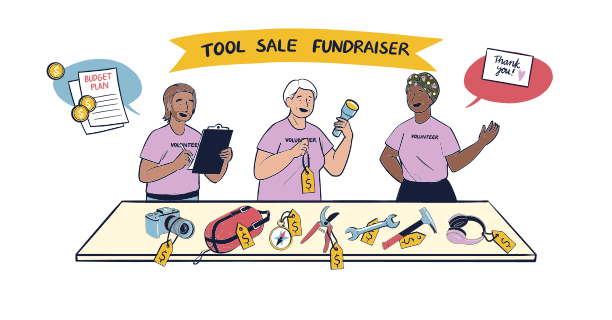
Finances can feel like the greatest barrier to creating and running a successful Library of Things. This section breaks down key aspects of LoT finances, including fundraising and grant writing, to demystify and guide you through the process.
Chapter 1: Income generation and operational budgeting
Making and sticking to a budget may be the most daunting part of running your Library of Things—but if you spend time planning, find the right system, and take it step by step, it’s totally achievable. This section covers some of the basics.
Operational budgeting (seed to sustaining)
Expenses
Before gathering funds, you need to create a budget and do your best to understand where that money will go.
1. Reflect on your mission and vision. What is the most important thing for you to achieve?
2. Narrow your spending goals to focus on what you absolutely must do.
3. Consider the timing of different steps:
- Will you need to begin paying rent before you buy inventory items?
- How much will you need to spend before money starts coming in (e.g. membership dues, donations, and grants)?
- Timelines are very important for grants, which often have spending deadlines and reporting obligations with their own due dates.
4. List the big categories of expenses you can anticipate. Often, they are:
- Space
- The physical space for your library (obviously) but also any overflow storage or event space you might need
- Repairs and maintenance (if they’re your obligation)
- Signage, storage, and organization
- Property insurance
- Utilities
- Operations
- Liability and event insurance
- Website hosting
- Internet
- Phone line
- Software licenses (e.g. inventory, project management, payment platforms)
- Point-of-sale system
- Credit card processing fees
- Professional services like bookkeeping or legal review of business documents (including leases)
- Printing and mailing flyers, posters, stamps, and thank-you cards
- Fiscal sponsorship fee (if you have a fiscal sponsor). This is generally based on 5-15% of your LoT’s income.
- Inventory
- Try to predict what you will buy versus what may be donated. You can also start with donations and then draft a purchasing wish list.
- Be sure to also budget for repair and replacement based on what you acquire.
- Other physical things
- Furniture (desks, chairs, meeting table)
- Laptops, tablet computers, or other devices for use in the LoT
- Markers, printer paper, and other office supplies
- Events
- Events may be for outreach, volunteer appreciation, fundraising, or just fun, but they will all cost money!
- Even if you plan to raise money through an event, be sure to budget for what it will cost you to put on.
- People
- You might not have paid staff yet, but if you’re planning ahead, think about roles that would benefit from dedicated hands, even if they’re part-time. [See Section 3 on Operations for more about the costs of paid staff.]
- And don’t forget about your unpaid staff too! Be sure to budget for volunteer and committee snacks, meetings, and appreciation. You can also track the value of volunteer labor with a standard hourly rate (as of 2026, the estimated value of volunteer labor in the U.S. is $34.79/hr.). This is often helpful in future budgeting for staff and when applying for grants.
Income
Once you’ve figured out what you need to spend money on, focus on where you’ll find funding for it. There are two major categories of income you can plan for: earned income and charitable contributions.
Earned income: This category includes anything you bring in as part of a sale or transaction, including:
- Membership payments or donations
- Check-out fees
- Fees for late returns and repair/replacement of borrowed items
- Sales of t-shirts, stickers, and other “swag”
- Sales of donated or excess inventory items [See the Tool Sale case study in Chapter 1 of Section 7 for one example.]
- Workshop or class registration fees
- Ticket sales to events
- Contract revenue (when your organization is hired to do something like consult)
Charitable contributions: This encompasses everything given as a donation or grant where the donor doesn’t get anything tangible in return. In the U.S., these donations are generally tax-deductible.
- Individual donations: Gifts of cash/cash equivalents given from a person or family, usually unrestricted
- Restricted grants: Designated for a specific purpose and/or time, restricted grants usually may only be spent on a limited, pre-approved budget and usually have a deadline for spending and reporting.
- Unrestricted grants: These funds are available to be used how and when the organization needs them, usually within a limited timeframe and with reporting requirements.
- Sponsorships: Often, these aren’t technically grants, but may come with agreed-upon marketing, employee volunteerism, or other “intangible” benefits for the sponsor.
- In-kind donations: These are donations of physical things, often LoT inventory items or food/drink for an event. (They are accounted for differently—make sure your bookkeeper has a plan!)
Fundraising events: These might incorporate multiple revenue streams, including ticket sales, raffles or auctions (in the U.S., be sure to check your state’s charitable gaming licensing and requirements!), and a request for donations. When providing tax receipts, be sure to consider whether all or part of a transaction includes the donor getting something in return (e.g. the value of a meal would be deducted from the overall cost of a ticket to determine the amount that counts as a donation).
Other budgeting considerations
Once you have a balanced budget, there are some important things to keep in mind for success.
Don’t over-rely on any one source of income. For example, it’s easy to burn out your donor base if you’re leaning too hard on individual donations—this can get especially tricky if your primary donor base is also paying membership fees.
Be prepared for the work required after getting a grant. Be sure you understand the reporting requirements—including restrictions on how and when the grant can be spent. You don’t want to have a final report due and realize you haven’t tracked a key metric all along!
Make sure that you’re on the same page with business sponsors and follow through on expectations about including their logo, promoting the donation, etc.
Ensure you have an experienced Treasurer on your board and create systems for tracking expenses. At the end of the year, you want to look back at your budget and compare it to reality so you can plan the next year. (Many organizations do semi-annual or quarterly budget re-forecasts to ensure they are on track with their annual budget.) Even if you have a fiscal sponsor handling your books, it’s important to have internal systems for managing spending and keeping track of expense receipts so everyone has the full picture.
Establish policies and practices for tracking and acknowledging donations, handling reimbursements, tracking petty cash, budget creation and regular review, discretionary spending caps (i.e. at what money amount does someone else need to approve a purchase?), and, ideally, savings plans.
Check with your insurance provider about what kinds of annual reporting you’ll need to do. You will likely need to resubmit a value estimate for your LoT inventory at a minimum. Your agent can advise you on estimating depreciation or the amount each item loses in value with time and use.
Start-up and growth
Your budget for the first year will probably look different from every year thereafter! Some common sources of start-up funding are:
- Grants: One of the most common sources, in part because grantmakers tend to prefer new projects and initiatives. Grants can come from governments, private foundations, families and individuals, and companies. Keep in mind that grants may take a while, and you might not get the same grant every year—or even twice!
- Fundraising events: These gather supporters (and future members) and build momentum and excitement, but you might not net much income after accounting for event expenses.
- Crowdfunding campaigns: These fundraisers are generally aimed at individual donors within your network and/or people who are or will benefit from your LoT. They should have a set deadline and a clear pitch for what you’re raising money to do. This could be adding items to your LoT, offering new programming, buying a building, etc. They often include gifts for donors who contribute at different levels. This can make it more fun and encourage people to give.
- Pre-sales: This can include pre-paid memberships (standard annual or one-time lifetime membership), naming rights, or other perks for early supporters. This can be part of an event or crowdfunding campaign, too!
Planning ahead
It might be intimidating to look even a year ahead when you’re not sure how things are going to work out, but making a rough multi-year budget can help you identify which costs will recur or rise (e.g. if you have a multi-year lease with an escalation schedule), which costs are one-time, and how you might pay for future staff, events, expansion, etc. As you develop strategic plans, make sure you’re also aligning your budgets to meet those goals.
Fundraising basics
The first step in fundraising is to clearly define what you’re raising money for.
Spend time developing a brief “case for support” that answers the questions:
- What are we aiming to achieve?
- Who is involved?
- What are the steps to get there?
- What will be different when we accomplish it?
- How will we know we’ve succeeded?
- How much does it cost?
Once you’ve defined your goals and budget, develop a funding plan.
- Gather a committee! Different strengths lend themselves to grant writing, individual outreach, and events. Cover your bases with a group.
- Look at your budget. What are the big categories? (e.g. inventory items, rent, food for meetings)
- How much are you expecting to get from earned income? Budget conservatively if it’s your first year, but don’t forget about membership and other built-in revenue sources.
- Set clear, specific goals to match potential money to identified needs. Allocate earned income to things that are harder to fundraise for, like operational costs. Focus your fundraising efforts on what’s left, especially physical inventory, public programs, and other expenses that people might be more excited about helping to pay for.
Now it’s time to find funding!
- Research local foundations and companies. Who would want to see an LoT thrive in your city or town?
- Think about the kind of people, organizations, companies, and foundations who might share your excitement, based on your case for support. Who has the same goals?
- Research who is funding work similar to yours, using websites and annual reports.
- Make specific prospect lists. If you think local businesses might donate, generate a directory of names and contacts. Think about individual people who are involved or have expressed enthusiasm and might be able to give larger donations.
- Ask your organizing team, volunteers, and even members who they know. Fundraising is all about relationships! Many larger employers will match employee donations or have corporate grant programs. Volunteers may have wealthy family members or connections to foundations.
Create a tactical fundraising plan. Make a document outlining where you plan to apply, your goal/ask, when the deadline is, how much you might raise from that source, and when you’ll know. Here’s an example:

Once your fundraising goals and plans are in place, ensure everyone involved has a clear task and the resources to tackle it. Regular check-ins can help the team stay on track, share progress, and troubleshoot any hurdles together.
Face your fears. One of the most common reasons that fundraising efforts fizzle is that people are afraid of asking for money. Here are some tips for getting your team feeling more positive:
- Remember, you’re not asking for yourself. You’re asking on behalf of every future LoT user! Keep the goals in your case for support in mind, and how much you need to raise in order to achieve them.
- Think back to the last time you donated to a great cause that you believed in. How did you feel? Almost everyone will say “great!” Altruism and philanthropy are good for our sense of self and community.
- Soften the ask if you’re unsure about the answer. Use the phrase “Would you consider…?” instead of “Please…”
- Remember, the worst someone can say is “no.” If you’re really worried that the fallout could be bigger than that, you might not be the right person to ask this donor.
Get the word out! Often, in fundraising, volume is key, and trying a variety of approaches can help you figure out what works best for your LoT. Below are some fundraising methods that have worked for others, along with some key tips to help you break through the noise and reach a lot of people with your new, compelling case for support.
- For grant writing, create a master document with all the grant language and statistics you might need. Then you can copy/paste and tailor what you need for each proposal. Spend time reaching out and building relationships with potential funders (don’t skip this step!), then submit, submit, submit. You won’t get every grant you go for, so apply for much more than you’ll need.
- For individual donations, plan a crowdfunding campaign and recruit energetic volunteers and members to help grow your network. Also, make direct requests to specific people with money and/or known to be generous donors in your community (really, you can do it!). General asks on social media or websites are far less effective than a one-to-one appeal.
- Have your team plan low-lift fundraising events with local bars and restaurants (e.g. where a percent of proceeds is donated) that can help build awareness while also raising a little money.
Regardless of your specific strategy, one of the most important things you can do is pare down your case for support to create a clear, compelling elevator pitch with images.
Summarize what you want to do in a few sentences and pair them with photos or graphics of real people. This could be a slide deck, handout, or webpage.
Plan now for follow-up later. Note that nonprofits in the U.S. are legally required by the IRS to send a written acknowledgement of donations $250+ (an email is fine!). Most online donation platforms are set up to send these automatically to all donors, but you will most likely need to send recognition manually for cash, checks, and in-kind donations. If you want to keep your donors year over year, make sure you have a plan for thanking them and keeping them in the loop! Here are some ideas:
- Handwritten cards, even with a very short message, go a long way.
- Having volunteers make thank-you calls together can also be a fun team-building event. Consider a “thank-a-thon” night once or twice a year, or after a big campaign.
- Regular emails to donors are almost always appreciated, even a mass send. Be sure to include pictures so people can visualize the “what is/will be different” part of the goals they supported.
- Remember that grantmakers are people, too! Especially if you intend to apply again, include your program officer or other contact in your donor communications to ensure that they see more detail than just the required reports.
NE Seattle & Shoreline Tool Library tool sale fundraiser
This section is a case study of the NE Seattle & Shoreline Tool Library Tool Sale (which regularly raises thousands of dollars!), including the benefits, history, model, pricing, and advertising to help plan your own sale.
History
Seattle REconomy (SR) began hosting tool sales in 2017 to keep excess donations from ending up in landfills. What started as an informal way to manage surplus has since grown into a signature fundraising event. While early sales yielded under $1,000, SR’s investment in better promotion and volunteer coordination saw returns grow to a steady $5,000 per sale. By 2023, through more intentional donation drives and dedicated storage, SR raised $20,000 across two sales. This model continues to serve as a significant and reliable source of revenue for the organization.
Tool sale model
Accept all working, non-gas-powered tools. The only exception might be ones that take up too much space and don’t sell for much.
Get all volunteers involved. SR averages 40 to 50 people helping in some capacity. This can include contributing bake sale items, helping with organizing, being a cashier, or helping to direct event attendees.
Sort all the tools the night before and lay them out on tables or in bins so they are easily stackable and sortable. If you are in a rural area, you may be able to simply cover tools up overnight with tarps. For urban areas, you could utilize a box truck for storage and pull it all out early.
Attendees move through the tool sale in a line, where everyone tracks through the same path, making the flow simple and encouraging everyone to see nearly every item.
Utilize email lists, social media, online advertising, signage, and in-person reminders. Anything that encourages word of mouth is extremely impactful.
Keep it simple and focus on the tool sale as the main event. Tables for the community to sign up for membership or volunteering can be helpful additions. SR has also conducted tours of their tool libraries to engage with first-time visitors.
SR’s tool sale is a one-day event from 9:00 AM–3:00 PM, twice per year. For local weather, late May and late September have worked in the past to best avoid the Seattle rain, while keeping it spread out throughout the year.
Make all offers accepted on a donation basis and all sales final. While the pay-what-you-can pricing model might not work for some LoTs, it has several benefits:
- Saves time because you don’t need to price every single tool
- People tend to give more because they enjoy donating to charity
- Usually sells out, and most leftovers can be donated or recycled
Benefits
Large sales, like tool sales, have several benefits, including:
- Supports the environment by keeping items out of the landfill and encouraging principles of reuse
- Helps people avoid the downsides of buying new (e.g. packaging, transportation, monetary costs, etc.)
- Gives people an opportunity to get rid of tools—SR noticed that large donations mainly come from folks who are retiring, downsizing, or seeking places to donate collections of tools from loved ones who have passed away.
- Raises money
- Brings positive publicity to the LoT
- Generates new LoT members and volunteers
- Keeps current volunteers engaged
- Creates a fun, community-wide event that people can look forward to
Chapter 2: Fundraising (digital, crowdfunding, and in-person)
General best practices
Before you begin fundraising, make sure that you are in compliance with your state rules and regulations. In the U.S., each state has different charitable registration rules, and most of them require you to tell the state—the state attorney general, secretary of state, and/or other office—that you are fundraising. Additionally, make sure you have an entity to receive the money. [Learn more about legal structures in Chapter 1 of Section 5.]
Goals
Before you begin any type of fundraising, take the time to set clear, realistic goals. Ask yourself the following questions to clarify your plan:
- What are you fundraising for? Do you have a stretch goal in mind if you raise more than expected? How does this goal resonate with the community and get them excited about supporting you?
- How much do you need to raise? How much would you need to reach our stretch goal?
- When do you need the money? Do you need some right away and the rest later? Do you need it all at once or will it come in over time?
What will change once you have the funds? What impact will these funds have on your LoT, your community, and on people’s lives?
Storytelling
The question of “What will change once you have the funds?” is the most important piece to think about. It helps you articulate a clear vision of what will happen when you fundraise this money, which gives people confidence that their donation will create a real result.
Your story must be graphically illustrated through photos and videos. Don’t worry about fancy graphics or professional filming. Some crowdfunding research shows that videos that are less polished perform better because they allow donors to make the connection that real people are working on this project.
Focus on the positives. There are two ways to approach fundraising: deficit-based and asset-based. The deficit-based approach, which is widely popular in politics, leans into the narrative of “If we don’t get this money, horrible things will happen.” This approach is far less effective outside of politics. Instead, try to focus on the positive narrative of “When we raise this money, this amazing thing will happen.” People will be more inspired and more likely to maintain their support of your LoT because they are not constantly reminded of crisis.
Highlight previous successes. Although your story should be about the future, pointing to previous successes proves to investors that you know what you’re talking about and that you will be able to use their money effectively. Try to give specific, impactful examples.
If you don’t have previous successes, remember that people give to people, not organizations. People don’t get excited about an abstract budget. They care about helping someone or something. Bring up specific examples of ways that the money you are raising will impact people’s lives.
Platform and logistics
Once you have your story, your clear pitch, and some simple visuals ready, it’s time to plan the logistics.
Think about how people will actually give you money. You will need an online platform that is easy for you to set up and easy for donors to use. Givebutter is a good example. It’s free, simple, and looks nice on both computers and phones. There are many others out there, like Indiegogo, or your local donation processor. The exact tool you choose matters less than whether it’s user-friendly, looks trustworthy, and does not add extra costs for your donors or for you.
Your donation link can take many forms. For example, you could set up any of the following:
- Crowdfunding page where people can join teams or fundraise together
- Simple donation form for everyday giving or a specific cause
- Giving page linked to an event, where people buy tickets or RSVP, and give extra if they are able
- QR code in your space that links visitors straight to your online form
Most gifts happen online, but many donors still write checks or send funds by other means. Try to diversify your accepted gift types and be ready for anything.
Checks, specifically, can be helpful to avoid fees (e.g. online processing fees or credit card fees), so it’s important to provide clear instructions for where to send a check, especially for larger gifts. If someone drops off a check, take the chance to thank them in person or send a handwritten card.
If you sell tickets for an event or sell merchandise, always include an option for people to add an extra donation because many will. Finally, thanking your donors is critical!
Plan ahead for how you will recognize and thank people:
- Ask donors if they want to be recognized publicly or stay anonymous.
- Decide who will send thank you emails and cards, and do it promptly.
Bonus
If you are running a specific campaign with a clear goal and a deadline, such as a capital campaign or a short-term crowdfunding effort, there are some strategies that can make it more engaging and encourage donations. Having a defined goal and timeline helps people understand the impact their gift will have. This might be for something large, like purchasing a building, or something smaller, like adding inventory items to your library.
One of the most effective fundraising strategies is a challenge grant. When speaking with major donors, ask if they would like to pledge to match donations up to a certain amount. For example, a donor might promise to match every dollar raised up to $10,000. Or you can set a challenge where, for example, if you raise $50,000, an additional $10,000 will be unlocked from a matching donor. This typically motivates folks to donate, as their gift could go even further, and creates urgency, as the match offer is typically time-bound in some way.
Other incentives can work as well, though they tend to feel more transactional. While they can raise funds, they may not build long-term loyalty with members and supporters. Some typical incentives include:
- Prize drawings or raffles where every donation is an entry to win items like handmade gifts
- Donors-only swag gift, such as stickers or tote bags
- Public recognition by adding donor names to a wall, brick, or other visible space
- Friendly competitions among your fundraisers (e.g. awarding a gift card to the volunteer who raises the most money)
Bonuses like these can make your campaign more fun and lively. Just be sure the main focus remains on your mission and the impact you are creating.
Delegating
Whether or not you’re crowdfunding or running a digital or in-person fundraising campaign, you need people to help you. While you can start by reaching out to your own network or email list, involving more people multiplies your reach and impact. The more people you and your team engage, the more personal and compelling the ask becomes.
To set your team up for success, provide them with a comprehensive fundraising toolkit. This should include templates and resources that they can adapt. Afterward, train them on your strategy and the story behind it, but make sure each team member has a personalized story that they can tell people. The Station North Tool Library has a good example fundraising toolkit to adapt.
With all this work they’re doing, don’t forget to incentivize and celebrate your team! The fundraising they are doing is crucial to the sustainability and success of your LoT, and showing appreciation keeps motivation high.
Volunteers are some of your best ambassadors when it comes to fundraising, too, because they’re already giving their time, and they know how important your LoT is and are invested in its success.
When building your fundraising team, it’s important to provide clear options that suit different levels of commitment. A handful of folks may want to go all out in ways to help you, whether that means putting together a raffle or creating multiple social media posts throughout the month. Many other folks might want to support you without taking on major tasks, such as donating raffle items or sharing a post. It’s helpful to meet people where they are by giving people concrete ways to opt in that are still meaningful.
Making the ask
Asking for money can be daunting, but thinking about how people feel after giving can frame this ask in an entirely different light.
Think about how you felt the last time that you gave to someone or something that you care about. Did you hate it or regret it? Never. Did you feel proud to contribute to something that made a positive difference? Absolutely!
Everyone is happy to support something that they care about. It’s crucial to remember that you are not taking anything from anyone. Instead, you are giving them the opportunity to have this great feeling while supporting a project they appreciate.
Fundraising methods
There are many different ways to go about fundraising. Try a variety of approaches and see what works for you and your team.
Posting on social media and asking for donations does not usually work. People are exposed to so many fundraising messages online that these kinds of posts often get ignored.
Mass emails, such as newsletters focused on fundraising, act mainly as reminders for people who were already planning on giving.
Direct email to someone you don’t know that is slightly edited to seem personal (e.g. mass-merged emails that come from your email address) will be a little bit more successful.
Personal emails to a select group of individuals you know closely with a specific ask is going to be one of the best things you can do.
Finally, asking in person is always the best method. While it might feel awkward, it is very similar to sending an email. The worst thing they can do is say no. Throughout this interaction, remember that you are asking on behalf of your community, not for yourself. This perspective can make the ask feel easier and less uncomfortable.
Be specific
Specificity is the soul of fundraising, so be sure to provide details about:
- The amount you’re raising and why (itemize if possible). For example, “Of our $30,000 goal, $10,000 is going to go to new tools and repairs.” This encourages people who really care about borrowing new tools to contribute.
- What the money will be spent on, and how much each dollar amount will accomplish. For example, a gift of $25 covers a replacement battery, and $50 covers materials for a community workshop. People want a sense of exactly what their money will do so they can feel confident their contribution is meaningful. Note that these examples are representative of typical costs your LoT incurs; unless a gift is specifically “designated” (usually reserved for major donations), funds are generally applied where the need is greatest at the time.
- The amount of money you’re asking for. For example, telling someone that if they have $50 to contribute to your campaign, it will cover a scholarship to one of your workshops so that someone who cannot afford to attend your workshop can do so. There’s a psychological phenomenon that when people have to make a choice, especially a choice about something that has a social impact, they question whether the amount they’re giving is enough. Within this idea, you could offer a few options, such as $25, $50, or $100, and explain what each amount will accomplish. This approach makes giving feel more meaningful and helps donors choose an amount that fits their ability.
If you don’t have previous successes to speak to, that’s okay. Instead, you could lean into the specificity of your vision or highlight your team. Both of these will give people a similar sense of confidence that reminds them that you have a well-thought-out plan and a solid team that is going to help you accomplish your fundraising goals.
Digital campaign options
Pairing events with online donations
One effective approach is connecting donations directly to an event. Platforms like Givebutter allow guests to add a donation during their ticket transaction. Some LoTs find that offering free drinks or activities encourages giving, as donors feel they are receiving a “fun experience” in exchange for their support. This method also captures attendee emails for future outreach without the friction of a manual sign-in sheet. However, be mindful of your overhead; ensure that the “fun” doesn’t cost more than the donations it brings in by strategic budgeting for your event and tracking the net proceeds.
Annual crowdfunding campaign
Online giving is made more challenging with changes in the economy, the growing wealth gap, and demands on people’s time, money, and attention. Regardless, clear goals and strong teamwork can still bring good results. Some groups run one larger, annual crowdfunding campaign.
Here are a few tips to run a successful annual crowdfunding campaign:
- Ask your LoT community members (e.g. board members, volunteers, instructors) to set their own goals on the crowdfunding page. They will then be encouraged to reach out to their own communities to get donations. This personal connection makes a big impact on reaching the fundraising goal.
- Give people updates on your fundraising. This excites folks and can sometimes encourage others to donate more.
- If you are able to allow comments on your fundraising page, make sure you do so and interact with people. It helps highlight your LoT as a personable organization that listens to its community.
- Set goals specific to the services the community is most interested in so that folks with different involvement with your LoT can get invested in your fundraising efforts.
- Be transparent about your budget so donors trust where their money will go.
Permanent donation page
Not every digital campaign needs to be a big push. Some LoTs keep permanent donation pages linked by QR codes inside their space. It is less of a campaign and more of an ongoing online donation option where people can give a donation that is directly linked to how much they use your space.
Startup crowdfunding with perks
When launching an LoT, a startup campaign can help cover high upfront costs. LoTs often use sites like GoFundMe, Indiegogo, or Kickstarter.
Crowdfunding campaigns can stand out with:
- Several videos and compelling visuals
- A simple, strong tagline or mission statement
- Perks like lifetime memberships and thank-you events
With any campaign, but with startup campaigns specifically, you should think about what you will do if you do not meet your goals. This is especially true for grant makers. While the answer is situationally dependent, make sure to stay positive and directly acknowledge what your plan will be if you don’t reach your goals. This may mean you’ll have money to start the process or that you’ll have to plan another fundraising campaign in the future.
Emergency or crisis fundraising
Sometimes, an LoT needs urgent support just to stay in operation. Even though it is difficult to keep that type of message positive, it’s important to be honest about the situation and clearly explain how donations can keep your LoT’s doors open. You should also prepare a stretch goal in case you surpass your goals, which will state what you plan to do next.
Fundraising reflection questions
- What is your community’s capacity to give?
- How much have you been able to raise in the past?
- How many large gifts can you count on?
- What will your funding mix be (e.g. grants, sponsorships, crowdfunding)?
Buffalo Tool Library crowdfunding example
When the Buffalo Tool Library set out to purchase its own building, they didn’t just launch a fundraiser—they launched a $500,000 capital campaign. By the time they went public with their crowdfunding appeal, the “quiet phase” of their campaign had already secured over 50% of their goal. By leveraging board engagement and strategic donor outreach early on, BTL transformed a massive financial hurdle into a community-wide victory.
Chapter 3: Earned revenue streams
Earned revenue is typically more stable and can help a Library of Things build financial sustainability beyond grants and donations. This section highlights key revenue streams like reuse materials stores, bike shops, program stipends, super tools, and merchandise.
Reuse Materials Store (Shoreline Tool Library)
The Shoreline Tool Library in Shoreline, Washington, U.S. (part of Seattle REconomy) operates a 1,000-square-foot Reuse Materials Store (RMS) alongside its LoT, generating consistent earned income for the organization. Four shipping containers provide additional storage.
Sourcing items
All inventory is donation-based. All items offered through the RMS are donated, with donations arriving consistently. The RMS accepts all working tools that have all their parts, are not gas-powered, and are not overly rusty. Accepted materials vary depending on demand and space. See details here.
Pickups are available for larger donations. A van allows staff to transport large loads, and while there is no fee, donations should be valued at $100 or more to ensure staff time and transportation resources are used effectively.
Businesses and government agencies contribute bulk materials. These donations often include high-quality or specialty items, helping to divert surplus materials from landfills.
What is available
The Reused Materials Store offers a variety of items beyond building materials, including surplus or oversized tools not suitable for the Shoreline Tool Library, garden equipment, consumables like nails and sandpaper, and household goods such as dehumidifiers and air conditioning units. Occasionally, miscellaneous items like chairs are also available.
Tools represent the largest category by value. Tools tend to be higher-value items, so while they may also be among the most numerous items, their individual value means they generate the most revenue. For example, selling a single $200 tool can bring in more income than selling dozens of low-cost consumables.
Other inventory categories include items used for woodworking, painting, and electrical tasks, as well as lumber and household goods. Niche categories such as plumbing and electrical parts tend to have lower sales. This is likely because customers needing specific parts often prefer to visit hardware stores, since the donation-based inventory does not always have the full range of items they require. The Shoreline Tool Library continues to increase the RMS selection of these niche items and encourages customers to consider the store as their first stop for shopping.
Selling items online
Sales occur both in-store and across multiple online platforms. Items are listed on:
- Facebook Marketplace (primary source of clicks, views, and messages)
- Craigslist (better for some older or higher-priced tools)
- The store’s website (to serve members in a familiar space)
- OfferUp (mainly for household items)
Online sales focus primarily on higher-value items, leveraging the ability to reach the right buyers to maximize income. There is an added benefit to posting sale items online: many people have come in for a specific item, then purchase additional items once at the store, or have joined the LoT after seeing what it has to offer.
Challenges and limitations
Space constraints in the store present a major challenge. To address this, a pricing gun is used to label items with the exact date they were priced and shelved. This replaced a previous system of color-coded pricing, which relied on memory and was less precise. The pricing labels help staff decide whether items should be moved to storage, set aside for tool sales, or have their prices lowered, maximizing valuable shelf space and visibility.
Online marketplace sales come with their own challenges, such as managing inquiries from potential buyers who may not follow through. To mitigate this:
- Holds are not offered for online items. This policy avoids lost sales caused by buyers who commit but do not show up, ensuring items remain available for other interested customers.
- Payments are not accepted online prior to pickup, though the RMS is looking into this as an option.
Income statistics
Income from material sales fluctuates month to month, influenced by factors such as seasonal demand and the timing of special sales events, which affect customer traffic and purchasing patterns.
The volume and quality of donations also play a significant role in revenue generation. Higher-value items typically bring in more income, especially when combined with effective online sales channels.
Additionally, business-to-business (B2B) sales of bulk donations provide an important supplementary revenue stream beyond individual customer purchases. Tracking income trends alongside these factors can help guide strategies to optimize sales and revenue.
Bike Shack (Shoreline Tool Library)
The Bike Shack is a community bike workspace and a resource available to Shoreline Tool Library members. It occupies approximately 200 square feet in one corner of the tool library, including a work area with a bike stand and a sales area that holds around 15 bikes at a time. Most items and bikes come from donations received from individuals, local organizations, or businesses. Additional bike storage is provided in a nearby storage container.
What is offered
The Bike Shack provides a workspace for members to use a bike stand and repair tools. Knowledgeable volunteers assist by offering guidance, teaching repair skills, or performing repairs on behalf of members. Members can:
- Use the space independently with volunteer oversight
- Receive instruction on bike maintenance
- Have volunteers complete repairs when needed
A suggested fee of $20 per hour applies for bike stand use, in addition to the general Shoreline Tool Library membership fee. This follows a pay-what-you-can model to ensure accessibility.
The Bike Shack stocks basic new and used parts, such as tubes, tires, cables, and salvaged parts for future repairs. It also sells refurbished bikes and offers bike maintenance classes as part of its broader educational program.
Sourcing items
Almost all items come from individual donations accepted in person at the tool libraries (Seattle REconomy has two tool library locations). Some donations are received from local organizations or businesses.
Income statistics
The Bike Shack generates income primarily from bike sales, bike stand usage, and parts sales. Bike sales account for the largest portion of revenue, followed by fees for bike stand use. Since opening in April 2024, income has steadily increased. This growth aligns with an uptick in bike donations and active promotion on social media channels. Seasonal patterns influence activity, with slower revenue during winter months. There are ongoing efforts to maintain consistent engagement year-round and expand volunteer capacity to support growth.
Challenges and limitations
Several operational challenges affect the Bike Shack:
- Inventory management: Maintaining up-to-date listings on online marketplaces is time-consuming due to frequent inventory changes and volunteer involvement.
- Volunteer guidelines: Setting clear limits on what repairs volunteers should perform versus what to scrap.
- Volunteer recruitment and involvement: Attracting and retaining skilled volunteers is an ongoing challenge. Current staffing limits are a barrier to more open hours.
- Fee enforcement: Ensuring members understand and comply with the suggested stand time fee requires continuous reinforcement with both volunteers and members.
- Parts inventory: The Bike Shack stocks basic parts but keeps a lean inventory to manage overhead. Customers requiring specific or uncommon parts are advised to source them independently.
- Seasonality: Usage and sales drop during winter months, impacting volunteer workload and revenue. Efforts continue to maintain activity during slower seasons.
- Storage space: Bikes require significant storage capacity. The Bike Shack has a hanging bike storage system in a container that can hold approximately 100–150 bikes, alleviating space constraints.
- Disposal: Non-repairable bikes are either scrapped for metal or donated to other community bike programs that handle recycling or redistribution.
Program stipends (Repair Café)
The Buffalo Tool Library’s Dare to Repair Café program brings repair services directly to communities through mobile events hosted in libraries, schools, and community centers. Volunteers work collaboratively with participants to diagnose and repair items, teaching valuable skills while reducing waste and building community.
Program growth and sustainability
The Dare to Repair Cafés started in 2017 as a volunteer-led effort. The program grew to monthly events supported by a part-time coordinator hired in 2023. To support financial sustainability, host stipends are set on a sliding scale according to an organization’s capacity. Groups with budgets under $250,000 contribute $500, while larger organizations pay $1,000. This revenue covers on-site expenses like materials and refreshments, though it excludes the cost of planning and administration.
Funding sources
Host organizations fund the stipends through various channels, including:
- Local public library programming budgets
- On-site business partnerships, including employee engagement through volunteerism
- Government grants and elected official sponsorships
- Statewide initiatives
Challenges
Program stipends currently cover a portion of overall costs (projected $6,000 of $45,000 annual expenses), so grant funding remains essential.
Balancing equitable access with earned revenue goals requires flexibility. Events proceed even if organizations cannot afford stipends.
Introducing fees can impact relationships, so transparent communication and ongoing collaboration with host organizations are critical.
Super Tools
Some libraries choose to designate certain high-value items as “Super Tools,” which can generate additional income to help cover maintenance costs and create a dedicated budget for purchasing new tools. These tools typically have a higher borrowing fee than standard items due to their purchase cost and maintenance needs.
For example, the Buffalo Tool Library defines a Super Tool as any item that costs the organization more than $500 to acquire. They charge $20 per day or $40 for an extended weekend, which means the item is checked out on Friday or Saturday and returned the next open day (Wednesday). In 2024, this program generated about $2,800. While not a large percentage of overall revenue, these funds directly supported repairs and the purchase of new tools.
At the Buffalo Tool Library, there are currently about 10 Super Tools within a total inventory of 4,500 items. This limited number ensures that the majority of the collection remains affordable and accessible for members. Examples include an infrared paint stripper, pavement breaker, jackhammer, thermal imaging camera, benchtop planer, full-sized carpet cleaner, and battery-powered generator.
Challenges
One of the defining characteristics of LoTs, compared to tool rental businesses, is their commitment to accessibility and equity. Adding extra fees to borrow a Super Tool can introduce barriers for some members. Although few people may openly say they cannot afford the extra cost, there will inevitably be cases where it affects access. LoTs need to decide in advance how to handle these situations to avoid excluding community members.
Another challenge is defining what qualifies as a Super Tool. A tool’s purchase price is not always the determining factor. For instance, an LoT may have multiple $800 HEPA vacuums acquired through grant funding for a lead-safe borrowing program. These remain free to borrow for anyone who completes the required training because the goal is to remove financial barriers to community health and safety—plus, grant terms often prohibit charging extra for equipment meant for public benefit. In contrast, an $800 item purchased outright by the library might be designated as a Super Tool with an additional fee to help recover its cost. Without strict rules, these decisions often come down to internal discussions about what feels fair and aligns with the LoT’s mission.
Merchandise
Merchandise can be a modest earned revenue stream and a powerful marketing tool. Branded items turn members into ambassadors, serve as thank you gifts for donors and volunteers, and spark conversations that raise awareness about LoTs.
Merchandise ideas
Successful programs mix apparel with smaller items and maker-made goods. Popular choices include T-shirts, hoodies, tote bags, stickers, coasters, and keychains. In-house production using a laser engraver or 3D printer can lower costs and showcase the LoT’s maker capabilities, provided items have a clear purpose and avoid unnecessary waste. Merch ideas include:
- Apparel: T-shirts, hoodies, and beanies are visible, higher-margin items
- Low-cost items: Stickers and tote bags are impulse purchases and conversation starters
- Maker-made goods: Laser-engraved coasters or 3D-printed small items that highlight in-house skills
Best practices
- Volunteer-first access: Reserve new releases for volunteers as a thank you and to generate authentic user photos for promotion
- Event alignment: Launch merchandise alongside major events or fundraisers to increase visibility and on-site sales
- Cost accounting: Track production, fulfillment, and overhead per item so gross sales translate into net revenue
- Quality and purpose: Prioritize durable, useful items to avoid producing low-value or wasteful products
- Local sourcing: Work with ethical, local vendors when possible to improve quality and build community partnerships
- Simple promotion plan: Pair each drop with basic outreach (email, social posts, volunteer-shared photos) to drive awareness
Chapter 4: Grants
Libraries of Things are more than just tool sheds; they are vibrant hubs for sustainability, connection, and community resilience. This chapter focuses on identifying, applying for, and managing grants, while leveraging partnerships, data, and storytelling to strengthen your impact.
The power of grants
LoTs act as catalysts for community transformation. By lending items and hosting hands-on workshops, they:
- Reduce waste and promote environmental stewardship
- Strengthen community resilience and skill-sharing
- Provide affordable access to essential resources
By demonstrating these clear benefits, your grant applications show how an investment in your work contributes to a sustainable future.
Preparation
Goals and alignment
Before searching for funds, you must understand your core mission. Define your goals—whether they include community engagement, program expansion, or staff benefits—to ensure partnerships align with your values.
Clear objectives can help you guide the grant search and help you secure the resources specifically for those goals. For example, while your aims might include community engagement, program expansion, and staff benefits, you must also remember that operational costs are essential too. When funders do not align perfectly with your goals, consider adapting your communication strategies to highlight the impact and value of your work.
If you have clear goals, know your values, and practice patience, grants and strong partnerships can help you succeed.
Information gathering and peer support
Don’t hesitate to reach out to similar organizations for advice and recommendations. Those who have already navigated the grant process can offer invaluable guidance and templates. It is also helpful to create a basic project summary, budget, and program outline before applying. Throughout this process, seek community input to ensure your goals reflect the people you want to serve.
The checklist
It’s helpful to be thorough when beginning the grant process. There are several fundamental pieces of information that you should keep handy to set yourself up for success:
- Organizational data (mailing addresses, EIN numbers, and, if applicable, your IRS nonprofit determination letter)
- Mission/vision statements
- Team bios (Here’s a good tool to use: Purpose Driven Bio Worksheet)
- Short pitch (2–3 sentences)
- LoT user story/transformational testimony
- Latest financial statements or IRS Form 990s (for U.S. nonprofits)
In addition, having the following documents with key information at hand will help keep you organized:
- Grant website login document
- Calendar or spreadsheet for grants with due dates and funding dates
- Project-specific executive summary and/or a draft Letter of Intent (LOI)
- Your LoT budgets (project, capital versus program, funded, operational)
Save time by starting with templates and reusing language from other applications. Always proofread your work and be honest about your gaps—if technical writing or budgeting isn’t your strength, tap your network for feedback. The hardest part is starting, so pick a section and just dive in!
Identifying opportunities
Now it’s time to start looking at different types of grants. Not every opportunity will be the right fit for your LoT, depending on both your desired outcomes and a funder’s requirements. Grant types include:
- Private foundations (e.g. Ford Foundation, Kresge Foundation, community foundations)
- Corporate grants (e.g. utility providers, banks, credit unions, both big and small businesses, and formally structured foundation arms of for-profit corporations)
- Federal government (e.g. EPA, Department of Energy in the U.S.)
- State and local government (e.g. county or city solid waste, human services, climate commitments, department of commerce)
- Other (e.g. local tribes, service clubs, community groups, churches, alumni groups, unions, business services, and activist programs).
Each type of grant has varying difficulty, from applying to reporting. Make sure you consider the following so you’re more aware of how different aspects may impact your appeal or why one project may be more attractive than others:
- Regionality
- Match requirements
- Disbursement periods
- Renewals
- Reimbursements
- Registrations
- Accountability
- Training
- Retention
- Certifications
- Verifications
Search tools
When seeking grants, it’s important to have access to the most comprehensive, up-to-date information available, as funding opportunities change regularly. Fortunately, there are many free resources available that are designed to help organizations like LoTs. These resources can help you streamline the grant process and increase the chances that you can secure funding.
There are both free and paid search tools available. On free and paid grant databases, you should be able to search by region, funding amount, and previously funded projects.
Free resources update frequently and vary from region to region, but below are some national programs that other LoTs are familiar with:
- Grants.gov for federal grant opportunities
- Foundation Directory Online, now part of Candid—look for free access through your local public library
- Candid news digest (Philanthropy News Digest), subscribe for frequent updates
- Letters of support from city, state, county, and regional Departments, Divisions, Delegates, etc.
Paid resources can be a good option once you become more comfortable navigating similar databases. Examples include:
- GrantStation
- Instrumentl
- GrantWatch
- GrantScape
- Grant Gopher
- Grant Forward
- TechSoup for software, hardware, and other discounts for nonprofits
Partnerships
Partners are essential for successful grant applications. They often provide an additional connection to the communities that a specific funder aims to uplift and can fill gaps in your LoT’s capabilities to amplify your impact. Municipalities, schools, and nonprofits with past experience with grants can also provide valuable references.
Funders are also future partners. If you maintain a long-term relationship with them, they might be willing to continuously invest in your projects. These relationships can be more hands-on or hands-off, and they can even be mutually beneficial. Ultimately, a good relationship with a funder can lead to sustained funding and long-term projects—transforming lives and communities.
Alphabet soup of grant jargon
Navigating grants also comes with lots of technical jargon. These are some common terms used in the U.S.:
- NOFO stands for Notice of Funding Opportunity. It is a publicly available document used by federal agencies to solicit applications for a specific grant program.
- RFP means Request for Proposal. It is a document that solicits proposals from potential vendors or service providers for a specific project or service.
- SAM refers to the System for Award Management. It is the official website of the U.S. government, where entities must register to do business with the federal government.
- UEI stands for Unique Entity Identifier. It is a 12-character alphanumeric ID assigned to entities registered in the SAM system, replacing the previous DUNS number as the primary means of entity identification for federal awards.
- LOI stands for Letter of Intent / Inquiry / Interest. While these terms differ slightly, they all serve as a “pre-application.” A Letter of Intent or Inquiry is typically a brief, required overview used by foundations to screen projects before inviting a full proposal. A Letter of Interest is often less formal, used to introduce your LoT to a funder and see if your mission aligns with their current giving priorities.
- UBI usually refers to Unique Business Identifier. It is a number assigned to businesses for identification purposes, though the exact meaning can vary by context.
- EIN stands for Employer Identification Number. It is a unique nine-digit number assigned by the Internal Revenue Service to business entities operating in the U.S. for identification purposes. It is a business’s version of a social security number.
Crafting the proposal
Once you have identified a funder, the focus shifts to translation: taking your LoT’s vision and putting it into the specific language of the grant application. Writing a proposal is part storytelling and part technical documentation.
Build the narrative
A compelling proposal tells a consistent story. Use the “User Story” or “Transformational Testimony” from your checklist [mentioned above] to anchor your narrative. You want the funder to see the human impact before they see the line-item budget.
- The short pitch: Have a 2–3 sentence “elevator pitch” ready. Many applications ask for a brief summary—this should clearly state who you are, what you’re doing, and the specific community needs you’re addressing.
- Framing your data: You are the expert on the LoT model. Use this section to explain how your unique lending functionality meets the funder’s specific goals, especially if they are a traditional or government agency.
Create a transparent budget
Your budget is a narrative in numbers. It should reflect every resource needed to make the project a success.
- Account for the “invisible” costs: Don’t just budget for the items in your LoT. Include the software, hardware, and staff time required for the tracking and reporting you’ve planned. These often fall under “indirect” costs or administrative line items.
- Mind the gaps: Be honest about your organization’s current capacity. If budgeting or technical writing isn’t a core strength of your team, be transparent and mention how you are tapping into your network or partners for support and oversight.
Don’t reinvent the wheel
Heavily rely on written material you’ve already created for your LoT.
- Recycle language: Often, the most compelling descriptions of your work have already been written somewhere else. Look for “pre-written” language in:
- Your website: “About Us” pages or mission statements are often perfectly polished for a grant intro
- E-newsletters: Look back at your “Year in Review” emails or spotlight stories—these are goldmines for qualitative impact
- Social media: Captions from high-engagement posts often contain the most relatable, human-centered descriptions of your impact
- Past applications: Create a “master narrative” document. Once you’ve written a great response about your environmental impact or community demographics, save it! You can adapt and “recycle” this language for future applications to save time.
- The power of proofreading: Always have a fresh set of eyes look at your work. If possible, have someone unfamiliar with LoTs read it—if they can’t understand what you do, a grant reviewer might not either.
- Just start! The hardest part of grant writing is the blank page. Pick the easiest section—often the organizational history or team bios—and just dive in.
Systems
Strong data is the backbone of successful grant applications and reporting. Think of data as the story of your impact; by tracking both quantitative and qualitative metrics, you can effectively explain to the public and funders what your LoT actually accomplishes.
Building your tracking plan
It helps to think about tracking as soon as you start the grant application process (not just after you receive an award). While you’ll want to stay in sync with your grantor on their specific reporting requirements, you get to determine how to demonstrate your impact based on the data you can reasonably collect. A solid approach often involves a mix of hard data and informed estimates:
- Countable data: These are the precise figures pulled from your software or records, like the number of tool checkouts, new member sign-ups, or workshop attendance.
- Estimated impact: Other metrics might be better as calculated estimates, such as the total money saved by neighbors through borrowing or the approximate weight of waste diverted from the landfill. [See Section 8 to learn more about environmental impact tracking.]
Mapping these out early ensures your reporting is both realistic and manageable, helping you avoid over-promising or feeling like you’re playing catch-up once the project is underway.
Managing your records
Regardless of the system you choose, assign at least one person to manage your records. This ensures data is updated after every event, allowing you to accurately measure your impact over time and avoiding a “scramble” for data when a report is due. Proper tracking helps with:
- Refining future goal setting and grant success rates
- Presenting valuable feedback to your community
- Preventing missed opportunities for future potential support
Software strategy
Before submitting a grant budget, determine the cost of the software and hardware needed to complete the project; these should be included as “direct” or “indirect” costs where possible.
To facilitate effective tracking, look for tools that offer:
- Comprehensive reporting: The ability to pull data within specific time frames (weekly, monthly, quarterly)
- Technical verification: Tools that can track details like tax and payroll breakdowns, as well as more industry specific data like GIS-verified residences, non-repeating names, tonnage, and digital receipts/invoices
- Ease of use: Integration with your team and accessibility for smooth transactions
Choosing the right platforms
To facilitate effective tracking, most LoTs utilize a combination of spreadsheets and specialized software. As you gain experience, you may branch out into more complex systems for:
- Inventory and checkout management: The core of your daily operations
- Customer Relationship Management (CRM): A centralized database to track donor history and volunteer hours (Salesforce is a popular free option for nonprofits, but it is very complex and only useful if you have someone who understands how to set it up.)
- Administrative operations: Tools for grant management, web hosting, outreach, marketing, payroll, and volunteer coordination
If your LoT is a nonprofit, be sure to explore discounts through TechSoup and Google Workspace.
Framing your data
Since LoTs are relatively new, some government institutions don’t properly recognize them. For some grant applications, you may have to be more creative with how you present your LoT and intention. You may have to focus more on how the functionality of lending and the operation of LoTs may fulfill some of the specific needs of the funders in innovative and unconventional ways. While creative and adaptive thinking may present challenges, it also offers opportunities to drive meaningful change.
Getting a grant award!
Negotiating the scope (not the award amount)
Once a grant award is announced, you enter the contract phase, which often includes some negotiation of the scope of work the grant will help fund. If a funder awards you 50% of your requested budget, they generally don’t expect 100% of the original results. This is your window to align your deliverables with the actual funding provided.
It’s worth remembering that funders are staffed by people who want your project to succeed. They aren’t looking to trap you in an impossible contract; they just need to ensure the final agreement meets their reporting requirements while remaining realistic for your team. If the math doesn’t add up, speak up—this is the time to revise your outcomes to match the money on the table. Alternatively, if you’re committed to the original scope, ask the funder if you can use their partial award as a “challenge grant” to leverage additional community support. [See the Bonus information in Chapter 2 of this Section for more details.]
Clarification and support
The grant process is complex, and there are a lot of moving parts, make sure you:
- Verify with your grantor on acceptable tracking and reporting expectations.
- Ask for help as soon as a question or issue arises so you can adjust your outcomes and deliverables appropriately.
- Create a calendar with key dates so you don’t miss or exceed milestones outlined in your grant application.
- Don’t wait until the last minute to verify that you are on track to meet your goals.
- Have at least one other person you can rely on to create and pick up relationships with grantors, so that you are not the only point of contact. Identify people on your team who can support with technical assistance, revisions, and amendments.
Grant management and reporting
The grant process doesn’t end when you have been awarded the funding! Once you’ve received a grant, you will have to report on how the funds were/are used.
There are many different types of reporting in different funding categories to explore. The work you do at your LoT—putting the grant funds to good use—is the most important part. Outcomes and deliverables are the primary tools that people use to report.
Different types of grant reports
Here are a few types of reports to consider:
Financial
- Budget versus actual spending (e.g. payroll, invoices, manifests, backups, tax documents)
- Cash flow statements (e.g. receipts, manifests, and documentation backups)
- Breakdown by programs, tasks, projects, or categories
- Reimbursement (costs must be accrued)
- Verifying matched funds
- Not “double-dipping” with other cost shares
- The period for billing should be established and can be adjusted
Progress
- Milestones achieved (e.g. percentage, cumulative, usually quantitative with room for qualitative)
- Challenges, solutions, and explanations
- Audits, approvals, and adjustments (e.g. renewals, review periods, suspensions, and amendments
Final
- Overall summaries (e.g. impact, achievements, and progress)
- Lessons learned (e.g. feedback on the grant experience, grantor, and programs/projects
Tracking and summarizing
This is where your preparation pays off. By putting the tracking tools and storytelling systems you planned [see Systems above] into action from day one, reporting becomes a process of plugging in data rather than scrambling to find it.
As your project progresses, consistently update your CRM or spreadsheets and maintain your reporting/outcomes log. This ensures that when an interim report is due, you can easily articulate:
- Quantitative progress: Hard numbers on checkouts, members, and waste diversion pulled directly from your tracking software.
- Qualitative impact: The human perspective, strengthened by the surveys and testimonials you’ve collected along the way.
- Financial accuracy: A breakdown of all project-related expenses, ensuring your “budget versus actuals” stay in sync.
Final reports can be more complex, often requiring unique close-out terms or specific data verifications. Because you established an upfront understanding of these requirements before you applied, you should be able to navigate these “paperwork” hoops without getting bogged down.
Don’t forget to make your reporting process transferable. Document how you pulled your data and where you stored your stories. This ensures that the knowledge stays within the organization, allowing future team members and volunteers to understand the process and maintain the relationships you’ve built with your grantors.
Beyond the numbers
While data provides the “bones” of your grant applications and reports, storytelling provides the “soul.” Qualitative impact proves that your LoT is more than a warehouse—it is a community catalyst. Effective storytelling shows funders the human ripple effect of their investment.
Capture qualitative data in real time
Don’t wait for the final report to start gathering stories. Build a “culture of collection” within your LoT. Here are some ideas to get you started:
- When a member returns an item and raves about their successful repair or project, ask: “That’s amazing! Do you mind if I jot that down as a quote for our funder report?”
- Create a simple shared digital folder and/or a physical notebook behind the counter. Encourage staff and volunteers to record “uncountables”—like two neighbors meeting in the aisles and deciding to start a community garden, or a member who gained the confidence to start a small repair business after using your tools.
- Don’t forget visuals! A photo of a proud LoT member holding a birdhouse they built with borrowed tools often carries more weight than a data table showing 100 drill checkouts.
Surveys
Quantitative surveys tell you how many; qualitative questions tell you how well. When you survey your membership, be sure to include open-ended prompts, too. (But be mindful of the overall survey length! The best response rates come from surveys that are five questions or fewer.) Some examples:
- “How has access to these items changed your home, your budget, or your confidence?”
- “Is there something you were able to do this year that wouldn’t have been possible without the LoT?”
- “Tell us about your favorite project you completed or activitiy you participated in with a borrowed item.”
Testimonials
A testimonial is more than just a “thank you” note; it is a brief narrative that documents a transformation. While your data shows that an item was borrowed, a testimonial explains the value of that loan. Funders look for these stories because they provide “social proof” that your mission is working in the real world. A powerful testimonial usually follows a simple arc: it identifies a specific challenge a member faced and describes how access to your LoT provided a solution.
When gathering and selecting testimonials for your grant reports, look for stories that highlight the key areas of impact for your mission and fundraising goals. For a lot of LoTs, the areas below are mission critical:
- Economic impact: These stories focus on financial relief and resourcefulness. Example: “I was quoted $400 for a plumbing repair I couldn’t afford. By borrowing a drain snake and watching a tutorial, I fixed it myself for free. That’s a week’s worth of groceries for my family.”
- Social connection and confidence: These stories highlight skill-building and community-weaving. Example: “I felt isolated after moving to this city, but volunteering at the LoT helped me meet my neighbors. I didn’t just learn how to use the items; I learned that I have a community I can rely on.”
- Environmental stewardship: These stories emphasize the “circular economy” and the reduction of specialized waste. Example: “Our family wanted to try low-impact camping, but the cost of buying all that nylon and gear new was daunting…and environmentally heavy. By borrowing the tents and cooking kits from the LoT, we avoided purchasing hundreds of dollars of ‘fast-fashion’ outdoor gear that would have sat in our attic for years. It taught our kids that you don’t need to buy a bunch of new things to enjoy nature.”
Permissions
Always treat your community’s stories with respect. Even if someone gives you verbal praise, ensure you have a “clear yes” before publishing it. Here are some things to keep in mind:
- The “opt-in”: Include a checkbox on your membership waiver or survey that asks for permission to use feedback for promotional or grant purposes.
- Anonymity: If a story is powerful but the member is private, ask if you can use it with just their first name or identified as an anonymous member of your LoT.
- Documenting consent: Keep a simple log or save the email where the member gave their approval. This protects the organization and maintains trust with your members.
Note that funders also love “creation stories”—how and why your LoT was started and the specific community gap it was designed to bridge. Keep a “master narrative” template that you can pull from for every application.
Additional grant tips and tools
There are many hesitations about doing larger-scale grants, so below are some simple tips to stay on track:
- Maintain records
- Pay attention to details
- Collect data and stories continuously
- Align reporting with the funder’s requirements
- Tell a compelling story/narrative
- Be honest, transparent, and face challenges head-on
- Work as a team to check, balance, and support each other
- Matching funding opportunities with organizational goals
- Find the right grants with available tools and resources
- Build strategic partnerships
- Do thorough research
- Use available resources
- Keep good records
- Develop relationships with funders
- Report results to funders
- Just go for it!
Finance: Resources, templates, and videos
Income and budgeting resources and templates
- Budget Template
- Case for Support Template
- Nonprofit Public Document Checklist
- SKTL Operating Budget 2019-2024 (2019)
- SKTL Operating Budget 2019-2024 (2023)
- Tool sale volunteer signup template
- Fundraising & finance resources
LoT Co-Lab: Income generation and operational budgeting
Video recordings
- Part 1: Fundraising [11:04]
- Part 2: Fundraising Q&A [4:35]
- Part 3: Tool sale case study [8:04]
- Part 4: Tool sale case study Q&A [6:12]
- Part 5: Operational budgeting [16:38]
- Part 6: Operational budgeting Q&A [7:18]
Fundraising resources and templates
- Givebutter
- Station North Tool Library Fundraising Toolkit
- Station North Tool Library Member Social & Open House
- Station North Tool Library Building toward 2024
- Station North Tool Library Knife Shop Consumables Fund
- The Denver Tool Library Startup
- Toronto Tool Library Keep the Tool Library Alive
- GlobalGiving
- Minnesota Tool Library MightyCause
- Saint Paul Tool Library ioby
LoT Co-Lab: Fundraising
Video recordings
- Part 1: General best practices [5:58]
- Part 2: Platform and logistics [9:26]
- Part 3: Making the ask [5:41]
- Part 4: Campaign examples [6:23]
- Part 5: The Tool Library, Buffalo case study [18:07]
- Part 6: Q&A [6:58]
Earned revenue streams resource and templates
- Tool Library Alliance
- Shoreline Tool Library
- Fix-It Fair Budget Model
- Tool Sale Case Study
- Dare to Repair Café Liability & Feedback Form
- Tool Library Alliance – Comprehensive Data
LoT Co-Lab: Earned revenue streams
Video recordings
- Part 1: Material reuse store – Shoreline Tool Library case study [10:39]
- Part 2: Bike Shack, community bike space – Shoreline Tool Library case study [9:14]
- Part 3: Program stipends, super tools, and merchandise – The Tool Library, Buffalo case study [17:09]
- Part 4: Q&A [13:07]
Grants resources and templates
- Purpose-Driven Bio Worksheet
- Letter of Intent Draft
- Budget Template
- Capital Project Budget/Cost Proposal
- Grants.gov
- Foundation Directory Online
- Candid
- Guidestar
- Philanthropy News Digest
- GrantStation/Instrumentl
- Tech Soup
- Census
- Living Wage Calculator
- Federal Financial Assistance
LoT Co-Lab: Grants
Video recordings
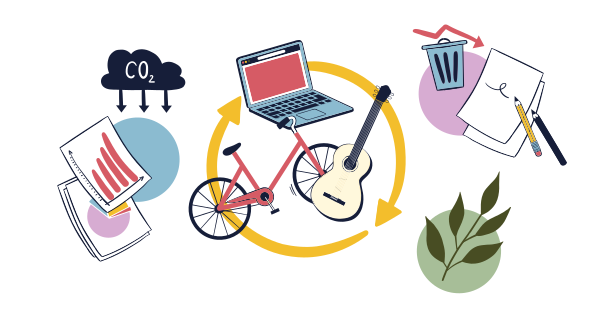
Measuring the environmental impact of a Library of Things proves the real value of sharing, reuse, and repair. This section explores why tracking matters, what to measure, and how tools like myTurn or Lend Engine simplify the process.
Why impact tracking matters
Sharing items rather than owning them can have an enormous environmental and social impact, but we must measure it to move beyond “good vibes” and into concrete evidence. Solid data allows you to:
- Optimize operations: Identify what works, what doesn’t, and how to improve access
- Inspire behavior change: Show members the tangible results of their participation
- Secure funding: Become more competitive for grants by backing up claims with data.
- Shape policy: Help governments integrate reuse into climate and zero-waste strategies.
So what? Connecting the data to your daily work
If you are running a local LoT, highly technical case studies like the ones below might feel a world away from your daily operations. However, this high-level environmental impact research others have done provides the “social license” for your library to better tell its impact story.
Here is why this data matters for your daily work:
- Due to decreased demand, LoTs can help reduce production in the first place. Research shows that up to 98% of an item’s impact happens before it reaches your shelf. You aren’t just keeping items out of landfills, you are preventing habitat destruction and the carbon-heavy manufacturing of new items.
- You don’t have to hire a scientist or do your own native research. By citing vetted research like the Reuse Impact Calculator below, you can report to funders things like: “Based on established Life Cycle Assessments, our loans represent a documented reduction in embodied carbon.“
- Using a “universal language” for products helps local officials see LoTs as essential infrastructure—like public transit—rather than just a quirky community project.
- Using a platform like myTurn can align your local impact with global standards. When you use the myTurn impact dashboard, your data is framed by the same research used by established LoTs worldwide—accomplishing much more than just managing your inventory! This allows even a brand-new LoT to produce reporting that carries the weight and authority of a global movement from day one.
- The standard is evolving in exciting ways (and you can be part of it!). While the myTurn impact dashboard is a groundbreaking tool, it isn’t yet perfect. The sector continues to innovate and learn from alternative methodologies to create a better universal standard for environmental impact tracking. The case studies below represent the “cutting edge” of this work—while these specific tools may not be widely accessible yet, they are being developed with the goal of future availability or incorporation into standard platforms. Your LoT can also use them as inspiration for creative solutions to measure your local impact using data and resources that may be different in your community. Then sharing your work and results with the global LoT sector can help us all move toward a more accurate shared tool! [Learn more about joining and connecting with other LoT groups and networks in the Conclusion.]
What to measure and report
While we prioritize core metrics like emissions reduction, resource conservation, and landfill diversion, don’t overlook “secondary impacts.” LoTs enable projects people might not otherwise afford, such as:
- Energy efficiency retrofits and home weatherization
- Community environmental restoration
- Disaster preparedness and recovery
Don’t forget to connect the dots! Numbers prove the scale, but stories provide the context. Data—especially complex and technical environmental impact data—can be hard to grasp on its own. Find qualitative “proof of concept” from your LoT’s work to provide a local, real-world example and really bring the data to life. The stories about a borrowed item helping a neighbor repair a family heirloom or insulate a drafty home are what people will remember.
Accuracy and transparency
If we want reuse to be taken seriously, it’s critical that our impact reporting is credible, conservative, and transparent. In other words, the impact data should be as accurate and defensible as possible in order to confidently report positive impacts. Here’s a checklist to guide that process:
- Underestimate savings rather than over-claim
- Be transparent about methods and assumptions so they can be double-checked and trusted
- Use the best available data, recognizing that sometimes it means using any available data. Lifecycle assessments can provide some of the most accurate information, along with other estimation methods.
- Account for trade-offs, such as reduced emissions savings when the same person borrows an item many times, as there are added emissions from transportation each time an item is returned and picked up
- Continuously improve by refining and rerunning impact reports as better methodologies emerge
Purchasing versus borrowing
Calculating the difference between buying and borrowing is complex. When someone purchases an item, they “own” 100% of the emissions from raw material extraction, manufacturing, and global supply chains.
Now, imagine five people borrowing that same item. Instead of five items being manufactured, only one is produced. The emissions for four copies are entirely avoided. While transportation (trips to the library) adds a small carbon cost, the overall savings grow every time the item is shared.
How to measure impact using myTurn
In order to make impact tracking easier, myTurn, which runs one of the most-used lending library software platforms, has launched an Impact Dashboard. It has actionable data to show users what’s working, what their positive impacts are, and where they can improve.
The new impact dashboard:
- Tracks savings from reuse compared to purchasing new items
- Provides sample emissions data from partners such as the Edinburgh Tool Library and Circular Library Network, with links to U.S. Environmental Protection Agency and U.K. government tools for local and regional manufacturing impact data
- Prioritizes accuracy by avoiding overclaiming, accounting for multiple trips for the same item, and using configurable lookback periods
- Supports custom assumptions for item lifetime and repurchase rates
- Enables item usage surveys to capture real-world data, such as measuring emission savings from reuse and contributions to building energy efficiency retrofits
To help organizations communicate their results, myTurn utilized data from millions of borrowed items to launch their Impact Dashboard. This tool allows you to track and report on data starting from your very first loan, providing a way to refine your impact storytelling as you grow.
How to increase impact
There are several ways to increase impact, including:
- Grow participation by making borrowing and reuse easier, more visible, and accessible. Increasing the number of times items are used will increase overall savings.
- Tell your stories using visuals and use cases to make the impact more tangible.
- Expand access by adding pickup locations, lockers in multifamily buildings, and partnerships to bring items closer to where they’re needed and used. This reduces travel time and boosts participation. [Check out Chapters 3 and 4 in Section 3 to learn more about mobile and kiosk LoTs.]
- Extend item lifetimes through regularly scheduled maintenance and repairs to keep items in good shape and in use longer. When purchasing, choose durable and repairable items that will last.
- Start with secondhand items to reduce emissions further. With the myTurn Impact Dashboard, you’ll be able to choose not to count emissions from donated or secondhand items against your organization’s total emissions.
- Actively show why reuse matters and work to make reuse and sharing the norm in your external communications.
Telling your impact story
What do you need to tell your impact story?
- Stats and data consolidated in one place?
- Visuals and infographics?
- Insights and example reports?
- Any additional resources?
Amplifying your LoT’s environmental impact is an effective tool for increasing reuse and sharing by your membership and beyond. Below are a couple of examples of how organizations are collecting data and sharing their impact story.

By measuring our impact accurately, increasing participation, and sharing results, we can ensure LoTs aren’t just great community resources, but key players in climate action, waste reduction, and the circular economy.
Reuse impact calculator
To create a universal language for reuse, Laura Novich (partner at Hyloh and creator of Untangling Circularity) developed the Reuse Impact Calculator (RIC) for the New York City Department of Sanitation (DSNY). The goal was to provide a systematic way to compare data from various hyperlocal organizations and determine the true environmental impact of diverting diverse products from landfills.
While the EPA’s WARM model is effective for construction materials, it is less accurate for consumer goods like clothing. To improve this, Hyloh incorporated Life Cycle Assessments (LCAs) that consider embodied carbon along with water use, air quality, and other environmental factors for a fuller picture.
To make this data manageable, the system uses a tiered structure similar to the genus/species biological classification system. The team:
- Condensed thousands of product types into manageable categories
- Identified representative products (e.g., small appliances = toaster, microwave, blender)
- Gathered average weights and material compositions
- Linked each material to a WARM model emissions factor, or substituted with expert-derived values when WARM was inadequate (e.g., replacing “carpet” with cotton for clothing)
- Updated with LCA-based emissions factors when available for greater accuracy
The RIC is a living tool. As new LCAs or emissions factors emerge, the system is updated to remain accurate alongside advances in environmental measurement.
How DSNY uses the RIC
DSNY utilizes the RIC through its donateNYC program, a network of non-profit reuse organizations. Because the network includes everything from massive operations like Goodwill to tiny social service agencies, the data coming in is often inconsistent.
The RIC translates this varied data—whether it’s a simple sales list or a detailed inventory of redistributed goods—into a cohesive, universal language. This reduces subjectivity and gives DSNY a clear overview of the tonnage and environmental impacts of the waste being diverted.
Beyond the numbers, the tool’s locational filters allow DSNY to see where certain types of reuse are thriving and where gaps exist. For example, if textile reuse is thriving in the Bronx but limited in Queens, DSNY can strategically introduce new programs or drop-off sites in the underserved areas. This ensures resources are balanced and data-driven across the city.
While this system is currently behind a firewall, efforts are being made to create an accessible one in Washington State. It will mainly serve small organizations that may not have the funding or the capacity to use any current types of fundraising. This should amplify their voice within the reuse sector.
Edinburgh Tool Library carbon calculations
In 2018, the Edinburgh Tool Library (ETL) secured funding from the Climate Challenge Fund, which required all recipients to use the same carbon calculator. However, the tool they provided was designed mainly for waste electricals and had very broad categories. This meant ETL had to record all their diverse tools simply as “computers,” which made comparisons inaccurate and frustrating.
This mismatch meant ETL’s real environmental impact was undervalued. For example, community gardens diverting food waste were sometimes credited with higher carbon savings than the ETL’s entire tool-sharing program. This created challenges when justifying funding or demonstrating ETL’s true value.
To better understand their impact, ETL referred to research from WRAP (The Waste and Resources Action Programme) in the UK, which included a detailed life cycle analysis of a cordless hammer drill.

The key insights from this research are:
- About 98% of a tool’s carbon footprint happens before it reaches the user, during manufacturing and distribution.
- LoTs increase the reuse rate, raising that small remaining percentage and reducing the need for new tools
- Many LoTs carefully repair and salvage components, extending tool lifespans beyond typical consumer use. This approach diverts more material from landfill and reduces demand for new manufacturing.
This experience highlighted two important points for ETL:
- Existing carbon calculators often don’t capture the full environmental benefits of tool sharing.
- The biggest impact comes from preventing unnecessary production by extending tool lifecycles.
By understanding these nuances, ETL could better communicate its role in reducing carbon footprints and advocate for more tailored impact measurement tools in the circular economy.
Creative informatics case study
Terence, an Edinburgh Tool Library volunteer, led a project funded by Edinburgh University that built a model to analyze the environmental impact of tools shared through the ETL, using data exported from the myTurn platform. He used the following research to inform this model:
- Greenhouse Gas Reporting: Conversion Factors 2020, UK Government
- The Climate Impact Forecast
- The ICE (Inventory of Carbon and Energy) by Circular Ecology and the University of Bath
These three main research sources cover the materials in most shared tools:
- Tools with electrical motors (e.g., drills, lawn equipment)
- Simpler hand tools made mainly of metal and wood
This model ran continuously in the background to support both internal reporting and external communications. ETL used it to share the impact of their LoT with transparency and care, including a clear explanation of the model’s assumptions and limitations. This commitment to openness ensures stakeholders understand the basis for the impact claims and reflects best practices in transparent environmental impact reporting.
New Scottish carbon calculator
The Scottish Government, Circular Community Scotland (CCS), and Zero Waste Scotland (ZWS) are working together to develop a carbon calculator that can be used across the entire reuse sector. The goal is to create one model that works for furniture reuse charities, repair projects, and LoTs alike.
The model draws on data from multiple sources across Scotland’s reuse sector, including detailed figures from myTurn for LoTs. This allowed the LoT portion to be developed quickly, and the results show that the figures used in Edinburgh Tool Library’s model are broadly accurate.
It takes into account several factors that influence carbon impact, including:
- Weight of items shared or reused
- Transport considerations
- Alternative sources people would have used if the tool library were not available, based on a national CCS consumer survey
Environmental impact tracking: Resources, templates, and videos
Resources and templates
- myTurn Impact Reporting Resources
- donateNYC Reuse Impact Calculator
- Waste Reduction Model
- US Environmentally-Extended Input-Output (USEEIO) Models
- The Untangling Circularity Podcast
- Carbon Data for Sharing Libraries
- Zero Waste Scotland
- The Circular Communities Scotland Share and Repair Network
- Environmental Benefits of Tool-Sharing
- Share and Repair Network Sharing Library Impact Survey Report
- Zero Waste Scotland Producer Responsibility for the Circular Economy
- Library of Stuff
- Emission Factors for Greenhouse Gas Inventories
- Reuse Minnesota Impact Report
LoT Co-Lab: Environmental impact tracking
Video recordings
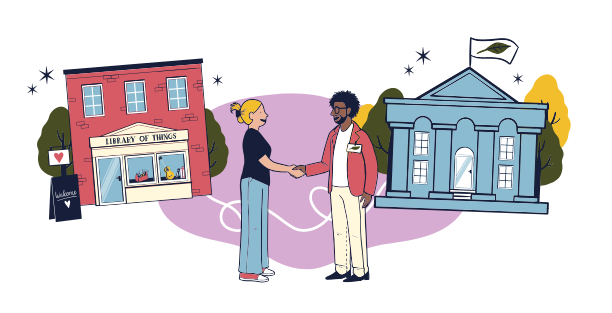
Partnerships are the long-term, structural relationships that provide the backbone for a sustainable Library of Things. While collaborations are often project-based or temporary, true partnerships are mutually beneficial alliances built on shared missions and a deep commitment to one another’s success. By building a durable network of partners, an LoT moves from a siloed project to an integrated, vital resource that is woven into the fabric of a community.
Chapter 1: Selecting partners
Is it the right fit?
When deciding whether or not to commit to a partnership, we recommend utilizing a decision-making rubric. This model, shared by the Station North Tool Library in Baltimore, Maryland, U.S., helps ensure that every partnership “yes” is sustainable and mission-driven.
To proceed with a partnership, the proposal should pass through these three filters:
Filter 1: Organizational alignment
Goal: Ensure the partner represents your mission meaningfully.
Requirement: At least two of the following must be true:
- Right geographic area: Project or organization is in a target neighborhood
- Equity-led: Led by marginalized people
- Mission-aligned: Their “why” matches your “why”
- Values-aligned: Their internal culture is similar to yours
Filter 2: Logistical alignment
Goal: Ensure the partnership is sustainable and doesn’t drain your resources.
Requirement: All three of the following must be true:
- Resource-centered: Uses or centers around an existing resource OR a planned or desired resource you haven’t created yet
- Capacity-ready: You have identified a staff or volunteer point person who has the time to commit
- Budget neutral: Financially fits within your existing budget or have you have dedicated external funding
Filter 3: Strategic alignment
Goal: Ensure the partnership moves your specific goals forward.
Requirement: At least one of the following must be true:
- Outreach: Would raise awareness and/or bring in new members/learners
- Capacity building: Would build internal capacity in strategic areas (e.g. develop a new class, create a durable resource)
- Engagement: Would engage members
- Networking: Request is from an organization we seek a closer relationship with
Know when to say “no”
Take time to consider all the things that could go wrong. A failed partnership is worse than no partnership, and could tarnish your public image or result in loss of staff, resources, or capital. If a potential partnership can undermine other priorities, be ready to pass on the opportunity.
Say no if:
- There are equity concerns with the organization or project
- The request is for free programming outside of your strategic priorities or for non-marginalized groups
- There isn’t enough staff time to manage the project or the relationship
- The organization isn’t a close fit with the mission or strategic priorities
Chapter 2: Library of Things partnerships
From the outset, we recommend partnering with local, regional, and international LoTs that can set you on the path to success. Our collective impact as a sector can grow exponentially through collaboration and resource sharing.
Mutual benefit for LoTs
Share resources
Partnering LoTs can share:
- Strategies and experience: Learn from the experts, share your knowledge, and put your heads together to solve common problems.
- Translated materials: Extend your outreach and engagement opportunities with cross-cultural content.
- Overstock inventory: Jump-start your inventory, fill in gaps, and find new ways to redistribute things you don’t need for mutual benefit.
Expand access
If your LoT is limited by capacity or environmental restrictions, a neighboring project may be able to fill a gap in your inventory through shared access.
Grow sustainable networks
Successful networks not only improve outcomes, but they also provide resiliency. Whether you are looking to reduce environmental impact and the cost of living, or promote access and opportunity, a network is often there to help. If something goes wrong, a network may provide essential support or aid in transitions.
How to partner
Make digital resources free for nonprofit use. If you love something, give it away! Other programs around the world can benefit from your hard work, increasing our collective impact.
Post to a Google group or on Reddit. Connect with established programs to learn from each other and potentially avoid redundant resource development. Here are a few favorites:
- groups.google.com/g/toollibrary/
- groups.google.com/g/lotmutualaid
- https://www.reddit.com/r/toollibraryhub/
Host or attend events collaboratively. Share the investment in outreach events and attract more attention to your project with a larger event. Or cross-promote your partners at outreach events that attract a broader audience.
Collective power: The Tool Library Alliance (TLA)
While individual partnerships between LoTs are valuable, your LoT is also part of a much larger global movement. To truly tap into the collective power of the sector, we recommend connecting with the Tool Library Alliance (TLA). Based in the U.S., the TLA is a network built by organizers, for organizers, to ensure that no one has to reinvent the wheel. (Note that TLA is currently a fiscally sponsored project of Shareable.)
How TLA supports other LoTs:
- Resource sharing: Access a public drive of “vetted” templates, including liability waivers, borrower agreements, and maintenance logs contributed by libraries around the world.
- Monthly network calls: Join workshops and resource-sharing meetings to troubleshoot common operations issues—from board engagement to sustainable funding and much, much more.
- The tool library map: Add your LoT to a growing international map to help members find you and to identify potential neighboring partners for inventory sharing.
- Collective advocacy: By uniting hundreds of LoTs, the TLA leverages collective power for initiatives like securing larger grants, negotiating better business services, and advocating for the “Right to Repair” at a policy level.
How to get connected: While TLA “membership” is currently open to any independent library of things in the U.S. that has been operating for at least two years and lends tools, everyone is encouraged to visit the Tool Library Alliance website to access the resource drive and sign up for upcoming network meetings and Co-Lab sessions.
Case study: this toolkit!
The document you are reading is more than just a manual; it is a living example of a successful peer-to-peer partnership. The Library of Things Toolkit was produced through the LoT Co-Lab initiative; a long-term partnership between TLA and Shareable to produce monthly training and resource-sharing webinars (“Co-Labs”) with, and for, LoT practitioners around the globe. Rather than a top-down approach, this resource was built by synthesizing the expertise of dozens of LoT practitioners (like you!) who participated in monthly Co-Lab sessions.
In fact, TLA members drafted most of the content in this toolkit to ensure the advice remains rooted in real world experience. Beyond just gathering information, the Co-Labs serve as a primary “matchmaking” space for the sector. By participating in the network, you build the relationships necessary to find your own peer-to-peer partnership opportunities—whether that’s co-applying for a regional grant or sharing overstock inventory with a neighboring LoT. The existence of this toolkit proves that when we move beyond individual silos and participate in a shared network, we can create resources and alliances that no single organization could produce alone!
Chapter 3: Government partnerships
Governments at most levels have a mandate for waste reduction, environmental protection, and expanding access, often intersecting with the values and missions of LoTs.
Benefits of government partnerships
Support community development or waste reduction initiatives: Helping governments to deliver on climate, equity, health, or neighborhood beautification goals can build a strong relationship and community.
Expand community resources: Shared access to things enriches the entire community.
Promote sustainability: Governments responsible for land and resource stewardship and waste management have a vested interest in sustainability, which can be achieved in part through LoT development.
Grow community: Many LoTs are grassroots organizations started by passionate neighbors. When governments encourage community-led initiatives, civic engagement often blossoms.
How to partner
Access funding and grants: Federal and private funding, which is restricted to municipalities can be accessed through partnerships to help both organizations achieve government-supported goals.
Share facilities: Surplus government property can incubate your LoT or provide a permanent home for publicly accessible resource hubs.
Promote the partnership: Governments often send mailings and newsletters to the entire municipality. Publishing news about your collaborations can build goodwill with citizens and increase awareness about your LoT.
Support policy: The regulatory framework that governs your sharing organization or funding environment can be influenced by partnerships where LoTs collaborate with the government in listening to the community and delivering services.
Chapter 4: Nonprofit partnerships
Do more public good in partnership with nonprofit organizations that share your mission or values!
Benefits of nonprofit partnerships
Increase access to tools or items for projects and programs: Supporting garden maintenance days, cooking classes, or events with free or discounted access to your inventory items can build lasting partnerships and strong community support.
Expand outreach: Reach customers and funders with common values through common sense partnerships, collaborations, and cross-promotion.
Increase impact: Collaborate on waste diversion, collection, and repair initiatives.
Diversify funding streams: By partnering with organizations outside of a typical LoT funding bubble—such as health, housing, or youth development nonprofits—you can access funding pools that likely aren’t available to you alone.
How to partner
Launch joint community projects: Show the neighborhood you are serious about your commitments by launching visible projects that connect your organizations through shared service delivery. By combining your LoT’s technical inventory with your partner’s specialized expertise (like a housing nonprofit or a gardening club), you create more effective enrichment opportunities. This “division of labor” not only makes the project more professional but also signals to the community and funders that you are part of a coordinated, efficient local network.
Leverage specialized expertise and joint funding opportunities: Play to each other’s strengths to create a more effective program than either could produce alone. By combining your LoT’s technical inventory management with a partner’s subject-matter expertise (like master gardening or youth development), you demonstrate the kind of multi-sector impact that grant-makers love. This division of labor not only ensures you are operating where you are most effective, but also signals to funders that you are sharing resources rather than duplicating them—demonstrating high-level fiscal responsibility and increasing your competitiveness for funding.
Share administrative capacity and leadership. Working with partners in advocacy work, fundraising, and community listening are just a few ways to reduce administrative burden.
Create reciprocal membership/services. Consider promotional or permanent reciprocity with organizations that share your mission or serve an audience you would like to connect to.
Chapter 5: Business partnerships
Business partnerships can bring vital resources for marketing, inventory development, and administration. In return, your LoT offers businesses a way to fulfill social responsibility goals and offset their environmental impact. These relationships work best when they are built on a shared commitment to local community resilience.
Benefits of business partnerships
Employee engagement and volunteer opportunities: Many businesses look for team-building activities and “out-of-office” opportunities for their staff. You can tap into this by hosting business volunteer teams to help with the essential, labor-intensive tasks your LoT requires, such as inventory inspections, tool maintenance, or clean-up days.
Social/environmental responsibility: Businesses build goodwill and enhance their brand by supporting organizations that do social or environmental good. In places like the UK, responsible giving is even required by law.
Waste reduction and logistics: Partnering with an LoT allows businesses to divert “deadstock” or open-box returns from landfills, helping them meet waste-reduction targets while revitalizing your inventory.
Brand visibility and community relations: Partnering with manufacturers to share their products can build long-term brand loyalty by getting their tools into the hands of users. An LoT serves as a “real-world showroom” where people can try high-quality items before they decide to buy their own.
How to partner
Establish inventory donations and sponsorship. Local businesses and national brands alike can build market share through donations or sponsorships. Manufacturers like Craftsman have made large stock donations directly to many LoTs, including Asheville, NC, U.S., and Baltimore, MD, U.S., through partnership arrangements. Don’t forget to ask about their deadstock!
Create employee item borrowing programs. In exchange for a sponsorship fee, the employees of the partner business receive memberships, giving your LoT predictable annual revenue while helping the business support their workers’ DIY projects and skill-building.
Host events and workshops. Sponsoring events or hosting a team-building exercise for employees can be a great way to strengthen partnerships and demonstrate the community benefit of long-term collaboration.
Special business guidance
Know your terms. There are many buzzwords that can help direct your requests for partnership to the right person and demonstrate your experience and understanding of their business needs, including:
- CSR: Corporate Social Responsibility
- Deadstock: Open-box returns, display models, or otherwise unsellables
- In-kind support: Donations of goods or services instead of cash
Build a relationship. Lean into the mutual benefit opportunities with businesses—use terms like “partner with,” “support each other, ” and “creating relationships.” Connect with community relations, logistics, and other departments. Try to meet face-to-face!
Do your research. Make sure you go into meetings prepared. Consider:
- Has this business given in the past? Acknowledge that! And share specific impact of their previous support.
- How long has the business been operating in the community? Use their longevity to discuss the value of long-term neighborhood stability.
- Make a case for shared prosperity: How does your LoT helping people maintain their homes and learn new skills directly create a more vibrant, resilient neighborhood for their business to operate in?
Carhartt Workshop and Tool Library
In Detroit, Michigan, U.S., the workwear brand Carhartt has moved beyond traditional philanthropy by directly founding and operating an in-house Library of Things. Known as the Carhartt Workshop, this brand-run LoT serves as a “borderless” community resource, providing over 3,100 users with free access to a 1,600-item inventory. While the company provides the facility and the baseline corporate funding, the LoT is designed to be community-led—local members guide the inventory development to ensure the tools reflect the real-world needs of Detroiters. This model demonstrates how a business can integrate the LoT framework directly into its corporate structure to foster long-term community resilience.
To validate this operational model, the Workshop partnered with Purdue University to conduct a research study on the carbon impact of their lending activities. The study provided a powerful “so what” for the circular economy, finding that the tools lent through the Workshop offset the carbon footprint of three full-scale retail stores annually. By taking on the role of the LoT operator, Carhartt has successfully turned a corporate commitment into a measurable environmental asset, proving that businesses can be the primary engines behind high-capacity sharing programs.
Seattle REconomy
The growth and success of Seattle REconomy, as executive director Josh Epstein puts it, is really reliant on partnerships.
Through government partnerships, Seattle REconomy has earned $500,000 in state and county funding, collaborating with the City of Shoreline, Washington, U.S., to access funds only available to municipal partners.
Nonprofit partnerships have enabled Seattle REconomy to operate collection and redistribution programs for bicycles and building supplies, growing everyone’s capacity and impact. Partners collaborate on receiving donations, hosting resale events, and leading workshops, too.
Attention to their efforts has brought interest and funding resources toward a larger collaboration: the Reuse Commons. Now, feasibility funding from the state is building a roadmap for a secondhand mall project that would include several LoTs.
Chapter 6: Public library partnerships
For the general public, traditional book-lending libraries are the most familiar point of reference for understanding the Library of Things (LoT) model. While these two forms of social infrastructure often operate independently, they share a common DNA rooted in equitable access and community resource sharing. Today, the line between them is blurring as public library systems increasingly expand their collections to include physical objects, and independent LoTs look to established library networks to scale their impact.
This evolution is not a new phenomenon; the Berkeley Tool Lending Library—the longest-running program of its kind in the U.S.—began as an independent project in 1979 before being fully integrated into the Berkeley Public Library system. Whether your LoT remains independent or seeks a deep integration like Berkeley’s, a partnership with a public library can be a powerful catalyst. By collaborating, your project gains the institutional stability and reach of a trusted civic anchor, while the library expands its relevance by offering sustainable, hands-on resources that go far beyond traditional media.
Note: “Public library” is used as shorthand for traditional “public book/media-lending library” in this section.
Public libraries 101
Public libraries in the U.S. and elsewhere have long been one of the most important social “third places” (neither home nor work) and community hubs. There, you will likely encounter shared values like access, diversity, democracy, and sustainability.
Public libraries often share additional services such as general help desks, public restrooms, tutoring, and internet access. Partnering with public libraries can connect you to these established competencies and resources, as well as:
- Access to unique people and groups—public libraries often have a strong and trusted reputation with a diversity of local people
- Event publicity, registration systems, and space
- Relationships with diverse communities, organizations, and spaces
- Multilingual communities, different age ranges, and cooperation examples
- Deep expertise in a wide range of topics
- A staff with enthusiasm and expertise about lending systems and sharing!
Since many public libraries are beginning to expand their inventories of “things,” you can also likely offer your own expertise and wisdom with maintenance, member education, and other unique considerations.
In developing relationships with public libraries, you may also encounter some challenges, including the following:
Staff silos: Community engagement, youth, and adult programming staff may be separate. Don’t give up at your first “no.” Listen and adapt your approach.
Different priorities: Public libraries are often overstretched, and individual staff members might be experiencing pressing issues. Try to focus on “win-win” opportunities that meet the public library’s goals, too.
Municipal restrictions: There is a wide range of structures for public libraries; they may be run by a city or county, a library district, or a nonprofit (or a partnership). Their fundraising arms are usually set up as a separate library foundation. Their staff may be unionized. Their buildings might be historic. Make sure you understand and adapt to rules and regulations, including liability and how you use the space. And remember that the librarian you’re working with probably didn’t make that rule.
Curated space: Public libraries often balance a large number of items and programs in limited, multi-purpose spaces that need to stay clean and appealing. Organization is often a high priority, personally and institutionally. Be extremely tidy, make sure you understand their expectations and needs, and communicate in advance about timing, storage, photography, and signage.
Note: In the U.S., most public libraries that are members of the American Library Association have the following requirements for programming:
- Free (no monetary cost)
- Open to the public
- Not exclusive to a particular group
Lend everything! Collaborative design for a community ecosystem
Neither the traditional public library nor the grassroots LoT is going to meet all community needs on its own. The future of a Solidarity Economy has to blend the centuries of experience, reputation, and infrastructure of public libraries with the responsiveness, expansiveness, and community involvement of the LoT movement. Learning to fill in the gaps together is a big, beautiful challenge. Here are some of the most common differences you might encounter along the way.
Public libraries are often accustomed to dealing with a much larger membership, which means an emphasis on efficiency and reducing risk. Often, their growth areas are in building community engagement and participation.
- How can you share your LoT’s strengths and experience with smaller, more involved member groups while learning about efficiency and risk management?
Public libraries have gotten very good at the process of acquiring, lending, and maintaining specific kinds of items. Staff might not realize how much is involved in lending a sewing machine or baby stroller rather than a book, CD, or DVD.
- How can you share broad learnings about repair, maintenance, and borrower education?
- What might you learn about standardizing the borrowing process?
As tax/government-dependent institutions, public libraries are often less able to be experimental, adaptive, and take risks.
- When you work together, how can you practice the risk tolerance to try new things or pilot a program while taking advantage of institutional infrastructure to support it?
- How can you help public library staff reduce the stress of their workload and increase the satisfaction of their patrons? (Hint: Library patrons will likely appreciate having items that the books they check out reference to accomplish a task, whether it’s a chess board or a drill—and appreciative patrons improve the work environment!)
Often, LoTs rely heavily on volunteers for maintenance, repair, member interactions, and other tasks. A majority-staff model at a public library might present challenges in translating processes and understanding liability and risk between organizations. If you’ve done the work to carefully define the people or communities you want to serve, you might find that your goals are slightly different from those of a public library, which has its own outreach priorities while being designed to serve everyone. Look for the overlaps in both sets of goals and lean into them.
In addition to public libraries and LoTs, consider where people are also accessing shared items, such as schools, gear rental services, community swaps, makerspaces, and museums. There are all kinds of opportunities for community collaboration! Consider:
- Once you learn to work with public libraries, how else can you build an interconnected sharing network?
- Consider where your complementary and shared skills and goals might align and where you might need to be prepared for differences in values or approach.
Approaches
To save time and demonstrate readiness, approach your local public library with a “menu” of potential partnership approaches. Here are some common ways to get started:
Share your programming. Offer classes, repair workshops, and/or informational tabling at their location(s) or as part of their planned events. Be sure you know what the costs would be (if you can’t offer it for free), and be clear about what that price includes. Invite them to the table or promote events in your space and newsletter, or go in on a table together at a community event.
Host youth workshops. Public libraries are often looking for new ways to engage with youth. Bring a few of your inventory items to a show & tell or host a hands-on activity for kids. Experienced public libraries can usually cover liability, which can be expensive and complicated for an LoT.
Share your membership. Allow public libraries to offer access to your inventory through shared memberships or borrowable short-term passes. (Consider your waiver and insurance policy!) If your public library system has access to transportation, work with them to schedule buses to help people without cars get to and from your library.
Additionally, many libraries now offer day-passes to museums or local attractions for free or at a reduced rate. If your LoT is a paid program, consider offering promotional access through your public library, like Maine Gear Share or the Denver Tool Library does.
Share expertise. Trade advice and guidance with public library staff. Help them learn how to expand into lending things and learn from them how they navigate your organization’s pain points. Collaborate on new ventures, like a Repair Café or a new category of borrowable items.
Share space. Some LoTs have co-located with their local public libraries, integrating both sets of inventory into the same building. Sometimes, their membership and borrowing systems stay separate as they operate as sub-tenants or co-tenants, and sometimes, they eventually integrate into a merged organization.
Think beyond the local! There are LoTs in public libraries in every state in the U.S., provinces in Canada, and many in Australia and other parts of the world. The LoT Mutual Aid Group is an email group for public libraries that are lending beyond traditional media items. Typically, members of the group belong to the national library association in their country and are a school, academic, or public librarian. Yet, anyone is welcome! The Group meets once a month to listen to a representative from a public library lending something unusual, and it is active with folks asking about public and academic library questions. Sometimes it can be helpful to hear from other public libraries that collaborate with external LoTs or who are managing internal LoTs—don’t hesitate to reach out to this group if you could use that assistance!
Chapter 7: The partnership ecosystem
The different types of alliances outlined in this section—from government to nonprofit to business—rarely exist in silos. In a resilient community, these partnerships overlap to create a safety net of shared resources.
The most powerful real-world example of this ecosystem in action is the collaboration among the Asheville Tool Library, the Western North Carolina Repair Café, and Mutual Aid Disaster Relief (MADR). [Read the full story in Chapter 2 of Section 11.] Their model isn’t just about one organization helping another, it’s about a complex, organic partnership that combines specialized repair skills, tool inventory, and grassroots logistical power. When Hurricane Helene hit, this pre-existing web of trust allowed them to bypass the usual bureaucratic delays and serve as a primary engine for regional recovery.
Partnerships: Resources, templates, and videos
Partnerships resources and templates
LoT Co-Lab: Partnerships
Video recordings
- Part 1: Why partnerships? [4:54]
- Part 2: Types of partnerships [8:33]
- Part 3: Carhartt Workshop case study [8:23]
- Part 4: Seattle REconomy case study [17:28]
- Part 5: Q&A [9:26]
Public library partnerships: Resources and templates
LoT Co-Lab: Public libraries
Video recordings
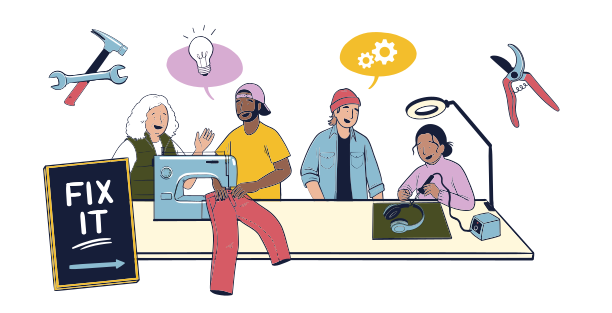
Sharing knowledge and skills is a natural extension of sharing items! Workshops and events can be a great complement to a Library of Things, whether they help people learn how to use your inventory, repair things, or just build community.
Chapter 1: Workshops
Note: We’re using the term “workshop” to encompass any kind of educational programming, whether it be an instruction-only class, a training, or a hands-on, interactive workshop.
Benefits of educational programming
Workshops help members learn how to use the items in your inventory, which goes a long way toward keeping both your items and their users safe. By providing training and teaching safe practices, you encourage people to try using things they may not have used before. This focus on education is an essential part of ensuring access, especially for those who aren’t typically given many opportunities to learn. Many tool libraries, for example, prioritize education for women, girls, and trans or gender-non-conforming individuals, as these groups often face social or cultural barriers to accessing this type of technical instruction elsewhere
Beyond safety and skill-building, education serves as a powerful outreach tool to introduce new people to the LoT concept. If someone is interested in learning a skill like sewing, they are far more likely to join your LoT as a member once they realize they can borrow the LoT’s sewing machine to practice. Ultimately, programming like this builds a sense of community, transforming the LoT into a “third place”—a vital social space that is neither home nor work.
Workshop considerations
Offering workshops is not always easy! Before jumping in, consider:
- Do you have the consistent staff capacity to run the workshop and manage marketing, sign-ups, student questions, follow-ups, curriculum development, teacher recruitment and training, and handling payments?
- Will programming affect the availability of your space for other priorities, including lending? How will you balance this?
- Do you have enough space for a class of learners, including restrooms and parking for vehicles and bikes?
- Where will you store the materials and tools for your workshops?
- Look at borrowing trends. Which items are most frequently used? Of these, which could be dangerous or difficult to use?
- What kinds of projects are people borrowing items for that you might be able to offer training in?
- What does the community want and need? To get the most out of your investment, be sure to align your workshops with the specific community needs and desires you have gathered through surveys and other means. Keep a running list of frequently asked questions from your members about the items in your inventory. You may notice patterns that can become a workshop. Have one-on-one conversations with your members and volunteers. Not only will you understand more about what people are interested in learning, but you might also find some teachers or workshop leaders! Ask things like:
- What are you interested in learning?
- How much can you afford to pay?
- What times work best for you?
- Will you need translation, childcare, or other accommodations?
Mission alignment
Once you understand your community’s needs and wants, consider what aligns best with your values, mission, goals, and capacity. Here are some things to consider:
- Offer one-off workshops that can be easily planned and executed if your staffing is limited to volunteers. Let volunteers take the lead in offering up what they know and want to share.
- Is the goal to create a collectively led space? This might impact how you share teaching responsibilities or even structure workshops without a single, designated teacher.
- Consider how you can make education as accessible as possible through scholarships or low-cost registration, translation, and even off-site offerings in other neighborhoods, especially if you’ve identified reducing barriers as a value or goal.
- Consider if/how you can compensate instructors, especially if your values include honoring labor.
- Consider your budget for workshops. Do you want/need them to be significant generators of revenue, or is it okay if they’re self-sustaining (i.e. break-even), or is it a loss-leader and you need them to be subsidized?
- Education grants are often available to cover the internal cost of workshops, allowing you to offer them for free or at a reduced cost. Just keep in mind that these grants are generally temporary funding.
- Offering free or low-cost registration options is another way to still make money from those who can afford to pay full price while lowering the cost barrier to entry for those who need it.
Recipe for successful workshops
Every LoT’s offerings will be different! Making sure your education offerings work for your organization and your community is most important. Below are just some of the “ingredients” for successful education.
People
The most important ingredient!
Instructors or leaders can be staff, contractors, or volunteers. Carefully consider how you support, recognize, and/or compensate people regardless of their status:
What are the job descriptions for your instructors?
- Are they responsible for developing and marketing their workshops, sourcing and preparing materials, setting up and/or resetting the space, and following up with students? Or do they just show up and teach?
- Often, it’s more cost-effective to have one person handle support and logistics for all workshops, including scheduling, marketing, registrations, and space set-up. Still, you might not have the capacity for this at first.
The target audience are the people that could benefit from your LoT if they know where it is, when it’s open, and that they are welcome there. Consider:
What audience are you prioritizing?
- Beginners? Older adults? Youth? Renters? Homeowners? People with marginalized identities?
- Defining who you most want to attend your workshops will shape what you offer, when, and how you do it. It may also impact your liability insurance and how you screen instructors if you plan to offer programming to children and teens.
Curriculum
Don’t just think about what you’re teaching or sharing but also how you’ll go about it. Be sure to consider the following:
Concrete goals: At the end of the workshop, what do you want participants to know or be able to do?
Accessibility: How will participants of different backgrounds, experience levels, and abilities achieve those goals? What days and times can you make workshops available? Are there physical ability considerations, like moving heavy objects or navigating a tight space, that might be barriers? Consider interactivity, hands-on practice, and physical models to help people of different learning styles understand a concept or practice.
Length and frequency: Many people have trouble focusing on a subject for more than three hours at a time, so consider breaking up a longer workshop into multiple parts. Balance shorter sessions with the difficulty of scheduling more than one visit. Having a consistent schedule and workshop length can help people plan and commit more easily.
Ideal class size: Often, smaller classes offer more opportunities for hands-on learning and instructor attention. Balance this with the benefits of larger classes, including more exposure, access, and revenue.
Writing and testing: You may have one person develop a workshop, and someone else deliver it, or different people offer it over time. Consider aiming for every attendee to have basically the same experience, no matter who their instructor is. Documenting a lesson plan, prepping and sourcing materials, and thinking through other logistics like timing, skill level requirements, accessibility, etc., helps reduce repeat work and enable refinements over time. Consider running at least one prototype workshop to test timing and get feedback from volunteers before publicly launching a new offering.
Venue and materials
Once you have a plan to offer and run a workshop, refine it based on the opportunities and constraints of your space. Consider the following points:
Systems for smooth operations: Think about the workflows involved in preparing and cleaning up from workshops. Some examples are below:
How does the space need to be arranged and reset?
- What materials need to be prepared in advance to maximize in-class time, and where are they stored? Where, how, and by whom are materials sourced?
If you have on-site workshops, what else is happening in the space at the same time (e.g., lending and other workshops)?
- Try to minimize impacts in both directions, including traffic going into your space, sound, walking through one space to get to another, etc.
How many people can you actually fit in your space?
- Make sure you know your space’s maximum occupancy, in addition to considering space needed for practice, visibility of demos, and seating.
What amenities do you need, especially in different seasons?
- If your workshop is messy, where will people clean up? Do you have drinking water and restrooms? What personal protective equipment is needed, and do participants bring it themselves? Be careful of summer and winter temperatures in un-air-conditioned/heated spaces, and ensure you can keep the space between 65 and 80 degrees Fahrenheit to protect health and safety.
Off-site programming: One way to get around the limitations of your own space is to offer educational programming elsewhere. This is a great opportunity to build partnerships and get the word out about your LoT. Be sure to discuss in advance:
- The expectations for transporting materials
- Everything needed for the workshop
- Who will handle registration and get participant information
- If you or the host will need additional insurance, a rider, or waivers
- Who is responsible for set-up and cleanup
Virtual education: Remote workshops can also be a great option, especially for topics that don’t lend themselves as well to hands-on practice. While you lose some of the magic of in-person community building, you can reach more people with a higher level of accessibility. However, keep in mind that virtual sessions may create new barriers if participants don’t have the necessary equipment or materials at home. To keep a virtual session inclusive, consider offering borrowable “workshop kits” or ensuring the curriculum uses only common household items.
Participant engagement
How do you find and keep students?
Host workshop enrollment on an event software platform (like Eventbrite, Zeffy, or Humanitix) that’s easy for you to use and easy for your community to interact with (many nonprofit donation platforms like Givebutter and Give Lively also support events/ticketing). If you want to streamline the process, make sure it meets your needs for processing payments, signing waivers, collecting registrant information, and sending reminders and follow-up emails. You can always do these steps manually if you opt for a free or simplified tool, but there is a cost in terms of time and consistency. Check to see if your fundraising platform, email client, or website software already offers ticketing.
Marketing your workshop is essential to reach the people you want to prioritize and fill your seats. [See Section 1 on Getting started and Section 4 on Communications for guidance about how to get the word out.]
Ensure participants have a responsive point of contact before and after workshops. There are frequently asked questions (FAQs) about enrollment logistics that can be time-sensitive (e.g. Can I register on behalf of someone else? What if I need to cancel?). Including an FAQ page on your website can help, but keep in mind that not everyone will read it. After a workshop, there may also be questions about how to get more involved with your LoT—a quick response to these inquiries are much more likely to keep folks interested and engaged.
Assessment
Be prepared to implement responsive, adaptive improvements over time. Regardless of how much work you do in getting to know your community and planning an effective workshop, you won’t get it exactly right the first time. That’s okay! Here are some ideas for how to assess your education programming.
Surveying at the end of a workshop is one of the most effective ways to get specific feedback for improvement. At the end of each session, offer a QR code to an online survey and a paper version in person (if you have the capacity to transcribe responses). Send a follow-up email with the survey, too.
Casual, one-on-one conversations can be a great approach to get feedback, especially with repeat customers who have taken multiple workshops. Encourage a culture where all staff and volunteers actively engage with participants to gather informal feedback. This “on-the-ground” insight is invaluable, but it only works if it’s captured! Make it a standard practice to document these insights immediately after the fact—whether through a shared email or Slack thread, a dedicated “feedback notebook” at the checkout desk, and/or a digital log that both staff and volunteers have access to.
General feedback forms are another way to capture input, sometimes more broadly related to what you do/don’t offer, workshop timing, etc.
Before you begin capturing feedback, make sure you have a plan to act on it. Regularly review survey data and compare it with your established goals. If there is specific feedback for an instructor, don’t be afraid to share it (tactfully and professionally, of course). Keep the organization’s values, mission, and capacity in mind and try to maintain a curious, growth-focused mindset. When you need to make changes, be clear about who is implementing them and how you’ll communicate updated methods or practices to everyone involved.
Costs—for you and your participants
When you plan for the “in” and “out” of funding related to a new workshop, don’t forget to include initial startup costs.
You may need to buy new tools, equipment, or materials. This is especially important if you make a bulk purchase that covers many sessions.
Developing a new workshop takes time and energy, which you may want to pay for. You may need to rent more space, temporarily or long-term. You may want to offer compensation to instructors, including their time and effort to help plan as well as administer the workshops. Know that the majority of your ongoing costs will be labor and materials (in addition to any rent and software fees). If you’re using a paid enrollment or payment processing tool, be sure you know both the start-up and monthly fees associated with it. These are all great opportunities to look for a one-time grant!
Don’t forget to account for the “invisible” labor outside of workshop time, including planning the curriculum, marketing efforts to get people there, and assessing the class’s impact.
Getting started with workshops
There’s no right way to begin offering workshops at your LoT, but don’t be afraid to start small! You can try something new once or twice, evaluate it, and then try again. Learning as you go is totally fine.
While it’s easy to run with a workshop idea that one volunteer or member is excited about, don’t skip the step of community assessment before you start the process of designing/offering a workshop. You’ll get more out of your time and money if the need is broad and the excitement is shared by many people.
Start with a very basic workshop, like how to use a tool or simple one-day projects, and build a community of people who want to learn more advanced or specialized skills. Never forget education on how to use the items/tools you are lending in a safe manner! [Be sure to review Chapter 2 of Section 5 about liability insurance implications when it comes to safety training.]
Work with partners. Collaborating with another group to host or teach workshops is a great way to grow your community and help both organizations meet their goals.
Reach out to other LoTs! If you see cool programming happening somewhere else, ask for behind-the-scenes information about what makes it successful. Be sure to ask them what they’ve learned along the way and what they wish they’d done differently when they started. [See Section 9, Chapter 2 on the Tool Library Alliance to get connected with a global network of other LoTs.]
Chapter 2: Repair events
Many LoTs find public repair events, and sharing knowledge and skills about repair, are a natural add-on to their lending program, as well as a great way to build community and reach new people interested in the work of their Library of Things.
There are many ways to host and facilitate item repair, and there are many kinds of items that can be repaired! Most repair events follow a basic model:
- Community members are invited to bring broken, torn, or worn items to a central location at a certain time.
- Experienced people help to repair, mend, sharpen, tune up, etc.—often working directly with the person who brought the item in and showing them how they’re making the repair in real time.
From there, the details of the repair event can vary based on the core goal of the LoT, organization, or event. You might consider centering one or more of these common goals, all of which are possible through public repair events:
- Keep things out of the landfill or reduce consumption in your community
- Help people feel more confident about repairing their own items
- Save people money on repairs and buying things new
- Meet new volunteers who can help your library
- Build positive connections between people (often fixers and owners)
- Introduce people to your library and recruit new members
- Raise funds for your LoT
Repair as a byproduct
While the ultimate hope of any event is a fixed item, repair success is never guaranteed—especially when working within the constraints of limited time, specialized parts, or “planned obsolescence.” By centering your programming around the broader goals listed above, you ensure a positive outcome even when an item proves unfixable. If the primary focus is shifted toward community connection or skill-sharing, then a “failed” repair is still a successful educational experience. Most repair events are guided by two common philosophies that treat the physical fix not as the sole objective, but as a byproduct of a much deeper community exchange.
Model A: Repair Café
Repair Cafés—inspired by Martine Postma in the Netherlands in 2007—are free, community-focused meeting places where volunteers with repair skills help visitors fix broken household items (like electronics, clothing, furniture). They offer “do-it-together” repairs that focus on the social aspect.
The main goals of Repair Cafés are often:
- Community building
- Environmental motivation
- Awareness of reusability
Participants are encouraged to sit down, spend time, and get to know their fixer as they both try to keep broken items out of the landfill. Repair Cafés emphasize a comfortable environment with things like coffee and snacks for all attendees.
Model B: Fix-It Clinics
Fix-It Clinics—modeled by Peter Mui in 2009—focus on education and empowerment.
The main goals of Fix-It Clinics are often:
- Critical thinking
- Empowerment
- Discovery
When attendees come through the doors with their items, they should expect to be handed tools. Repair coaches circulate throughout the space to guide repairs, but the goal is for participants to overcome the fear of failure and learn lessons through hands-on experience. You may break it more, and that’s okay!
What to repair?
Determining your community’s needs and interests is the essential first step in planning a repair event. While your own LoT inventory—specifically the items that are most frequently broken or in for maintenance—provides a great starting point, there are likely countless other items in your neighborhood sitting in closets or headed for the landfill. To identify these hidden needs, look beyond your own shelves and explore the broader local waste stream. Engaging with local businesses and municipal waste management programs can reveal which items are most frequently disposed of and where there are gaps in existing repair services. This research helps you identify “repair deserts” where your event can provide the most value.
Once you have a sense of the community’s needs, you must bridge the gap between those needs and your available resources. This begins with a simple census of your human capital: survey your members to find out what they are struggling to fix, and simultaneously ask your volunteers to catalog their specific skill sets.
Finding the right “fixer” fit
As you gather this data, ask yourself two critical questions to help determine the focus and scope of your event:
- Do you have specialized experts? If you have volunteers with deep knowledge in specific areas—like bicycles, textiles, or small electronics—you can host a focused repair clinic. These are often easier to manage and market because the tools and parts needed are predictable.
- Do you have “generalist” tinkerers? If your volunteers are all-around “MacGyvers” who excel at diagnosis and creative problem-solving, you can host a general repair event. This model is more flexible and can handle a wider variety of surprises, but it requires a more diverse set of foundational tools and supplies.
By balancing what is being thrown away with the unique talents of your volunteer base, you move from a reactive approach to a strategic event that solves real problems.
Categories of repair
Repairs can often be categorized by type to match broken items with capable fixers. Successful models include grouping by item types and points of failure.
Item types include:
- Electronics
- Small appliances
- Fabric
- Jewelry
- Bicycles
- Furniture
Points of failure can be difficult to diagnose, but when done correctly, repair speed and success can be dramatically increased by focusing tools and attention on one type of repair. Points of failure types include:
- Electrical
- Mechanical
- Sewing
- Sharpening
No system is perfect, though. Broken items may have multiple points of failure or may be misdiagnosed by the owner.
Replacement parts
Fixing a whole item often involves replacing one or more small things. Many repairs require specific parts that can be provided on-site, such as bicycle components or heat shrink tubing for faulty wiring. Consider collecting, salvaging, or purchasing a supply of parts to have on hand, or even 3D printing needed parts that are hard to find in the market. [See Section 2, Chapter 4 on Maintaining items for information about other LoTs using 3D printers to assist with repair parts.]
Note: If you do not have a budget for consumables, be sure to communicate that to attendees in advance, as it will significantly reduce the likelihood of success for some item types. Attendees should be encouraged to bring needed components if they already know what needs to be replaced.
Where to repair?
Now that you have an understanding of what repairs your team is ready to attempt, it’s time to find the right place for your community. Successful repair events are hosted around the world in large and small ways nearly every day, from public libraries and large outdoor events to small coffee shops and roadside stands. Think about available spaces, possible partnerships, or events to bring your program to. Below are common models to consider:
Pop-up events
Many repair events start by testing out community interest with a pop-up event, often partnering with sustainability fairs or other environmentally-focused events. Whether you are hosting an event at your own space or off-site, a one-off event is easier and more successful with collaborators.
Benefits:
- Valuable partnerships can be developed through collaboration.
- Popping up at new locations can reach new people outside of your community.
- Large spaces can be borrowed to host more comprehensive repair events.
Drawbacks:
- Off-site events are easily the most labor-intensive and logistically challenging.
- Setting up space and importing all equipment and repair components is a large undertaking, and can be overwhelming for a small team.
- Inconsistent timing and location will require significant outreach efforts for each event.
Possible locations for a pop-up repair event include farmers’ markets, food banks, breweries, hardware stores, community centers, festivals, makerspaces, block parties, and social organizations.
Be sure to think outside your LoT! Completing projects outside of your LoT space can lead to valuable insights for what borrowers need. Station North Tool Library in Baltimore, MD, U.S., learned that developing kits with tools and consumables for common tasks can be very helpful for repair events and individual borrowers alike.
Embedded events
Several LoTs host general repair events or targeted repair programs at their own locations:
Benefits:
- Accessible repair inventory: Storing repair parts increases environmental impact through component recovery AND increases the likelihood of successful repairs!
- A consistent location means less communication burden for each event.
- Programs like knife sharpening, bicycle repair, or Kitchen-Aid mixer maintenance can bring specific groups into your space to discover your LoT.
Drawbacks:
- Space limitations are real! If you’re renting by the square foot, repair programs can be quite costly to sustain.
- Repairs can expand: If your space isn’t flexible, it can be difficult to fit tables or bike stands indoors with room to maneuver. Some repairs spread across an entire table. This extra space demand reduces inventory storage capacity and can interrupt flow during lending hours.
Recurring events
Hosting events on a regular schedule—whether at a single location or a consistent circuit of sites—allows you to broaden your impact by blending the excitement of a pop-up with the stability of an embedded program.
Benefits:
- Consistency helps develop a self-sustaining community of fixers and attendees, creating a staple on the local calendar that eventually requires less promotional effort.
- Regularity allows for iterative process improvements at each follow-up event, as your team can refine the layout and registration flow based on past experience.
- Consistent events make it easier to maintain and deepen partnerships with hosting venues and sponsors, turning a one-time collaboration into a long-term community pillar.
Drawbacks:
- This model requires a sustained capacity for setup and breakdown at every event, though these logistics often become more efficient as the team becomes familiar with the hosting site.
When to repair?
Finding the right frequency can be influenced by many factors, including demand for repair and availability of fixers.
Monthly or weekly
If you have capacity, frequent repair events led by volunteers can be an almost passive value-add to your lending program.
Benefits:
- Less promotional effort per event
- Lower attendee volume per event, keeping the mood more comfortable
- Greater opportunity for overall participation
Drawbacks:
- More frequent staffing needs
- Nearly permanent space commitments
Quarterly or annually
Benefits:
- Infrequent events can build up demand to increase your attendance
- More promotional time
- May allow for more passive social interaction among community members.
- Seasonal events can adapt well to different demands, such as bicycle repair in the summer and sweater repair in the winter.
Drawbacks:
- Higher attendance from pent-up demand requires more space, seating, snacks, and patience for waiting.
User experience
If you are expecting a crowd, good planning is essential to ensure the event is an enjoyable experience for all involved. Managing the flow of a repair event requires balancing technical needs with clear communication. Here are some tips for a smooth event:
Sort requests by category and duration: As discussed earlier, some repairs—like sharpening scissors or mending a seam—are fast and predictable, while others require a lengthy diagnosis. Grouping fixers and repair requests by type helps you better predict wait times and improve the physical flow through your space. This is also essential for logistics, such as isolating noisy repairs or ensuring specific stations have access to power outlets.
Implement repair tiers: To manage expectations, consider setting time constraints, such as a 30-minute target per repair with a 60-minute maximum. Creating different areas for fast-track items (like replacing a button) versus complex electronics helps attendees understand why some fixes move faster than others and prevents bottlenecks.
Provide a visual queue: A whiteboard, chalkboard, or digital tracking system helps attendees understand their place in line and the reasons for potential delays. This transparency also allows coordinators to monitor the floor and identify when a specific repair is taking too long and may need to be wrapped up to keep the event on schedule. (For a practical example, see page 23 of the SNTL Toolkit.)
Offer “wait-time” activities: Because repair wait times can be significant, use the extra space to provide learning or play activities. These additions keep attendees engaged and turn a period of waiting into a community-building opportunity. Ideas include:
- Coloring tables
- Clothing swap/free store
- Bake sale
- Information tables
Finding and keeping fixers
Maintenance and repair are essential to your LoT’s health, a need that requires a constantly growing pool of skilled labor. While many programs rely on volunteers, others provide an hourly rate or a stipend for frequently engaged repair specialists. Regardless of your payment model, long-term success depends on a strategic approach to recruitment, training, and appreciation.
Recruitment and intake: Dedicated outreach for repair events serves as a targeted volunteer recruitment opportunity that supports your daily operations. To manage this effectively, develop an intake form (see the templates in our resource section) to catalog fixer skills, availability, and preferred frequency. You should also consider contacting local artisans and tradespersons directly—even professional repair shops may be interested in sharing skills. If your LoT allows for referrals, these events offer pros a way to reach new customers for advanced repairs that cannot be completed on-site. (See page 15 of the SNTL Toolkit for a communication timeline.)
Growing capacity: If your community needs more fixers, you can develop your own through dedicated workshops or volunteer-only training. Facilitating internal skill shares or hosting specific repair classes ensures your event isn’t limited by the current expertise of your pool, but is instead a place where new fixers are actively trained and developed.
Elevate and celebrate repair: Many fixers volunteer specifically for the chance to interact with neighbors and see the immediate impact of their work. Providing that positive reinforcement and elevating your fixers as vital community members is the best way to keep them coming back. Recognition shouldn’t just be an afterthought, it should be a core part of your event’s culture.
Refreshments for workers: Practical support is just as important as social recognition. Always provide coffee, water, and snacks for fixers and volunteers during the event. If your budget is tight, this is an excellent opportunity for a local grocer or restaurant sponsorship, allowing a neighborhood business to support the workers who are keeping the community’s goods in circulation.
Data collection
Making the extra effort to collect data from repair events can be very helpful in the long run. Measuring the impact not only guides your program development or funding strategies, but data can also produce impact stories for your organization.
What data is most important?
Basic details, like contact information, can be collected with liability waivers and media releases [template available in Section 5 resources]. Demographic data can also be collected to support grant seeking and ensure your program is serving a representative sample of your community.
Tracking the make and model of repairs can support advocacy work that suggests manufacturers should be held accountable for the wasteful byproduct of unrepairable items.
Environmental impact tracking can include how much weight is being saved from the landfill. More complicated models can indicate how many greenhouse gases are being offset by this item remaining in circulation longer. These impact tracking models are being integrated into several common lending platforms. [Learn more about environmental impact tracking in Section 8.]
How others use data
Several common data sets have been created by Open Repair Alliance, The Restart Project, and others. These data sets inform policy decisions to require manufacturer accountability and improve product design. Additional data collection and impact tracking resources include Fixometer and Open Repair. (Learn more at repair.org.)
Software can help
For programs with a high volume of activity, using designated software can help bridge the gap between lending and repair. A prime example is La BOM in Montreuil, France, which utilizes an embedded software system to manage its programming. By allowing members to reserve repair spaces in advance, the organization can collect granular data on repair status and outcomes for future reporting. For membership-based LoTs, these digital tools are invaluable for drawing clear connections between a member’s lending habits and their repair needs.
If you are looking for a specialized platform to manage your events, Repair Monitor is a widely-used option designed specifically for the repair community. This tool streamlines the process of checking in items, tracking the progress of various fixes, and generating the final data reports needed to demonstrate your impact to stakeholders and funders.
Setting participant expectations
You’re almost ready to host your repair event! Informing your community of a few key requirements ahead of time is the final step in preventing logistical headaches and ensuring the day runs smoothly.
Waivers and liability: Every participant should sign a liability waiver to mitigate the risk of property damage or injury. While these are essential, they do not replace the need for proper liability insurance and having emergency medical supplies on hand. (Sample waivers are included in the Resources section below.)
Media consent: Be sure to include a media waiver. This allows you to take photos and videos during the event to use in future communication materials and impact reports for your LoT.
Cleaned and sanitized items: Remind participants to bring items that are ready to be serviced—free from debris, oily film, or gunk. While it is helpful to keep wire brushes and sanitization supplies on-site, setting the expectation of pre-cleaned items makes the experience much more efficient and pleasant for your fixers.
Realistic wait times: If possible, provide a range of potential wait times before participants even arrive. Including a note like “please plan for at least an hour” helps manage anxiety and prevents frustration caused by unrealistic expectations.
What not to bring
Make it clear to attendees in advance what items will not be accepted, especially items that take significant effort to bring or that are potentially threatening. Consider some of these categories to clarify or exclude:
- Sharpening: Not all of someone’s kitchen knives and scissors can be sharpened at once. Some repair events focus on only garden tools or chainsaw sharpening, for instance.
- Complex sewing: No rebuilds, zippers, or custom alterations—if your community is interested in these skills or services, consider a dedicated repair event or workshop with a singular focus.
- “Nothing used internally”: For the safety and sanitation of their repair volunteers, the South King Tool Library restricts anything that enters the body, which can include electric toothbrushes, certain medical devices, or massaging toys.
- Big items you need help carrying: You may be surprised by what people are willing to do for a free repair! Make it clear that large appliances like refrigerators or washing machines are not allowed at your repair event. This can be as simple as saying “small appliances only.”
- Gas-powered items: While there is significant benefit to fostering a repair culture that can sustain generators and similar fueled tools in the event of a disaster, there is a significant safety concern with gas-powered repairs. Fumes, leaks, and potential explosions require a well-ventilated, usually outdoor repair space with environmental mitigation strategies and increased liability coverage. Listen to your community, and determine what is right for you.
- Weapons: Generally, weapons are not welcome. Exceptions are sometimes made in rural areas for hunting tools, but only if you have the specific skills and insurance protocols to ensure absolute safety.
- Smartphones: Many repair events do not work with smartphones due to complexity, margin for error, and demand for specialty parts. These services are often referred out to local businesses.
- Computers: Similar to smartphones, computer repair can be very complex to diagnose and require very specific parts. In the context of a larger repair event, computer repair will likely require too much attention.
- Refrigerators: Chemical refrigerants are an environmental hazard and usually require specific certifications to handle. Even minifridges are typically excluded from fix-it events.
- Microwaves: Specialized testing equipment and experience are essential to safely repairing a microwave, due to high voltages and radiation exposure. An improper repair could also lead to serious harm to the owner. These appliances are almost never serviced outside of a dedicated repair center.
Keeping it going
Repair events and programs have been successfully started and maintained by a range of organizers. What is the right model for your community to sustain a repair culture?
All volunteer
An independent group of fixers, planners, and hosts can lead a repair event with little more than tables, chairs, and a few tools!
Benefit:
- Highly flexible
Drawbacks:
- Institutional knowledge is usually held by a single person or a small group, which can easily lead to burnout and expertise that isn’t transferable if they stop participating in your events.
- It can be difficult to solicit and accept donations or apply for sponsorship.
- Liability costs can be prohibitive for one-off events.
Organization-based
LoTs, groups, or other nonprofits can host repair events as part of their programming. These events are often led by a paid coordinator, but powered by volunteers.
Benefit:
- Cost is reduced by sharing organizational resources, including liability insurance, outreach, promotional channels, and, often, a stable location.
Drawbacks:
- As with any add-on programming, continuity can become dependent on funding sources.
- If funding becomes unavailable, repair programs can abruptly stop.
Government programs
Solid waste departments can host or sponsor repair events, using existing channels to promote and sustain fix-it clinics and Repair Cafés for years to come.
Benefits:
- Institutional credibility
- Broad pool of funding pathways
- Communication channels often well-established
Drawbacks:
- Getting started can be slow-moving with large bureaucratic considerations.
- Liability is a major concern for municipalities that are unaccustomed to hosting participation events or taking risks.
La BOM (Bibliothèque d’Objets de Montreuil)
Located on the outskirts of Paris, La BOM (Bibliothèque d’Objets de Montreuil) operates as a high-capacity sharing hub that seamlessly integrates a Library of Things with a recurring Repair Café. Unlike many community events that happen monthly, La BOM hosts repair sessions twice a week, managed by a part-time staff member and a dedicated rotation of five to six volunteers. To ensure a smooth operational flow, the program utilizes a reservation-based system with eight 30-minute repair slots available per day. This structured approach has proven highly effective, resulting in a consistent 70% repair success rate and an average of 60 items restored every month.
One of the most notable aspects of La BOM’s model is its financial and administrative independence. While some European governments offer repair subsidies, the reporting requirements for such funding are often too rigid for community-scale operations. La BOM has instead opted to run its Repair Café entirely on donations. This choice allows them to prioritize community needs over administrative paperwork, proving that a well-organized, recurring program can achieve significant environmental impact—and maintain high participation rates—through a self-sustaining, donation-based model.
Station North Tool Library
The Station North Tool Library (SNTL) in Baltimore, Maryland, U.S. hosts semi-annual, large-scale Fix-It Fairs at their facility and makerspace. These pop-up events are intentionally broad in scope, offering a full range of services, from bicycle mechanics and small appliance repair to jewelry mending and garment tailoring. A key pillar of the SNTL model is active participation—attendees are required to stay with their items during the process, transforming a simple service into a collaborative educational experience where owners learn to troubleshoot alongside the experts.
Because of their scale and popularity, these fairs require a robust administrative backbone. The planning cycle begins six weeks in advance, led by one full-time staff member and a core team of four volunteers. On the day of the event, the library activates a massive human resource network, utilizing over 30 regular library volunteers and an additional 15+ specialized “event-only” fixers. This model demonstrates how a biannual anchor event can serve as a powerful volunteer recruitment tool, drawing in specialists who might not have the capacity for weekly shifts but are eager to contribute their expertise to a high-energy community fair.
Workshops and repair events: Resources, templates, and videos
Workshops resources and templates
- SNTL Class Recipe Book
- SNTL Instructor Job Description
- SNTL Scholarship Fund
- SNTL W˙orkshop Take-Home Guides
LoT Co-Lab: Workshops and classes
Video Recordings
- Part 1: Why education [9:04]
- Part 2: Mission-driven education [3:53]
- Part 3: Building successful educational programming [25:27]
- Part 4: Next steps [3:29]
- Part 5: Q&A [17:22]
Repair events resources and templates
- Fix-It Fair Toolkit (Station North Tool Library)
- How To Run a Repair Event (The Restart Party Kit)
- Check-in/Check-out Template (Repair Economy NW)
- Volunteer Liability Waiver (Repair PDX)
- Participant Waiver (Repair PDX)
LoT Co-Lab: Repair events
Video recordings
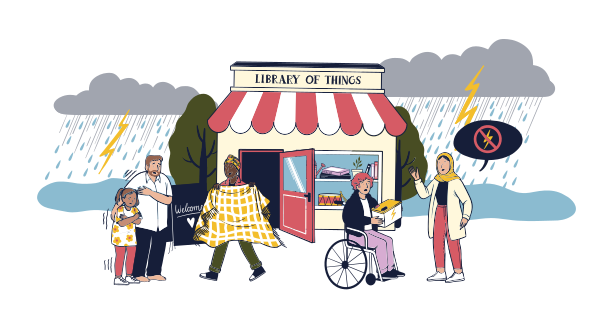
Beyond their daily role in resource sharing, Libraries of Things serve as vital anchors for collective resilience. In an era of increasing environmental and social volatility, an LoT’s inventory and community network become life-saving assets. This section explores how to transition your project from a standard lending model into a proactive hub for disaster preparedness and a reliable engine for community-led mutual aid during times of crisis.
Chapter 1: Preparing for extreme weather
Many steps can be taken to prepare for extreme weather events like ice, snow, wildfire smoke, and flooding. These guidelines will help with preparation, planning, and stocking your LoT to best serve your community if/when crises arise.
Note: This chapter is based on the LoT Co-Lab session, “Winter Weather Preparedness,” hosted in November 2025 by the Tool Library Alliance (TLA) in partnership with Shareable. While it covers scenarios like flooding and winter storms, it is not an exhaustive guide for all disasters. A future session is being planned to feature preparedness tips specific to additional extreme weather events. To access past recordings, stay informed on upcoming sessions, and join the network, please visit the Tool Library Alliance (TLA) online.
Preparing your community
The most effective way to reduce the strain on emergency services is to invest in community education and infrastructure planning long before a crisis occurs. By leveraging its role as a trusted local resource, your LoT can help neighbors move from a state of vulnerability to one of preparedness.
Identify expected vulnerabilities: Climate patterns are shifting in largely predictable ways, allowing us to anticipate future weather emergencies with increasing accuracy. Use tools like the Future Urban Climates Map (developed by Matt Fitzpatrick at University of Maryland) to see what your local climate might look like in 20–50 years. Once you identify these trends, reach out to other LoTs already operating in those climates to learn from their established protocols and disaster response strategies.
Promote weatherization awareness: Encouraging routine maintenance—e.g. caulking, weather stripping, and adding insulation—can significantly reduce home energy loss and improve safety during extreme temperatures. Use your newsletters, social media, and physical space to demystify these tasks and promote the specific items in your inventory that make these upgrades possible.
Leverage utility and government incentives: Many local utility providers and regional governments offer financial incentives or educational resources for energy efficiency and safety improvements. By curating and sharing these resources at your LoT, you become a one-stop shop for both the physical tools and the institutional support residents need to weatherize their homes.
Coordinate community-led response: Preparation isn’t just about physical structures; it’s about social ones. [See Chapter 2 of this section to learn how other LoTs have successfully bridged the gap between basic tool lending and full-scale, community-led disaster response.]
Build partnerships
Connection and collaboration are the bedrock of community resilience. By establishing formal and informal partnerships long before an emergency strikes, your LoT ensures that when a crisis occurs, your response is coordinated rather than reactive.
Engage your community’s human capital
Identify the specialized skills already present in your neighborhood to build a “Rapid Response” talent pool.
- EMS & firefighters are professionals with life-saving technical knowledge.
- Veterans have foundational training in safety, logistics, and response.
- Community centers and resilience hubs can be great logistics hubs, providing space for distribution, education, and response.
- Neighborhood emergency teams (NET) are hyperlocal volunteers trained to provide immediate emergency assistance, before official first responders arrive. They are currently active in many communities.
Local businesses
Local companies are vital neighbors in the resilience ecosystem who can offer financial support and much more! Here are some ideas for how they can help:
- Trade professionals like electricians or plumbers can provide expert advice for weatherization workshops.
- Hardware suppliers can be a primary source for surplus materials and tool-specific education.
- Sponsorship dollars can help fund emergency preparedness programs and demonstrate community support.
City and county programs
Identify public officials responsible for safety and utilities to ensure your efforts are amplified by institutional resources.
- Health and safety departments often have access to grants or overstock supplies—like weatherization kits or first aid kits—that can be redistributed through your LoT.
- Watershed or sewer departments are natural partners for sandbag stations or water shut-off training.
- Emergency management departments are essential for ensuring your LoT’s efforts align with federal and regional disaster strategies, including potential access to federal funds.
- Energy efficiency programs support electrical grid sustainability and natural resource use by reducing waste. They can often provide both funding and guidance.
Conscientious coordinating
A resilient community is a coordinated one, where every group understands how their role fits into the larger picture. Use the “off-season” to connect with emergency responders and city services—such as transportation, water, and waste management—to learn about their established protocols. By understanding these professional response plans, your LoT can identify the best ways to provide mutual support without duplicating efforts or creating bottlenecks. Establishing these lines of communication early ensures that your library is an integrated part of a healthy, cooperative local response network.
Identify who you are serving
Organizational priorities may vary, but we should all be investing in the most vulnerable members of our communities.
Community members
- Houseless people and families: Recognize the additional needs of unhoused people and how you can support them (e.g. waterproofing, drying clothes, hydration, short-term storage).
- People with disabilities: Accessibility is critical! Think about routes free from ice and snow, ramps, communication tools, additional power needs for life-sustaining technology, etc.
- Immigrants: National and international transplants may not have any previous experience with your local weather. Citizens and people on the pathway to citizenship may require additional language support, as well.
- Seniors: Changing ability levels and potential life-supporting technology present many unique challenges. Older people living alone may also get lonely or lack resources and connections to respond to changing conditions.
- Youth: Kids need help, too! Try to provide a place to play or stay that provides emotional and physical safety while their caretakers interact with your LoT. Stocking a variety of age-appropriate games and other kid-friendly items is a valuable resource for families.
Plan ahead!
Still not sure if you should open up in an emergency? That’s the right instinct! Here are a few things to consider before making a commitment to serve your community in a crisis:
Do you have a clear staffing strategy? The right people in the right place at the right time. Sounds simple, right? Consider:
- Reliability: Storm crews should be within walking distance and not have other obligations to deal with in emergencies.
- Connectedness: Get your response team connected with redundancies. Chats, phone numbers, home addresses, walkie talkies. Let them plan independently of top-down control as much as possible.
- De-escalation training: When an emergency is at hand, people lose their cool in the heat and in the snow. If you’re going to open, you’re creating a space for interaction. Unprepared volunteers may make the situation worse. (Consider starting at https://homelesstraining.com/)
Pro tip: Give out water! Not only is hydration healthier, but you can slow down a fear response by signaling a safe space to take a break.
Is pre-lending a better alternative?
Get things where they need to be ahead of the crisis. Wouldn’t that be great? Consider:
- Distributing to trusted networks: Have established neighborhood groups, snow brigade, or a few close-knit library volunteers? Give them the tools to solve problems around town!
- Reciprocity agreements: Ask borrowers to commit to helping a neighbor or two when borrowing a snow blower, roof rake, or evaporative cooler. Or encourage faster returns to help more people.
- Pop-up at grocery or hardware stores: Meet people where they are going anyway so they have fewer stops to prepare for the storm, heat, or emergency.
Communicate
A plan only works if the community knows how to access it. Clear communication prevents confusion, manages expectations, and ensures that resources get to the right places without delay.
- Broadcast status across all channels: Ensure your operating status is visible everywhere—social media, your website, and your email footer. If you anticipate power or internet outages, post your “Last Updated” status early. Don’t forget physical signage on your LoT doors for neighbors who may be walking by without tech access.
- Establish clear boundaries and expectations: To prevent wasting precious time in an emergency, establish your related policies before disasters strike. Be explicit about what your LoT can and cannot provide. If you are a tool-pickup point but not a heated shelter, state that clearly. Clear boundaries allow community members to make informed decisions quickly rather than arriving at your door to find you don’t offer a particular service.
- Sync with local leadership: Keep emergency management services and local officials informed of your activities. By clearly outlining your efforts and capabilities, you ensure they have an accurate map of community resources and don’t accidentally redirect people to you for services you aren’t equipped to handle.
Stop and answer: Do you respond to the bat signal?
- Now that you’ve reviewed common failure points and assessed your readiness, are you a resilience hub or not? If the answer is no, that’s okay! Find out who is and tell everyone where they should go for help in an emergency.
Inventory suggestions
Snow items
Pro tip: Know your snow! Is it heavy? Deep? Icy? Different jobs require different tools.
- Durable shovels: Scoop or push styles, depending on your snow type
- Roof rakes: Some have wheels, others don’t; depth matters
- Snow blowers: Gas-powered is generally preferred, but electric options are available
- Plow heads: For trucks, bikes, barrows
Ice items
- Scrapers and chippers: Long and short for clearing windows, sidewalks, or basements
- Spreaders: Efficiently cast sand, salt, soils, or other slip-resistant materials
- Hair dryers or heat guns: Melting ice is different from melting plastic—recommend the right tool for the right job!
- Ramps: For when the ice won’t clear up; stock many different sizes
- Safety markers: For temporary warnings for temporary danger
Downed tree items
- Chainsaws: Even for those LoTs that opt not to carry chainsaws for safety and liability reasons, you can still help sharpen chainsaws and teach small engine maintenance in your LoT.
- Safety gear: Chaps, face shields, and ear muffs; consider hair sleeves when lending headwear
- Reciprocating saw: Limb blades can extend 14” for small limbs; also make rolling logs easier
- Log peavey: Make it easier to roll trunks and heavy limbs out of the way
- Chippers: Not shredders. This is a high liability tool—if you prefer not to expose yourself to risk, partner with a small business or a city or county department.
Flooding items
- Sump pumps: Remember hoses!
- Shop vacs: Include spoken and written instructions for wet operation; clarify returning in a clean, empty condition
- Carpet blower: Bulky but worthwhile; sizes do vary
- Squeegees: For windows, floors, and anywhere moisture needs to be squeezed out of a flat surface
- Absorbers or socks: Suck up water quickly; reusable
- Barriers: Divert water to protect walkways from overnight freezes
- Five-gallon buckets: Catch drips and bale water (Pro tip: Food-grade lasts longer. Ask your local grocer, deli, or sandwich shop to set aside a few pickle buckets instead of buying new.)
- Transfer pumps: Higher quality versions will last longer. If you’re stocking potable pumps, mark them and keep them separate from non-potable to avoid contamination.
- Hand-powered pumps: Vital stock when there’s no power or for where power can’t reach (Pro tip: Include as many hand-powered pumps as possible–you’ll be glad you did!)
Pro tip: Carry enough flooding items for a group, and consider making a kit for emergency deployment. You can be the hero who saved the roller rink from water damage!
Extreme cold items
- Heaters: Indoor-safe propane heaters exist, like the Little Buddy. Guarantee safety features are included, like carbon monoxide detector shutoff and knockover shutoff.
- Sleeping bags: Hang or store uncompressed to preserve insulating qualities (Laundry facility is needed!)
- Emergency tent: For indoor use, creating multiple heat-trapping layers
- Survival blankets: Durable, fabric-backed versions with reinforced corners
Pro tip: Accepting donations of and then giving away sleeping bags and tents is also a great way to offer mutual aid without ongoing management or replacement needs. Be mindful of educating people on disposal and end-of-life options for damaged goods.
Prep items
- Blow dryers: Used for installing temporary window plastic, a viable alternative for apartment dwellers and income-restricted homeowners
- Efficiency detection tools: Items like infrared cameras and radon detectors empower everyone to improve home performance
- Food preservation: Canning equipment, dehydrators, and smokers are great lending items to reduce food shortages and waste
Power items
Brownouts, downed wires, or rolling blackouts are common in extreme weather events. Provide some solutions for personal and community-scale outages.
- Power banks: USB engines can be charged by car engines; small solar banks can charge devices
- Portable solar: Small and large solar panel options are available
- Extension cords: Outdoor-rated cords with safety information are always preferred!
- Gas generators: Consult your local emergency responders first for recommendations on safety guidelines (fumes and fire hazards abound)
- Electric vehicles: The most portable power options! EV banks are often larger and more useful than home storage banks.
Light items
- Solar-charging lanterns: Inflatable or collapsible models store small and charge fast
- Floodlights and headlamps: Light solutions for all situations
- Portable bonfire kits: Safe solutions for outdoor heating (gas and wood-burning options exist)
Communication items
- Walkie-talkies: Good for pedestrian communications and have unlimited network capacity
- Baofeng radios: Requires training to protect emergency response channels
- Analog social media boards: Pop-up solutions can be deployed, but permanent locations are the most effective
- Speakers and microphones: Boost the party vibe, or the emergency communications!
- WiFi hotspots: Connect your community with these lendable hubs. Bring Your Own Device options do exist, helping reduce e-waste!
Pro-tip: Remind your members (and librarians) to connect to cell phone alert systems.
Fun items (for mental health)
- Board games: Durable options with minimal pieces work best. Bonus points if it keeps you warm and active.
- Mending, sewing, and craft kits: As long as you’re not working, fix something!
- Age-range play kits: Consider toddlers, K–2, 3–5, 6–9, and older teens. Remember to skip the ones that require power or make sure you supply batteries with the kits.
- Books: Host a book club during the storm, and plan to come together for a discussion when things stabilize.
- Sleds: Some LoTs and public libraries caution against safety concerns, with even helmets presenting some risks, like headlice. You know your own community best!
Food items
- Solar ovens: Box cookers, panel cookers, parabolic concentrators, and evacuated tube cookers exist. Try to stock all styles, as they all work differently.
- Portable stoves: Camp cookers, pocket rockets, and other options exist. Remember cleaning, maintenance, and safety instructions!
- Portable water jugs: Support warm and cold water distribution with large drink dispensers.
- Hot water carafes: Storing hot water is energy-saving and mood-improving. We recommend restricting these to water only for tea and noodles. Coffee can leave a bad aftertaste over time, reducing the longevity of your items.
DIY support items
- Maintenance tools: Encourage sharpening and other upkeep of tools year-round, including members’ personal tools. You never know when you’re going to need them!
- DIY books and DVDs: Help your community build household resilience, and encourage them to develop solutions directly.
Emergency Battery Network Toolkit
In 2023, Shareable partnered with People Power Battery Collective to create the Emergency Battery Network Toolkit to help organizers like you build strong and effective backup power supplies owned by local communities.
This toolkit is based on the work that was done by People Power Battery Collective (a project of People Power Solar Cooperative), who were a self-organized mutual-aid collective in the San Francisco Bay Area. Their purpose was to provide backup electricity to support people who are facing power emergencies.
Members of an emergency battery network safely keep backup batteries until there is a need for power in the community. In response to power emergencies, the person in need connects with the battery holder and arranges delivery. When the emergency passes, the person who received power will recharge the battery to share with the next person experiencing a power emergency, creating an ebb and flow of resourcing within the community.
Much like this Library of Things Toolkit, the Emergency Battery Network Toolkit is based on the recordings of the 2023 Emergency Battery Co-Lab and includes all trainings (edited into bite-sized chapters), summaries of each lesson (including key takeaways), graphic recordings, customizable templates, and other resources.
Chapter 2: Mutual aid and community-led disaster response
When Libraries of Things align with mutual aid networks, they transform from simple service providers into vital civic infrastructure. This chapter draws on the real-world experiences of Central Florida Mutual Aid, Asheville Tool Library, the Western North Carolina (WNC) Repair Café, and Mutual Aid Disaster Relief (MADR) to show how these partnerships function under pressure. Their success during crises highlights a common blueprint: start with the resources you already have, keep your systems simple, and define volunteer roles clearly before they are needed. When an LoT operates as a trusted hub built on shared responsibility, the community doesn’t just wait for outside help—it finds the tools and the power to support itself.
Central Florida Mutual Aid
Central Florida Mutual Aid (CFMA) is a mutual aid collective of individuals organizing to meet each other’s basic needs. They are based primarily in Orange, Seminole, and Osceola counties in Florida, U.S., though anyone is able to join. CMFA offers multiple programs and services including:
- Solidarity fund: Redistribute funds to anyone requesting support with housing, shelter, food, medication, transportation, etc.
- Trans safety fund: Anyone who lives in the state of Florida can receive shelter, food, gender-affirming care, and support for leaving the state
- Monthly sustainability gathering: Garden brigade and skill shares with Blue Trunk Community Network
- Workshops: Cover financial topics to create more financial security
- Mesh network: Mesh networks can share web connections throughout a neighborhood, spreading the reach of a broadband connection
Hurricane Ian
The CMFA Tool Library was formed after CMFA completed its recovery work in the aftermath of Hurricane Ian in 2022. This support consisted primarily of mucking and gutting homes, which involved an abundance of tools that people and organizations, like Mutual Aid Disaster Relief, donated. This included hammers, shovels, and other miscellaneous tools.
In the beginning, members were accessing tools as needed, but there was no formal system. Over time, CMFA realized they had a large enough collection of tools that they could turn it into a public tool library. After Shareable gave them a generous grant as part of the Library of Things fellowship, they were able to grow their inventory to over 200 tools in their small, 15-by-20-foot storage facility. Their small collection of items will enable them to be properly prepared if another hurricane comes through their community. Their collection includes:
- Hurricane preparation and recovery: Lithium battery-powered tools for home and yard maintenance
- Recreational items: Arts, crafts, camping, and games
- Health care equipment: Medical equipment, rolling walker
- Reliable chargers: Solar-powered battery items, power banks, and a generator
- Portable home goods: Washing machine, air movers, and fans
How the CFMA tool library works
- Membership is a $20 donation
- Open on the first and third Sundays of the month, from 12-2pm, and by appointment
- Run by at least two volunteers at a time
- People have to text in order to get into the locked facility
- Items are due whenever they open next
- Has received funding from membership donations, grants, and sliding scale workshops
Rapid response partnership: Asheville Tool Library + Western North Carolina Repair Café
Asheville Tool Library
The Asheville Tool Library (ATL) in North Carolina, U.S. was conceptualized in 2013 and engaged in an extensive planning and organizing phase until its official launch in 2016. Since then, they’ve grown to over 1,300 members and 3,000 tools in inventory. With two part-time staff and a powerful team of volunteers, ATL is open four days a week.
ATL also has:
- Entirely volunteer-powered maintenance department that services its tools under the guidance of part-time staff
- New community art space that hosts skillshares, workshops, and open craft nights
- Designated days when people can come in and use some of the bigger machines
- Seeds of Solidarity group that is working on a community garden and seed library
- Workshop and skillshare programs
- New community firewood program that processes and delivers firewood for winter heating
Western North Carolina (WNC) Repair Café
The WNC Repair Café was founded in 2018 and began hosting repair events. They are ongoing partners of ATL and often set up a mobile repair space out of the tool library, as well as public libraries and community colleges. They also have regular sewing and mending events for clothing.
The WNC Repair Café is not just about providing a service, but also about helping educate and demystify the process of repair. Participants are encouraged to learn from the fixers and leave with newfound confidence in trying to DIY repair for themselves in the future.
Hurricane Helene community-led response
In September 2024, most people were unprepared when Hurricane Helene hit western North Carolina. It caused catastrophic landslides, flooding, massive infrastructure and property damage, and several fatalities. Neither ATL nor WNC Repair Café had any sort of planned disaster relief response ahead of the storm. There was no internet or electricity, and the roads in most of the area were entirely impassable—communities were completely cut off.
Fortunately, ATL had a powerful solar setup with Goal Zero Yetis, and Shelby Treichler, an ATL and WNC Repair Café volunteer, was able to access it quickly after the hurricane hit. They were able to take it out into the community and start providing power from a spot in town that had service. While Shelby sat there for six hours providing power, she learned about a community meeting at Firestorm, a local anarchist bookstore and community center.
Folks who had experience organizing put together a system of pages with different categories of needs and offers (e.g. medical, food, water, and transportation). People wrote down things that they could offer the community, what was desperately needed, where they would be, and how long they would be there. If someone could respond within the time frame, they would help.
Repairing chainsaws and generators
Immediately, it was clear that generators and chainsaws were doing lifesaving work, clearing roads, getting trees off of houses, and bringing access to people. Dan (founder of WNC Repair Café) and Shelby set up a Repair Café at Firestorm to begin helping the community with these vital fixes to chainsaws and generators. Their repair services were picked up over the radio, and word spread quickly.
As people visited, they heard stories about communities hit by the disaster and realized they needed to take their repair events directly to the hardest-hit areas. Over one month, four to five repairers went to 11 different spaces and worked on over 600 chainsaws and generators with a repair success rate of about 90%.
Tool library hub
ATL became a learning hub and a place for folks to donate tools in the aftermath of the hurricane. At the ATL:
- People brought food, water, and gasoline
- Skill Academy for Women taught basic chainsaw safety courses. They completed four in the month and had over 250 participants to help reduce the spike in chainsaw-related injuries during this time.
- Oregon Tools donated personal protective equipment (PPE)
- Mutual Aid Disaster Relief provided support on how to respond to a crisis and get information out to folks.
When they received tool donations during the response, they generally chose not to track them. The most important thing was to get those items where they were needed in the community as soon as possible. Exceptions were made for a few items that they wanted to lend to multiple people during the initial response or that they knew they would want to add to their collection long term.
Managing lending without the internet
Before the storm, ATL had already physically labeled all tools to match their myTurn database. When the internet went down, they utilized a simple “trust-based” system:
- Access: Active volunteers used existing door codes to enter the space at any hour
- Manual tracking: Volunteers wrote their names and the items they were taking on post-it notes
- Digital sync: A volunteer/board member later took the notes home to a location with working wi-fi to manually enter the checkouts into the digital system
Centralized hub: Mutual Aid Disaster Relief (MADR)
When Hurricane Helene hit, Mutual Aid Disaster Relief (MADR)—a grassroots network that provides disaster relief based on the principles of solidarity and mutual aid rather than top-down charity—was uniquely positioned to help. They already shared an established space directly beside the Asheville Tool Library, which enabled a swift and seamless transition into crisis response.
Shift to a fulfillment center
Disaster response often brings a massive influx of donations and volunteers. While valuable, this support can become overwhelming without a clear strategy. Recognizing this, MADR pivoted from their initial plan of conducting mobile supply drops and well repairs to operating as a centralized fulfillment center. By directing all donations to one physical location, they could focus on efficiently sorting and dispatching supplies to the community spots that needed them most. Once their role was clarified, they used flyers to spread the word and ensure neighbors knew exactly where to go for help.
Being located behind ATL and the WNC Repair Café created a powerful partnership. This allowed them to:
- Access chainsaw chaps
- Support chainsaw crews clearing roads and mountain passes
- Help ensure community members can access medication, food, and water
Creative volunteer system
As volunteers arrived with high energy and good intentions, MADR recognized the need for clear delegation. A turning point occurred when a long-term volunteer began wearing a Pikachu hat found in a donation truck while organizing supplies. When someone needed direction, a coordinator naturally said, “Go talk to Pikachu.”
This moment sparked a realization: in a disaster, visual clarity and defined roles are essential, leading to a creative system to organize the chaos. By assigning each volunteer a “code name” paired with specific color codes and icons, MADR created a functional map of the human resources in the room. This allowed anyone—even a brand-new volunteer—to scan the crowd and immediately identify the right person to talk to without needing to interrupt the flow of work.

MADR’s defined roles and codenames are still being used in their response plan today! Here are some role examples:
- Comms Octopus: Coordinated logistics and communication behind the main desk.
- Hedgehog: Assigned specific tasks to incoming new volunteers.
- Bay Bees: Generated receipts and organized the constant flow of incoming donations.
- Fulfillment: Processed requests, built supply pallets, and dispatched runners.
- Runners: Handled the physical pickup and delivery of requests.
- Fixers: Focused on repairing broken equipment.
- Medic: Managed higher-level medical needs and coordinated with external medical collectives.
Lessons learned
The following insights were gathered from the real-time experiences of the Hurricane Helene response in Asheville. The following can help any Library of Things transition from daily operations to crisis response:
Build systems that fit the situation: Organizations often find themselves in new roles during disasters. Because of the urgency, success often comes from “learning by doing” and refining systems over time. Establishing clear roles—e.g. Coordination, Volunteer Management, Communication, and Administration—creates a repeatable workflow. This structure allows new volunteers to step in immediately without needing to understand every complex detail, which is essential for preventing burnout and emotional strain.
Create strong communication systems: In the early stages of a crisis, disconnected communication tools often lead to duplicated work and missed info. Testing these systems during the “off-season” is vital. In Asheville, centralized tracking systems allowed multiple hubs to successfully coordinate the distribution of medication, the dispatch of repair crews, and the delivery of food, water, and shelter.
Nurture community bonds: Emergencies have a unique way of dissolving barriers. Many organizations observed that collective organizing capacity increases when basic needs are at stake. Shared challenges make differences seem less important! Mutual aid efforts thrive because they provide a common ground for survival and recovery.
Create space for rest and emotional care: Building rest into disaster response systems supports long-term sustainability and reduces burnout. It’s important to create a quiet space where people can step away, reset, and take breaks without unnecessary interruption.
Build a web of shared responsibility: True preparedness is tied to connection. LoTs serve as natural hubs for trust and coordination, but shared tools require maintenance and collective care. When a group—rather than an individual—takes responsibility for these resources, it reduces personal stress and increases the community’s total capacity to respond. Sharing the “load” of maintenance and access creates more resilience for everyone.
Starting an LoT as a mutual aid group
The most effective way to begin is by taking stock of the resources your community already holds. You will likely find that neighbors possess a wealth of useful items they are eager to contribute—often because they would rather see a tool put to communal use than have it taking up space in their own home. Starting with these internal contributions allows your LoT mutual aid infrastructure to grow organically from within before seeking outside donations.
As the library grows, serving a large geographic area can become a logistical challenge. To manage this, consider creating a network of local hubs. Trusted members with available garage or storage space can host small, specialized collections of tools. This “neighborhood branch” model makes access easier for residents and ensures that the workload of maintenance and coordination is distributed across the community rather than falling on a single location.
The scale of the Asheville response might look like a massive operation, but it was really just a local LoT and its partners using the systems they already had in place. You don’t need a fleet of trucks or a disaster mandate to start—you just need the tools and the people you already have. Every time you lend a piece of equipment or connect two neighbors, you are training for a crisis. Transitioning to a mutual aid mindset isn’t about reinventing your library—it’s about recognizing that your LoT is already the infrastructure! Now, it’s just a matter of adding the coordination that turns a collection of tools into a community lifeline.
Collective resilience: Resources, templates, and videos
Winter weather preparedness resources and templates
- Future Urban Climates Map (What will climate feel like in 60 years?)
- Appropedia
- TechSoup Donation Program | Donated Devices | Mobile Beacon
LoT Co-Lab: Winter weather preparedness
Video recordings
- Part 1: Preparing your community [3:03]
- Part 2: Partner up [2:55]
- Part 3: Who are you serving? [3:48]
- Part 4: Plan ahead [5:46]
- Part 5: Do you respond to the “bat signal”? [1:00]
- Part 6: Selecting inventory [28:24]
- Part 7: Emergency Battery Network toolkit case study [3:36]
- Part 8: Q&A [6:55]
Mutual Aid and community-led disaster response resources and templates
- Video recording of “Mutual Aid 101: Tool Libraries, Mutual Aid & Community-Led Disaster Response”
- Central Florida Mutual Aid Tool Library
- Central Florida Mutual Aid link tree
- Central Florida Mutual Aid Tool Library link tree
- Asheville Tool Library
- WNC Repair Cafe
- Meshtastic.org
- Mutual Aid Disaster Relief
- Shareable’s Mutual Aid 101 Toolkit
- The Response podcast: Fighting misinformation in the aftermath of the Mexico City earthquake
- Mutual Aid Disaster Relief Smith Millworks Distribution Hub “Hub Guide”
LoT/Mutual Aid Co-Lab: Tool Libraries, Mutual Aid and Community-led Disaster Response
Video recordings:
🛠️ Conclusion: Now What?

Whew—that was a lot of information! If you’re feeling a mix of overwhelm and excitement, you’re right where you need to be. Building a Library of Things is a marathon, not a sprint, and it’s a journey meant to be shared. You don’t have to implement all 200+ pages today, this year, or even the next handful of years! This toolkit is meant to be here for you when you’re ready.
The first step
Before you dive into the technicalities, find your people. Whether it’s a core group of three neighbors or a partnership with a local nonprofit, leaning on a team is the only way to make this sustainable. Start with one conversation, one tool, or one community meeting.
Stay connected
You are part of a growing global movement of practitioners who are (or have been) in a similar situation as you. Lean on these communities for advice, troubleshooting, and solidarity:
- Register for the international Tool Library Google Group (1,600+ members!).
- Check out The Tool Library Alliance, a U.S.-based alliance that holds monthly learning sessions open to anyone.
- If you’re working in (or with) a public library, you can join the LoT Mutual Aid Google Group (540 members) and check out the LoT Mutual Aid YouTube channel.
- Join these groups on Facebook: Tool Libraries & Libraries of Things: A Global Movement (~480 members), Lend Engine Libraries of Things Administrators (~780 members), and Library of Things (~1,700 members). These are all great places to look through the archives of previous discussion threads and ask new questions that haven’t been addressed yet.
- Plus, if you use Reddit, check out the subreddit for tool libraries. These are all great places to look through the archives of previous discussion threads and ask new questions that haven’t been addressed yet.
Share your progress
Please let us know if you use this Toolkit, and if you have suggestions for other resources we should include, by contacting info@shareable.net. And revisit this page, as we’ll continue to add the new videos, resources, and toolkits.
🛠️ Credits
Project team
- Written by Leanna Frick, Josh Epstein, Anna Marie Wing, and Jason Naumann with Alison Huff, Paige Kelly, Tom Llewellyn, Bobby Jones, Aaron Fernando, and Madelyn Kelly (based on Co-Lab sessions delivered by the presenters listed below)
- Edited by Paige Kelly, Tom Llewellyn, Alison Huff, and Bobby Jones
- The Shareable Library of Things Co-Lab was coordinated by Candice Spivey and Tom Llewellyn with additional communications, operations, and fundraising support from Paige Kelly, Alison Huff, and Bobby Jones. The continued LoT Co-Lab (17-23) was led by the Tool Library Alliance, including Darren Cotton, Josh Epstein, Leanna Frick, Amanda Miller, and Jason Naumann
- All videos were produced by Paige Kelly and Madelyn Kelly with support from Candice Spivey and Tom Llewellyn
- Toolkit designed by Paige Kelly
- Toolkit illustrations and cover art by Anke Dregnat
Advisors
- Amanda Miller, South King Tool Libraries
- Emma Erwin, Circular Communities Scotland
- Gene Homicki, myTurn
- Jason Naumann, Green Lents and Rockwood Common
- Kelley Dennings, The Center for Biological Diversity
- Leanna Frick, Station North Tool Library
Library of Things Co-Lab presenters
- Getting started – Amanda Miller of South King Tool Libraries
- Getting things – Jason Naumann of Green Lents and Rockwood Common
- Operations – Leanna Frick of Station North Tool Library
- Volunteers – Josh Epstein of Seattle REconomy and Jessa Wais of Station North Tool Library
- Space – Steve Bade of Toolbox Project, Amanda Miller of South King Tool Libraries, and Keenan Philips of Asheville Tool Library
- Membership – Tim Willison of TTL Makerspace, Toronto Tool Library, and Oddly Studios, Keenan Philips of Asheville Tool Library, Jason Nauman of Green Lents and Rockwood Common
- Income generation and operational budgeting – Leanna Frick of Station North Tool Library, Amanda Miller of South King Tool Libraries, and Josh Epstein of Seattle REconomy
- Governance – Leanna Frick of Station North Tool Library
- Communications, branding, and marketing – Darren Cotton of The Tool Library
- Going mobile – Anna De Matos of Munassfn RVK Tool Library, Mirella Ferraz of The Share Shed and Network of Wellbeing, and Amanda Miller of South King Tool Libraries
- Workshops and classes – Jenn Kim of Station North Tool Library and Barrett Ihde of Seattle REconomy
- Public libraries – Hazel Onsrud of Curtis Memorial Library
- Fix-it fairs, Repair Cafés, and more – Tatjana Uskokovic of La BOM (Montreiul Library of Things), Kami Bruner of Repair X Reuse WA, Jessa Wais of Station North Tool Library
- Community governance – Leanna Frick of Tool Library Alliance and Kate Hersey of Minnesota Tool Library
- Digital fundraising – Leanna Frick of Tool Library Alliance and Darren Cotton of The Tool Library
- Grants – Amanda Miller of South King Tool Libraries
- Environmental impact tracking – Gene Homicki of myTurn and West Seattle Tool Library, Laura Novich of Hyloh and Untangling Circularity, Chris Hellawell of Edinburgh Tool Library
- Earned revenue streams – Ava Lim of Shoreline Tool Library and Darren Cotton of The Tool Library
- Partnerships – Achille Bianchi of Carhartt Workshop; Josh Epstein of Seattle REconomy and Jason Naumann of Green Lents and Rockwood Common
- Staffing structures and hiring – Kate Hersey of Minnesota Tool Library
- Community service volunteers and internship management – Darren Cotton of The Tool Library
- Tool libraries, mutual aid, and community-led disaster response – Rachel Kinbar of Central Florida Mutual Aid, Shelby Treichler of Asheville Tool Library and WNC Repair Cafe, and Ben Wyatt of Mutual Aid Disaster Relief
- Winter weather preparedness – Hazel Onsrud of Curtis Memorial Library and Jason Naumann of Green Lents and Rockwood Common
Additional editing by Steve Bade of Toolbox Project, Amanda Miller of South King Tool Libraries, Jason Naumann of Green Lents and Rockwood Common, Josh Epstein, Seattle REconomy, and Hazel Onsrud of Curtis Memorial Library.
Additional contributions were provided by Greg Stone, Vancouver Tool Library (top tool list), Rayden Sorock, Grow Pittsburgh (top tool list), Tina Jenkins Bell (The Making of La BOM), Chandler Poole, Kelley Dennings, and Malia Becker (A guide to starting a Library of Things on campus).
Special thank you to the Tool Library Alliance for collaborating on this project.
About Shareable
Shareable collaborates with organizers and allies to imagine, resource, network, and scale cooperative projects. We envision a just, connected, and joyful world where sharing is daily practice and communities flourish.
Shareable was founded in 2009 during the Great Recession, when, out of necessity, many in the U.S. were rediscovering the ancient-but-neglected daily practice of sharing. Inspired by a fragmented but growing culture of sharing, co-founders Neal Gorenflo and Laurie Schecter launched Shareable to uplift and connect the stories and lessons of this emerging movement.
Shareable quickly became a go-to source for news and how-to guides about the “sharing economy.” From the beginning, we paired solutions journalism with organizing to build a sharing community. In 2013, we launched the Sharing Cities Network—a group of local organizers leading sharing projects around the world—which led to the publication of Sharing Cities: Activating the Urban Commons in 2018 and the development of municipal programs in more than 100 cities.
Today, Shareable continues to publish articles, podcasts, and how-to guides that amplify the people and ideas shaping a world where sharing is a daily practice and communities flourish.
Shareable’s organizing work is currently focused on:
Sharing Hubs & Infrastructure
We’re working to establish sharing hubs like Libraries of Things in every community. Whether it is a simple how-to guide; our comprehensive Library of Things Toolkit; incubating the Tool Library Alliance; or partnerships to scale Libraries of Things in universities and affordable housing, we’re developing useful tools so every community can create infrastructure for sharing.
Mutual Aid
We’re working to build capacity and to network mutual aid projects across the US and around the world. Whether it is sharing stories on our award-winning podcast The Response; our ongoing Mutual Aid 101 learning series and toolkit; or partnerships to build capacity for mutual aid disaster resilience, we’re developing resources and networks to build communities of care.
Co-op Sector
We’re working to support and strengthen democratic, community-controlled cooperative businesses and organizations. Whether it is educational partnerships like the Social Co-op Academy; piloting Food Assistance Co-ops; fighting to modernize and democratize local Electric Co-op Utilities (the second largest co-op sector in the US); or restructuring our own organization as a worker self-directed nonprofit, we’re shifting the narrative toward cooperative governance.
Learn more about the Shareable staff and board on our website.
Use, remix, and share this Toolkit
This toolkit was published by Sharing, Inc (DBA Shareable) in March 2026 with a Creative Commons license (CC BY-NC-ND 4.0.) You may copy and redistribute the material in any medium or form under the following terms:
- Attribution — You must give appropriate credit, provide a link to the license, and indicate if changes were made. You may do so in any reasonable manner, but not in any way that suggests the licensor endorses you or your use. This includes providing a link to THIS original Toolkit on Shareable.net.
- NonCommercial — You may not use the material for commercial purposes.
- No Derivatives — If you remix, transform, or build upon the material, you may not distribute the modified material.
If you’re interested in the use of Shareable’s material outside of our CC license, please email us: info@shareable.net. We allow our material to be remixed or republished commercially on a case-by-case basis.
🛠️ Appendix
Resources and templates
1. Getting started
- Start-up reflection guide
- Stakeholder Mapping Exercise
- Community Needs Assessment Guide
- Recommended reading:
- Earth for All: A Survival Guide for Humanity, Sandrine Dixson-Declève, Owen Gaffney, Jayati Ghosh, Jørgen Randers, Johan Rockström, and Per Espen Stoknes.
- Palaces for the People, Eric Klinenberg
- A Brief History of Equality, Thomas Piketty
- Creative Confidence, Tom Kelley & David Kelley
- Emergent Strategy: Shaping Change, Changing Worlds, adrienne maree brown
2. Getting things
- Green Lents Tool Repair Procedural – Who, Where, & How to Maintain
- Toolbox Project Inventory Development Policy
- What is a Collection Development Policy?
- Repair Workflow
- Most Popular Tool Library Items
- MAP-Tool Hospital
3. Space
4. Going mobile
- Share Shed Toolkit
- Share Shed website
- Share Shed promo video
- The Circular Library Network website
- Circular Library Network kiosk hardware – limited availability in 2025
- Circular Library Network kiosk promo video
- The Digital Kiosks Resource Hub
- Lending and community building at The Thingery – Shareable article
- Discover Containers
5. Branding and communications
- Materials examples from Co-Lab presentation
- TL_Brand Guidelines_Jan 2023
- TL_Annual Report_2022
- Media release form (template)
- Marketing tools and resources:
- Canva offers free nonprofit subscriptions for easy graphic design. You can store your brand colors, logos, and templates here as well. It also includes integrated QR codes.
- Through TechSoup, you can access discounted graphic design software, including Adobe products
- The Noun Project provides icons and other resources for infographics
6. Operations
- SNTL Articles of Incorporation
- SNTL Bylaws
- SNTL Code of Conduct
- SNTL Emergency Procedures
- SNTL Employee Handbook
- SNTL Sample Liability Insurance Application
- SNTL 1023 Filing
- SNTL Waiver
- Nonprofit Public Document Checklist
- Fiscal Sponsorship agreement
- Nonprofit software discounts:
- TechSoup – a clearinghouse for free and discounted software and hardware, including Adobe, QuickBooks, Microsoft, and other major brands.
- Canva – free cloud-based graphic design software.
- Google Business for Nonprofits – free email and other Google apps.
- Google Ad Grants – free credits for 501c3’s toward paid targeted ads.
- Asana – discounted project management software for nonprofits.
- Salesforce – “free” client resource management database (requires a lot of setup and maintenance, usually from someone who has extensive experience with Salesforce for nonprofits)
7. General governance
8. Community governance
- Board Support Goals
- Board Annual Business Calendar (Public)
- Strategic Planning Goals/Metrics
- Strategic Plan Progress Dashboard_REconomy (Public)
- Staff Feedback/Input
- Cooperative Governance Primer (UW Center for Cooperatives)
- Co-Leadership (Oxford HR Report)
- NP Governance Resources (Twin Jett)
- Minnesota Tool Library Get Involved
- “Do-Acracy” at the Asheville Tool Library (Public)
9. Membership resources
10. Volunteers resources
- Seattle REconomy Tool Library Staffing template
- Sample Volunteer Form
- Sample Volunteer Landing Page
- Librarian Handbook 2024
- SNTL Code of Conduct
11. Structured volunteer and internships
- Job Descriptions & Project Plans
- Marketing Materials
- Minnesota Tool Library Tools for Life
- Bonner Program
12. Staffing
- Understanding your Form 1099-K
- About Form 1099-NEC, Nonemployee Compensation
- Proper Classification of 1099
- Steps for Hiring a 1099 Employee (Plus What Forms are Required)
- Hiring Your First Employee
- Living Wage Calculator
- Justworks (Shareable benefits referral link)
- Staff Roles
- Station North Tool Library Employee Handbook
- Staffing Resources
13. Income and budgeting
- Budget Template
- Case for Support Template
- Nonprofit Public Document Checklist
- SKTL Operating Budget 2019-2024 (2019)
- SKTL Operating Budget 2019-2024 (2023)
- Tool sale volunteer signup template
- Fundraising and finance resources:
14. Fundraising
- Givebutter
- Station North Tool Library Fundraising Toolkit
- Station North Tool Library Member Social & Open House
- Station North Tool Library Building toward 2024
- Station North Tool Library Knife Shop Consumables Fund
- The Denver Tool Library Startup
- Toronto Tool Library Keep the Tool Library Alive
- GloablGiving
- Minnesota Tool Library MightyCause
- Saint Paul Tool Library ioby
15. Earned revenue streams
- Tool Library Alliance
- Shoreline Tool Library
- Fix-It Fair Budget Model
- Tool Sale Case Study
- Dare to Repair Café Liability & Feedback Form
- Tool Library Alliance – Comprehensive Data
16. Grants
- Purpose-Driven Bio Worksheet
- Letter of Intent Draft
- Budget Template
- Capital Project Budget/Cost Proposal
- Grants.gov
- Foundation Directory Online
- Candid
- Guidestar
- Philanthropy News Digest
- GrantStation/Instrumentl
- Tech Soup
- Census
- Living Wage Calculator
- Federal Financial Assistance
17. Environmental impact tracking
- myTurn Impact Reporting Resources
- donateNYC Reuse Impact Calculator
- Waste Reduction Model
- US Environmentally-Extended Input-Output (USEEIO) Models
- The Untangling Circularity Podcast
- Carbon Data for Sharing Libraries
- Zero Waste Scotland
- The Circular Communities Scotland Share and Repair Network
- Environmental Benefits of Tool-Sharing
- Share and Repair Network Sharing Library Impact Survey Report
- Zero Waste Scotland Producer Responsibility for the Circular Economy
- Library of Stuff
- Emission Factors for Greenhouse Gas Inventories
- Reuse Minnesota Impact Report
18. Partnerships
19. Public library partnerships
- Libraries of Things at libraries around the world video series
- Brooklyn Public Library Tool Waiver
- Library of Things Collection Development Policy_Curtis Memorial Library
20. Workshops and classes
- SNTL Class Recipe Book
- SNTL Instructor Job Description
- SNTL Scholarship Fund
- SNTL Workshop Take-Home Guides
21. Repair events
- Check-in/Check-out Template (Repair Economy NW)
- Volunteer Liability Waiver (Repair PDX)
- Participant Waiver (Repair PDX)
22. Winter weather preparedness
- Future Urban Climates Map (What will climate feel like in 60 years?)
- Appropedia
- TechSoup Donation Program | Donated Devices | Mobile Beacon
23. Mutual aid and community-led disaster response
- Video recording of “Mutual Aid 101: Tool Libraries, Mutual Aid & Community-Led Disaster Response”
- Central Florida Mutual Aid Tool Library
- Central Florida Mutual Aid link tree
- Central Florida Mutual Aid Tool Library link tree
- Asheville Tool Library
- WNC Repair Cafe
- Meshtastic.org
- Mutual Aid Disaster Relief
- Shareable’s Mutual Aid 101 Toolkit
- The Response podcast: Fighting misinformation in the aftermath of the Mexico City earthquake
- Mutual Aid Disaster Relief Smith Millworks Distribution Hub “Hub Guide”
LoT Co-Lab videos (self-paced online course)
1. Getting started
- Presentation transcript
- Presentation slide deck
- Video recordings
2. Getting Things
- Presentation transcript
- Presentation slide deck
- Video recordings
3. Space
- Presentation transcript
- Presentation slide deck
- Video recordings
4. Going mobile
- Presentation transcript
- Presentation slide deck
- Video recordings
5. Branding and marketing
- Presentation transcript
- Presentation slide deck
- Video recordings
6. Operations
- Presentation transcript
- Presentation slide deck
- Operations video recordings
7. General governance
- Presentation transcript
- Presentation slide deck
- Governance video recordings
8. Community governance
- Presentation transcript
- Presentation slide deck
- Video recordings
9. Membership
- Presentation transcript
- Presentation slide deck
- Video recordings
10. Volunteers
- Presentation transcript
- Presentation slide deck
- Video recordings
- Part 1: Power of volunteers [2:06]
- Part 2: Common volunteer roles in LoTs [1:34]
- Part 3: Common issues of volunteer management [3:06]
- Part 4: Recruitment [3:42]
- Part 5: Communication and ongoing management [7:32]
- Part 6: Purpose [5:59]
- Part 7: Building community [6:17]
- Part 8: Questions to chew on [0:59]
- Part 9: Q&A [14:47]
11. Structured volunteer and internships
- Presentation transcript
- Presentation slide deck
- Video recordings
- Part 1: Background [2:00]
- Part 2: Volunteer roles [1:38]
- Part 3: Sourcing volunteers [26:07]
- Part 4: Creating a compelling case for volunteers [2:25]
- Part 5: Mentorship and check-in structure [2:53]
- Part 6: Celebrating and sharing outcomes [3:08]
- Part 7: Potential challenges [4:26]
- Part 8: Apprenticeship models [4:15]
- Part 9: Discussion and brainstorm [3:04]
- Part 10: Q&A [7:52]
12. Staffing
- Presentation transcript
- Presentation slide deck
- Video recordings
13. Income generation and operational budgeting
- Presentation transcript
- Presentation slide deck
- Video recordings
14. Fundraising
- Presentation transcript
- Presentation slide deck
- Video recordings
15. Earned revenue streams
- Presentation transcript
- Presentation slide deck
- Video recordings
16. Grants
- Presentation transcript
- Presentation slide deck
- Video recordings
17. Environmental impact tracking
- Presentation transcript
- Presentation slide deck
- Video recordings
18. Partnerships
- Presentation transcript
- Presentation slide deck
- Video recordings
19. Public libraries
- Presentation transcript
- Presentation slide deck
- Video recordings
20. Workshops and classes
- Presentation transcript
- Presentation slide deck
- Video Recordings
21. Repair events
- Presentation transcript
- Presentation slide deck
- Video recordings
22. Winter weather preparedness
- Presentation transcript
- Presentation slide deck
- Video recordings