
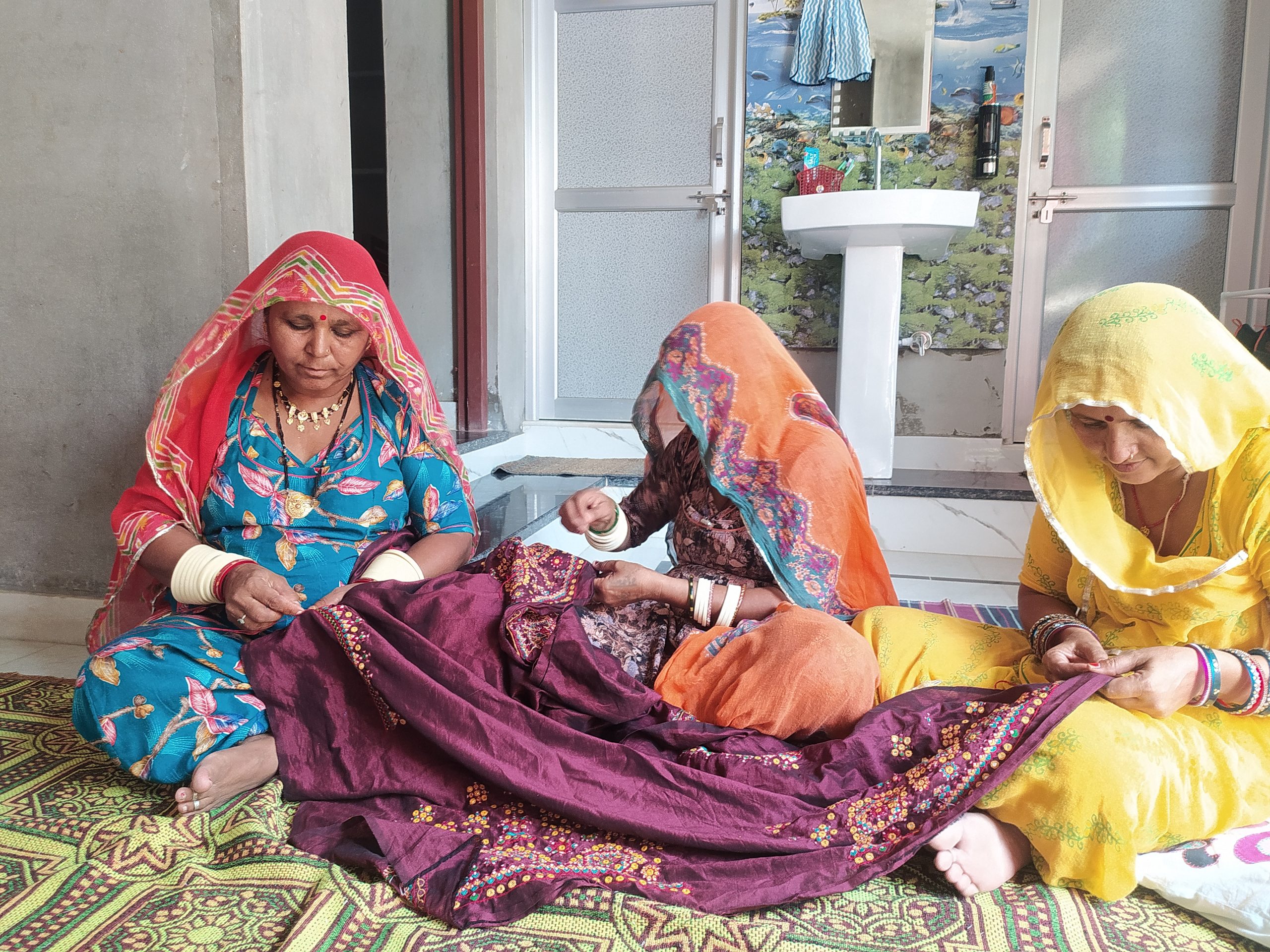
Inside a modest home in Indira Nagar, a neighborhood in the border district of Barmer in India’s western state of Rajasthan, several women gather in a small room one afternoon, preparing their needles and yarns for the hours of work ahead.
The women have gathered, as women in these villages often do, to work through a batch of orders, moving between one another’s homes to stitch, talk, and help one another along.
They work side by side, their hands carry needles tethered to brightly colored threads that dive from one stitch into the other. The intricate motifs and patterns they sew onto clothing and handkerchiefs are part of the traditional Sindhi embroidery, often passed down from grandmothers and mothers to daughters.
This year, we’ve seen Mutual Aid in Motion.
From scaling sharing hubs to Mutual Aid 101 trainings, we’re helping communities build the tools they need.
Every dollar fuels lasting resilience – proving that when we move together, we all move forward.
The embroidery fits into the edges of the day. Cooking, cleaning, washing utensils, tending livestock, and minding children fill most of the hours, and only once that work is done do the women find a few hours to sit down to the craft that has become the foundation of their income and dignity.
The women in that room are among thousands of Pakistani Hindu artisans in Rajasthan’s border districts who turned Sindhi embroidery into a livelihood after fleeing Sindh, many of them escaping religious persecution. Between 20,000 and 25,000 Pakistani migrants have settled in the state. Their handiwork feeds Rajasthan’s ₹750 crore ($100 million) handicraft export economy, recorded between April and August of 2023-24, part of India’s larger $1.8 billion handicraft sector in fiscal year 2024. Yet most of the craftswomen earn barely ₹150 a day ($1.67), far below the state’s legal minimum wage of ₹285 ($3.18) for so-called unskilled workers.
For decades, a chain of middlemen and exporters has stood between the artisans and the buyers who prize their work, setting piece rates, controlling access, and keeping most of the value the women create. Now, grassroots cooperatives are testing whether that chain can be rebuilt, and whether a craft born of displacement can become a way out of poverty rather than a trap within it.
Among the women is Neeta Devi Meghwal, whose family has carried the craft across three generations. She learned embroidery from her mother, taught it to her daughter, and has since trained her daughters-in-law.

She recounts how her family migrated to India from Jhande Ka Tala village in Pakistan’s Sindh region during the 1971 war. The conflict, which ended in the creation of Bangladesh, also saw Indian forces occupy large stretches of Sindh’s Tharparkar district along the Rajasthan border, pushing tens of thousands of mostly Hindu residents across into Barmer. Life was incredibly difficult in the early days in Mithrau village in Barmer.
“Amidst the sand dunes, even finding drinking water was a struggle. My father worked as a daily-wage laborer, though work wasn’t always available. My mother possessed only the skill of embroidery, which she had learned from my grandmother,” she tells Shareable.
Her mother began selling embroidery after the family reached India, following the 1971 war. With no land, livestock, or steady income, it became one of the few ways to feed the household. At first, they sold through local traders who paid very little. Meghwal followed her mother into the craft and at that time depended on middlemen.
“Middlemen would get us to do the work but pay us a pittance. It wasn’t just us; almost every woman faced such exploitation,” she recalls.

The gap between what the women earn and what their work sells for is stark. According to Achal Singh Bhati of Rangsutra, a social enterprise owned by the artisans who supply it, cushion covers and curtains are the products most commonly sold overseas. A single cushion cover typically retails for around ₹800 to ₹900 ($8.36 – $9.42), and curtains for about ₹2,000 to ₹2,500 ($21-26).
But the women themselves see little of that revenue, trapped in a system where middlemen and exporters control pricing, materials, and market access. For decades, these artisans have worked in isolation from their homes, receiving piece rates determined entirely by intermediaries.
Grassroots cooperatives and fair-trade initiatives offer a possibility of a different way. SURE, the Society to Uplift Rural Economy, is a Barmer-based organization that has trained artisans since the early 1990s and helped them form companies they own themselves.
One of these companies is the Thar Artisans Producer Company, incorporated in 2020 and run by the women artisans who are its shareholders and directors, giving them a stake in the profits and a say in how the business is run.
All 700 women artisans in the Thar Artisan Producer Company are equal shareholders. Each contributed ₹500 ($5.2), buying 50 shares at ₹10 ($1) apiece, giving every member an identical stake.
The members elected ten of their own to serve as directors, and they vote on business decisions. SURE provides management support, but ownership and decision-making power remain with the women.
The artisans are paid on an order basis and, as shareholders, are entitled to dividends. None have been distributed yet, as the company’s first two years coincided with the COVID-19 pandemic. It is now preparing for its first distribution.

Rajasthan, India. Photo courtesy of EGAB.
A separate and larger enterprise, Rangsutra, works with more than 2,000 artisans across Rajasthan and other states on the same model, turning craftswomen into shareholder-members with direct access to national and international buyers.
These cooperatives also teach digital marketing skills, enabling women to bypass exploitative middlemen and ensuring fair compensation that reflects the true value of their labor.
Neeta Meghwal now earns around ₹4,000 ($42) a month, and sometimes even more. Before that, when she used to work with intermediaries, she earned only around ₹400 ($4.1) to ₹1,000 ($10.46) a month.
Moomal Meghwal’s family also migrated from Meh ka Tala village in Sindh in 1971. After first living in refugee camps, they settled in Sanwa village. Her mother did embroidery and passed the skill to her daughter. Today, Meghwal’s own daughter also earns around ₹4,000 a month from the work.
“Earlier, the effort was immense, but the earnings were very low,” the 50-year-old craftswoman says. “After associating with SURE, for the first time, it felt like we were getting the true value for our hard work.”
SURE provides management support, but ownership and decision-making power remain with the women.
Others in the village report similar gains. Badli Devi earns between ₹4,000 and ₹5,000 ($42-52) a month, and Hariya Devi, one of the more established artisans, earns between ₹7,000 and ₹8,000 ($73-84). This is several times what women still working through middlemen take home.
“This style of embroidery was once used on the garments of royalty and wealthy feudal families in Sindh. After coming to India, this art became their means of survival, yet they lacked direct access to the market. Traders would buy their products at low prices and resell them at much higher rates,” says Lata Kachhawa, Joint Secretary of SURE.
With the assistance of experts from fashion design institutes, traditional Sindhi embroidery was adapted for products such as bedsheets, cushion covers, bags, dupattas, kurtas, sarees, and home décor items. To date, the organization has trained approximately 15,000 women.
“SURE opened a Craft Development Center in 1994,” she adds. “Women were trained in embroidery and quality control, time management, color coordination, modern design, and product development aligned with market demand.”
Bhati says that his company, Rangsutra, trains women artisans and helps them reach international markets, where their work commands far higher prices than they are paid to make it.
“These products are being exported to several countries, including Japan, Germany, and Singapore,” he explains, adding that the organization has also trained approximately 350 women in Barmer.
“After associating with SURE, for the first time, it felt like we were getting the true value for our hard work.” —Moomal Meghwal, craftswoman
But challenges remain. The cooperatives have not reached every woman who needs them. Chhagni Devi says many artisans in her area have been trained, but she has not.
“If I get training, I can earn more like the other women,” she says. “I have never had the chance to take part in exhibitions or handicraft fairs, because I don’t know how to get those opportunities.”
A SURE representative has since told her she will be brought into the collective, which she hopes will lift her earnings above the little she now makes through middlemen. But SURE is growing one woman at a time, and the barriers that kept her out remain in place for many others.
Dinesh Sain, District Manager of the Rajasthan Rural Livelihood Development Council, known as Rajivika, acknowledges that many women artisans still lack strong market linkages. The district administration, he says, is now placing greater emphasis on product quality, design, branding, packaging, and value addition.


The strain reaches the cooperatives themselves. Kachhawa, the Joint Secretary of SURE, says orders have fallen since the COVID-19 pandemic.
“This is a big challenge for us. We are trying to bring in more orders and sell more products. Only then will we be able to provide work to more women,” she says.
Hariya Devi hopes organizations like SURE will continue creating work opportunities for women artisans.
“Getting work through SURE has helped my family meet its basic needs,” she says. “Life is difficult in this desert region. Thousands of women here know embroidery. If more women receive training and regular work, it can change their lives.”
This story is produced in collaboration with Egab.
