
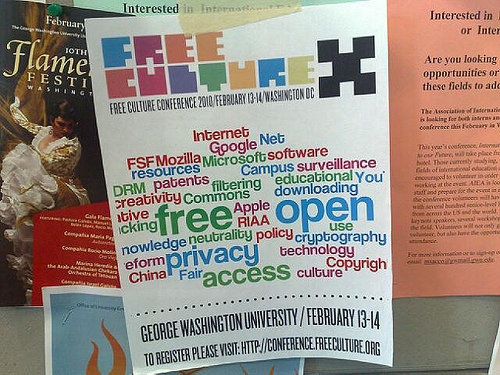
I highly doubt that when he published it, Harvard Law Professor Lawrence Lessig expected his 2004 book, Free Culture: The Nature and Future of Creativity
But if you needed any confirmation that it did, look no further than last weekend’s Free Culture X, a conference held in Washington, D.C. and organized by Students for Free Culture, an organization on whose board of directors I serve.
Free Culture X brought together hundreds of activists from as far away as Europe or Puerto Rico to discuss and debate some of the most pressing issues facing the free culture movement. Panelists debated issues ranging from the importance of mandating network neutrality to the role that open educational resources can play in transforming higher education. Headline speakers like Pat Aufderheide exhorted the crowd to exert their rights to exceptions in copyright law such as fair use while Jonathan Zittrain gave a presentation via webcast from Boston that was both a hilarious and thought-provoking look at the new forms of labor that the Internet enables.
This year, we’ve seen Mutual Aid in Motion.
From scaling sharing hubs to Mutual Aid 101 trainings, we’re helping communities build the tools they need.
Every dollar fuels lasting resilience – proving that when we move together, we all move forward.
Students for Free Culture is an international chapter-based organization of students and affiliates which works to promote the public interest in intellectual property and information policy. It was started in 2003 after a couple Swarthmore students fought and won in court against copyright infringement claims that were being used to censor emails detailing flaws in electronic voting machines. Since then, students have demonstrated against digital locks on media, promoted OpenCourseWare and spread the use of free and open source software.
Today, the movement is even larger than the more than 50 chapters officially associated with Students for Free Culture. The White House has embraced the “Some Rights Reserved” licensing of Creative Commons, a longtime partner of SFC whose work paving a middle-road for copyright was featured at Free Culture X by Timothy Vollmer.
Also in D.C., the fight over net neutrality, the principle that all Internet traffic should be treated equally, has raised awareness well outside typical free culture supporters of the importance of minimizing the role of gatekeepers in our information society. And as students and researchers realize the new possibilities opened by low-cost digital publishing, the issue of open access publishing has grown from a niche issue into one that millions care about.
Although there seems to be a growing awareness of the potential that digital technologies open up – and the role that existing laws, especially intellectual property play in limiting it – the future is unclear.
Gigi Sohn, the co-founder of the D.C.-based public interest group, Public Knowledge, gave a keynote address in which she gave some clues, though. She unveiled the Copyright Reform Act, a series of five modest changes to existing copyright law, which aims to “tip the balance back in favor of the constitutional mandate that copyright protection ‘promote the progress of science and the useful arts.’” Furthermore, the Creators’ Freedom project aims to highlight and promote artists who are pioneering new business models that don’t rely on exercising monopoly rights.
Unclear as the future may be, two days of conversations and meetings makes clear one thing: the excitement and energy behind the free culture movement is palpable. The generation of born digital students are committed in a serious way to a world that is free and shareable.
