
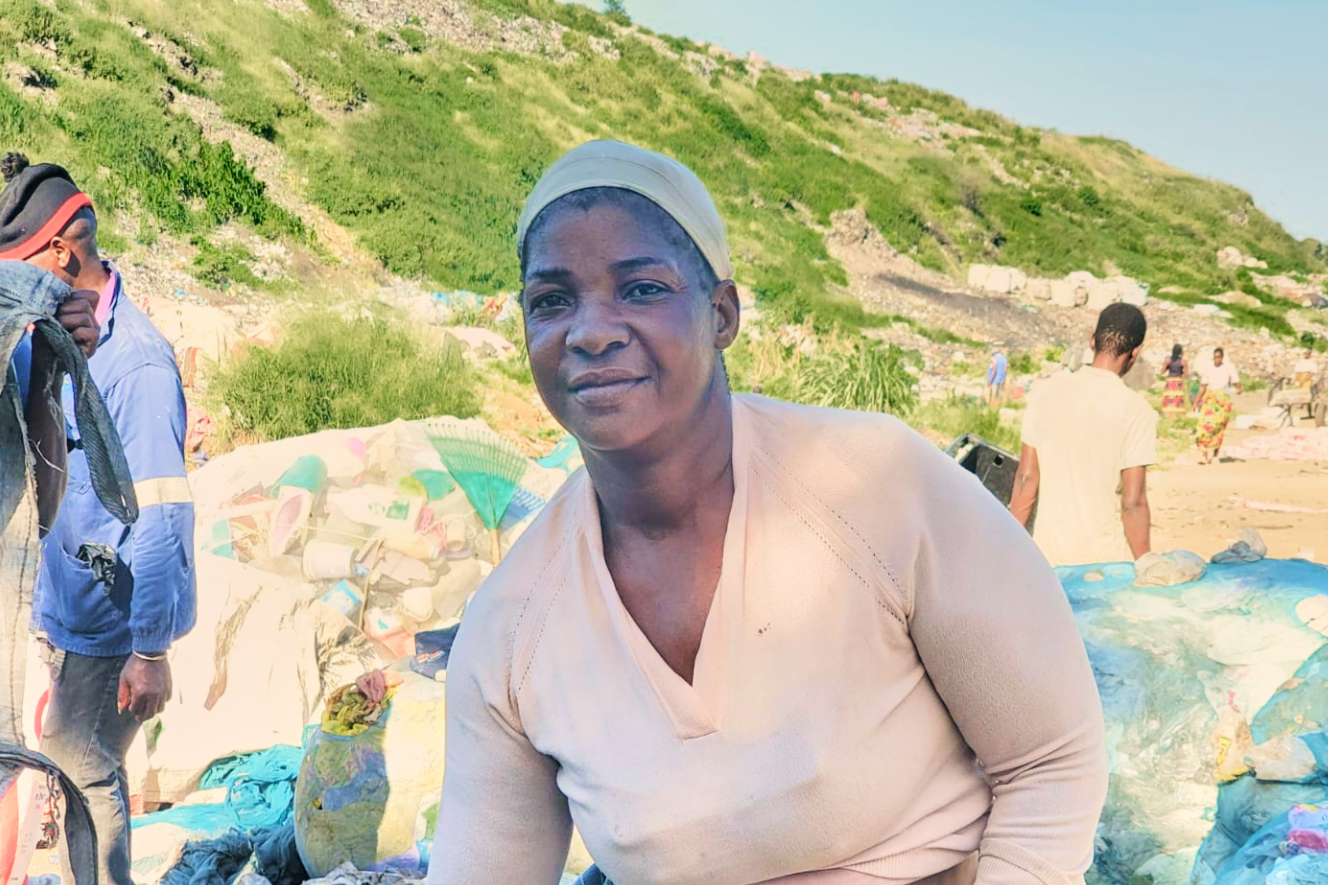
Maputo, Mozambique
Isaura Matola (pictured above), a widow and mother of four, wakes up every day at 5 a.m., before sunrise, to begin collecting recyclable waste at the Hulene landfill on the outskirts of Maputo, Mozambique’s capital.
After losing her job as a domestic worker in 2023, Matola faced unsuccessful attempts to secure other employment. Waste sorting at the landfill became her only viable option.
Celebrate the new toolkit
Limited time only! Help us celebrate version 2.0 of the Library of Things Toolkit by chipping in $100 and receive an advance print edition.

“With what I earn here, even though it is not much, I manage the basics to live. It’s different from doing nothing,” she says, while separating plastic, paper, and metal from large piles of rubbish. “At least my children are able to go to school.”
With her income, the 47-year-old keeps all four children in school—one studying business management at university—and has managed to renovate her type-two house in the Maxaquene neighbourhood, several kilometres from the dumpsite.
“I hope God gives me the strength to keep working until my children graduate, because without me, there is no one else to support them,” Matola says. “That is why what many people see as rubbish is gold to us, because it puts bread on the table.”
Matola is one of more than 100 women in Real Reciclagem, a cooperative founded in 2022 to help women recover from the economic impact of the Covid-19 pandemic. The cooperative, officially registered in 2023, also provides a support network for widows, single mothers, and women who are survivors of violence.

520 tonnes collected, 186 children in school
Real Reciclagem reached a significant milestone in December 2024, having collected more than 520 tonnes of recyclable materials from dumpsites, streets, and avenues since its creation. This has helped reduce waste that would otherwise clog roads, drainage channels, and informal settlements around the city.
Women in the cooperative earn between $100 and $150 monthly—modest amounts that keep 186 children in school and ensure minimally dignified lives, explained Yolanda Jorge, 39, the cooperative’s founder.
“We are not here just to separate plastic. We are creating a new way of living—one that restores our autonomy, supports our families, and shows that the economy can be built on collaboration and mutual care,” Jorge said.
The cooperative mainly collects metal, plastic, plastic-based materials, and cardboard by hand, averaging 18 to 21 tonnes each month. This comes as the municipality of Maputo produces between 1,200 and 1,400 tonnes of waste daily.
According to Jorge, the type of waste available varies over time, but buyers exist for all materials. “At the moment, for example, we have more cardboard and plastic. Metal is scarce, which may also be because many people are now sorting waste,” she explains.
Recently, the cooperative secured a purchasing agreement with Vulcano Reciclagem, which pays around $0.50 per kilogramme of sorted metal.
“In this type of work, collaboration is essential, and when dealing with recycling companies, what matters most is payment. There are many companies, but we prioritise those that pay on time,” Jorge said.
Some cooperative members have expanded into residential areas, collecting waste in central neighbourhoods and drainage channels, reducing rubbish that blocks streets and rainwater drainage systems.
The work presents challenges: long hours under intense sunlight, the risk of accidents, and exposure to hazardous waste, in an environment where protective equipment remains scarce. Even so, many say the alternative—complete unemployment—would be harsher.
“We are not here just to separate plastic. We are creating a new way of living—one that restores our autonomy, supports our families, and shows that the economy can be built on collaboration and mutual care.” —Yolanda Jorge
Government moves to strengthen infrastructure
Independent efforts led by women such as these predate the government’s recent interest in strengthening waste management infrastructure. In September 2024, the government announced plans to invest around 1.5 billion meticais (approximately $23.5 million) in constructing two sanitary landfills in the northern cities of Nampula and Nacala.
Sergio Manhique, municipal director for environment and sanitation, said work carried out by women organised in cooperatives—more than five in Maputo alone—supports municipal efforts to keep the city clean and reduces waste sent to the Hulene dumpsite.
“We have a group of cooperatives and associations that intervene and help divert between 400 and 500 tonnes of waste per month that would otherwise go to the landfill,” Manhique said, stressing these activities reduce pressure on municipal waste collection services, particularly during festive periods.
The municipality has been encouraging people to organise into cooperatives to collect waste in the city centre, arguing that it reduces the volume sent to the landfill.
“We also want to introduce a pilot project to start separating waste at the household level—bottles in one plastic bag, paper in another,” Manhique said, explaining the project aims to “improve the working conditions of waste pickers.”
Mozambique produces 4.2 million tonnes of waste annually, but only 1 to 2 percent is recycled through informal networks—a situation the government aims to reverse through a 24 million euro project investing in three recycling facilities, said Gustavo Dgedge, the Mozambique Secretary of State for Land and Environment, in March 2024.
Among other waste collection and treatment initiatives supporting government efforts is the Mozambican Recycling Association, which, over 15 years, has collected more than 1,200 tonnes of waste and impacted over 50,000 people.
Jessica Nacaroa, 36, an informal waste picker in Beira, central Mozambique, began collecting plastic from beaches and coastal neighborhoods through the Coastal Waste Resilience Project implemented by AMOR, creating an economic value chain where collected material is weighed and integrated into the recycling system, generating income from waste that previously accumulated in the environment. The project also establishes ecological management mechanisms involving schools in raising awareness about proper waste disposal to prevent dumping in inappropriate places. With her earnings from waste collection, Nacaroa opened a small snack bar in the city center after limited health conditions prevented her from continuing collection activities long-term.

Recycling as a poverty reduction strategy
For environmentalist Rui Silva, the activities of women organised in cooperatives generate income while reducing waste that would otherwise be left in containers and transported to landfills.
“These movements of women collecting waste for recycling are extremely important because they help create income,” Silva said, stressing the importance of communities understanding that what is often seen as rubbish is raw material with the potential to reduce poverty levels.
According to Mozambique’s National Development Strategy (ENDE), by 2024, more than 65 percent of the population was unable to afford food and non-food items sufficient to meet basic individual or household needs.
The World Bank indicated that in 2022, more than 81 per cent of Mozambique’s population lived in poverty, with a daily consumption of less than $3, based on 2021 purchasing power parity.
For women such as Cristina Vilanculos, 40, a mother of three and a Real Reciclagem cooperative member since 2024, the cooperative model represents a way to escape extreme poverty when opportunities are scarce.
“This work is not easy, but I feel it is a way to escape poverty,” Vilanculos said. “We have to wake up early, work under the sun, and face many challenges. But through this work, I support my family and see my children going to school.”
This story was published in collaboration with @Egab.
