
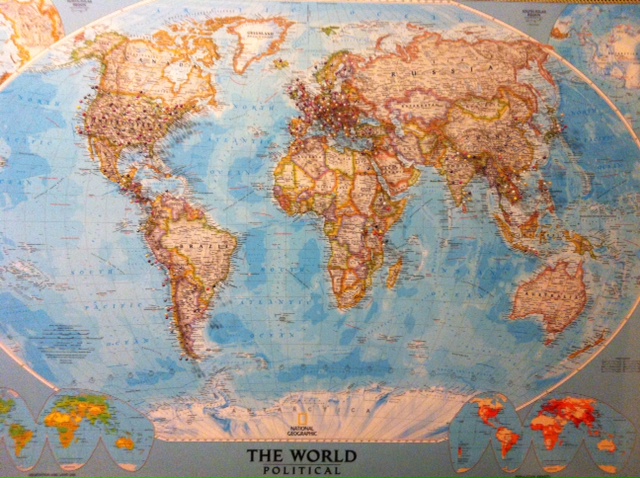
I have been traveling my whole life… 84 countries and counting. I have insatiable wanderlust and I love going off the beaten track.
Most of my travels happened pre-Airbnb. I spent almost four years traveling independently with a backpack, a shoestring budget, and a wicked sense of adventure; I also researched and guided hiking and biking trips for Butterfield & Robinson around the world. The combination of solo and customized small-group travel gave me a deep appreciation for the pros and cons of both: I treasure having a church or scenic vista all to myself while, at the same time, the best memories are almost invariably shared.
In the late 1990s, just before travel blogging went mainstream and long before technology platforms enabled instantly connecting with strangers halfway around the world, I wrote about my adventures as they were unfolding. There was something very special about writing long travelogues offline, in some tropical forest, and then e-mailing them whenever I got Internet access again. There was – and is – an incredible feeling waking in a brand new place having no idea where you’ll sleep that night, or arriving at a train station with nothing but a hand-scrawled recommendation and scrappy map from a fellow traveler you met days ago.
This year, we’ve seen Mutual Aid in Motion.
From scaling sharing hubs to Mutual Aid 101 trainings, we’re helping communities build the tools they need.
Every dollar fuels lasting resilience – proving that when we move together, we all move forward.


Nevertheless, Airbnb has absolutely transformed my travel experiences – for the better – and is playing a key role in redefining travel writ large. This crystallized brilliantly for me this holiday season. I spent Thanksgiving as an Airbnb guest in Kigali, Rwanda, and I hosted a family from Florida during Christmas week at my home in San Francisco, California. Both experiences were extraordinary.
In Rwanda, I was greeted by local and ex-pat social entrepreneurs who had added a few rooms onto their restaurant. The place is called Heaven, and it is. The rooms were lovely and just far enough off the beaten path to feel unique. But what was even better were the Heaven team and their dreams for the future: a culinary academy, skills training for local youth, and a venture fund investing in sustainable dairy, grains, and more. Heaven is more than just a place to stay or eat: it’s a glimpse into Rwanda’s future.
Fast-forward a couple of weeks. It’s a few days before Christmas and I’m preparing for our annual trip to Colorado. I receive a query asking if our home is still available for last-minute travelers. They want to have a family reunion, there are no good hotel options nearby, and they’re trying Airbnb for the first time.
We jump into action and show them how fun, easy, and comfortable Airbnb can be. They have a couple of young children, so we mention that being in a home is more practicable for bath time, snack time, and nap time. They get it, and we get a note afterward saying, “it was wonderful.” What a bonus holiday gift!

#TravelRedefined
Heading into 2013, I pause to reflect on travel: how it has been revolutionized since the advent of personal blogs, Twitter, GPS, Airbnb, Vayable, SideTour, and so much more. When I head to Switzerland later this week, it will be a much different experience than my first visit there; it will be harder to truly “get away” in the Alps, though I expect the Alpine culture to be as warm, welcoming (and efficient) as ever. More generally, so much has changed around the “how” of travel, yet certain fundamentals – adventure, serendipity, and the kindness of strangers – remain markedly comforting common themes. Here is a mini-recap of how I see travel being redefined in the 21st century:
**Just for fun, a visual map of these links and a few more can be found here.
Travel Adventures, Looking Forward
Travelers undertaking the 18th century Grand Tour would never have imagined a world in which we could climb in a metal cylinder and 10 hours later emerge halfway around the world in a culture, climate, and topography completely foreign to our own. Nor would they have imagined talking into mobile devices that would give directions, make recommendations, or inform us that the metal cylinder would be late. What is the equivalent sea change in travel that awaits us today, and what are some of the pitfalls that it could face?
Change is rarely all good or all bad. It’s a combination of trade-offs, evolving priorities, and possibilities. Travel today is easier than ever before. New travel platforms enable “slightly structured, shared serendipity” for locals and visitors alike — collaborative consumption of experiences, enhanced ability to meet fascinating strangers, and individualized itineraries with a couple of clicks. I can share my Himalayan ascent or Bolivian village life snapshot with the world instantaneously, and I can keep in touch with my Maasai safari guide almost as easily as my neighbor: What’s not awesome about that? In many ways, travel today includes the best of all worlds – plentiful upsides and adventures, with far fewer mishaps and unknowns.

That said, some of those unknowns led to the most incredible experiences, and some of the mishaps led to the best memories. Not knowing what would happen or where I’d be next, or when, was part of the fun. Travel today has, to a certain degree, lost that edge. It’s harder to be spontaneous when you know that you must check out (or check in) on a particular day. It’s harder to listen to one’s heart when it encourages you to stay longer – or, at least, it means you need to find another place to stay. It’s harder to hold that moment of arrival at Macchu Picchu at sunrise as singularly unforgettable when you’re easily distracted by tweeting about it real-time. When nearly every moment can be mediated by the web or through your smartphone, what does that leave to (fortuitous) chance? And what is the importance of simply being present and in the moment?
Both despite and because of the advances of technology, looking to the future, I see a world ripe with possibilities in the travel sector. These are coupled with some key questions:
- Policy: Which cities or countries will proactively integrate sharing-based travel opportunities into tourism policy? Will those cities become favorite destinations because of such decisions? (I’m going to visit my 85th country, Myanmar (Burma), this Spring. It’s the first country I’ve been to where Airbnb is strictly illegal. All accommodations must be sanctioned by the government – hopefully not for much longer.)
- Culture: How will culture affect travel trends internationally? For example, as the rising middle class increases in places like China and India, will people there opt for sharing-oriented travel options? Will expats or locals be more likely to share – or both, as in Rwanda?
- Partnerships: Will Airbnb develop external partnerships with local experience providers, or will it curate partnerships in-house? Will sector-specific companies forge joint ventures for a seamless travel experience, or will it be a redux of the unfortunate Expedia.com “flight + hotel + car” offer for mass consumption?
- Dynamics: What are the bottlenecks and limitations of this value chain from a traveler’s perspective, and how might these change as collaborative consumption platforms themselves evolve? And of course, how might today’s established players – hotels, cruise ships, airlines – approach and react to these new opportunities?
Today, there are myriad ways to see the world. The sharing economy has created, leveraged, expanded, and re-formulated many of the options available to travelers. The travel industry itself is becoming more democratized and more social, more hyper-local and more global, more individualized and more intelligent, all at the same time. Although I wonder if we will ever really “learn to let go” of new technologies, As I look back at where I’ve been and look forward to visiting my 100th country – wherever and whenever it may happen – I can’t help but marvel at how such technologies are making this a much less lonely planet.
