
The Health Department didn’t show up when I made dinner for my neighbors last night. Fortunately, our health and safety laws don’t usually dictate how we prepare food in our personal and private realms. But humans have a natural tendency, an urge to feed each other, and the shareable food movement is taking that to new levels – levels that bring up some legal curiosities.
“The Underground Food Movement” has become a thing lately. It’s a foodie’s utopia in Oakland these days, where I’ve snuck off to meals at “underground restaurants” and sampled urban homesteaders’ goat cheeses and preserves.
But this movement goes deeper than its sheer yumminess. We thrive on food. When we share in efforts to grow, process, prepare, and serve food, we greatly enhance our abilities to eat well, provide for ourselves, and build livelihoods around food. Sharing food is particularly important during hard economic times and many small food projects develop out of unemployment.
This year, we’ve seen Mutual Aid in Motion.
From scaling sharing hubs to Mutual Aid 101 trainings, we’re helping communities build the tools they need.
Every dollar fuels lasting resilience – proving that when we move together, we all move forward.

The realm of shareable food is flourishing with community meal sharing, potlucks, gift-economy restaurants, community food growing projects, food swap events, pop-up stores, stone soup gatherings, food-buying cooperatives, goat-sharing, chicken cooperatives, events like The Big Lunch, and so on. Plus, restaurants step aside! A handful of start-up companies are creating peer-to-peer platforms to help people feed each other. Check out Grubly, Munchery, Gobble, and EatWithMe which connect chefs with foodies and/or catalyze community food events.
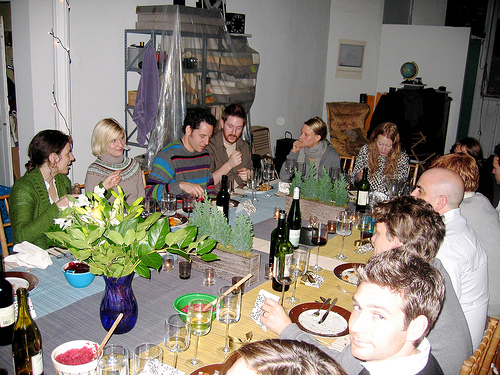
A dinner party in New York City. Photo credit: Locomomo. Used under Creative Commons license.
Now picture all of this food sharing activity on a spectrum. At the private and personal end, we eat a homemade meal with our family. At the public and commercial end, we get chicken nuggets from the drive-thru window at a chain restaurant. Somewhere in between is a point at which our society has decided to impose protections and regulations. At the Sustainable Economies Law Center, we are on a constant search for that elusive point.
Many health codes specifically exempt “private clubs” and “private events.” When San Francisco’s Underground Market got started, the Health Department gave it a nod and recognized that it was a private event where people exchange (albeit, with money) homemade foods. It then became one of San Francisco’s most loveable phenomena – a place where many food entrepreneurs got their start, where community members gathered to enjoy each other and rave about bafflingly delicious items such as “Bacon Crack.” The whole point was to create opportunities for food entrepreneurs who could otherwise not afford to operate out of certified commercial kitchens.
But when hundreds and even thousands of people lined up to join, the market passed that point between the private and public realms. A couple of weeks ago, the Health Department came back and put a halt to the whole delicious operation. At present, the market is in limbo and the founders of the market, the Health Department, and many others are chewing on the question: What is a private event or private club?
What is a Private Club?
“Private club” could very well be the magic password to the sharing economy, for legal purposes, anyway. At first, it might conjure up images of an exclusive place that we are not cool enough or rich enough to get invited to. But, to the extent that private clubs are exempt from burdensome legal regulations normally applied to public activities, such exemptions will also benefit groups of people that come together for their own mutual benefit, for collaboration, and for sharing.
Sustainable Economies Law Center intern Kelly Densmore has been spending her summer reading cases where courts have had to answer this very question. What follows are some of her findings.
The public/private distinction is relevant for the purpose of applying many laws, not just food regulations. With a shortage of case law in the food realm, we can derive guidance from a handful of cases that examine the issue in the context of Civil Rights laws, the Americans with Disabilities Act (ADA), smoking laws, and employment laws. For anyone wanting to delve deeper, there is a list of relevant cases at the end of this article.
The cases vary, but generally, courts have weighed a handful of factors to decide whether a club is really and truly, well, private. Factors that courts tend to weigh include:
-
Whether the club applies meaningful selection criteria to the admission of new members
-
The size of the membership
-
The degree of member control of club operations
-
Whether substantial membership fees are charged
-
Whether the entity is operated on a nonprofit basis
-
Whether members know each other and whether there is personal interaction among members
-
Whether the primary purpose served by the club is social or business
-
The extent to which the facilities are open to the public
-
The extent to which the club advertises to the public and/or publicly solicits new members
-
The degree to which club facilities are available for use by non-members
-
The degree of public funding
-
Whether the club was created specifically to avoid compliance with the Civil Rights Act or other laws
Although no single factor is controlling when determining whether a club is private, most courts have considered the selectivity of the membership to be of great importance. Preferably, private clubs will have meaningful criteria on which people are chosen to be accepted as members, rather than allowing anyone to join at any time.
In Nicholls v. Holiday Panay Marina (2009), a tenant brought an ADA lawsuit against a marina for not making the marina accessible to wheelchairs. The marina argued that the facilities were “private,” since only member tenants could enter and must use a key card to access docks and boats. The court ruled that, although the marina was restricted only to members, it was not private because it provides leases on a first-come, first-served basis to the general public without setting any member selection criteria.
In City of Wausau v. Jusufi (2008), the operator of the Red Apple Social Club restaurant was found to have violated a ban on smoking. Red Apple’s operator asserted that the restaurant was a private club, pointing to the fact that only members could patronize the restaurant and members must pay a one-time membership fee of one dollar. The court ruled that Red Apple was not private because the small, one-time fee was not a sufficient barrier to patronizing the club. Another factor that weighed against the “club” was that members exercised very little control over the restaurant. The court warned that, without meaningful membership criteria and member involvement, “[r]estaurants could create the illusion of private clubs by creating memberships with no meaningful membership criteria. The memberships would essentially be shams, with members having no control over, or stake in, the restaurant's operations.”

Items at a bake sale for Haiti. Photo credit: Tom Nguyen. Used under Creative Commons license.
Now for an example where the court argued, fervently, to uphold a group’s private club status: In Equal Employment Opportunity Commission v. The Chicago Club (1996), the court ruled that the social/recreational club in question was, indeed, private and, therefore, exempt from certain employment reporting requirements because:
-
Club candidates go through an extensive screening process that involves the approval of the board, as well as interaction between the candidate and club members.
-
Members elect their own board of directors, which oversees the club’s operations and appoints a general manager.
-
The club was not open to the public; there is a limited use of facilities by non-members; and guests must be invited to the club by a member.
Of particular note in this case, the court took no issue with the fact that the club was rather large: 1,247 members! The court stated that the “size of an organization is not, without more, probative of its privateness.”
Private Restaurants and Private Markets?
So how does all of this apply to the sharing of food? Is it possible to create a “restaurant” or “market” that is private and, therefore, exempt from some of the regulations that apply to its public counterparts? We’ll look at these possibilities, as well as a scenario for a private raw milk club.
Your Private “Cafe:” Let’s say you and 10 of your close friends agree that you make the world’s best quiche. You jointly hatch a plan for Quiche Café, which is essentially a weekly dinner party at your house. You buy the ingredients and make the quiche. Your 10 friends, the core members of the Café, bring the drinks and concoct fun activities and games. Most importantly, everyone helps out with the dishes. Each core member of Quiche Café is encouraged to bring a friend or two, so each dinner is attended by an average of 25 people. Everyone chips in around $8, even though you’ve calculated the per-person cost of ingredients to be around $4. Everyone feels that any surplus could be seen as a modest stipend or your thank-you gift for being the hostess with the most-est.
So is Quiche Cafe private enough to avoid health and safety regulation? Based on guidelines we’ve gleaned from the court decisions, we think so.* Participation is restricted to the original 10 friends and the friends that they personally invite. Quiche Café is not advertised and is not open to the public. The members jointly manage the club for their own benefit. Although the quiche chef is making a small stipend, the core purpose of the activity is to provide social and edible sustenance to friends.
Note that zoning is a separate issue: A neighbor could still complain to the local Planning Department that you are operating a social club or business out of your home in violation of the residential zoning of your neighborhood. Arguing that you are a private dining club might not help here, but you could argue that this is a dinner party, which is generally accepted as a residential use of a home.

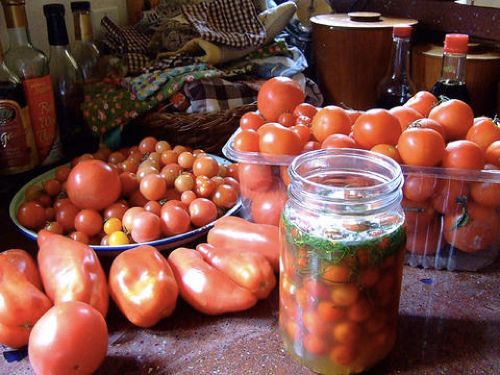
Homemade pickled tomatoes. Photo credit: Knitting Iris. Used under Creative Commons license.
Your Private “Market:” Now let’s imagine you want to share your quiche with more people. Your friend tells you about a weekly gathering where people exchange homemade foods. Sometimes people gift their foods to each other, sometimes they barter, and sometimes they sell. Before you can bring your quiche to the gathering, you have to be recommended for membership by someone who is already a member. You also need to fill out a membership application and explain how most of your ingredients come from socially responsible sources. Once you are admitted as a member, you are given passes to bring up to five guests to the gathering each week. No one can get in the door without a pass, and you are not allowed to sell your five guest passes or give them to people you don’t know. Members are required to pay monthly dues of $50, to attend four meetings per year, to elect a board of directors, and to sometimes take part in special committees. The board of directors may hire a manager for the event, but major decisions about the gathering are made by the member-elected board. The gathering is limited to 100 food artisan members and overall attendance is limited to 600.
Again, we feel that this activity should be treated as private and not subject to health permit requirements.* The activity is collaboratively managed by members, membership is restricted, the event is not publicly advertised, and non-member attendees may come, on a limited basis, only as a guest of a member. Although income from the event may contribute to the livelihoods of the food artisans and the event manager, the entity itself is not operating for a profit, but rather to provide a forum for the appreciation of interesting and hand-crafted foods.
Your Private Goat Club: Sharing goats and cows is a common way that people have overcome barriers to raw milk access. Raw milk is subject to strict food and agricultural regulations, and has become a hot topic with the recent and dramatic shutdown of some raw milk operations and vendors. Most recently, we learned that a goat-sharing arrangement managed by Evergreen Acres Goat Farm was cited by the District Attorney in Santa Clara County, California. It seems that the legal particularities of goat sharing still need to be explored and clarified. Nevertheless, a small and private group of goat sharers, in our opinion, should be exempt from the legal hurdles.
Here’s an example: You and 10 community members come together to buy and share ownership of four goats, which are kept in your yard. Each week, members stop by to pick up bottles of milk. Your group has decided to allow in only four more members, but only if those members demonstrate that health needs prevent them from consuming pasteurized milk. Everyone takes turns helping out with the goats, and the group meets monthly to touch base and meet about goat-related things. Everyone chips in $30 per month for goat food and veterinary costs. Since you are the designated goat keeper, you don’t have to pay the $30.
Once again, we believe that this club is private and should not be subject to food safety regulations.* Like the private “market,” this goat club is collaboratively managed by the club members, membership is restricted to 15 people, and it is not advertised to the public.
But Feeding Total Strangers is Fun and Important!
This is true. Enabling people to feed each other should be a high priority, and it won’t always be practical or desirable to relegate our food sharing activities to the private realm. We’re hungry for a world where tons of small food entrepreneurs can make it in competition with the giant food conglomerates. The shareable food movement localizes economies, feeds communities in challenging economic times, and supports our environment by encouraging localized food production and lower carbon “foodprints.”
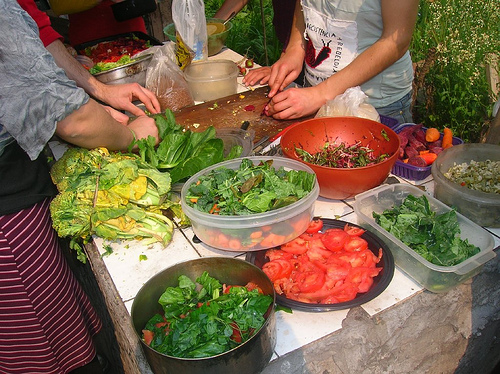
Food Not Bombs volunteers prepare vegetables. Photo credit: Huerta Orgazmika. Used under Creative Commons license.
Furthering the Shareable Food Movement
There’s much to say on this topic, but here are a few thoughts. First, we can create new platforms for food production and food sharing: Shared commercial kitchens, like La Cocina in San Francisco, are part of the answer, because they reduce the barrier to entry for small entrepreneurs; more community marketplaces create a space for entrepreneurs to get their products out there; and marketing cooperatives can help entrepreneurs aggregate and sell their products. These are all sharing solutions that give entrepreneurs access to spaces and markets that are normally expensive and inaccessible.
Furthermore, we can all work to pass new laws that lower the overall set of legal barriers to small food enterprise. An easy place to start is with cottage food laws which have already been passed in half of the U.S. states. Cottage food laws enable the sale of home-made foods that are “non-potentially hazardous,” such as breads, cakes, jams, and granola. Allowing the sale of back-yard produce is another step, and a handful of cities have recently done this or are currently considering it. (See San Francisco, Berkeley, and Oakland.) Food sovereignty laws take this even further and endeavor to de-regulate many facets of food production.
Glutton for Legalese?
They say that laws are like sausages – it’s better not see them made. But, okay, if you must know, here are some cases where courts have examined the question of what is a private club:
-
Nicholls v. Holiday Panay Marina, L.P., 173 Cal. App.4th 966 (2009)
-
Tillman v Wheaton-Haven Recreation Ass’n, Inc., 410 U.S. 431 (1973)
-
Hurley v. Irish-American Gay, Lesbian, Bisexual Group of Boston, 515 U.S. 557 (1995)
-
Nesmith v. Young Men’s Christian Ass’n of Raleigh, N.C., 397 F.2d 96 (1968)
-
Warfield v. Peninsula Golf & Country Club, 10 Cal.4th 594 (1995)
-
National Organization for Women, Essex County Chapter v. Little League Baseball, Inc., 127 N.J. Super. 522 (1974)
-
Players, Inc. v. City of New York, 371 F. Supp.2d 522 (2005)
-
See also: Americans with Disabilities Act of 1990, § 307, 42 U.S.C. § 12187
Acknowledgments: This article was a collaborative piece written by the Sustainable Economies Law Center’s Legal Intern Kelly Densmore and Co-Director Janelle Orsi.
* Disclaimer: Please don’t rely on anything in this article as legal advice or even as being thorough and applicable to your own situation or jurisdiction. In spite of what some courts may hold or what we at SELC may opine, every jurisdiction has a mind of its own.
