The Next Net
01.03.11, 10:36am Comments (156)

The moment the "net neutrality" debate began was the moment the net neutrality debate was lost. For once the fate of a network -  its fairness, its rule set, its capacity for social or economic reformation - is in the hands of policymakers and the corporations funding them - that network loses its power to effect change. The mere fact that lawmakers and lobbyists now control the future of the net should be enough to turn us elsewhere.

Of course the Internet was never truly free, bottom-up, decentralized, or chaotic. Yes, it may have been designed with many nodes and redundancies for it to withstand a nuclear attack, but it has always been absolutely controlled by central authorities. From its Domain Name Servers to its IP addresses, the Internet depends on highly centralized mechanisms to send our packets from one place to another.

The ease with which a Senator can make a phone call to have a website such as Wikileaks yanked from the net mirrors the ease with which an entire top-level domain, like say .ir, can be excised. And no, even if some smart people jot down the numeric ip addresses of the websites they want to see before the names are yanked, offending addresses can still be blocked by any number of cooperating government and corporate trunks, relays, and ISPs. That's why ministers in China finally concluded (in cables released by Wikileaks, no less) that the Internet was "no threat."

I'm not trying to be a downer here, or knock the possibilities for networking. I just want to smash the fiction that the Internet is some sort of uncontrollable, decentralized free-for-all, so that we can get on with the business of creating something else that is.

That's right. I propose we abandon the Internet, or at least accept the fact that it has been surrendered to corporate control like pretty much everything else in Western society. It was bound to happen, and its flawed, centralized architecture made it ripe for conquest.

Just as the fledgling peer-to-peer economy of the Late Middle Ages was quashed by a repressive monarchy that still had the power to print money and write laws, the fledgling Internet of the 21st century is being quashed by a similarly corporatist government that has its hands on the switches through which we mean to transact and communicate. It will never truly level the playing fields of commerce, politics, and culture. And if it looks like that does stand a chance of happening, the Internet will be adjusted to prevent it.

The fiberoptic cables running through the streets of San Francisco and New York are not a commons, they are corporate-owned. The ISPs through which we connect are no longer public universities but private media companies who not only sell us access but sell us content, block the ports through which we share, and limit the applications through which we create. They are not turning the free, public net into a shopping mall. It already *is* a shopping mall. Your revolutionary YouTube video has a Google advertisement running across the bottom. Yes, that's the price of "free" when you're operating on someone else's network.

But unlike our medieval forebears, we don't have to defend our digital commons from corporate encroachment. Fighting and losing that un-winnable battle will only reinforce our sense of helplessness, anyway. Instead of pretending that the Internet was ever destined to be our social and intellectual commons, we can much more easily conspire together to build a real networked commons, intentionally. And with this priority embedded into its very architecture and functioning.

It is not rocket science. And I know there's more than a few dozen people reading this right now who could make it happen.

Back in 1984, long before the Internet even existed, many of us who wanted to network with our computers used something called FidoNet. It was a super simple way of having a network - albeit an asynchronous one.

One kid (I assume they were all kids like me, but I'm sure there were real adults doing this, too) would let his computer be used as a "server." This just meant his parents let him have his own phone line for the modem. The rest of us would call in from our computers (one at a time, of course) upload the stuff we wanted to share and download any email that had arrived for us. Once or twice a night, the server would call some other servers in the network and see if any email had arrived for anyone with an account on his machine. Super simple.

Now FidoNet employed a genuinely distributed architecture. (And if you smart hackers can say why that's wrong, and how FidoNet could have been more distributed, please continue that line of thought! You are already on your way to developing the next network.) 25 years of networking later, lessons learned, and battles fought; can you imagine how much better we could do?

So let's get on it. Shall we use telephony, ham radio, or some other part of the spectrum? Do we organize overlapping meshes of WiMax? Do we ask George Soros for some money? MacArthur Foundation? Do we even need or want them or money at all? How might the funding of our network by a central bank issued currency, or a private foundation, or a public university, bias the very architecture we are trying to build? Who gets the ability to govern or limit what may spread over our network, if anyone? Should there be ways for us to transact?

To make the sorts of choices that might actually yield our next and truly decentralized network, we must take a good look at the highly centralized real world in which we live - as well as how it got that way. Only by understanding its principles, reckoning with the forces at play, and accepting the battles we have already lost, might we begin to forge ahead to create new forms that exist beyond any authority's ability to grant them protection.

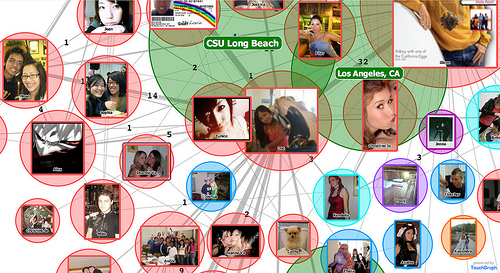
Teaser image by Glenn Zucman.

##

UPDATE: response to this article has been so great that Douglas Rushkoff is convening Contact, an open space event to catalyze projects that support decentralized peer-based communication, commerce, and culture. Read more about Contact in his follow up post, "The Evolution Will Be Socialized" and follow related Twitter conversation with the #nextnet hashtag.

Related Posts:

  • Shareable Futures, our Sci-Fi series featuring original short stories by Bruce Sterling, Cory Doctorow, Benjamin Rosenbaum, and more

Rate this article

Your rating: None Average: 3.4 (97 votes)

Comments

I'm glad I'm not the only one thinking of the possibilities of a *true* internet, but I cannot think of a system that can't be abused by a central power.

Great read.

Where there are centers for the servers and the energy, i see no reason why there can't be other alternative markets and communities, people leading local and sustainable lives communicating and networking with others. We can build our own infrastructure between these diverse nodes. Each node can have its own organisational ethos and currency.

Great that famous people begin saying what the radical fringes have been saying for years - maybe the idea will finally spread further...

For future reference, perhaps: take note of critical/radical voices before it is too late :)

Wonderful article Douglas. You've struck right at the heart of why I'm launching the connective (http://theconnective.net).

There's a radical new spirit of trust, transparency and openness emerging in our networked culture ... it's time to permanently weave that spirit directly into the architecture of the internet itself.

2011 is going to be the year that we grow a citizen-owned internet together ... an alternative network of free and open connectivity that will protect our freedoms and privacy, support peer to peer and hyperlocal innovation, and sustain a free and open culture based on cooperation and trust.

peaceandlove
/mark
http://theconnective.net - seeds for a grassroots citizen owned internet

Have you looked at Freenet? It is the decentralised highly anonymous network that is the most censorship resilient form of communication available today. Well worth looking at.

good article.

my only worry is that there is very hard to imagine how it might work with our contemporary mindsets and ideology. the computer and its technologies are surely built around these ideologies (of control, ownership, individualisation and rationalisation). but do we need to think beyond the nation and the individual, beyond ownership. perhaps even beyond technology here?

otherwise it'll just get shut down in the interests of 'national security' or something else they invent to make us feel like anyone who opposes the control of the net is some kind of criminal, paedophile or terrorist.

maybe we need an irrational machine. or maybe we already have this, we just havent seen it yet? there's some dark, opaque places on the web and have been for a long time.

ironically, the very power structures that currently govern our contemporary system- corporate power - has managed to find a mechanism to avoid this kind of control. hence business can largely do what they want. all in the name of progress etc. an ideology that is allowed to exist outside of any particular national jurisdiction, ethical or moral system. should we mirror this?

or, if we all chip in maybe we could buy a server on the moon or something! or, just confuse the corporate web a bit by acting unexpectedly (ie not doing what it wants us to do, clicking what it wants us to click)

very good article and highly relevant. will telepathy eventually take over, as one musician suggested to me a few years ago?

Will buy it when a Kindle version is available.

Nice Alastair!

Mark, all, wondering if there's a technical proposal out there that someone can add to the discussion.

As it has been pointed out, this isn't a new idea, though I think it's exceptionally timely given the latest net neutrality ruling and how Wikileaks has been dismantled.

Curious to see how it can actually be done, as is Douglas as he closed the post with practical questions.

Yes, lots of good thinking here. Thanks for the kind feedback as well as the links. I think there are people already working on this, and this comments thread is as good a place as any for us all to learn about them and lend our assistance.

As for Kindle, both of my latest books are on Kindle - Program or Be Programmed and Life Inc.

I will keep reading here and checking out everything being referred to.

Hey Pete, I like what you suggest in your second paragraph. I see the possibility of an alignment between citizens at the city scale and below and digital communitarians at the global scale. The provinces / states, nations, and the global bodies composed of nations seem totally taken over by corporations.

There may be some interesting ideas along these lines in the work of David De Ugarte and his community. Not totally sure yet because I haven't dug into them, but if you're curious, here's three books by him, sent to me by Michel Bauwens of the P2P Foundation, one of my must read blogs along with Rushkoff and a few others.

http://deugarte.com/gomi/phyles.pdf
http://deugarte.com/gomi/Nations.pdf
http://deugarte.com/gomi/the-power-of-networks.pdf

We, the users, already pay all the costs of the physical layer *and* we also pay profit because of our lack of ownership.

This proves we could afford to buy or build our own network if we could learn to cooperate - since we already pay all those bills and more!

So those who are willing and able to prepay can be co-owners and receive at-cost access under our collective control.

That solves the 'static' case.

The 'dynamic' case is the difficult part, but I think I have discovered a solution.

So, to allow us to grow without suffering the usual problems of over accumulation and concentration of power, let's try the following:

Let's allow all all late-comers who have not yet paid enough to purchase access from us as they already do from the current corporations - and even pay profit when the "market will bear", *but* under the strict condition that we treat that profit as an investment from the user who paid it - so they too can gain the ownership needed to protect themselves from the collective we.

Handling profit as payer investment creates a negative-feedback loop that auto-distributes control into the hands of those willing to pay for it.

Nice article. Good point about 'net neutrality automatically being lost the moment it's brought into question.

One idea might be for a government to write it into its constitution that a network connection must be provided to every household, much like running water, and that a government body must maintain any centralisation of such a network, and paid for by the tax payer.

You may think that it would be dangerous for any government to control its country's internet, but considering that they own and control the water supply, surely a consensus of trust could be made. And again, legally, its owned by the people.

Just one idea.

How about a point-to-point network using lazers encoding, possibly aided by satellites and adhoc wifi? Maybe a solution aided with the use of the new Community Radio Act? More networking events centered on wifi file sharing?

Well you might have to start with community projects to provide subsidised access to the poles. Otherwise you're going to be leasing your lines from the very corporations you seek to avoid contact with. And at least in Canada, the CRTC has already ruled that they're allowed to regulate traffic on their network that they reserve for whole-sale access. It pretty much killed the last of the competition in the telecommunications industry here.

You're going to have to lay cable if you want to cross the distances to reach rural communities and send packets across continents. It cost the telco's tonnes of money over many decades to get where they are now. The employed hundreds of thousands of people over the years to do it too.

I used to dial-up Fidonet BBS's too dude. I'd much rather have a 25Mps connection and a VPN that spans across the world. The cost of any such large project is that it's the work of many people and that means regulation governing its use so that we can all try and get some benefit from the effort in building it.

If it's just pervasive advertising that's ruining your culture and free exchange of ideas, there's ad-blockers and dark-nets of all sorts out there where you can exchange your radical literature free from the bonds of "the man."

The problem isn't with the Internet, it's the people.

I used to work for a big telco, so gotcha JKing, good point.

What I'm wondering is how can we use the existing infrastructure, but do something different with it.

For instance, Rushkoff mentions the DNS system on his blog, and how it's managed centrally. Is there a way around that?

And perhaps wireless mesh networking is a way to broaden access?

What about a sort of Pirate Party inspired solution where you set up a server farm on an island or even set up a separate country to better inspire free speech?

What about an open source payment system so Wikileaks type projects can get funding without corporate interference?

So bottom line, I agree, it's not likely citizens are going to be able to duplicate the physical infrastructure of the net. What I'm really curious about are the technical and legal workarounds that would enable citizens to fork the net in our favor.

Watcha got?

Surely the most obvious constriction which has to be overcome is the wire? To be really free the people's network needs to be totally ubiquitous, with as few landing spots as possible?

Mark's Connective project looks like a great initiative, but perhaps we need more out of the box thinking to make it really work?

Sounds exciting! But how will we connect to NewNet, or whatever we choose to call it?

Prima facie, wireless seems much more promising to me than wired phone/cable lines. But how will we reach NewNet? The way it works now, I believe, is that our wireless carriers (AT&T, Verizon, etc) have wireless-to-Internet gateways in place. So that seems like a dead end...

Over HAM radio, encryption is illegal, so that's out.

The best option I'm aware of is OpenBTS, which is "a new kind of cellular network that can be installed and operated at about 1/10 the cost of current technologies, but that will still be compatible with most of the handsets that are already in the market" (it uses GSM). I'm not sure what the wireless "reach" of each base station is using their current design, but if there's anyone else in SoCal who may be interested in setting one up to get our own wireless GSM network going, contact Santa Barbara Hackerspace!

You can find us on IRC in #sbhackerspace on Freenode, or email us at sbhackerspace@gmail.com.

Steve Phillips
Co-founder of Santa Barbara Hackerspace

Fairly simple to do, a series of point to point wireless radios and head units with Alpha, Beta, and Gamma faces to distribute through neighborhoods. The big issue is to decentralize electrical distribution, lastly you can transmit data through electrical wires too.

I am terribly interested in this. If something gets off the ground, I am located right between Baltimore and DC and would truly enjoy trying to help.

dgfitz (at) gmail (dot) com

You pretty much summed it up. All we can really do without building our own infrastructure is subvert the existing one... which has shown itself to be a difficult thing to do.

Private networks and darknets are one way to go. There are lots of them. WASTE, Freenet, etc. Basically impromptu distributed and encrypted p2p networks. They have the problem of isolating content to your immediate group of friends with whom you have shared and signed one anothers keys. In other words: complicated to set up.

Another way to go would be to build a new DNS service. Perhaps one that can resolve names across islands of encrypted p2p networks. The only barrier to entry with that is maintaining consistency. Caching would be hard. And again, encryption scares away end users.

But then again, all of this can be subverted by the people maintaining the network infrastructure... so if they don't like what you're building, they'll just deny access to their networks.

The only real way is to literally build your own. Form policy to subsidize access to the poles and blocks of wireless spectrum for community projects. Invest in the commercialization of space and launch satellites. Etc.

I think it's probably cheaper and easier to try and subvert the policies that are eroding the ownership of the public investment in the infrastructure in the first place. It's going to be a while before it's viable for a grass roots organization to launch a network of satellites to provide cheap wireless access. Not saying it won't happen... just that it's not here yet.

(in reply to Neal Gorenflo)

P2P is a very active research topic and maybe someday we'll create a distributed censorship-resistant naming system. In the meantime we can support alternative DNS roots and TLDs, independent TLS CAs, etc.

On the other hand, I don't find very interesting the idea of wireless networks parallel to the Internet, like netsukuku. Firstly because I don't like wireless networks so much, their impact on health are still unsure. Secondly because you can hide on the Internet for as long as cryptography is not strictly restricted, while wireless access points can be located and taken down by police, for whatever phony reason they can think of.

In the end, the real problem is censorship, not the fact that the Internet can't stop it, because a censorship-free network would be destroyed by governments anyway. So what can we do against censorship ? We have to try and take control of governments, by proposing a better societal model.

Great idea! And don't forget the hardware - we can't have greedy corporations manufacturing the hardware for this new internet. That could become a point of control by corporations and politicians.

Also, we should come up with alternate sources of electricity for the same reasons.

(yes, I am being sarcastic)

I've been thinking about this for years, including recently. I sat down a few nights ago and started jotting down notes for an ad-hoc mesh network protocol for such a network. And FidoNet was an example for me, too. This new network would be store-and-forward, Unicode text only, much like FidoNet, with e-mail and forums. I'm of the opinion that this new network should use multiple possible transmission channels—modems, ad-hoc Wifi, optical links, and even things like USB sticks and CDs that could be mailed (write the outgoing mail to a file, put on USB stick, snail mail to receiving node, they grab the file, process, and the mail is delivered). There's a lot to think about, but yes...there are those of us who are thinking about it.

And not all FidoNet sysops were kids (although I was :) ). And yes, FidoNet is still in operation.

Fidonet and others like it were all using telephone lines to connect to one another at the time so they used the basis infrastructures provided by the telcos. So I would feel that a free internet would have to be built on top of the existing internet infrastructure. The Freenet project was going in that direction. Wouldn't it make sense to pool all the efforts in that project as it has already started the work. It just needs a lot of support which seems to be lacking at the moment.

Invest in Quantum Teleportation research, this is a real area of science that could see us within the next few years capable of transmitting point-to-point data instantly over any distance. Thats when you create a truly distributed network..

I think the entire network—all the way down to the data transmission channels and associated hardware and software—should be owned by the network operators themselves. That means that, while the network might USE phone lines, they would be considered almost as backups. I would suggest against using Internet tunnels (AT ALL, EVER), pretty much on principle. Wireless links, dedicated lines/cables, optical links, "sneakernet/MailManNet", etc. should be the main way to move traffic around.

I started a room on Freenode.net about this a couple of weeks ago. This is weird seeing this article now. ooooWEEEEEEoooooo. ;-)

#newnet on irc.freenode.net

A simple layered solution over an IPV6 network would make sense, you'd simply sign up to provider who would let you on and you'd go from there. Whatever was in between would be inconsequential. We can have our internet over top of their internet, they cannot stop us lest they stop the internet.

signed an original anonymous contributor, not a 4channer.

here are some tools that could put each component of the internet fork together in a decentralized way:
https://groups.google.com/group/openmanufacturing/browse_thread/thread/4...
(the post that quotes the blogs.computerworlduk article)

i used to belong to a group in amsterdam who worked on a project creating a kinda of local shared internet, we built our own antennas, hooked them to discarded old pentium II or IIIs (running debian linux) and shoved the contraptions into the attics of all the local squatted buildings, we used it mainly to distribute a handful of dsl/cable connections outward, but as well to trade files, movies, music whatever on our own network which we controlled, this was done using open mesh software creating a kind of giant ad hoc network, which often messed up, but it worked more often than not. i am not so up to date on the development of the software behind this, but i know there of meshlinux and the b.a.t.m.a.n. project, which are working still on improving the mesh network idea, see http://www.open-mesh.org/ its certainly a way of creating your own network, and cheaply.

I like this article. I like the idea of a "Plan B" as a just in case. But I also see the value in crafting proposals similar to what Google did regarding net neutrality. There wasn't much proposal from the private sector beyond what they recommended. How can govn't do the right thing without the right information? I would also encourage everyone to make their voice heard, similar to how one should get out and vote during an election, and help advise big brother on how to do the internet properly. If they mess it up, you vote them out, or proceed with plan B. ISPs and the like are trying to please the consumer. It's our dollars that keep them in business. Speak with your voice and with your dollar to help achieve the common goal.

There is something horribly wrong with this proposal.

You are abandoning the "real". The issues threatening the web are already in full force in the "real" world doing much more serious damage than they ever will on the net.

The inventiveness, strategy and will to build must be taken to the streets and against those who oppress you IRL. Inventing a parallell universe where you are free but utterly trapped by the confines of the medium is ridiculous.

I could not imagine a greater copout! Read the text again and consider the horror of the defeatist argument.

Meh. Attempts to create a new internet will simply be met with legal injunctions from organizations holding patents over the very technology that allows the Internet to function.

While corporatists and their elected lackeys will try to lock everything down in a manner that corresponds to their interests, the means to resisting this will always emerge. We live in an information society, they are technology haves and have nots, and the haves always seem to start on the outside when it comes to 'the establishment.' I think we can count on a few more generations of hackers to screw things up, and let our kids return to the issue if things really do get too awful.

In the above suggestions, they are many interesting ideas. I'd like to propose the following: ubiquity through simplicity.
Create an open project for making the hardware (say Arduino + communication shield + solar power shield), code the software so an easy download would be sufficient to assemble the device. Design the whole thing so that this device is real cheap. Keep the device real cheap, make it so that the device-to-device is fully self-booting and distributed.
Now let the people put these wherever they want. Got some fund money? Order a large quantity of these, and distribute them widely. This ad-hoc system is hard to disrupt, easy to maintain. Now to figure out how to handle spammers, etc. and the system can be kept clean.
The point of the above brain-fart is that a cheap self-maintaining self-sufficient
system can be made, and can provide valuable service. But it may not allow one to compete with a full fiber-to-the-door service; nor would it be able to provide a robust security/self-cleaning service.

Back to the future. Before DARPA eased the restrictions on access to what was to become the internet (government and educational agencies only), businesses and individuals connected to UseNet. It was an ad-hoc collection of computers that communicated by dial-up modems. Most (if not every) UNIX systems has all of the tools used still installed for email and file transfers. Type "man uucp" to get a start...

I sympathize with your idea here. But as a few other posters have mentioned, and as every good IT person knows, the problem is people. You can't design human nature out of the equation. You think the new, technologically superior and 'empirically more free' internet wouldn't eventually succumb to similar pressures of money and policy wielded by competing interests? At some point you're going to have to put your money where your mouth is and either convince someone else that your beliefs are better, or have the power (legal, political, financial, etc) to craft the system closer to your vision. One will have to (horrors!) engage with society. There's no digital redoubt from society. Plus, a democracy, even one as broken as ours, gives us the opportunity to (with much struggle) change things. Even citizens of undemocratic governments have been able to do _something_. Unfree regulation is a symptom - the cause is the autocratic, corporatist people pulling the levers.

Here's an alternative frame: applying a technical fix to problems of justice (human problems) is no more than a band aid. Computers (really all technology) are a little bit like hammers, they make nails appear everywhere.

Subverting the current infrastructure is useless for large amounts of data. Yes, we can prevent the ISPs or the government from knowing exactly *what* we're sending (via encryption, onion routing, etc.), but we can't keep the ISPs or the government from controlling whether or not our data "gets there".

Look at file sharing, for example - Bittorrent (not the best example, but just go with it) has started using encrypted protocols to transfer packets of data between its users. It's a distributed network, more anonymous than straight HTTP traffic, and yet ISPs have found a way to hinder it.

It's quite simple, really - if the traffic is something they don't recognize, or if it fits the file-sharing profile, the ISP slows it to a crawl, and we end up with the very problem that started the net neutrality debate. It's always going to be possible for the ISPs to filter out a darknet's traffic or slow it down. "But what if the darknet's traffic looks exactly like a legitimate service's, like HTTP or SSL?" Then it can't transfer much data. The ISPs will notice a 1MB/s HTTP or SSL session and throttle it.

The only way we're going to have a chance against net neutrality is to replace or subsume the current infrastructure. There's no way to effectively subvert it while ISPs and big media still hold the legal keys to the kingdom - and the equipment. Wireless mesh seems like the best option to me - health concerns *have* been disproven, and WiMax is almost affordable enough to make it happen. Broadband-over-TV using the old analog TV spectrum is even more affordable, so when consumer equipment for that comes out, this might actually happen.

@Darin

"I think the entire network—all the way down to the data transmission channels and associated hardware and software—should be owned by the network operators themselves."

Couldn't that create the opportunity for, in the distant future, a hereditary caste of network operator/high priests, ruling the webs with an iron fist and blindly, ignorantly reciting and copy/pasting the config settings passed on to them by their forebears. Couldn't UNIX become a god crueler, more arbitrary, and more pitiless than any mere 20th century despot?

Oh wait, I forgot. Nerds can't reproduce. Nevermind. :)

Yeah, there's some horror in there to be sure.
But it's no different than saying "the money system is corrupt, so let's see how much we really truly need to use it to get things we need in our communities."

Sure, we need regular money to buy our iPhones, but not our agriculture.

Still, yes, I take your point. Abandoning the net is giving up in a certain sense. But I do feel like our public net became a private net. And perhaps easier than getting that cat bag into the bag would be to build another net based on what we know now.

You're right, you can't change human nature. There's always going to be a thick layer of sludge over whatever utopian ideal we come up with. The way to solve (or at least mitigate) that problem, however, has already been demonstrated in other areas of society.

For example, look at music piracy. Back when the best tech available was large vinyl discs, the music industry had almost perfect, greedy control. When cassette tapes came out, copying became popular, even though its spread was limited by the problem of imperfect copies. When CD burners became available at low cost to the public, file sharing got big - suddenly there were inifinite copies possible with no degradation! The music was still somewhat tied to the hardware, though - you either had to buy CDs to burn, or you had to sit at your computer to listen.

When digital music players became widely and cheaply available, file sharing *exploded*. Perfect copies, unlimited playability, and world-wide availability became the perfect storm. Sure, there were people who uploaded fakes and viruses. Sure, people scammed others and sold bootleg copies on the street, but it flourished anyway because *the bad apples couldn't stop the good ones*.

In any solution we come up with, there will be the dregs of society doing their damnedest to destroy, subvert, or exploit the system, but as long as everyone has equal and irrevocable access, there will always be free transfer of data and ideas between the people who will use it properly.

The solution is cheap, ubiquitous, un-throttled access. I think mesh networks have potential. If you screw around too much, your neighbors will simply stop forwarding your traffic, but they won't be able to know *what* you're sending, so they can't discriminate except by bandwidth usage. If your neighbors block too many people, they won't get their own traffic forwarded. The problem will solve itself - at least, it will once the mesh reaches critical mass, which is always the first thing to worry about.

I at one time put a fair bit of thought into the possibility of decentralised network running on some combination of short range, high bandwidth (100's Mhz - Few Ghz range) radio links, and a longer range lower bandwidth link using a HF band. Everything would be done using some kadmilla-esque hash table system combined with distributed storage. The idea being that as long as you had another node within say 50km you could "patch-in" to the network, albeit at a somewhat low bandwidth. If the whole thing was topography aware then you could get clusters of nodes with high speed links using their combined low speed links to pull desirable content into their combined local cache.

Getting hold of some suitable licenced chunk of spectrum would be an issue, I imagine the restriction on encrypted traffic over amateur bands would prevent their use, and 2.4 Ghz for the short range links would probably have problems with overcrowding and limit range. I suppose it's just a pipe dream, but a few dozen EE students living in the same city could certainly build something 'interesting'

I have been thinking about this as well as FidoNet. People did have to pay here and there to keep it maintained but, it worked great and was run by mostly home users.

When will the revolution start? Count me in.

Isn't that something a constitutional gov is supposed to provide? Freedom of speech? The right to privacy? Innocent till proven guilty? Without those rights - a utopian, truly democratic network will be suffocated at birth - for your own protection, you know.

But I admire your balance of idealism with hard and true facts.

I'm not an expert but I was glad to see you mention mesh networks - where every access point is a router and amplifier. You'll always need cable though - hard to get that data to jump the pond wirelessly (though maybe it can be!).

Good luck, enjoyed the article :)

Great points, Douglas

I was a Fidonet Point back in the day (last half of the 80's). Talkin' slow modems over POTS. It is very doable, albeit asynchronous. But what's the hurry?

Can I join others in saying what a wonderful article, like others it has my mind racing.
Here is my rushed first thoughts.
An interesting experiment to try would be to apply the dynamics of small world (scale free) networks with bluetooth.
Text messages would be swapped with bluetooth devices (phones tablets netbooks laptops) that are running the appropriate software as they come with in range (as they move about within and between cities with their owners) only messages that are not already on the device are swapped. This would only really work with text communication and would be snail mail slow but could create a free net work for text delivery. Worth a try at a conference with-in a defined world of attendees, or at a university campus.

Just a thought.
Ric

As a ham operator, I can tell you that running any kind of network like this on amateur frequencies would be blatantly illegal. You can't use encryption of any sort. So unless you want the entire world reading your email, that's no good. Plus you can't use them for commerce, so it would be personal and public sites only. Not a terrible idea, but you're going to have a hard time keeping a network like this up without commerce. I'd imagine most public frequencies are the same way. You could _maybe_ use CB, though that would be damn slow and the amount of traffic would choke it up pretty fast.

So, you can't use public frequencies. You also can't use anything wired - I mean, good luck getting even a single neighborhood wired without any corporate control, let alone the nation. That costs real money. Huge money. And you have to convince a lot of people who will probably not want to even be part of your network. So that's out.

So what you're left with it buying spectrum. But that's extremely expensive as well. Plus whoever buys the spectrum has control. So that's pretty much out.

So you're left with using existing (corporate owned) wires and just rewriting the software. Which is all the Internet really is anyway. Forget about replacing the infrastructure. Anything physical will always be able to be controlled. Even with a wireless system, the government or corporations can deploy signal jammers and packet sniffers and such. But that doesn't matter. What we need is just more people interested. Get more users on Freenet, FCON, or I2P. Encrypted, anonymous, distributed networks built right on top of the regular Internet.They can't filter traffic they can't read. The problem is that, at the moment, these networks are small enough that they could just block all such traffic and get away with it. But if we got a sizable enough user mass, that wouldn't be so easy. Admittedly there are problems - Freenet and FCON, for example, rely entirely on links. There's no real domain name system. But these can be overcome, and it would be a hell of a lot easier than overcoming the problems of building new infrastructure.

Sneakernet. My favorite. And mesh networks.

Secure. Free. Slow? Yes. But- you get to hang with your buds. And really, what's the hurry.

This depends on what we mean by "The Internet". For me the Internet is the idea that thanks to "Best Efforts" we can decouple the applications from the transport.

As I write in http://rmf.vc/FCCPerspective?z=drs we need to distinguish between that portion of the Internet that is within the realm of telecom and the larger concept.

I go into more detail in http://rmf.vc/Demystify?z=drs and you can back an earlier essay http://rmf.vc/OurCFR?z=drs.

Sounds like a good idea, but a few questions?

How do you deal with...

1. TROLLS.
2. Spammers.
3. Cyber criminals (the ones making botnets)

Granted, at the moment, those 3 things are already running rampant on the existing system. However, the existing system is big enough and robust enough to deal with the shenanigans without falling apart. In short, we have the luxury of being able to mostly ignore them, or at least to a point.

On such a small, limited and non-standard network, it would take just a small handful, or perhaps even just one malevolent creep to bring the whole thing crashing down.

Back in the day, we had the UDP, or "Usenet Death Penalty", where abusive nodes got chopped off the network. Would that be a possible solution? Get caught spamming, trolling, being malicious, and you get the boot?

(Accidental resubmission removed)

This video talks about one way of doing this. Essentially, the idea is to use hashing to address content rather than using IPs or domain names to address servers.

http://video.google.com/videoplay?docid=-6972678839686672840#

Yes, lets fork! I'm down!

I'm an independent consultant (IT Architect) currently working for a client that is investing billions to create a private network covering most of the US. Spectrum has been bought, custom radios are built, and the custom messaging platform (which abstracts messaging from the transport layer) is on the way. It can use radio, cell, satellite, WiFi or wireline IP transport (based on availability and cost).

KB3RTKs comments are right on... To truly fork the Internet you need spectrum. Otherwise you'll have to piggyback on existing infrastructure. If the latter, building a logical network based on a private PKI/Certificate Authority might be appealing.

I was just thinking of this - doing something like a meshnet over ham radio. Ideally, it would be completely decentralized and anonymous. All you have to do is by a base station and you get a free connection as long as your hardware is working.

Part of the solution would be to build 501(c)(12) cooperatives encompassing a group of mutually interested individuals who build their own last mile infrastructure and negotiate wholesale deals with existing telecoms. They could start with existing wireline technologies such as VDSL, HPNA, HCNA, MOCA, or others, and eventually perhaps fiber optics. Eventually, a cooperative formed of these cooperatives could develop a national infrastructure to replace that of the existing telecoms.

What an amazing article and comments. The vision I had of an alternate Internet goes back to the days when it was created as a tool for universities to share information. Somehow the whole thing became so commercialized. How feasible is this idea; what if we all ran our own DNS servers. I have an old computer running Debian sitting here pretty much doing nothing. What if it was converted to a DNS server but the lookup tables were of an alternate internet (lets call it Plan B). Everyone is welcome except for any .com. As long as the traffic was legal (mainly no pirating) I can't see why anyone would even want to shut us down or even care we exist. For a user it would be a simple task to just enter the IP address of the nearest Plan B DNS server instead of the one supplied by the ISP. The whole thing should be easy to maintain, cheap, and a committee can oversee who makes it on the DNS list and who doesn't.

An open source internet? =)

First I have to say that the future looks a lot less dark knowing there are this many people with similar thoughts.

I have thought about this for several years. Looked hard at the ham radio idea since my father has been a ham for 60 years. I agree with those that have already posted - ham is not it.

The main idea I want to share is one that is half way between the two current ideas. i.e. Rebuild a whole new internet and build an internet over the top of the current one. My theory is that we don't really need to rebuild the whole thing. The corps have control now because they have almost complete control of the last mile. If we were to build local only intrAnets that didn't use corp owned methods to distribute the data that would be enough to kill most of the corps power. We could use the corp lines to share the data between local nets. Now the corp lines are dumb pipes again! You could also inject internet content into the PRIVATE local nets. This way you can start small with one small community at a time. There are generally enough geeks in each community to get things started especially with some help from some "super-geeks". If the communities are kept small enough could we not just use dd-wrt access points/routers to build the local net???

ive been suggesting this on slash dot for a while now; nice to see more people r thinking of it to

i think wires would always be a good idea, and the radio and other wireless things are by nature, laggy and unsecured; and if we want future wikileaks it should be hard to find. cops just to go wifi fishing to find him? no we want digged up cables and riots when they are (trying) disconnecting the whole town/city/state/etc to stop him

heres my idea of the 'newnet' basically everyone on it will have multipliable connections to computers around it, such as maybe 3 people with in a block and then the tech guy/isp? of the town who has 12`s of people connected to him and one extermly fast connection to some other towns.

the way the data could find its way around the network is a path generated by the sender(i`ll get to that :P), or copied form some one asking for the web page, form a 'map' of the internet (complete or not, from a dns or isp or copied from a friend or even self generated) and it just dumbly sends it down the way the data asks in the start of the file
lets say a computer with 4 connections(as in 2 bits) and it just sends files with the first 2 bits deletes them form the file and sends it on its way based off those 2 bits(or more if they have more connections) with the expectoin of the file asking to go back the way it came as a sign of a end point

i could go on about how the system im making up as i go but i got bored
crazymonkyyy@gmail.com

A peer to peer system will get rid of central control. The OLPC already uses this method.

We should call it the Hinternet

We do need a censorship regime to eliminate the spam and other evil content, we just need to make sure that it's not run by thugs with guns. We need an organization that is capable of making these decisions that is respected by the community and not subject to takeover by corporate interests or governments. It needs to be capable of standing up to these forces even under extreme pressure to reveal the identity of a user.

I've proposed creating a Trust for this purpose (see my homepage). You would need to choose the initial set of trustees from people with a strong record of supporting free expression and human rights.

-Pete

Been having thoughts on this for a long time, and Fidonet was something I kept getting back to -- it's more than possible to build a decentralized network. The problem is getting people to use it when all the content is on this one. If the only people using the "new" internet are people with something to hide or people who are overly obsessed with privacy, it will have a microscopic userbase and become nothing but a joke filled with a dozen people all asking each other "Why doesn't anyone SEE how IMPORTANT this is? BTW, did you see that cool video on YouTube?" You need an neo-net that non-hackers, non-geeks, non-privacy-advocates both CAN use and WANT to use. You want a neo-net that people will want to use to post pictures of their cat being cute. If you don't have this, you have bupkis, buddy. (Older folks might recall that there was an attempt to build a "Usenet2" that was a separate hierarchy that would not have all the "flaws" of the old one. With endless barriers to entry and hyperfanatical moderators and ceaseless naval-gazing discussions on how to build the "proper" hierarchy, it was the XFL of communication protocols. Or compare nupedia (look it up if you haven't heard of it, you probably haven't, and that's the point) to wikipedia. The flip side, of course, is that if you make a system people can use and want to use, that means the spammers, salesman, and spooks will be using it too. So it goes.)

I keep thinking that one thing to look at as a first step is replacing vulnerable, server-based web boards with something akin to Usenet, where all messages are distributed to all hosts, probably using P2P software which already exists. Use some form of distributed "trust" or "reputation" algorithm to try to keep out the spammers.

Here is what we need:
P2P DNS (from what I heard already in process of being developed) decentralizes dns.

We need a way to bypass routers on the internet and setup our own routing scheme where peers route data back and forth through a P2P like routing system as well. Somehow, a tracker needs to be setup and certain hosts assigned to act as routers. The computers with the fastest bandwidth and fastest cpus (whih could be determined by client software and sent to the tracker distributed via P2P) would act as routers and somehow the app would need to load balance the traffic so no computers on the network got overloaded with routing.

We either need a whole new network separate from the Internet or somehow a new network with possibly a new protocol within the current Internet. The problem with using a protocol within the existing Internet is that it could be filtered. But we definitely need some way of either bypassing the routers used by the big telcos/isps or else we need a new network entirely. The more distributed and P2P like it is the harder it will be to shut it down.

It would be best if the P2P dns system somehow forced you to create a url and then checked to see if it was registered in P2P dns already. P2P dns could work similar to current dns only would need to be P2P enabled so there is no central authority controlling it. Also with P2P dns, there would be no need for limitations on a URL. You could have a url like:
blahagagsgsgsgsgsgs
no need for .com .net .ca or anything like that though there is no reason those domains couldnt exist either

http://xkcd.com/743/

So, what, a global VPN? That'd be interesting. Have to be a home-only thing.

Last I saw, Freenet isn't close to done enough yet. It's not searchable and publishing has to be done sideband. I fired it up and it ate all the bandwidth I was willing to give it, 512Kbps each way, nonstop, for days, until I shut it off.

An alternative net is something I've been thinking about for a while as well.
The number one issue, is how to implement a physical layer that isn't dependent on any centralized, corporate or government influenced entities. Secondly, it would be ideal if the presence of such physical infrastructure could be effectively hidden from 'official' efforts to destroy, suppress or spy on it.

Obviously, the original DARPA concept of a distributed web of connections, with no central points of vulnerability, is a good idea. Too bad the present Internet doesn't implement this - since it depends on the major telco carriers and ISPs for everything from the backbone right down to end-user connections. Also, there are central administrative vulnerabilities, such as the DNS and IP address allocation systems.

One way to implement a fully distributed lowest physical layer, would be to market high bandwidth point-to-point IR laser coms links, able to be set up surreptitiously between private dwellings. Note that this is actually illegal under present telecoms laws - but screw that. Together with a more distributed, peer-to-peer routing system, city and country wide webs of such links could actually bypass and eventually replace the present Internet.

Other key requirements would be for a node identification scheme that did NOT require any 'official' allotment from a name-space. So it couldn't use unique numeric addressing like the current MAC and IP addressing. Something that might work could be based on geographic (lat.long) location plus personal identifiers - which are individually chosen. This would allow long distance message routing based on destination area, with final local look-up by personal node identifiers.
Node identifiers should be human-readable text and of extensible length. No more 'running out of address space'.
Full anonymity and free use of aliasing must be allowed.
Strong public key encryption of all message traffic should be the default.
All link endpoints should generate random (encrypted) fill traffic when idle, with no way for eavesdroppers to differentiate between fill and real traffic.
The system should support real-time voice and data links. If something like this is going to be implemented, why not put the (government lap-dog) telcos out of business while we're at it?
It should NOT depend on RF links for anything system-critical. Too easily jammed, not to mention revealing of activity and location. And increasing already bad RF pollution, with (arguably) negative health effects.

Here's a name for it: Annet - the anarchist net. Because although a degree of social order is desirable, when it comes to the right of free communication, nothing less than total anarchy is acceptable.

In every age, the dominant social hierarchy is determined by the weapons and information technologies available to the people. Today we (the people) are getting the pointy end of the stick, as governments tighten their control over both weapons and information. Time to flip it around and start poking Elite eyes.

TerraHertz

Excellent ideas! Several of us readers are in the midst of a 4-hour-long chat in response to this post. I've posted the IRC logs in these two blog posts:

http://sbhackerspace.posterous.com/theconnectivenewnet-an-internet-alter...
http://sbhackerspace.posterous.com/ (Part 2 posting momentarily)

We're in #NewNet on Freenode. Webchat link: webchat.freenode.net/?channels=#newnet

--Steve Phillips
Co-founder of Santa Barbara Hackerspace

Any method using some form of VPN over a threatened "non neutral" channel has the strong possibility to be blocked. Therefor a way of putting down a communication network is the first thing that needs to be figured out. The biggest challenge to building a network is access to "right of way". Most large fiber trunks run down RR tracks and they are unlikely to work with common people unless they have lots of money for access to ground. Further digging up peoples lawns isn't going to happen unless you get some serious permits.
I think the best way of going about this is to get access to the old analog TV spectrum. Using a point to point mesh network overlapping bandwidth isn't so much of an issue if the signals could be directed well enough. It would increase costs but a 2D variable phase delay antenna array should allow for reasonable control of multiple lobes for directive communication between the node and three others. PSK and some fun with jam resistant functions should make the network fairly robust and allow for overlapping spectrum use as long as one signal is reasonably stronger then the others. The exit nodes of the network would need to be trusted but communication between your PC and that node could easily be encrypted by your entry or local node.
As the patch antenna can be fabricated on the PCB itself at the frequencies I'm talking about the cost should be fairly minimal with the primary amount being the transmission hardware.
I would estimate the cost of a single node to be around $300 for neighborhood nodes where you can assume a next neighbor to be within 1000m and $500 for rural where external antennas and higher transmission power is required. However, I have no idea how many patents this violates. (I love this country)

Ham radio won't work. As I posted earlier. Internet over ham is _somewhat_ tolerated so far on things like D-STAR, but it's 100%, no questions about it illegal to have anything even resembling the modern internet with it. It's illegal to encrypt anything sent over the amateur frequencies. There are still feasible methods of authenticating messages, but _everything_ you send will be 100% plaintext. Hope you don't want to buy anything or check your bank statements or even just have anything at all secure. Not to mention that it's illegal to use those frequencies for any commercial purposes as well. No corporate sites at all, and anything you put up you would have to fund 100% out of pocket - no ads, no way to get donations...unless I suppose you put your address up and ask people to mail you a check...

In other words, yea you could transmit some info, but it won't be anything like the internet as we know it...and won't be very useful to 95% of the population

This was a great article. However, I think it was a very flawed move to even suggest taking money from a philanthropist, especially a politically-motivated one such as Soros. He's every bit as bad as, if not worse, than the government-corporate cooperative that we have today.

The way to a free Internet is through free markets. It is, in fact, the *only* way. There must be competition at every corner, free from regulatory influence that serves as a preferential meter for those that fund the ruling class.

I have learned a hard lesson - being "pro business" is not the same as being "pro free markets". I believe that a capitalist solution is the only way to make this work, the dreams of a shared electronic utopia are nonsense that should have died with Marx. The idea that Obama's buddies at Google are part of the solution is equally flawed.

If you want your Internet back, take your government back - and cut that mother down to size and make sure we never, ever make the mistake of choosing a security blanket from our nannies over being free ever again.

I am ready! Could it please remain elegant for dial-up or low-rez or such. I pine for simpler options & less site redundancy!

I don't know if you see the real issue...connection.

Phone lines are operated by regulated companies, coax lines are operated by regulated companies.

I believe what the author is implying is this:

The only way we'll be able to change the internet is to not use the internet and rather focus our attentions on creating a new method of distributed computing which doesn't involve any controlled means.

In response to Steve Phillips chat logs:

MOBILE = CONTROLLED!

TCP/IP does it's thing...but there's got to be a better way (I think that's the point of all this...abandon the concept we know as "INTERNET").

This would have to start as a local (I mean like two households running their own network cables) network...and grow from there. ONLY USING PRIVATE MONEY AT THE LOCAL INSTALLATION LEVEL.

We do make choices, whether to have one particular set of breakfast or to have Blackberry over Iphone. Why can't we have the choice to choose which Internet we want? We already have chosen our connectivity so Internet itself should be no different. In fact we should have many Internets; i.e, the current Internet, the new Internet, the educational Internet, the political Internet, the pornography Internet, etc..etc...
Just like we have many cables or channels for our TV...

I'd like to point out that any concerted effort to manufacture, market and install private infrastructure to bypass the present government-controlled Internet, WILL be meeting with serious government efforts to suppress it.

As has been pointed out, full scale networking over ham radio is illegal. Running wires between individual homes is illegal. It's a given, that *any* method chosen to achieve the ideal of free, uncensored, unstoppable, unmonitorable large-area private communication will become illegal just as fast as it can be developed. Anyone attempting system architecture planning of a replacement net, must work with the assumption that the entire thing will be seriously illegal, and must be able to succeed regardless. Effectively, it will be a mechanism of revolution - overthrow of the existing political (dis)order. With all that implies.

This is why using RF for any part of the system other than extremely low power, short range end-point links is untenable.
It is also why any technology used for the physical network layer *must* be suitable for 'clandestine' installation (ie unseen and undetectable by governments and their proxies), or it stands zero chance of succeeding.

These people are not stupid. They already understand what a threat the existing internet is to their power, and are working on many fronts to subvert it. They will go totally apeshit if anything even more civil-empowering looks like appearing. After all, given the crimes these people have committed over the last few decades alone, it is their very lives they are defending. If knowledge dissemination ever truly breaks free of Elite control, they are dead.

How about switching completely to mandatory ipv6+ipsec in transport mode? Will solve LOTS of problems once and for long time (ISP will have no way to tell what we are using our connections for, beyond fact we contact with some IP - everything almost encrypted: cleartext, tcp, udp, port numbers, urls). Unfortunately for ipsec we need some kind of certification system. But this should not be hard to achieve in some simple ways of proving you own (or at least) have access to IP. IPv4 will not work well in transport mode due to the lots of NAT. Fortunately Ipv6 will probably kick in in not long future. Having enabled ipv6, we can enable ipsec, and the try developing global tor-like network (with one hope). This will hide also the IP we (as a person) are connecting to (at least to ISPs), and make blocking IPs somehow unpractical.

Only way to regulate this will be to completely connect somebody off (or block ipsec, or make it all slow, which are all essentially the same and pretty agressive). Unfortunately there is practically no possible way to prevent this. One need to choose proper ISP to know what to do. Hobbyists will not build physical network infrastructure easly on global scale (yes, in big cities it is possible to build good MAN, especially using wifi and meshing, but who will have money to connect two such cities). Business is needed, and it already do the right job quite cheaply. The problem is with policymakers, not business.

By software/hardware we need to help projects like openwrt, etc, to enable more secure connectivity for home users. Start enabling ipsec with opportunistic encryption by default (desktop and server) in all major Linux and other open-source OS distributions.

FDN - one of the oldest not-for-profit ISP in France - is starting a project to do just that: independent ISPs that do not filter, censor or otherwise "distort" the Internet.

You can read more (if you understand French, of course) about these projects here: http://www.fdn.fr/-Essaimage-.html

Full Disclosure: I am the system/network admin for one of these ISPs, and we hope to officially accept members sometime this year.

People involved in the Pirate Party movement and filesharing movement are working doubletime on this right now....check it:

http://blogs.techrepublic.com.com/security/?p=4828

P2P is the way to go

"I'm not asking you to march to the beat of a different drummer, I'm asking you to beat the drum to a different march"!

"withstand a nuclear attack"

Sheesh. That tired old mistaken myth never seems to die.

Ah yes...Fidonet. How well I remember. It was 1988 and we had Evans BBS, in our small west Michigan town of 1,000. It worked beautifully, and brought us all together, long before Windows and ISP's. Your article, and the international conscience it speaks of is a powerful indication of how we are evolving beyond this failed paradigm. "Life finds a way."

The first and most important requirement is to control the physical layer. Due to regulation or costs the only possiblility I see are WiMax meshes with some kind of backbone. But how to deal with transoceanic links?.

Frankly I find it disgusting that we are looking at how to reinvent the wheel just because our governments have decided they prefer to serve big business and their own interests rather than citizens.

What's this about running cables between individuals' homes being illegal? and the same being true for IR laser links (and, one assumes, point to point microwave links too.)
I've never heard of this law, please can you tell me exactly where I can find the details? I'd like to know what, if any, possibilities remain, and what's not allowed (sigh...sigh aimed at the massively nanny and big brother state!)

I too have thought that a network that was not owned by cooporations would be less biased toward certain types of traffic and more open, that is, supporting free speech and freedom of information.

I too (like many others here) find it hard to see it working without a infrastructure. It seems that almost any method that works on top of the existing infrastructures is compromised at some level or point in the network (the most obvious being at the ISP.) My (naive?) idea has been to use a cheap and basic method of connecting up the houses on a street using coax and a basic IC at each premisises - or even use bus ethernet or a modded version of this to better control anonymity. Using a type of 'IP masquerading' on a wide scale could also help to build such an anonymous network.
These 'local' networks would then be connected by enthusiasts, using laser or microwave point-point based connections.

I have got the impression that networks such as TOR and Freenet are not all that they seem, because they are also flawed - probably due to man-in-the-middle types of attacks, along with the fact that authorities can often force such groups into opening up their systems... however, this brings up problems, because policing is useful. It is a worry that such networks would be jumped upon by those wishing to carry out crime, and use them for selfish reasons. From what I have seen/heard of Freenet and TOR, whilst they are used for purposes of freedom it seems that this usage is far outstripped by people using them for pornographic and even worse. Then there's the problem that SPAM will bring when such a system really takes off.
It seems to me (naively?) tha the only way to get around such problems is by technical 'trust' mechanisms. Without policing o f these trust mechanisms it seems that all that would be possible is trusted individual-individual transfers, which is essentially the same as encrypted&authenticated email. Maybe the whole new network could consist of sub-groups (e.g. Special Interest Groups), each of which could govern the trust-status of their own members...

A people have pointed out that what is actually needed is a change in real society, not in the not-really-existing universe of cyberspace. I agree. There are many issues in the real world that need fixing, but in fact it is for these very reasons that people are here on the 'net thinking about creating an alternative network. It is because they are not entirely satisfied with all that is going on that a revolutionary group/system is required. It seems that the authorities are ignoring the people, and that democracy is disappearing to an even greater extent than ever. Such an anonymous and free speech network would facilitate a group to challenge the government on these issues, that is to form a powerful group of like-minded individuals that would be much harder for governments to ignore, as they have done to date. For me, the issues that are at stake are freedom-of-information (massive reduction or even full removal of copyright/intellectual-property, for the promotion of education and to allow the faster advancement of commerce and associated technology especially), and privacy. I think that if the authorities want to know what I'm saying/up-to then they should contact/investigate me with my knowledge, not be automatically and surreptitiously scanning my communications etc. In other words, rather being in some kind of technological panopticon it is much preferable to have human-interaction with authorities which secures our dignity as humans *and* reminds us of the social contract that we have with our fellow humans - to look after one another (which is why I believe we should of course support police/authorities this way.)

Something between having a nanny state and a system completely overrun with cyber-criminals and annoying spam would be great. But I think there are still a lot of fundamental questions that need to be thought through first - policing, trust, criminality, intefacing with external authorities. Then the ways in which a system can be legally created - if this is even possible.

I was wondering ... in 1984 the phone line was public? Or was it from a private company? Wouldn't be possible to them to just plug it off?

"Is it time now to start thinking about a new and possibly non-existant public utility ... for the transmission of digital data among a large set of subscribers?" -- Paul Baran, On Distributed Communications Networks, RAND Corporation, 1962.

The internet is deeply flawed, there's no doubt about it -- and some of its flaws are becoming more important as they're recognised and exploited by those who desire power. But before we start building a better internet, let's ask a couple of awkward questions. First, why do we want an internet at all? And second, how did we get the internet we've got now?

I ask the first question because I don't think the reason we want a new internet is the same reason we wanted FidoNet. Until perhaps five or ten years ago, the main attraction of the internet was that you could do things online that you couldn't do anywhere else. You could talk to a stranger on the other side of the country (or the world), read obscure (or just banal) information that wasn't available in your local library, play the game of masks and nicknames, enjoy the still-new thrill of seeing your own crazy ramblings published for the world to read. Nowadays? Google Maps and Facebook. The internet is an extension of your offline life.

But the thing is, the powers that be never gave a damn about the old internet -- and they still don't. We could reinvent it and they wouldn't care. But they give a damn about the new internet, because it's part of our offline lives, part of the world they control -- and if we reinvent it, they'll want to control that too.

So let's ask, are we building a new FidoNet that isn't controlled by government and corporate interests -- or a new Facebook? Because one may be possible and the other not.

On to the second question -- how did we get the internet we've got now? I ask this because I'm not sure it's an accident that the internet started in the military-industrial complex, where it enjoyed decades of funding and political respectability before a bunch of dirty anarchists hijacked it to share porn and bomb-making instructions. If those lefty weirdos had started the project back in 1962, do you think J. Edgar Hoover would have let them build a nationwide communication network to escape government and corporate power?

Let's assume, pessimistically, that no social progress has been made since Hoover and it's still impossible for shady beatniks like ourselves to build national infrastructure. What, then, can we build? We can build on national infrastructure. We can use the internet as scaffolding, like FidoNet used the telephone network. And we can use the telephone network, too -- and wifi, and Bluetooth -- thanks to the miracle of packet switching, invented by the RAND Corporation in 1962.

We don't need to reinvent the internet. We can use the internet to help us build the kind of network we really want.

"Escape always takes place in The World As We Know It." -- Brian Massumi, A User's Guide to Capitalism and Schizophrenia, MIT Press, 1992.

I like the idea of a Citizen's Internet - but, hey! that WAS what the original one was - the military and academia are supposed to be OUR government servants after all. I think this is going about things the wrong way. Admit that our government is now controlled by the corporations and fight to get it back off them. They actually NEED us consumers to function and their main weakness is that they have no ability to cooperate and will stomp all over each other for a nickel. So come on, people, all we have to do is work out how to get the corporations to tear each other to shreds. Don't run away and try and build another Internet - just roll up your sleeves and get in there and take the Internet back off them - and the way to do THAT is to start by taking our government back.

There are a lot of good ideas in the comments and it is encouraging to know that folks are thinking ahead of time about alternatives. In the mean time, what I'm hoping for is a few corporate "good netizens" who share our goals to the point that they put their future on the line to support them. I may be dreaming, but if a few big carriers and content providers (these would need to be real heavyweights) would sign some sort of manifesto, and agree to take real action to protect or increase the openness of the net, policy makers and coporafascists might think twice. Honestly, if they would think it through, such a move might well represent rational self-interest. Too many companies think short-term. This is a long haul issue.

hmm

The internet , was never designed from the ground up to be a publishing platform for the rich content we se today. Many of the technologies were originally hacks on top of the base stack in order to solve a need.

Today its a sophisticated bundle of protocols, scripts and software that deliver the content we see today.

Its a good point - What if we were to redesign the internet to solve all the issues we have today?

My number one gripe is the hacks we have to put in place for websites that provide multiple downloads.

(I run a digital downloads website , and there is no way with current browser technology to pick a destination folder on a users machine and have 20 mp3s download one by one into the folder) There are various Java (which we use (which feels horrible!)), possibly also flash based hacks that provide this ability. This is just one example of an everyday problem that is limited by the technology infrastructure in place today.

This I've been thinking for a while, about trully decentrilized nets, not depending on *ANY* central authority, glad to see people gathering here to talk about this.

I think (not a network expert myself, although I studied CS) that this has several layers to work on, at network/physical level and above.

As for the network options (specially for crowded areas like cities) I looked at this:
http://en.wikipedia.org/wiki/Wireless_mesh_network
specifically at the "Hybrid wireless mesh networks: Mesh clients can perform mesh functions with other mesh clients as well as accessing the network."

I think the prerequisite for such new decentralized internet would have to be always an architecture where each peer is acting as "server" (backbone, architecture, router, call it what you want) and "client". Ideally this two "functions" could be separated as to function independently. Each computer acts as peer, and (in a lower level) serves the basic functionalities (forward packets, update and propagate local topology to other machines farther, etc).

BTW I still have to read all the comments which seem great, will do later at home and write back.

I think the closest thing to this would be the piratpartiet which isn't very big or even capable of supporting a world wide infrastructure like what we are aiming for. but they have a good start by having their own ISP, I believe they either have or are planning on having their own satellite as well.

I wonder how this free network would communicate. Wimax? controlled by corporations. Other wireless spectrum? assigned by the government and subject to controls. Existing internet connections? also easy to censor. Infrared/laser/ultrasound/etc also easy to regulate/ban by a repressive government.

So is there any really free way to set up an alternative network?

indeed, wireless mesh networks, already deployed in a number of cities are the future of local connectivity, when big corporations will loose their tight on average people. We should organize best and concentrate in building these communities in people's neighborhood, not only in our labs or garages ... !!
look at babel routing protocol and AHCP for network config. it looks promising...

people are not ready to be free!
this is also the fact we should take into account, from theory (look at why no revolution gave actually birth to durable free world) and practice (look at how free software is hard to embrace because how it's freedom make people afraid).
If you build a "free inter network" some rigid people somewhere will always try to slow/shut it down or to make it disappear (at least for themselves), so these people need to be taken into account (they could be the majority). So resilience and local building is key.

I also cannot help but periodically spend time trying to dream up a solution to this problem. I'm glad someone else recognizes that you ultimately will not be able to stop powerful interests from censoring the Internet.

I usually refer to my dream of a FYETI (F* You Evil Telecom Industry) device--a free (as in freedom) digital communicator. But the problem with actually finding a wire/wave on which to communicate globally is extremely challenging.

(1) A WiFi mesh can work in urban environments but there are choke points all in between.
(2) Stenographic methods could mask communications over various FCC regulated channels but requires layers of trickery expensive on CPU to retain stealth.
(3) I hear the new bands from between TV channels are possibly opening up to a longer range WiFi. Are there possibilities there?

Being fully P2P and stealthy is entirely feasible. One legitimate reason governments won't like that is its usefulness for illegal activities and terrorism. We need to think of ways to police such things without handing out dictatorial censoring control to governments.

Overall, I think the Stenographic approach is the only fundamentally workable option. But that can work over a full mix of other communication mediums.

Matthew

The only problem I see is that, who controls the telephone lines? Er, that would be the telcos. Radio spectrum's owned by the gubmint... can't run wires, that would get into right-of-way issues.

So that effectively means using an already-ubiquitous technology like 802.11, which is pretty severely range-limited - while it has been demonstrated that it's possible to create a 100km link, it's prohibitively expensive and technically difficult.

Not long after this fabled new Net is live, you'll start getting porn and all manner of vile crap on it. Unless that's what you want?

"The cloud" is a main problem as it is seen today, since it centralizes the information at a few service providers. "The cloud" is effective for most people because it is convenient: buy a laptop, get a connection, pop up a browser and upload your stuff. It's all very accessible, with websites providing a very nice, well designed, easy to use and clean user interface. A web browser is great because people can now run apps without the traditional download/install/run process, like we did for years using windows. The traditional download/install/run process is replaced by a single action of entering a url (better yet: google it) and hitting enter. So for usability, we have made great steps toward getting apps delivered onto computers of lay-men.

Again we see the problem: all these apps rely on a single point of providing that app: the website. Or "the cloud". While there has been great progress for client apps; this progress has hardly been taken place in the area of server apps. An average Joe probably does not know what a server is, yet most of them have one: their ISP's router. It's always-on in most homes. Here is the big opportunity.

We need to have one "server app". It's the current equivalent of the browser page for setting up the router. The main difference is: we do not show any hard installation UI, but rather a very simplified view to install apps *on the server* (read: more powerfull router). Any other "app" should be able to be installed on it, without the hassle of maintaining them (auto-updates). If someone wants a blog; he goes to a blogservice. A social network page? social network service. Online storage? online storage service. I could go on. Instead, we make those services available on the server of the average Joe. Instead of Joe going to blogspot, he should go to the main screen of his router/server, and install a blogging app. When sharing files, he installs a filesharing app. All should go hassle free with a single click; we should automate all the hard sysadmin setup stuff.

Ok, so imagine we have most people with a box in their home where they have all their information available/shareable, as opposed to a few big websites where they dump their information. Now, how are they going to actually share it, and connect to others? We can't use the centralized internet connections, since they are owned by a few big corporations. So, in the box we include about 5-10 wireless interfaces. One for their own wireless devices (phone/tablet/laptop) and one to connect to their neighbours. As the neighbours also have a similar wireless box, a true network effect is there, connecting most neighbours to most other neighbours. The great thing to moving towards a true decentralized internet, is that we can make use of current lines in the meantime. When enough neighbours have a consistnt network (a nighbourhood with say 50 homes using 50 internet connections), we can gradually start cutting off connections to the internet. Of those 50 homes, we need not 50 connections any more, but maybe 40, or 30. When the network grows, this can continually happen.
Neighbourhoods connecting to other neighbourhoods might start to get routing done entirely by the wireless network; in such cases no internet connection would be needed.

TL;DR: 1. fix personal webapp on personal server for hassle free services setup, 2. Put a few wireless interfaces on the box and connect to neighbours.

First I've heard of this one. So, reading between the lines, I take it that enough proliferation of such local area networks would pressure ISPs to allow uncensored traffic in and out of them, in exchange for access to them? But Internet access remains from each home through ISP, unless you share connections through a mesh network which they can merely ban. Actually, aren't local communities already legally not allowed to create their own communication networks without FCC approval? Local wifi mesh networks are common in Turkey and some other countries that allow it, but that doesn't stop the censors at the ISP and backbone levels.

A P2P stenographic protocol is one way around this. It's just very resource hungry process to encode (when done in diversely sourced layers).

People in rural areas have been building their own last-mile networks for several years, everything from DIY wifi repeater kludges to professional radio/microwave equipment. In the latter case, the town hall often serves as a base station. Some examples are the towns of Heath, Warwick, and Leverett in Massachusetts. It can be done, but it's not cheap.

In the 1990s when I was young and idealistic, I put a lot of thought into decentralized censor-proof networking. Other commenters have enumerated the problems. This simply is not practical unless it becomes so integral to the economy that governments depend on it. Creating an alternative network is just too inconvenient.

Instead of creating a better Internet, I'm starting to wonder if we'd be better off without it. Communication is overrated. It takes time away from more important things in life, overwhelms us with useless information, makes us soft and vulnerable... like the Romans, for example. Look what happened to them.

Good to see this discussion developing here and to see how much interest there is and how many people were - each one for themselves - thinking about an independent network under user control.

I don't think it is a question of replacing existing infrastructure. We just simply add to it and start using it in a different way.

Mark (one of the early commenters here) has it right. And he's doing something about it. He has started the idea of "the connective" which is explained on this page:

http://theconnective.net

Basically, the idea is to form user cooperatives which, by whatever means is available, build up their local mesh network. This could be wireless as in Wifi, it could be ethernet cables strung between adjacent flats and buildings, it could be rooftop or window-to-window infrared transmission ... you get the idea. For longer distances the old TV spectrum, which is being opened for public use, comes to mind.

Now those consumer cooperatives do something very interesting. They allow sharing locally. Yes, you can send your neighbor that new movie you just bought over the wire rather than passing him the DVD. Whatever can be shared, it can make the rounds on those local wires. But that is not all. The cooperatives ALSO provide great value access to the internet by negotiating high bandwidth connections from service providers. The connections would be better than the ADSL lines most of us currently have and they would be coming at a lower price ... talk economy of scale.

Only traffic that is not local need go through the service provider. Of course each cooperative would do well to have not just one but several connections to the rest of the world. That would make the network resilient. Local caching could keep the most frequently accessed content close by. There is lots of stuff that could be done. We need to seriously think what it is we want of the internet, and design it into those local networks we will be building.

I am hoping this discussion will spark some serious action.

I think the first steps should be pretty clear:

(1) New internet over old internet. Like IPv4 over IPv4, we should be able to connect to the new network over the infrastructure of the old. That doesn't mean that we have to use the old infrastructure, but that we can if we have the capability and inclination. This is necessary for mitigation and/or migration.
(2) Tor-ified e-mail. It should be a simple matter to set up a mail client that works over Tor and that incorporates full public key encryption. It might take some jiggering, but you should at the very least be able to set up a makeshift listserv that has RSS feeds that update with the latest messages. Publish it on your computer in an RSS feed the listserv is set up to check, cryptographically sign it and encrypt it with their public key, and the listserv decrypts it, reencrypts it with each recipient's public key, and the recipients retrieve it via RSS password protected by HTTP basic access authorization. You now have a message that you can be sure came from the sender and has not been tampered with--so if it's spam, you know who the spammer is, and you do not know who is sending messages unless you're the recipient. You would probably also want a list of message-IDs for the messages downloaded to be kept on each recipient computer, so that the messages can be removed from the queue once the other computer receives them. I'm sure this could be streamlined, but this method works now.

(Please do not construe this opinion as representing that of my employers)

Now this method only provides asynchronous communication, but I designed it to transmit educational content in a store-and forward-manner into areas that do not have internet connectivity or where the internet is filtered.

Take a look at: http://www.ideationizing.com/2009/07/intelligent-epidemic-routing.html

Something to add to my previous comment:

We don't have to make a decision quite yet about the kind of technology to use for our evolving last mile - someone jokingly but quite appropriately said we should call it the hinternet - infrastructure.

If we push that decision down to the local cooperatives, then the best solutions will emerge through practical experimentation and they will be emulated. There may well be a mix of technologies to use, depending on what environment the community operates in and how distant its members are from each other. There shouldn't be any insurmountable technical problems.

We have choices.

There is normal Wifi, the thing used to make in-house networks. With better antennas and smart drivers that do beam-forming, those things are quite sufficient to start building up a mesh in a city or suburb.

Rural areas that have greater distances to bridge can use WiMax which, I believe, reaches farther than WiFi.

TV spectrum in the (I believe) around 700 MHz bands is becoming available and is being labeled white spaces in the US. This would be ideal for rural-type connectivity that needs to bridge greater distances.

Ham Radio can bridge huge distances like half way around the earth, but it is restricted in bandwidth. It's quite sufficient for emergency use though, sending written communications long distances.

In the Czech Republic there is a guy who has made, and who describes how to make, an optical line-of-sight interface that could go rooftop to rooftop, using red light or infrared. It has trouble only in very bad weather conditions such as a snow storm. The advantage of optical is that it doesn't add to the electromagnetic pollution. Those microwaves used in WIFI, WIMAX and mobile phones may not be the best choice health-wise, as they are modulated by packet frequencies (about 200 packets per second are sent in mobile phone traffic) and those low frequencies apparently lock onto and disturb intercellular comunication in living organisms.

The military has been looking into optical mesh networking, and they have produced some papers, perhaps even hardware that can be used, but nothing of this has been filtering out into the civilian area as far as I know. Optical has even been tested for mobile applications. It is routinely used as infrared optical in convention hall translation devices.

We can even use the wires of the soon-to-be-abandoned fixed phone network. All we have to do is wire the neighborhoods together with existing phone cables (once the phone companies get out of the way) and we have a basic network that's quite acceptable for any use we might want to make locally.

Basically, to construct our own net we aren't bound to any one technology. Whatever fits best can be adapted. Once the hackers start working on this and get some support, I believe we'll have all kinds of options.

The question of software is still an open one. What to put on those local networks, how to cache data, how to allow everyone to publish their own data to the network needs to be worked out, but it's also being worked on. Starting the local communities (cooperatives) communicating will stimulate software development to invent uses for that new part of the net and to handle/address traffic.

This post has set off quite a flurry of discussion in #NewNet on Freenode (webchat at http://webchat.freenode.net/?channels=#newnet).

There are NINE (9) of us still in here from yesterday!

To get caught up, you can find the current, full IRC log at http://bit.ly/NewNetIRC1.

As suggested by a member of #NewNet, I've created a spreadsheet where interested people can post their name, contact info, and skills/interests: http://bit.ly/TheConnectivePeople

There is already a new-internet-over-the-current-internet. It's called i2p (http://www.i2p2.de). I'm surprised it hasn't gotten more attention. It's not an anoymous gateway to the existing internet, such as Tor. You can only access i2p sites and you can tunnel any traffic in to it. There is no central DNS so anyone can register an address and host their own "website" called an eepsite, for free. And the source and destination of traffic are hidden. Even with an eepsite, users could not trace the location of the eepsite back to you. Don't ask me to explain how that works though.

The first nation/state that explicitly outlaws cyber crime and issues Letters of Marque and Reprisal to licensed, bonded cyber privateers will then be able to set up a defacto secure and safe successor to the World Wide Web (WWW), maybe called UUU (Universal Ubiquitous Users) portal. It will require a secure successor technology to TCP/IP. My bet is Australia for numerous geographic and cultural reasons.

Rick Bennett

Some ideas from #NewNet:

1. Use part of the unlicensed WiMax spectrum (yes, there is such a thing!) for this new network

2. Focus on getting several people in one localized area using it but use the Internet (at first) to provide connectivity between distant nodes (as Sepp suggested above)

3. Release a forked version of DD-WRT that enables a home router to become a node that connects local wireless users to the rest of the network over the internet (P2P VPN?)

Live IRC chat about these ideas: http://webchat.freenode.net/?channels=#newnet. Chat log, to get caught up: http://bit.ly/NewNetIRC1

Wow, tons of people all thinking the same thing! Very happy to see this.

I think the very next step is to set up some type of website that has forums, tech downloads, etc. is what is now needed. Maybe at the current theconnective.net site???

I also think there are some common theme's here. The newnet needs to be local, probably should be some form of wireless as that is the hardest to control/ban, and really should be set up where each site is also a server.

One poster mentioned that local communications networks are banned/controlled by the FCC?? Is this true??

I don't have THE answer, but in a way, that IS the answer; there is no single answer. Use any and all strategies, tactics, and technologies available (and of course dream up new ones). Any one or few methods are likely to be defeated sooner or later. Don't fall for the chicken-or-egg arguments--whether free networks/information or unoppressive governments/societies come first. It's a virtuous circle thing. More of each boosts the other. Conversely, less of each diminishes the other, a vicious circle.

I agree with everything except the capitalist part. Capitalism produces monopolies and concentrations of power.. simple as that.

-A- FTW

Why would you trust someone to rule your life but not your internet?

ingredients:

1. wireless mesh network
2. identifiers based on unique MAC address
3. GPS style relational position mapping using triangulation of signals.
#3a (used to help determine fastest routes)
4. software layer to deal with above

future addons:
naming layer to put a name to the identifier (like a domain name)
linkable identifiers to allow distributed hosting for high traffic sites
ex: google.free could allow 100s of identifiers so that when you enter google.free into your device, it sorts the google.free identifier list by relative distance and goes to the first one that gets a good "ping"

If you need to do something under the table: Darknets and private networks.

"Decentralized" networks of any scale is a joke.

Remember Murphy's Law: Anything that can make money WILL make money.

If you ever get a network up to a sufficient size and globalization that everyday folk like Bieber fans and grandmas and not just the manifesto-wagging 1337ists are using it, that network WILL fall under corporate / government / mogul control. Every "power" toppling revolution gives birth to a new tyrant. Every grass roots "Yes We Can!" movement -- be it Obama or the Tea Party -- gets coopted by THE MONEY (Obama's generous Wall Street sponsors and Sarah Palin & Repub Friends, respectively).

Let me know when Kurzweil's science fictional AIs figure out how to rewire the neocortex such that Homo Sapiens no longer desires to compete for status, prestige, and wealth.

The only solution is to re-examine the goals. Get real. You're never going to get a totally decentralized network, if not for the simplest point that most people don't give a shit about your cyberpunk subversion and don't have anything to hide from the government / corporations. Most people just want to lol at their cousin's baby pictures and check their email; and it's INFINITELY easier and faster to do that on existing corporate-controlled networks than to go through all the trouble. And why should they? Most people just want to get their paychecks for pushing iPhone branding in their marketing department, head down to Starbucks and pick up a ten dollar latte while checking Twitter. Most people don't NEED a decentralized internet.

The people who need a decentralized network are people who are going to get the Swedish government banging on their country's door to be extradited for fake rape charges.

If your goal is you want to say something that might piss off THE POWER, the best you've got is darknets and similar clandestine networks. They're imperfect, but that's as good as you're going to get. Simple as that.

We are very close to being able to use fiber optics from house-to-house, with every computer a router.

Use geographic addresses (lat/long) and routing is easier. There was a patent on that in the early 1980s, should have expired.

The issue we should be worried about is not the "corporatization" of the internet. The only legitimate threat comes from the government. The internet is not owned by "the public". It is solely the property of those companies which design and maintain it's architecture and provide it's services. The individuals behind those corporations have the right to determine how they would like to handle the maintenance and delivery of the technology that they have designed, invented, and mastered. The government has NO RIGHT to regulate them in any way (with the exception of outlawing fraud, which is a form of force). The premise of net neutrality, for example, is that the "public" owns the internet and has an unmitigated right to receive it's services on whatever terms they wish. This is a false premise. If ISP's, owners of servers, and other entities that maintain and own the infustructure behind the internet were to voluntarily quit tomorrow (like they have a right to do), the "public would not only have a "non-neutral" internet, but they would have a non-working internet. It is only due to the production, ingenuity, hard work, and inventiveness of these people that the internet is even possible. The "public" (i.e. everyone BUT the people who create and maintain the internet) cannot have the right to other people's work. These companies, with the self-interested goal of making a profit, will make the business decisions that they feel best serves their customers, and thus their bottom line. If they make the wrong decisions, they will fail as a business and make way for more effective/efficient companies. It is NOT the job of the government to decide which decisions these companies should make (like in the case of net nuetrality laws). It is not the actions of corporations that we need to fear. It is the potential rights-violating actions of the government that must be feared and stopped.

Neal,

Am completely with you on the role of free cities and alternative networks as centralized systems recede - @paragkhanna in Foreign Policy also has a good sense of their emergence in a new Hanseatic era (http://j.mp/fNe9GP), as does Paul Romer based on his work to seed Charter Cities.

You may be interested as well in slides from this 2009 talk at Princeton, on how virtual networks can help catalyze creation of free zones and free cities in coming years:

"Social Networks And Free Communities" - http://j.mp/aSKLHX

Look forward to further thoughts on turning the vision into action.

Best,

Mark Frazier
@openworld @peerlearning

Nice to see the Fidonet reference. I usually get blank looks whenever I bring it up. I do think it's time for advocates and activists to return to envisioning infrastructures that are truly independent and free from the current constraints - or at the very least be informed of the possibilities and differences with the current state of affairs. . Seems somewhere along the way, too many public media advocates got lost in their own facebook pages. Great to see the discussion and ideas here.

#newnet irc.freenode.net

Discuss!

Good article. I haven't had yet time to read all the comments (which seem as interesting and insightful as the article itself), but so far I would say I mostly agree with people like...

Darin wrote on 01.04.11, 3:18pm:
Jonathan wrote on 01.04.11, 3:20pm:
Anonymous but reachable wrote on 01.04.11, 4:12pm:
Pypes wrote on 01.04.11, 5:10pm:
Ricardo Colasanti wrote on 01.04.11, 5:50pm:
KB3RTK wrote on 01.04.11, 5:58pm:

The two most viable options we have are basically:

a) use the existing Internet as transport layer and build something decent on top of it (which shouldn't need explaining... it's what projects such as Tor, I2P and Freenet are attempting to implement, using both opennet and darknet P2P topologies);

b) use alternative (possible low latency/high bandwidth) links, like wifi mesh networks, bluetooth links or sneakernets to ensure the transport layer for asynchronous data transmission.

Suggesting someone implements a P2P DNS system right now doesn't make much sense to me, though. We know there's always a steep curve of adoption with these things due to the chicken-and-egg-problem (it's useless until _everyone_ is using it... much like facebook), so we might as well just use "secure" networks that don't depend on the current DNS system, which are already implemented and have (more-or-less) gone beyond that initial phase of obtaining the necessary mass to become useful (i.e. Tor, I2P, Freenet).

"2. identifiers based on unique MAC address"

you do know that it's trivial to spoof a MAC address, right?

identities have to be based on asymmetric cryptography; MAC addresses are pretty much useless as a guarantee of identity. identity is ensured by cryptographically signing things (usually hashes of other things, actually).

just sayin... ;)

Also, what his guy said:
Matthew C. Tedder wrote on 01.05.11, 8:13am

I actually think this is the killer feature for Freenet (if they actually implement it): the option of using "transport plugins" to mask your traffic as some other type of traffic (SMTP, HTTP, IRC, SSL, whatever). You could use as much steganography as needed and the sky is the limit here (single bits on the DCT coefficients of JPEGS, spam-coding, ).

It would probably burn up some Sandvine DPI boxes somewhere, though :P

What we need is a totally transport-agnostic store-and-forward (like FidoNet or usenet) or distributed cache (like Freenet or Tahoe-LAFS) system that can be tolerant to high latency and basically run over all kinds of transport you can think of:
- encrypted links over the "corporate" internet (why waste precious bandwidth?)
- sneakernet
- telephone systems
- bluetooth/wifi meshes
- HAM radio (steg+fun_with_markov_chains can make encrypted data seem like structured data, like spam)
- steg-over-youtube-videos
- steg-over-twitter-spam
- steg-over-flickr-spam
- steg-over-whatever
- hard drives over postal mail
- pigeons
- you name it

That way, each node forwards messages through their available channels and everyone can choose which types of links they prefer to maintain in order to maintain acceptable levels of latency/bandwidth/availability.

It's easy. Now, start working everyone! ^^

I love this article, but I dont assume this alternate-net will be planned top down.

For a while now I've been assuming that as powers start filtering or hampering data transmissions an alternate-net will be cobbled together. The want for completely free information is too great for it to successfully be held back just as it is impossible to stop the drug trade.

The physical infrastructure is the obviously the biggest hurdle. I've been imagining it will start with wifi meshes in cities, cities connected to other cities at first thru the existing regulated internet.

As the continual clamp down happens and as the this traffic starts getting sniffed out and blocked I was assuming some sort of coordinated multipoint entry and and multi point exit strategy would be the best way of obscuring the alternate-nets traffic. To clarify with an example, when a single alternate-net image is sent, it might be divided apart, routed thru many different connection points in to the regulated internet, sent thru completely separately to many different exit points in a different city's mesh, and recompiled. I've been assuming these entry points will appear and disappear as they get discovered.

Eventually I also believe that the fed will get involved and start actively sniffing out the alternate-net's city meshes and arresting people hosting the gear. This is where i am hoping, as it was mentioned before in the comments, that quantum teleportation provides a much harder to sniff out and hopefully longer distance method for transmission.

As a note, I currently for see this bit of sci-fi becoming a reality over the next 30 or 40 years with the uncontrollable and illegal alternate-net growing in pace with the speed of the clamp down of the existing regulated net.

Very exciting to see the surge of interest here.

This comment thread is getting a bit unwieldy, so I've opened a forum over at the connective where we can focus these discussions. You can log in using twitter, google, or open id, so no need to create a new account.

http://theconnective.net/talk

peaceandlove
/mark
http://theconnective.net

For similar vision, see Opera Unite: http://unite.opera.com/overview/

The original Web was on a single computer, unix

Truism - Cannot defeat human nature.
Question - How to use human nature to advantage?
Answer - Better content served with better relevancy to time and place.
Discussion -
Content is the first holy grail of VC - the best content wins.

Geolocation, relevance to current time and location may be second, it is getting chased hard by todays VC.

Local serving can win on both fronts. First step is every day people believing it is possible. Fanvision, Starbucks local, the tech is there, receiving limited exposure.

Raising awareness among every day people, so they will understand it is a possibility that can be delivered by their neighborhood geek is the difficulty. Articles like this are a first step toward raising awareness. Pirate radio? Ah, too few remember the good ole days of pre-digital out of band communications.

Truism - No free rides.
Question - Who will pay for it?
Answer - Local merchants who benefit from it. The same people who have always paid for media communications like magazines, newspaper, radio, tv.
Discussion -
Just Google revenue last year was $24 billion. Far too much of it was local merchants banging heads with each other only to get killed at the end game by better financed corporate conglomerates.

For local digital media services to make sense, advertising must pass the test of viability in a business sense, or in a community service context. Local businesses are your friends and neighbors, they do have something at stake.

Truism - Hardware and software are required for local serving.
Question - Which standards to apply?
Answer - Let free market capitalism work.
Discussion - All required tech, hardware and software, is basically commodity level stuff. Anything available is far better than anything from the early days of the Web and net. My own praescope.org, began in July 2010, is an attempt to frame a few ideas, while waiting upon the need to be widely perceived.

Local serving is easy. Whatever the local geek community understands well enough to deliver a product people enjoy and use works fine.

Truism - It is not a Web until it starts connecting everything together.
Question - How are the edge connections going to work?
Answer - ????????
Discussion -

The availability of 32GB and up SD chips, multi-terabyte raid arrays that fit in a ruck sack, makes storage capacity and raw information transfer not much of a problem.

The edge connections and overlaps are standards yet to be defined. But how to define these in advance of knowing what is going to happen when local serving becomes widespread? Will it all be text? Will it all be video? Will it ever make it off the ground?

Worrying about step two when step 1 is yet a distant glimmer of hope is pointless. Sneakernet worked before ethernet. Similarly sneaker net will play a role while edge connectivity waits to see if local serving gains enough traction to work. Speaking from personal experience, it ain't easy. Expect lots of blank stares. I tried a catch phrase, hyperlocal new media, more blank stares. This is from Southwest, MO, hopefully your mileage varies upward.

I am a long time opera user that has always believed in the fundamental vision of unite. Wish it would work better for the less connected among us. It will certainly be one of the first victims of bandwidth throttling.

The Internet! ... fun while it lasted

Our tech editor Paul Davis sent me this link - Peep Wireless, a company making a device that creates a cell mesh network from our cell phones, no towers needed:

http://news.cnet.com/8301-19882_3-20027296-250.html

He is right about the problem. But the solution can't be to try to compete with The Internet. It must be in some way to build on top of it. Examples (though not final solutions) are things like Tor https://www.torproject.org/
and
GNUnet https://gnunet.org/ .

_Inter_net means, that it connects between all kinds of nets. What you describe is the thing that the people want who started the net neutrality discussion.

Before I leave the world ,wish more people know the truth in China, please stop the stupid and evil continue to exist.

"Your revolutionary YouTube video has a Google advertisement running across the bottom. Yes, that's the price of "free" when you're operating on someone else's network."
I dont see a problem here. YouTube is a business just like any other, they have to show a bottomline in the balance sheet. it is exactly this sorta 'capitalism' that actually produced the internet and the YouTube in the first place. Pursuit of money is good. Greed and usury is not.

"They are not turning the free, public net into a shopping mall. It already *is* a shopping mall."
May be I am going tangential/offtopic here, talking about 'the virtues of capitalism' and 'different people get different rewards' philosophy but it is still relevant.
Commercialism/materialism actually spawns creativity and innovation. When people see they are being richly rewarded for their efforts, they are motivated to produce more and improve the quality of their output. "The promise of rewards" is what motivates people to put in their best - the possibility that 'I can get more money than he got' should be 'very real' and our efforts should be directed to make sure the deserving get rewarded suitably. It also follows that you *have to exclude the undeserving from being able to get unjustified rewards. This will demoralize the truly deserving.

I like what I'm seeing here. Maybe we should form a grassroots wiki to discuss our options for this project.

In addition, 1 idea I immediately thought of while reading this article was that each person who wanted to be "connected" front the cost of a customized multi-homed "transceiver" comprised of components hacked together from a wireless router, cellular GSM repeater, HAM radio, Satellite phone, etc... and whatever means they have to connect to an existing architecture (IE: cellular services, wired internet, etc) be used to allow long distance comms while the shorter distances can be handled by a free wireless means of communication. If every "node" communicated basic data such as public key, services available, and ports via a predetermined frequency/format... one could wardrive and map overlapping signal hosts to determine dead zones where we could focus on a community driven investment in a new node.

Basically the idea is to take advantage of existing networks while attempting to roll out a proprietary encrypted wimax net as a fallback should services or connections fail on existing networks.

Anyway... good article. Got me thinking a bit...

Had another thought I felt might be worth sharing...

What about organizing this project as a subsidiary of the Transition Initiative? http://transitionnetwork.org/

Not only going "green" by reducing oil dependencies but also making localized communities independently host their own transceiver nodes for free communication for their own registered citizens...

Worth discussion.

Time to bring back Usenet?

Wonderful article.

I would like to buy/join it.

isnt the phone system that fidonet uses a coprorate/centrally controlled system? So even that model was still dependent on some centeral system

What is really missing is the physical layer.
Fidonet is based on phone. then phone company could track, monitor and block the net (I'm italian and i was a kid with a 1200bps modem when the italian crackdown appens ad hit some italians fidonet nodes).
The new physical layer must have some characteristic:
- mid range
- not rely on commercial hertzian frequency
- possibly not trackable
And what if we can use quantum entanglement? think: devices built in pairs that can exchange information togheter without locality and radio waves, possibly DIY devices . Then you can built two pairs (at minumum), take two unpaired device and send the others to two friend of you (or quantum-net entusiastic). You connect your two device to the server and your friends (and you) can comunicate trought your server. If they done the same, and others also do the same, the mesh will become larger and reliable to some node lost.

The answer, I think, is plurality. The internet is fragile from a democratic (and I think, ecological) perspective due to it having an effective monopoly of this kind of information transfer; you can choose service providers; but they are ultimately the same kind of source. Corporatised and regulated by the government (rightly or wrongly). This isnt bad, as such, but it IS open to abuse, as the article points out. But if there is a plurality of sources/providers, AND a plurality of independant communication channels; then we build some serious redundancy into our communication system. We use ALL the proposed methods, with a focus upon the modularity of the systems, and encourage (through design) the use of multiple networks simultaneously; such that a user might be browsing the web through his ISP, whilst also sending any sensitive information through more secure but slower local networks (wifi, some form of cable and/or utilising mobile phone networks); his ISP may be a local communities efforts rather than a distant corporations, or indeed a pirate effort (from offshore, perhaps?), many of these networks would be ad hoc. Any one of these systems is vulnerable alone, but much more resistant in concert, to monopolisation by significant powers. The costs for governments to censor this kind of methodologically plural, ad hoc, network is going to be orders of magnitude higher than just censoring the internet, which is hardly entirely successful even in China's case; whilst the cost to the average consumer should, after some significant outlay, decrease due to the competition of paid-for and free & secure(r) but slower networks. There will always be some level of interferance by those with the interest and power to do so (and not just governments and corporations, look at anonymous, or the various 'digital' crimes), the point is to create a system robust enough to tolerate a large amount of that, and still deliver the basic service, not to create a system that will never suffer those kinds of abuse.

Haven't gone through all the comments but here's my 2 cents.

The internet by design is a peer to peer system with each node being equally important as the other and following the same protocols. But the problem is that somewhere to ac the routers controlled by the ISP's where the restrictions begin. What you propose is surely implementable.. but it requires some serious funding and an open organization managing it. If we had public switches/routers and if this could use other public routers to connect to everyone else.. that would be the free internet.

Seconding Rahul's comment - you're wrong to suggest that the Net is fundamentally centralized. In fact it was specifically designed not to be, which is why IP addresses still work when the DNS (your .com) doesn't. Network packages are all created equal and can be routed through the net in many ways to get to you.
The fact that disabling the "human readable" address is such a problem is that it means the majority of people won't know how to access that information, basically the non-technologically savvy ones. Which is exactly the same problem you would have with an alternative web system - in fact which you DO have, since as several people have pointed there are a bunch of technical solutions out there. But you can't access youtube with them.

And therin lies the crux: the reason so much of the net is controlled by large corporations is that it takes a large body to handle that kind of hardware rollout and to provide the needed service and bandwidth. We're talking satellites and thousands of miles of fibre. Grassroots groups are going to have to come a long way before they can handle that kind of engineering.

Point I'm getting at i guess is that rather than try to build the whole internet a second time our energies would be better spent controlling the one we have. And I won't say "re-gaining", because its not something that was ever lost. The internet was brought to a non-technical audience through the growth of the companies that now control large parts of the hardware (think Google and its massive data centres and fibre lines). It was never taken out of the hands of the people, rather the people have been given a taste of what information freedom looks like, and that should be enough motivation to make damn sure that continues.

Hmm...

the whole "lets create a new net"-idea isn't so new ,right? I already wrote an article on it (http://tron-delta.org/en/latest-news/news-articles/split-the-internet-in...) and recently enjoyed Bruce Schneiers CryptoGramm newsletter. He states that there will be decentralization, deperimeterization (as well as decustomerization, etc ...) and thus the net will change. However the changes he perdicts differ from what our (TRON-DELTA.ORG) expectations are. There will be more netsplits and there will be deperimetrization -- it's gonna happen at different times and different sides of the net though. There's no way to worry about it and theres no need for an "Internet 2.0" since it would end up the same way. Better take Schneiers analogy of the web as being a hard to control city.

Just launched a knowledge base for the connective ...

http://theconnective.net/fire/

part wiki, part Q&A.
seeds for a grassroots citizen owned internet.

The next stage should be the Tanglenet - decentralised, uncontrollable by governments or organised crime, uncensorable, untraceable. (Reference: www.bigheadpress.com, 'Escape from Terra') Other than having the right to use it as citizens, government should keep their hands off the new Net. It should be cheap so it empowers as many people as possible. In the end, the citizens should force elite government to disband and run their nation themselves.

Another compendium of related projects posted in an article here:
http://www.datelinezero.com/2011/01/29/3-projects-to-create-a-government...

Ryan wrote on 01.05.11, 2:16pm "The issue we should be worried about is not the "corporatization" of the internet. The only legitimate threat comes from the government."
Correct, except that the government (USA anyway) *IS* a corporation (and the Constitution is no longer in force.) Little known details. Google it.
In any case, the mechanisms of money and power influence these days cause the government and corporations to act very much in their mutual interests, and nevermind the (supposed) laws.

It is depressing to see how many commenters here don't seem to grasp how very, very inimical the ultimate powers of the land (government, aka thugs with guns to back their laws) will be to the development of any new, uncontrolled version of the Internet. Such naivety! The only reason heavily armed SWAT teams are not already battering down doors of *all* ISPs and taking away the servers(instead of doing it to just a few here and there, as they do now), is that the economy depends on the Internet, and the corporations haven't yet perfected the 'two tier Internet.' (Fast one for them, snail-net with an off-switch for the citizens.) Also such heavy handed actions now might provoke an uprising, of the Tunisian/Egyptian/etc kind.

However, try bypassing corp-gov information control, fees, monitoring, etc in a small way, involving numbers of people that would fit in spare prison space, and see what happens. Big surprise for all the 'government are basically on our side' believers. Countdown to widespread arrests of 'domestic terrorists, copyright thieves, pedophiles and evil, evil hackers' starting now. Ten, nine...
It's to Protect the Children, don't cha know? Outrageous arrests and fines for music downloaders would be *nothing* compared to what we'd see if the government felt threatened by an emerging alternate, free Net.

And so, every single person who proposes using any form of wireless RF links for the mesh of such a net, Just Doesn't Get It. Lets all run up flags on our wireless new-net nodes, saying "come get me, you stinking fascist swine!" And they'll say "OK punk, glad to oblige."

We need a decentralized internet at least for emergency situations or when the big government decides we no longer need to communicate with each other.

unfortunately this is all a fruitless discussion. Even if a whole new separate network - whether wires, wireless, or even optical- were built up, whatever country it exists in will deem it a threat when necessary and shut it down.
if you lay cable today, most countries will even now regulate what you can do over them.
even wifi is regulated... by that fact that it operates in an allocated "public" portion of the radio space, and as long as you stay under a particular power level.
The best you can try for is an alternative network that works on top of the existing one, but any widespread adoption will raise its profile to the point that it will become restricted or regulated (or shut down) eventually.

FYI:

http://www.zerohedge.com/article/how-maintain-internet-access-even-if-yo...

How to Maintain Internet Access Even If Your Government Turns It Off

Submitted by smartknowledgeu on 02/03/2011 10:47 -0500

This is a great companion article to the brief article I posted yesterday about the expected increasing growing civil unrest and violence worldwide that will be the fallout from Central Banks' highly inflationary fiat currency devaluation schemes. If mass civil unrest strikes a country, a government may respond by banning internet access and severely restricting information flow. To address this concern, Patrick Miller & David Daw just published an article to let you know how you can maintain your freedom of information even when your government tries to ban this right.

I've reprinted some of the most pertinent excerpts from Get Internet Access When Your Government Shuts it Down, by Patrick Miller & David Daw below. I figured that this information will probably be useful to someone living in a country where the next revolution is brewing.

....................................................

"Even if you've managed to find an Internet connection for yourself, it won't be that helpful in reaching out to your fellow locals if they can't get online to find you. If you're trying to coordinate a group of people in your area and can't rely on an Internet connection, cell phones, or SMS, your best bet could be a wireless mesh network of sorts--essentially, a distributed network of wireless networking devices that can all find each other and communicate with each other. Even if none of those devices have a working Internet connection, they can still find each other, which, if your network covers the city you're in, might be all you need. At the moment, wireless mesh networking isn't really anywhere close to market-ready, though we have seen an implementation of the 802.11s draft standard, which extends the 802.11 Wi-Fi standard to include wireless mesh networking, in the One Laptop Per Child (OLPC) XO laptop."

"However, a prepared guerrilla networker with a handful of PCs could make good use of Daihinia ($25, 30-day free trial), an app that piggybacks on your Wi-Fi adapter driver to turn your normal ad-hoc Wi-Fi network into a multihop ad-hoc network (disclaimer: we haven't tried this ourselves yet), meaning that instead of requiring each device on the network to be within range of the original access point, you simply need to be within range of a device on the network that has Daihinia installed, effectively allowing you to add a wireless mesh layer to your ad-hoc network. Advanced freedom fighters can set up a portal Web page on their network that explains the way the setup works, with Daihinia instructions and a local download link so they can spread the network even further. Lastly, just add a Bonjour-compatible chat client like Pidgin or iChat, and you'll be able to talk to your neighbors across the city without needing an Internet connection."

"[Another alternative is] FidoNet--a distributed networking system for BBSes that was popular in the 1980s. FidoNet is limited to sending only simple text messages, and it's slow, but it has two virtues: Users connect asynchronously, so the network traffic is harder to track, and any user can act as the server, which means that even if the government shuts down one number in the network, another one can quickly pop up to take its place."

"You could also take inspiration from groups that are working to create an ad-hoc communications network into and out of Egypt using Ham Radio, since the signals are rarely tracked and extremely hard to shut down or block. Most of these efforts are still getting off the ground, but hackers are already cobbling together ways to make it a viable form of communication into and out of the country. Given enough time and preparation, your ham radio networks could even be adapted into your own ad-hoc network using Packet Radio, a radio communications protocol that you can use to create simple long-distance wireless networks to transfer text and other messages between computers. Packet Radio is rather slow and not particularly popular (don't try to stream any videos with this, now), but it's exactly the kind of networking device that would fly under the radar."

"In response to the crisis in Egypt, nerds everywhere have risen to call for new and exciting tools for use in the next government-mandated shutdown. Bre Pettis, founder of the hackerspace NYC Resistor and creator of the MakerbotApps for the Appocalypse," including a quick and easy way to set up chats on a local network so you can talk with your friends and neighbors in an emergency even without access to the Internet. If his comments are any indication, Appocalypse apps may be headed your way soon. Tons of cool tech are also just waiting to be retrofitted for these purposes. David Dart's Pirate Box is a one-step local network in a box originally conceived for file sharing and local P2P purposes, but it wouldn't take much work to adapt the Pirate Box as a local networking tool able to communicate with other pirate boxes to form a compact, mobile set of local networks in the event of an Internet shutdown."

It seems the Tor people already have this well underway and have hinted at this reality to law makers, https://blog.torproject.org/blog/five-minutes-speak

We can build our own infrastructure between these diverse nodes. Each node can have its own organisational ethos and currency.

There’s nothing like an article about how the internet is changing our brains to really freak people out. Studies show our thought process is adapting to the constant influx of media. Google affects our memorization skills. And our reliance on smartphones has changed friendly debates forever. Whether we like it or not, the web is molding our minds. But what if that’s not such a big deal?

Just to be pedantic, almost. If you are a ham, you can use encryption for your spacecraft telemetry etc. And here is the interesting part. You can use encryption legally at home too. The trick is that the encryption must be public. That allows "obscure". And perhaps we could flood library of congress with 100 trillion keys? Hmm, just blue skying, but I really like corner case stuff.

Speaking of corner cases, I am unaware of restriction on laser signal encryption. Also, you can cheaply use a kitchen microwave to generate a tight beam. This is not the sort of stuff the FCC spends time looking for. And anyway, what they mainly look for is stupid interference, largely as reported to them by the victim.

My best take on this sort of thing has been that we should have multiple transmission methods and the default is the oldnet. But if you are playing serious then you do not need a lot of bandwidth. Maybe a hologram in the US Mail? A USB stick at a drop point? Keep an eye on the corners.

Excellent point, using technology for rule by people means that the most powerful will have to lose their power. You can have whatever form of connectivity you want and it's only a matter of time until financial elites can interfere. -with gov the way it is today.
__-As far as I can tell, this transformation requires a simultaneous shift in government world wide. When the technology for Open Democratic Government is so much better at doing everything current conceptions of democratic government is supposed to do, that everyday people can argue why it's time we fight for a governmental switch to this net based resource, then any real interference with our net will blow up in their faces. With a clever enough design for social networking, it won't make a difference if we're on servers or trying to run servers ourselves. The bottom line is that we have a new and true democracy, and interfering with it un-democratically is grounds for loss of privileges, like potentially the seizure of all financial assets. (to make greedy people think twice).