
When I was sixteen years old, I saw the space shuttle Challenger explode. I had cut class, and I was in the process of sneaking back onto my beach-side high-school campus when I heard a soft boom. Overhead, a white pillar of smoke seemed to be falling out of the sky. I wasn’t alone; millions of people saw the same image, in the Florida sky or on TV.
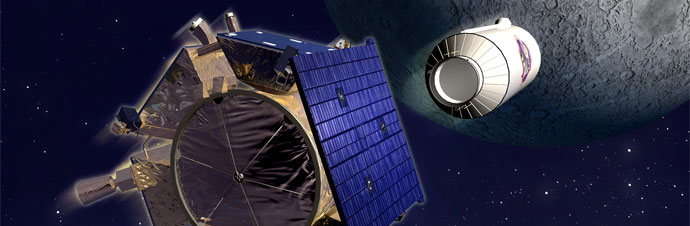
Tomorrow, NASA plans to send two spacecraft crashing into the moon. Scientists hope the impact will kick up enough dust — more than 250 metric tons — to help the Lunar Crater Observation and Sensing Satellite (LCROSS) find water vapor.
The Hubble Space Telescope and NASA’s Lunar Reconnaissance Orbiter will watch the collisions–and you can share in the experience on the Internet, by watching a live NASA TV broadcast starting at 6:15 a.m. EDT/3:15 a.m. PDT, Oct. 9.
Celebrate the new toolkit
Limited time only! Help us celebrate version 2.0 of the Library of Things Toolkit by chipping in $100 and receive an advance print edition.

This is the way it’s always been with space exploration. Unlike the age of sea exploration, every step into space has been exhaustively documented in the media, which today is interactive and viral.
And as we’ve explored space, our collective consciousness and our collective unconsciousness have expanded. "They should build spaceships of rice-paper and bamboo, decorated with poems," said British author J.G. Ballard, evoking the magical, shamanistic aspects of the space program.
This morning I spotted an amusing comment in my Facebook stream about the LCROSS mission: "What if we wake up some gigantic creature that decides to attack earth? Would Godzilla help us?" Over the next 24 hours, we’ll chatter through social media about the LCROSS mission, share favorite video clips, comment on our blogs, and we’ll mashup technology, pop culture, religion, and whatever else comes to our collective imagination. As space travel goes viral, it becomes a shared experience and a kind of ritual — and thus another means of social integration, as Shareable publisher Neal Gorenflo suggests in his essay on this year’s Burning Man.
Tomorrow, we’ll see another white pillar in the sky–but this one, we hope, we will be triumph instead of a tragedy.
