
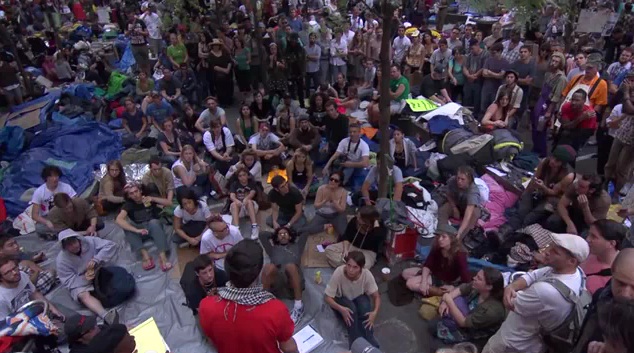
Occupy Wall Street's Consensus Process [VIDEO]
10.14.11, 6:29pm Comments (3)

This mini-doc shows in some detail how the general assembly - the heart of the occupy movement - operates. They make decisions by consensus and anyone can join the assembly. Through this process, the occupy movement models its own radically inclusive political economy and thus demonstrates that it's more than a protest movement. It's many things, but what may be overlooked is that it's a social process through which people can experience being a fully heard citizen, and maybe for the first time. It gives an opening through which people can experience first hand what's possible when a diverse citizenry works together.

Whatever the outcome of the physical encampments within the movement, my hope is that Occupy Wall Street is a starting place from which citizens will go on to create the democratic institutions, enterprises, and laws we need to avert disaster and thrive as a global civilization in the 21st century. I hope that at least part of the movement will turn to the many democratic social and economic innovations we write about at Shareable and put down durable infrastructure for a stable and inclusive global society. The spirit and workings of the Occupy Wall Street General Assembly would likely be in the cultural DNA of such a transformation.
Rate this article

Your rating: None Average: 5 (2 votes)

Comments

Just had to add a note to this. Starting at 1:00 a general assembly facilitator describes the consensus process and ends the description at 1:22 by saying, "there is no hierarchy".

It's contradictory (and funny) that the facilitator would say through a bull horn to the assembly, "there is no hierarchy" and then two waves of people repeat exactly what he says. Could come straight out of a Monty Python movie.

I doubt it's possible to have a political economy with absolutely no hierarchy. The structure of reality is of nested systems - cell to organ to individual to society. Nature is filled with both hierarchy and networks. The principle to consider is subsidiarity - from Wikipedia: subsidiarity is an organizing principle that matters ought to be handled by the smallest, lowest or least centralized competent authority.

The largest worker's coop in the world, Mondragon, has hierarchy (it's roughly a federation of coops with a umbrella governing body) but is still in my opinion radically democratic in a large part because they employ subsidiarity rigorously.

It could be that hierarchy is a consequence of categorization and classification ... a function of language and/or analysis. And even when the phenomenon "hierarchy" is real, we must be cautious that we do not blind ourselves with a hardening of the categories and miss the dynamics of change that are omnipresent.

Thanks CJ, while I don't understand all of what you're saying, I get the gist, and I have a feeling that you're on target. Bonus points because you're respectful.

 Building Youth and Student Power for a New Economy

Recent comments