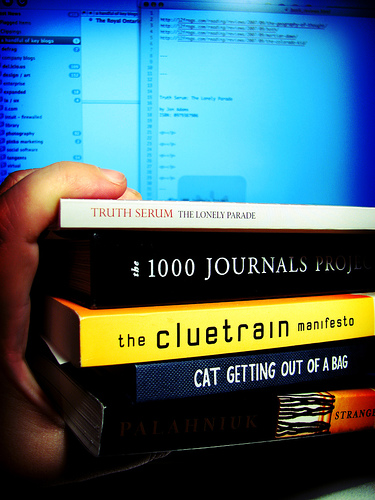
Imagine my surprise when I discovered one day that a large portion of my book The Daddy Shift is available through Google Books, which I didn't realize would happen.
Most authors (and publishers) intuitively believe that free digital book content diminishes print sales--but a new study in the Journal of Electronic Publishing suggests that, actually, the opposite may be true. The researchers compared sales data for four different groups of books, ranging from technology-oriented nonfiction to fantasy novels from the publisher Tor. The fascinating results:
Perhaps the most significant finding of this study was the contrasting results received by Tor and the other three groups studied. With one exception, sales of the nonfiction titles increased after a free digital release, and when the sales of the books were combined, sales were up 5%. The majority of the fantasy/science fiction books that were not part of a group release also had increased sales, and as a group their sales increased 26%, largely as a result of “Title 12.” Four of the five Random House books saw sales gains after the free versions were released; in total, combined sales of those five books increased 9%. These three groups were in contrast to our initial hypothesis that book sales would decline. Although we cannot say that the free e-books caused sales to increase, a correlation exists between a free e-book and increased print sales.
The results of the Tor book sales were quite different. Only four of the twenty-four books saw increased sales during the eight weeks after the free version was made available. Two of these books (titles 32 and 41) both had releases of paperback editions that preceded the free book by only a few weeks. Thus for the majority of the “pre” weeks, a paperback version was not available. These newly released paperback versions could easily explain why the “pre” sales of these titles were less than the “post” sales.
The book with the most dramatic pre–post difference (title 40) was released just ten weeks before the free digital version was released. It is possible that what was measured with this title was the natural decline of book sales over time instead of a result of a free version being made available. But even when these three books were excluded from the analysis, combined sales of the remaining 21 books decreased 18%.

Why were the results from Tor so different from the others? This question cannot be answered with certainty. The only thing we know is that Tor’s model of making the books available for one week only and requiring registration in order to download the book was substantially different from the models used to create free versions of the other books we studied. Further research is necessary to determine if the Tor results were related to their model of free book distribution, a natural drop in sales, or if other factors account for the decreased sales.
The present study indicates that there is a moderate correlation between free digital books being made permanently available and short-term print sales increases. However, free digital books did not always equal increased sales. This result may be surprising, both to those who claim that when a free version is available fewer people will pay to purchase copies, as well as those who claim that free access will not harm sales. The results of the present study must be viewed with caution. Although the authors believe that free digital book distribution tends to increase print sales, this is not a universal law. The results we found cannot necessarily be generalized to other books, nor be construed to suggest causation. The timing of a free e-book’s release, the promotion it received and other factors cannot be fully accounted for. Nevertheless, we believe that this data indicates that when free e-books are offered for a relatively long period of time, without requiring registration, print sales will increase.
I like the authors' methods, and I like how cautiously they interpret their results. One thing is for sure: The digital commons is here to stay.
I suspect that most people use the Google Books version of my book in the same way that I use Google Books: As a searchable reference. I cite or discuss those books, which expands their influence and audience. If I personally want to read a book cover to cover, I check it out of the library or I buy it.
And I have, in the past, relied on Google Books social media review aggregation to make that purchasing decision. My own book won an average of four out of five stars from seventeen reviewers, with seven giving it five starts and five readers giving it four. Will those excellent reader reviews drive more people to purchase the print edition for themselves? I think it's likely, and I don't think we're going to be able to stop the shareable future.

Discovered via Bloggasm.
Rate this article
Related Articles
- Occupy as a New Societal Model & Ways To Improve It
- Crowdfunding Social Change
- Time to Occupy the Calendar
- Enriching the Commons: Marvin Brown's Economics of Provision
- Who Are The 99%? Occupy Research Aims To Find Out
- Participatory Budgeting Gains Steam in San Francisco
- Please Donate $10 to Shareable
- iPhone's Darkside Exposed by New Banned Game App
- Reviving Main Street: A Call for Public Banks
- Micro-Participation Connects Citizens to Their Governments
Community Blog Posts
-
By Gary Horvitz
-
By Liz Elam
Recent comments
-
55 min 7 sec ago
-
8 hours 15 min ago
-
8 hours 58 min ago
-
10 hours 46 min ago
-
15 hours 13 min ago


I am an independent publisher who has recently co-produced and released the Open Collaboration Encyclopedia, with Alpha Lo, which is available for free as an Open Textbook permanently in addition to purchasable ebooks and paper copies, on our website: www.pioneerimprints.com.
I have looked at this issue from the trenches, and from many angles, and this is what I have determined...
I do find the present study of roll out times etc... to be very valuable, and it gives food for thought and some guides for my own operation.
However an apparently overlooked and obvious variable in the present study was the attitudes and demographic of the consumer niche.
Tracking the viewers of our free reader of the Encyclopedia, I have seen that in the last three weeks we have had approximately 900 readers from five continents. We consider this a great success. However, of this viewing group, the number of readers who have purchased copies, has been one. Yes, one. I attribute this to the consumer and reciprocal exchange attitudes of the reader niche.
I definitely sell more copies of my title, "Stewardship in Your Family Enterprise", a book aimed at family business owners, which does not currently have a free version, and has a much smaller relevant readership. But I hypothesize that I would sell even more copies of that title if I did provide a free reader. I believe this because I believe that the demographic that title is aimed at, has more of a traditional value and ethic of 'paying' for what they get.
Hence the difference between results of the Random House study, obviously a different consumer demographic, with different exchange values, than a fantasy book publisher, with usually a much younger and i would conjecture a less 'pay-for-it' oriented readership demographic.
The value for reciprocal exchange has decreased significantly in our present digital rip culture, and pioneers of shareable technologies do take a risk to offer free versions within communities that do not have a value for collective support. Business people understand that everyone has overheads, most teenagers, and even college students, don't really seem to get that.
In shareware programming culture of the 80's and 90's, there was an assumption one in 10 users would pay for that product, and business models reflected that. Again that was a different culture than we have even today. I'm looking today at one in 1000, in the demographic that is interested in our book.
As we progress deeper down the pathway of shareability, our fundamental attitudes towards reciprocity and how we take advantage of 'open licenses' will need to shift dramatically if we are going to maintain viability of such projects. Similarly I sense, but am not certain, that unless this occurs shareability will reach some lines in the sand which will cause us to look at whether we will practice shareability with the very stuff of survival, not just media and ephemeralities.
It should be remembered that Utopian Socialism, the ultimate shareable society, has only existed sustainably in one place, and that was the Galactic Federation of Star Trek. And then only due to the invention of the replicator in the 24th century. Our digital culture is in a sense a replicator. (im not actually a trekkie, but i have studied utopian socialism...)
I firmly believe that many of the buyers of the Random House paper books did so, not just because they wanted a paper version, but that they didn't feel comfortable taking something for nothing. They had an ethic ingrained in them in a place perhaps even below their own radar to identify what it was. It just wasn't right in their gut...
I also believe that the Tor group, didn't really find as much wrong with that.
And that's a result of the directions of our culture.
Its as much an ethics thing, and a cultivated sense of collective responsibility,
as anything else.
That is why our book, a very good one (buy) the way ; ), is so important and unique. It begins to map, as a key part of the equation, the foundational psychologic and spiritual requisites for an actually sustainable and flourishing sharing culture.
If we do not make wholesale shifts in our fundamental views, taking to full application the underlying ethics and perspectives that drive the impulse to sharing, not picking and choosing based on what's immediately comfortable to us, I propose that as a meme sharing like we're talking about may not compute in the long run.
So, do check out the book, and remember its fully open to collaborators...
And you aren't mandated to give anything, or 'pay for' anything. That's your choice. I'm just suggesting we all look deeper at what assumptions really drive that final decision in each of us.
Alden Bevington
editor@pioneerimprints.com