We’re over a decade into the digital music revolution, and there’s a million ideas of how to compensate artists in a post-label world, but no sure bet. Big-name artists like Radiohead and Trent Reznor have successfully distributed albums directly to the people using pay-what-you-want schemes. Other artists with smaller-yet-passionate fan bases such as Kristin Hersh and Amanda Palmer (link possibly NSFW) have also enjoyed some success with a donation model. But as pleas for donations increasingly dominate my social network news feeds, I’m curious whether this new donation-driven creative economy is sustainable--particularly since the donor pool trends toward the creative professionals’ starving-artist peers.
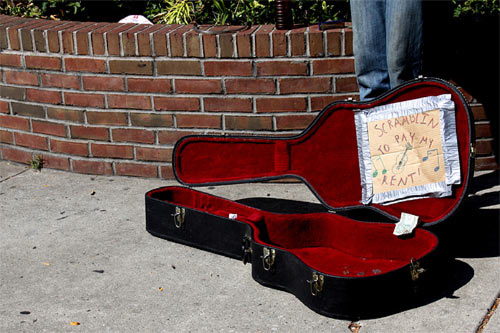
Photo By matthileo / Matt Katzenberger on Flickr
There’s a notion that the increased visibility social media offers, in conjunction with the Internet’s distributed tools of commerce, present a new business model to creative professionals. Since the music industry was one of the first creative businesses to be radically transformed by the Internet, much of this rhetoric is framed as a righteous battle between musicians, the industry and fans, with social media and online donations positioned as the liberators of the artists and their fans. The record industry, so the argument goes, was a middleman that became unnecessary as we entered the age of nearly-free digital distribution and social media promotions.
In practice, things haven’t proved quite so Utopian: maintaining an effective social media presence is a job in itself, often farmed out to interns by bands’ record labels or management companies, and the hyperactive mp3 blog hype cycle has become nearly as homogeneous and trend-oriented in its own way as the pop charts once were. Regardless, the artist-as-Internet-start-up myth persists. In his recent Poptimist column, Tom Ewing deconstructs this pervasive myth:
“Evangelists for a brave new post-record-biz world like to imagine musicians as start-ups: building a brand, leveraging social media, generally thinking outside the boombox. There's a Utopian element to all this-- in the real world, musicians and business skills haven't traditionally mixed-- and it's easy to read it as Silicon Valley's fantasy about itself as much as practical advice for an ailing industry: There's a reason entrepreneurs and gurus started calling themselves ‘rockstars.’ Meanwhile you can read a dozen articles about, say, Amanda Palmer's route to success and still come away with barely even a guess at what she actually sounds like.”
Despite the limitations of this model, there’s no argument that for a savvy, self-marketing musician, artist, writer or filmmaker, the shareable online world offers many opportunities. Online donation service Kickstarter may be the most successful implementation of this to date, offering a simple, attractively-designed service that allows creative professionals to solicit funding directly from their fan and friend communities. To some degree, Kickstarter builds upon the artist-as-start-up notion that Ewing skewers, but is far more grassroots and community-oriented than your typical start-up. Most Kickstarter projects are funded with small donations from friends, acquaintances and fans, not wealthy venture capitalists looking down from on high.
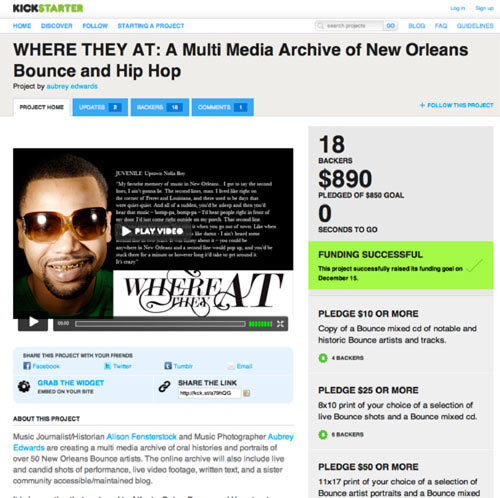
Kickstarter has had some notable successes in its short tenure: the service has helped fund an impressive number of creative projects. A few that come to mind include Where They At, a documentary film and online archive of queer New Orleans hip-hop, Coming & Crying, an anthology of stories about sex edited by Melissa Gira Grant and Meaghan O’Connell, and political cartoonist Ted Rall’s trip to Afghanistan for a hybrid comic/journalism project.
Yet there’s something about a donation-driven creative economy that services such as Kickstarter enable that makes me uneasy. I’ve considered using the service: I’ve got an album’s worth of material I’ve been sitting on for nearly five years, constantly delayed because of a lack of funds and (to be honest) a fair amount of procrastination. After recording multiple albums in the past on my home computer, I’ve been holding out until I can pay someone else to record the album. I’m not looking for a lavish studio, but I’d like a professional who costs more than $50 and a case of beer, who can record the vocals and the guitar and the drums on more than one pawn shop microphone. The resulting album will have, admittedly, niche appeal: I’m a 34-year-old freelance writer whose past musical successes have been modest and regional. Still, I’d like to have an album with a backing band, recorded by someone who knows what they’re doing, featuring album art from a professional artist who expects and deserves compensation, all pressed on a limited run of vinyl and sold digitally online for a modest sliding scale cost. These are pretty humble goals, but the require much more cash than I have on hand. A shareable solution to some of these costs exists: I can trade services with some of the vendors--write some copy for the artist, do some web consulting for the backing band members. But it’s harder to trade knowledge for a stack of physical product.
Yet this approach makes me uneasy. Is it insecurity? Fear that I won't be able to deliver? The dated and silly notion, inheirited from my English mother, that you "never ask for a handout"? Or is it my personal sense of Kickstarter fatigue?
A recent blog post by author Jami Attenberg speaks to that sense of fatigue. Attenberg urges young artists and creative producers to tap old-school funding sources before turning to their friends and fans, sources such as grant-giving organizations, their savings account, a trust fund, or family members. (Attenberg seems convinced that the artists soliciting Kickstarter donations all come from wealthy families, but judging from the creative professionals I personally know, this isn’t always the case.) She tartly addresses one of the fundamental problems that arises from Kickstarter overuse:
...please stop asking me. I know you’re ambitious, but for some reason your use of Kickstarter is starting to make me think you’re a little lazy.
Talking with friends and colleagues, I suspect that Attenberg and I are not alone in our Kickstarter fatigue, but for the time-being, it appears that we’re in the minority: a thoroughly unscientific, yet telling, glimpse on Amplicate (a service that aggregates online sentiment about various topics) puts Kickstarter “hate” at 3% and Kickstarter “love” at 97%. There’s no denying that the Kickstarter successes continue: Diaspora*, the open-source Facebook alternative we covered earlier raised over $200,000 using the service, and Adam Lisagor and Jesse Thorn’s “Put This On” web series about “dressing like a grown-up” has raised nearly $20,000 through a series of Kickstarter projects. In this tweet yesterday, Kickstarter announced that the service has raised $15 million dollars since its April 2009 launch, and that its amount of donations is increasing exponentially.
Put This On, Episode 2: Shoes from Put This On on Vimeo.
For the artists and fans that use Kickstarter, the service has earned quite an amount of trust, in no small part for its fail-safe method of ensuring pay-outs to the projects that meet their minimum donation goal. If you can’t achieve the necessary level of interest to reach your minimum solicited amount, the money pledged is returned to the donors. It’s a effectively Darwinian way of separating the wheat from the chaff, if somewhat unforgiving--I suspect that projects that appeal to an older, wealthier demographic such as Diaspora* or Put This On will prove more successful results than an activist punk band trying to raise money from cash-strapped teenage fans to embark on a basement tour across the nation.
Let me emphasize that I am not against the donation model in principle. It can be a fantastic way for creative professionals to interact directly with their fans and communities, which are much better creative partners than old-school distribution companies. I proudly donate to the user-supporter services I enjoy, whether they be public radio, Kickstarter projects such as Cellstories (which, full disclosure, has published my work), or podcasts such as WTF with Marc Maron, all funded primarily by fan contributions. I’m also a benefactor of donations: the literary culture blog I edit solicits reader donations, and your generous contributions to Shareable help compensate its contributors.
Still, I worry that we’re all going to the well too often. We’re soliciting donations for projects that don’t yet exist. Creative professionals may resemble Internet start-ups in superficial ways, but there are many fundamental differences. For one, venture capitalists invest with the hope of a major cash-out at the end. Most of us artists are in no position to offer our supporters potential profits in the future. Moreover, if our fans and communities do not grow exponentially, how many times will the same pool of people be willing to contribute to our projects? There are ways to reward those that support us--many artists both well-known and obscure have reaped large donations by offering perks and exclusive content to large donors. The Musician’s Guide to Fan Funding details some of the ways that artists have successfully crowdsourced their income, and this post at Flagpole goes deeper into some of the considerations artists should make when planning a donation-funder programs.
When we reach out to our communities to fund our creative and artistic projects, we have to acknowledge that we’re making a tenuous social contract, and that we must reward the goodwill and generosity of our communities and fan bases. And ultimately, no matter how much breathless hype new media gurus propagate (often via lucrative book deals from old-school media corporations), donations can’t be the only way we fund the creative arts: there’s a finite number of potential donors, and in the midst of recession, an ever-shrinking pool of money available to give. Contributions can be an important component in monetizing creative content, but there’s not enough goodwill, or money, for them to be our sole source of income. There are plenty of other effective alternatives, from live appearances to merchandising to the old-fashioned transaction of goods (physical or digital) for cash. Donation services should certainly play a role, but cannot fund our creative projects alone.
Rate this article
Comments
Excellent points, Soni. I think you're right-on in saying that much of the problem is how we frame the two types on transactions, and that the notion of "pleading" for donations gives the donation model an unnecessary stigma. Some great food for thought, thanks for the comment.
The donation model is a long-standing element of the arts community. Anyone who has ever gone to a house show or DIY-style event is familiar with the old pass-the-hat-for-the-touring-bands routine, and anyone who has ever gone to the theatre or symphony is familiar with the pages of donor names in the program.
What sets these donation requests/acknowledgments apart from what I'm seeing online is that I'm already a fan. I'm there. They have my attention. I'll usually pick up a t-shirt or whatever the bands are selling, and my partner and I donate regularly to several local arts organizations.
When the digital donation request is from someone who I have never heard of, it feels a bit spammy. The ease of distribution that the internet provides enables people seeking donations to cast a very big net, in the hopes of catching a few contributors.
That being said, I happily donated to, and spread the word about Diaspora as soon as I found out about it, and have contributed to social media "friends" who are raising money for a project that is too broad in scope to cover the expense themselves. I consider it a bit of small-scale philanthropy.
I guess I'll take the situationalist stance, and say that the donation model, when applied in a thoughtful and targeted way, has the potential to re-imagine our artistic communities (as the governmental funding model is being eviscerated), but when soak-sprayed on an uninterested audience, becomes just another piece of digital junk.
I'm going to give this one some more thought.
Thanks for the interesting read Paul.
When I started the Book Bike in 2008, it was reliant on publishers' book donations. With time, those donations dried up because many learned I was not not-for-profit (not organized in any way at the time, just a dude with a tricycle) they cut back and eventually cut off the donations. Fortunately I had received enough local press that people started donating books from their own shelves and, with time, those donations dried up too.
So I switched to a financial donor model at the start of this summer (2010). Since I had been at this for two years already. with press coverage from around the world, I didn't see it as any sort of 'pleading.' I felt I had proved I was legit. Donations came trickling in, and, as you state in this article Paul, I was reliant on my friends and family for that support. And my friends came through, they gave what they could and I know that for them to do that was a big deal. My circle of friends, and myself, we don't have money to give. We simply don't. So for my friends to dig deep...they sacrificed to show their support. I am damn lucky and that doesn't go by me.
But if the Book Bike was going to continue, I needed more (the donation process, and how the money is spent, is transparent on the site). While people extol the virtues of Kickstarter, I can't do it. The 'what if' factor is too damaging for my small-scale operation. Every penny donated to the Book Bike makes a significant difference, but if my goal is $1,000 and I only raise $999...I don't see a dime, let alone a penny. And what's going to convince those who get their money returned to them to ever donate to me again? If that happens, I prove that the project is NOT worth peoples' cash, that my project is a failure. I have always taken risks with projects that I believe in, we all do, but after two years of proving myself I just couldn't reconcile with this.
I decided to do my own version of what Kickstarter does as part of their thing is offering some sort of trinket for donations. So I put up a signed book from a well-respected contemporary author/publisher from my personal library and announced that if I could raise $1,000 in 30 days, someone would win my book. Donations came pouring in, in all amounts, and although we were $100 shy of meeting the goal...I ended up with nearly $900 to spend on books for the Book Bike (http://www.bookbike.org/the-great-book-bike-book-buy/). If via Kickstarter, then the Great Book Bike Book Buy would never have happened because I never would have seen the money that fell short of the intended goal. If I had done this via Kickstarter, the Book Bike would be dead in the water. Many people say "I don't know anyone who hasn't met their goal on Kickstarter." Well, if I didn't meet my goal and lost all those donations...I probably wouldn't tell you either. I've worked too hard for this project, for my community, to risk that sort of social embarrassment.
Back to the donation model: Once my offer of a trinket was past, despite regular traffic and kind emails, I went back to zero donations. Some would trickle in, but when I didn't have an incentive beyond the purpose of the project, people didn't seem to have an incentive to give. Obviously this is a gross generalization and not meant to sleight anyone who has dug deep to support the Book Bike at any time.
And then I ran into some trouble with city officials in Chicago and the Book Bike was launched into the national eye overnight. In one week, over 10,000 people visited my site to learn about the Book Bike (compare that to my average of 15 to 20 visitors a day). I got a collective $100 in donations that week. Now, for the Book Bike, $100 is a serious amount of money, I am not scoffing at that amount. But lets step back a moment and look at the bigger picture: 10,000 unique visitors in 7 days = $100 in total donations. Bummer.
The donation model is NOT sustainable, its simply not. Whether that is a sign of the financial times or my terrible business acumen, my personal experience in financial donation is a rough one. This does not discount the value of those who DO donate to the Book Bike, nor does it discount the value of those who WANT to but can't...but it does mean that I need to come up with another business model, and fast, if the Book Bike is going to stick around.
One big challenge of the donation model is that the ability to get people to donate is a skill. And you have to be really good at fundraising to get people to give.
More importantly, you have to spend money to get money. What is true in business is also true in nonprofits. To grow a nonprofit or a donation-based enterprise, you need to invest in building up a community of support. While some people are naturally good at this, it normally requires expertise. In nonprofits, fundraising is a profession with training programs, associations, and established practices and protocols.
The point is that 99% of people do not have this skill. And if you already have one profession, say as a musician, then it's really hard to pick up another trade even if you want to. Time limits, etc.
I would look at the donation model as augmenting other sources of income, not being the sole source of support. Whether in business, nonprofits, or in your personal life, I think diversifying your income stream is a good idea.
What a great dialog around this piece! Glad to see so many responding so thoughtfully.
My wife, who is involved in the theater, raised another good point: donations are a giant part of the theater world, as ticket sales do little more than keep the lights on. However, any established theater, such as Steppenwolf, has a team of professional development staff whose entire job is to solicit endowments and donations, which keep the organization going.
As solo and DIY artists, we do not have the resourses or infrastructure to court large, sustained endowments. Perhaps that could be a service that Kickstarter offers in the future?
In Gabe's case, the amount of goodwill that came after he was hassled by the Chicago park service brought in an unprecedented amount of support, but that was one unique and rare incidence--it's rare that a small DIY project makes its way to the front page of the New Yorker blog. A lot of things here to consider.
Great insights here, Paul. I can see your whole concern with the Kickstarter (Invest in a project before it's done) paradigm and I agree with you that this can't replace more traditional methods of funding. Also, the kickstarter presentations are so slick I begin to wonder what kind of budget went into creating them.
My main worry is all the artists who feel convinced that they must give so much away for free in order to promote their work. My site, goldhat.org, hopes to solve this problem by giving patrons a way to donate $0.10 to $100+ on content that they believe worthwhile.
I really appreciate this article because it gives me a lot to think about. I'm thinking that goldhat.org will have a different demographic than kickstarter, but right now the picture is fuzzy.
Two thoughts on this:
One:
Donation economies need Generous Nodes, which is to say nodes which give away more money than they accept. This would seem to make it impossible for a donation economy to survive at all, but a healthy donation economy (for any discipline) will have a lot of novices and amateurs, in fact many more than it has actual pros. Donation economies, in fact, need day jobs, which is not very Utopian but it works, and has done, for some time. (Kickstart incidentally is not a donation system at all but a conditional purchase system.)
Two:
Record Labels are polymorphic now. Yes, a lot of artists play the often-agony-wrought game of self-promotion, self-publication and self-management, but they don't have to, there are a LOT of options. Witness DFTBA Records, to name one, a record label which consists /entirely of YouTube artists,/ including the founders and owners, and which does alright both with donations and conventional record sales. Record labels occur in many sizes these days (as opposed to one, huge) which is a great benefit to artists.
In my singing the praises of the new internet age, I try to be realistic, and surely for every new way artists find to make a paycheck off the web someone else will be trying to screw them, but I think this new, bigger, more chaotic system is ultimately a good thing.
The web has made it far easier for artists to reach fans, and opened up new ways to bypass the traditional music-industry business model. On the other hand, there are a lot of artists out there. Getting money into the hands of artists "the kickstarter way" may help ensure that the buzzworthy prevail, while the majority of those artists are starving, just like the good old days.
Testimonial: I've bought lots of music online, and love hearing new artists via websites, but have never donated to projects that have yet to materialize. Not even with the possibility of paying to get Paul to record "Glory of Love" in the studio (on the other hand, if he sang a few bars on my answering machine, I might loosen the purse-strings).
I don't know how long it takes before we find out if a donation-driven economy is "sustainable," but I just gave our donut money to some wet Pakistanis, and they don't even have a MySpace page...
Really what's needed is the second half of a paradigm shift for users, which involves a lot of education of the cost of creating work.
The problem is really that most people have never had the chance to think through how one actually can make a living in a creative field... The average consumer hasn't commissioned a lot of artwork on their own. It's a lot harder than it seems, and costs more than people expect...
When the internet rolled around, people got really excited about the idea of free content, because the costs of distribution were removed. But at some point, we need to think about the fact that we still want people out there to be making awesome new stuff for us to share... and that's where investing directly in the creation of the work has the potential to be revolutionary.
I think that artists need to be a lot clearer about figuring out what their work costs them, and educating their audiences about that. Artists have a tendency to shun talks of money, and devalue their work by self-funding so much of it (through both day jobs and unpaid hours) without clarity about these investments. It's easy for us to end up operating like really mis-managed non-profits in unsustainable ways that lead to burn-out.
For example, I'm a photographer and do a lot of sliding-scale and pro-bono work that I share freely with communities that I want to support. But when I do this, people who appreciate the images tend to think of photography as "free" and "instant" - whereas I know that my business invests at least a few hundred bucks in a basic shoot. This makes it a challenge in doing this kind of work, and the financial support that I receive from the community has yet to make much of a dent in these costs- it's still very much supported by commercial work.
Still, I think that it's important to try and derive support from our audiences and communities. It's still a bit of a dream in many cases, but it's an important part in re-setting our cultural priorities. Money isn't good or evil, it's just a stand-in for value. If we value our work, we should be paid for it- and if we want to share our creative work freely with our communities, we should offer them the opportunity to share in the costs of creating it.
http://www.jjtiziou.net/jj/my-dream
-jj
Instead of using kickstarter, go to Indiegogo.com Whatever money you raise you get, regardless of your original goal. They charge a 9% service fee. HOWEVER, if you work through FracturedAtlas.org to be a sponsored project, your operation will fall under their 501c3 and your donors will get tax receipts plus the money you raise on Indiegogo will only be assessed a 6% fee. It's the most profitable way I've fund to fundraise and keep as much money as possible.

Shareable's eBook Crowdfunding Nation: The Rise and Evolution of Collaborative Funding, investigates this transformative tool for funding creative projects, startups, and social movements. It includes articles on crowdfunding's history, future, and impact on social movements, how-to guides exploring the best practices for launching a campaign, the legal considerations of crowdfunding and case studies of innovative and inspiring crowdfunding projects.
Buy Crowdfunding Nation: The Rise and Evolution of Collaborative Funding for only $2.99:
- Buy the no-DRM ePub: (ePub version can be used on the iPad, iPhone, iPod Touch, Android eBook reader apps, Nook, Kobo, Sony Reader, and most other non-Kindle eBook readers.)
You can also read all of Crowdfunding Nation for free on Shareable.
—————
Related Articles
- The Ultimate Guide to Traveling Without Money
- Hacking the Commons: How to Start a Hackerspace
- Kicking off a Year of Open Source Everything
- 9 Ways to Kick Off a Shareable 2013
- How to Make a Party Box to Share with Neighbors
- Help Us Improve Shareable (Takes 2 Minutes)
- This Week in Sharing: Creative Destruction!
- Pick Up and Play: a DIY Guide to Building Community Through Music
- Is Living in Your Car a Viable Way to Save Money?
- How I Saved $17,000 in One Year By Sharing
Community Blog Posts
-
By Drew Little
-
By Tim West
-
By Liz Elam
Recent comments
-
2 hours 22 min ago
-
2 hours 26 min ago
-
5 hours 17 min ago
-
16 hours 55 min ago
-
19 hours 21 min ago


The primary issue I see here isn't whether or not donations can work as a business model. It's the dichotomy that donations are inherently different, in some qualitative way, from asking for and getting a set price.
Both involve the simple act of asking for money in exchange for goods and services. The only difference is that when you sell something, you set the price and when someone donates, they set the price. In all else, these actions are the same.
And yet, people "ask" a set price, but they "plead" for donations. Selling something is a positive act, but letting the buyer decide how much to pay is "asking for a handout". Selling carries the feel of professionalism and quality (even when that's patently demonstrated not to be true every single day across the realm of imaginable products and services), while donated and bartered services and products feel amateurish and shoddy (even when that's also patently demonstrated not to be true every single day across the realm of imaginable products and services).
I think this isn't so much a problem of which transaction is more viable as it is a matter of determining why we have a mindset that these two transactions are, at their core, polar opposites when they really just delineate two points sitting right next to each other on the same line of possible transactions.
Venture capitalists expect a payback, but so do fans - just not a monetary one. They put in a bit of money that represents their faith, their trust and their love of the work, and they expect to be paid the same back by the artist or musician, plus the interest earned on their investment paid out in something they desire as much or more than money - a new musician to follow, new music to experience, the expansion of their community, the joy of helping something they love grow, and so on. I'm not sure that donors (as opposed to venture capitalists) aren't getting the better deal.
Try reframing your mindset re: donations and payments. Substitute "user-define sales" or some other such phrase, if you have to, for the word "donations" and see how that changes the conversation. Then, maybe, you'll be able to see where the right road for you truly lies.