
I’m a fan of contextually appropriate density in urban areas. If you don’t have sufficient population and income density, you can’t support urban neighborhood retail; if you can’t support neighborhood urban retail, you don’t have any real walkability; if you don’t have walkability, you are car dependent; if you are car dependent, then you are in direct competition with the suburbs; if you are in direct competition with the suburbs, you are probably going to lose. You can’t have a walkable neighborhood if there is not, in fact, anything to walk to, no matter how many sidewalks you put in.
But other benefits touted for density may not be as important in some cities. In the “spiky world” geography of globalization, high value enterprises are said to require dense networks and intense, face to face interactions. The best description of this I’ve seen is the notion that “people in global cities like to have lunch.” It’s an important part of how information and ideas spread. That’s why we increasingly see certain types of activities focused in the cores of cities like New York, Chicago, and Boston. Their high densities allow easy, frequent, face to face interactions.
I’m a fan of contextually appropriate density in urban areas. If you don’t have sufficient population and income density, you can’t support urban neighborhood retail; if you can’t support neighborhood urban retail, you don’t have any real walkability; if you don’t have walkability, you are car dependent; if you are car dependent, then you are in direct competition with the suburbs; if you are in direct competition with the suburbs, you are probably going to lose. You can’t have a walkable neighborhood if there is not, in fact, anything to walk to, no matter how many sidewalks you put in.
This year, we’ve seen Mutual Aid in Motion.
From scaling sharing hubs to Mutual Aid 101 trainings, we’re helping communities build the tools they need.
Every dollar fuels lasting resilience – proving that when we move together, we all move forward.

This need for high density interaction environments might seem to work against lower density cities that sprawl all over the place. But does it always?
I’m not so sure. For smaller cities – say those with metro areas around two million or less – I’m not sure a lack of a huge, packed, downtown core is as critical to those types of interactions.
Density is required in places like NYC and Chicago because they are huge and because getting around is difficult. For a downtown worker to have lunch with someone in an edge city development is painful in the extreme. So co-location downtown makes sense.
But small cities, because they are much smaller and transportation is so easy, don’t need co-location to achieve the same effect. The fact that anywhere in a region is probably no more than 30 minutes from downtown, plus the fact that almost all of these cities have “favored quarter” style development, puts pretty much all of the high talent workforce within easy lunching distance of each other.
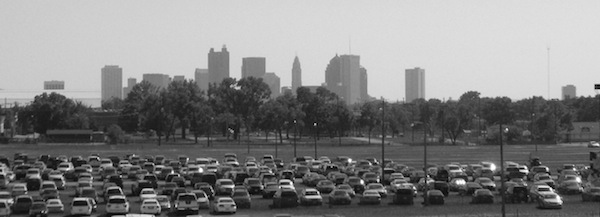
Think about Columbus, Ohio. It is fairly straightforward for someone downtown to have lunch with someone in the Polaris area – just drive up there. Anyone can have lunch with anyone in Columbus easily. Again, the city has a favored quarter development pattern, so the talent is clustered to the northside. OSU is conveniently located in the middle. The fact that Columbus is lacks the high downtown density of Chicago isn’t a problem. Having lunch – or coffee or a drink or attending an event – anywhere in Columbus is no issue.
These smaller cities tend to operate at the level Jane Jacobs called the neighborhood of the “city as a whole.” They are smaller and have shallower talent pools, meaning you need a bigger catchment area to bring folks together. Fortunately, their geography supports this. Also, the shallower talent pools in my experience leads to more cross-disciplinary interactions than you see in bigger cities, where there is much more congregating of people within their own scene.
Back to our big city examples, even within their core, getting around can be a chore. That downtown-Polaris lunch in Columbus probably didn’t take much more travel time than a Sears Tower-Hancock Building lunch in Chicago. Going from Midtown to Downtown Manhattan is even more painful. I suspect the pain of getting around Manhattan is one of the factors that drove subclustering of industries there.
So the good news in my view is that smaller cities aren’t compromised by their lack of core density on this dimension – if the region has a sufficient talent pool. The downside is that these cities as a result have weaker core business centers, because you don’t have to be downtown to be where the action is they way you do in Chicago. That’s why private sector employment in downtown Columbus (and I’d suspect almost any similar city) is declining. The forces that sustain a downtown Chicago just don’t exist there and probably never will. It’s a downtown challenge for them, to be sure.
—
Aaron M. Renn is an urban affairs analyst based in Chicago and author of The Urbanophile, where this article originally appeared.
