Dear Facebook, You Call That Sharing? (Towards a Sharing Manifesto)
08.13.10, 12:11pm Comments (12)

The resource-sharing movement is building, but to get it to the next level (where sharing is a natural, easy part of our daily lives) we need more people to dive in and start doing it. The more people do it, the better we’ll get at it, and the more incentive there will be for entrepreneurs to develop products and services to help us do it even better.

Manifestos have a way of crystallizing movements and galvanizing folks into new patterns of behavior. Remember Obama’s Yes We Can? That was a manifesto.

I think it’s time for a sharing manifesto.

Typically manifestos are written to someone. The Diggers’ wrote one to the Mayor of San Francisco in 1968:
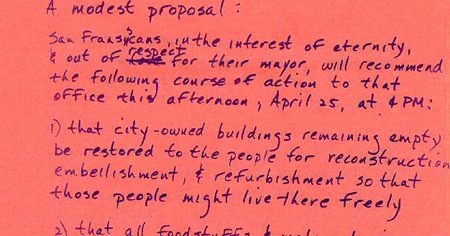
Here's the text, just in case you can't make out that handwriting:

A modest proposal:

San Franciscans, in the interest of eternity, & out of respect for their mayor, will recommend the following course of action to that office this afternoon, April 25, at 4PM:

1) that city-owned buildings remaining empty be restored to the people for reconstruction embellishment, & refurbishment so that those people might live there freely

2) that all foodstuffs & materials in surplus not accounted for in current welfare distribution be returned to the people for redistribution free through ten autonomous neighborhood free stores whose rent shall paid by the city

3) that presses & trucks be made available for the dissemenation of free news throughout the city so that the people will come to know one another & make channels of access available to each other

4) that the city provide resources for autonomous neighborhood celebrations of the city, the planet, & their own free beings

5) that parks & other public spaces be returned to the people for free life acts: all permit authority to be rescinded.

These are visions which will be realized by the people of San Francisco. The mayor's office is invited to share in that vision. Citywide celebration of the summer solstice will mark the entrance of free San Francisco into eternity.

Welcome home.

Or read Adbusters’ manifesto written to “the teachers of neoclassical economics”:

True Cost Economics Manifesto

We, the Undersigned, make this accusation: that you, the teachers of neoclassical economics and the students that you graduate, have perpetuated a gigantic fraud upon the world.

You claim to work in a pure science of formula and law, but yours is a social science, with all the fragility and uncertainty that this entails. We accuse you of pretending to be what you are not. You hide in your offices, protected by your mathematical jargon, while in the real world, forests vanish, species perish and human lives are callously destroyed. We accuse you of gross negligence in the management of our planetary household.

You have known since its inception that one of your measures of economic progress, the Gross Domestic Product, is fundamentally flawed and incomplete, and yet you have allowed it to become a global standard, reported day in day out in every form of media. We accuse you of recklessly projecting an illusion of progress.

You have done great harm, but your time is coming to its close. Your systems are crumbling, your flaws increasingly laid bare. An economic revolution has begun, as hopeful and determined as any in history. We will have our clash of economic paradigms, we will have our moment of truth, and out of each will come a new economics – open, holistic, human-scale.

On campus after campus, we will chase you old goats out of power. Then, in the months and years that follow, we will begin the work of reprogramming your doomsday machine.

Here are notes towards a few manifestos I’d like to see written:

Dear Oprah… We recommend that you hire a community expert. You’ve got Dr. Phil for marriage, and Suze Orman for finance, and experts for diet, exercise, spirituality and more. Why not community? Gwyneth Paltrow (GOOP), I’m talking to you, too. And in a similar vein, Barnes & Noble, why no ‘community’ section in the bookstore?

Dear Bank CEO… Be forewarned, we are moving beyond you. A grass-roots movement is building. We’re creating a new economic system that is supportive of community. We’re creating a user-controlled, community-centric, localized, relationship-based model of exchange that utilizes economic tools that have been with us since biblical times. This is a community-based resource-sharing third economy. It’s economy-as-ecosystem, with a decentralized, emergent character and no central point of control. It’s created and implemented by the people who use it, not by a handful of bankers on Wall Street like you. It puts economic power into the hands of the people, to use to strengthen their families and their communities; and to save money (and even make money) in the process. Be forewarned…

Dear Entrepreneurs Looking for the Next Big Thing… This is it. We are what you’ve been waiting for. We need better online and “offline” tools. Better products and services. Get in the game. Enough said.

Dear Social Scientists… We need a standardized definition for community. What is it? How does it work? Is it a noun (a place) or a verb (a behavior)? How do I know when I’m doing it? ‘Touchy-feely’ and vague definitions simply don’t cut it anymore. Community is too important to us as a species. Let’s dig deeper into the science of community; its causes, its effects, and how things like resource-sharing contribute to strengthening it.

Dear Local Governments… Sharing is too hard. We need you to make sharing easier. We need code changes, and zoning law revisions, and more. Please don’t force us “off the grid.” We want to stay where we are and make our existing communities better. You can help.

Dear Costco… We recommend that you launch a “shared” buying club to incentivize sharing. Sanction the thousands of informal buying clubs that have formed to save money by divvying up your bulk items. Bring us into the fold. Your brand and your business model will be the better for it. Wal-Mart and Amazon.com, you need to dive into the 'sharing' space, too.

Dear Facebook… You call that sharing? We think you could be doing so much more to encourage true connection and communal cohesion. How about facilitating cross-generation dialogue between our wise ‘elders’ and our imperiled youth, for instance? For good or bad, you are our current caretaker of social and communal life. If you don’t do it, who will?

Post your manifesto notes below! 

Rate this article

Your rating: None Average: 2.5 (2 votes)

Comments

That's funny--right before I saw this post, I posted my own letter that could fit into that list of notes at the end:
http://opensource.com/life/10/8/open-letter-my-longtime-friend-google

Thus began as a manifesto for sharing in education but became something more.

http://www.universityofutopia.org/sharing

Stephanie, here's some thoughts:

-Sharing is intrinsically pleasurable. There's something quietly joyful when you use a resource wisely, when it gives maximum benefit in relation to the energy needed to bring it into being. It feels good to use fully the gifts entrusted to us.

-In a world in which we share, people, places, and things connect us. We recognize these not as isolated points but as nodes in a network and part of the cycle of life. They either circulate themselves or are circulated in a process which bring us together in a league of wise prosperity.

-We are early in transforming modern economies from market-based to commons-based, so we should be patient with our experiments. It took centuries to make buying and selling as easy as it is today to the point that you don't even need money to buy, you can use credit. Sharing can be made as easy with diligent effort and long-term commitment. We should not make a judgement about the practicality of sharing based on failures of individual innovations. For instance, bikesharing has gone through a few stages before it began to work. First attempts decades ago were utter failures. The success of the Velib system in Paris has catalyzed the industry. It's now growing rapidly.

-Sharing is a domain where design thinking should be and is increasingly being applied. And a commons-based economy is a huge enterprise and design opportunity. Our material world came to being with individual purchase and use in mind. Our economy waits to be completely reinvented with sharing as a key principle. This is one of the most promising frontiers of the 21st century.

-Things connect and empower us. Things which sit idle die. Things burnish with use and come alive in circulation. They are, as Walt Whitman said, "uniform hieroglyphics" and are "dumb, beautiful ministers" which remind us of our own form and place in the warp and weave of the world, and when shared, affirm our sacred bond with each other and the earth.

Ruth, great 'manifesto' about net neutrality and open source... both totally essential to a sharing economy. Love it.

Stephanie Smith

U of U... wow. No kidding! I like "we share our work... so that one day we might become free." Powerful stuff.

Stephanie Smith

Neal, amazing to get these thoughts. You make a very important point about how early we are in transforming our world... this is gonna take awhile. Things that matter always do! In a similar vein, the most-circulated story right now on NYTimes.com is by Gail Collins called My Favorite August http://www.nytimes.com/2010/08/14/opinion/14collins.html?src=me&ref=home... about how long it took for women to get the vote... Thanks again for sharing the above. Fantastic.

Stephanie Smith

Contributor Chris Arkenberg just published something here on Shareable that I think qualifies as a note toward a sharing manifesto: http://shareable.net/blog/the-evolution-of-sharing

Jeremy Adam Smith
www.jeremyadamsmith.com

Thanks for the manifestos. I am old enough (57) to remember the Diggers, and have read about the original Diggers in England, one of whom was Gerard Winstanley. The New Economics Foundation in the UK has done something with reviving Winstanley's ideas, I think. What I wonder about is, what do you do if you live in a conservative Midwestern town, not a hip coastal city, where sharing is seen as a threat or a huge no-no? I've had Midwesterners tell me, oh, no, people will never share cars. Or if you share tools, someone will steal them or break them. That's the mentality. How do you overcome this?

Anonymous, that's a good question. What comes to mind are rural institutions like coops, churches, schools, and libraries that hold values and have actual physical space that would support sharing. My idea would be to base sharing efforts from these strongholds.

There are always going to be skeptics. Ignore them. Start efforts with people and institutions that do not need to be convinced.

-Neal

Do you think Americans are/will be particularly slow on the draw in moving toward a commons-based economy? Considering that this nation was founded by landowners and slave holders, it seems that we have deeply rooted, historical attachments to the things we own. Much like we're seeing the present-day implications of our historical racism emerge more and more, we are, I believe, just as attached to consumerism and ownership as core elements of our identity, myriad costs be damned.

I was just the other day reading about a new Tool Library opening in Boulder. The guy who came up with the idea consulted with the two dozen or so other similar projects around the country. So, it's possible to make it happen in the Heartland, too.

I just found this sight and find it so promising. It seems to take the sting out of reading the section in "The Grapes of Wrath" where the fruit is destroyed rather than given to the hungry. As for Americans being particularly slow to the concept, I see everywhere, everyday, Americans being involved in community and sharing. As a Mother, I spend so much time involved in groups like the Girl Scouts, PTO, and most importantly the local community of Mother's that discuss the economy and the future of our children, our mortality...We are always sharing ideas to inspire eachother in career solutions, home management solutions...We just find ourselves worn out and often despairing about time and what can really be accomplished in a lifetime. But I do believe that these hardly heard conversations-- real world hubs of sucessful sharing-- have created an essential powerful thread in America. I am a refuse artist and entrepreneur and understand the way people look at individual thinkers, my own husband chuckles at times over the directions that my creativity can take me, and I am located in the midwest, so I totally get Anonymous. Creativity, innovation, and sharing just needs thick skin and a raised chin. As the sharing movement maintains the thick skin that any great idea must have as it looks to gain its momentum, the future is promising. I find it amazing how many people I know that have begun to discuss the idea of shared gardening practices, shared labor practices....Good will follow from this economic slump. It is exactly the environment that can breed sharing.