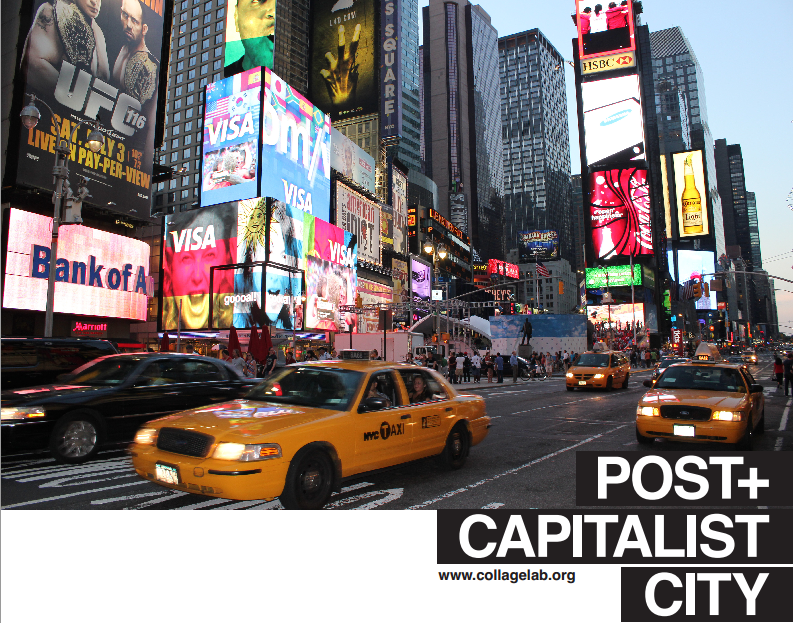
In the wake of the worldwide financial crises, there has been renewed debate about alternatives to the current capitalist system. Collagelab—a new platform for competitions about architecture and urbanism—has launched a yearlong competition called POST+CAPITALIST City with four themed contests that invite participants to reimagine cities in a post-capitalist context.
Cities… Their attractiveness was originally based on the economic opportunities they provided to their inhabitants…However, in a prospective future if attractiveness is no longer necessarily related to profit making…the question of the future of existing cities is wide open.
What if the change was tomorrow? What would be the characteristics of a system not based on profit making? What would be the consequences of a new system for the way in which we use urban spaces? Would cities enter a transformation process, becoming specialized centres in a globalized system? Would the global network of cities tend to erase borders or to affirm and reinforce them? What is (could be) the scale (the impact) of the change?
The first contest focuses on shopping. It asks entrants to rethink how we shop and consume and to imagine a city with a different kind of shopping culture. The scale of the project is wide open—you can think at a global scale or focus on your neighborhood or street corner. The only requirements are to be “urban and prospective.” It costs 30 € (about $39) to enter the contest and the total pool of entry fees will be divided as prize money between the top two winning entries.
The deadline to enter the shopping contest is July 1st, 2012, so get started creating your vision now. Future contests launching later this year will focus on work, lifestyle, and transportation.

Rate this article
Comments
Good point, Phoebe, about the pleasure and sociability of shopping. While that hasn't been so true for me, I know other people that have gotten real pleasure from shopping, including the social factor. And I'd say that to the agree that shopping is meeting real needs (and not manufactured ones) that it ought to be something pleasurable. And truth be told, while I don't get a whole lot of pleasure from shopping, I *do* enjoy finding a good buy, as you mention!
As far as piling up treasures, I think that's something that's part of the market economy. I've heard that in gift economies it's essential to always keep the gifts flowing and that hoarding is frowned upon.
Have you seen this article that was recently posted about the Freestore? You might like it: http://www.shareable.net/blog/free-everything
Related Articles
- Interviewed: David Harvey on Rebel Cities
- 7 Ways To Reinvent Your City, Burning Man Style
- Translating Tactical Urbanism: An Interview with Javier Vergara Petrescu
- Hurricane Sandy, Public Banks and Urban Resilience
- How to Map the New Economy in Your City
- Turkey Puts DIY Twist on Clothing Swap
- Have Your Cake & Eat Someone Else's Too!
- From Green New Deal to New Economy
- Is Peer-to-Peer Bikesharing Viable?
- Lego Bombing and the Art of Infrastructure
Community Blog Posts
-
By Drew Little
-
By Tim West
-
By Liz Elam
Recent comments
-
1 day 3 min ago
-
1 day 5 hours ago
-
1 day 5 hours ago
-
1 day 5 hours ago
-
1 day 9 hours ago


Hm... It's interesting to think about how we can keep the pleasure and sociability of shopping without the capitalism and class aspects.
You'd have to take into account (ha!) the pleasure of getting a "good buy" or finding something unique, discontinued, or otherwise limited.
This instinct to grab an opportunity or an object on sale when you come across it is part of marketing strategies to get people to buy more things. It works because there is a sort of instinct to pile treasures around you, to save something for tomorrow that you find today, or gain something your neighbors don't have to somehow make yourself (identity) more valuable, and also gain more power, more security, or more desirability.
When that same object (even at the same price!) is not on sale, or in a row with several similar objects, the instint to own it is not nearly as strong.
So to remove the scarcity (either by price or abundance) of an object lessens it's desirability, and also the pleasure gained from aquiring it.
This could be totally fine. We would have less things and find pleasure in other ways. But since consumerism is a part of our current culture, the pleasure we get from it has to be addressed, along with a method of transitioning from one type of pleasure to another.