Cooperatives 2.0: Santa Cruz's Computer Kitchen
03.22.10, 6:59pm Comments (11)

As Abby Quillen recently covered on Shareable, co-ops have proven to be a successful model for communities of bicyclists around the nation who wish to pool their skills and resources. Equally intriguing is a new type of community co-operative, taking inspiration from the bike model, devoted to sharing computer repair skills and empowering users of all skill levels to fix and get the most out of their systems.

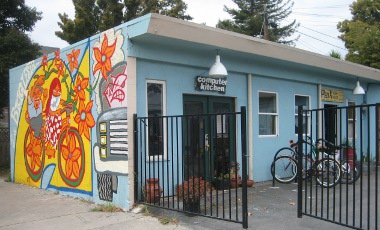
One of these co-ops is the Computer Kitchen, opened in May 2009 in Santa Cruz, CA. Sharing space with the town's venerable Bike Church co-op (for more info, here's an article I wrote for the Metro Santa Cruz about the Bike Church), the Computer Kitchen is devoted to reducing e-Waste by extending the life of computers by making repairs accessible and affordable, and teaching users how to use and repair their own systems. 

As tech becomes an increasingly ubiquitous part of our lives, it is increasingly marketed as disposable. This could have catastrophic environmental consequences, considering that your typical trip to the Geek Squad for repairs can cost nearly as much as a replacement, encouraging unnecessarily early upgrades to systems. What was once a computer lifespan of 4-5 years has become as short as 1-2 years as upgrades become cheaper than repairs. This can also disenfranchise computer users without the economic resources to keep up with the latest tech, unable to enjoy a reasonable lifespan from technology they can barely afford. The Computer Kitchen model suggests a way that we can encourage digital literacy in our physical communities, empowering tech neophytes by offering them low-cost, hands-on training far more accessible than arcane tech support message-boards and FAQ's .

Rate this article

Your rating: None Average: 5 (3 votes)

Comments

I have a Dell laptop that's about 5 years old. It still works, but I'd love to have a community help me keep it going, upgrade it, or even switch all the software to open source.

We seem to have reached a place technologically where computers are fast enough that there's little reason to upgrade to get more speed. Maybe the time has come for the open source computer, built so that it's easy to upgrade both hardware and software.

Neal, your comment brings to mind an interesting argument I've read, that computer upgrades by non-power-users are more often the result of viruses or minor (and easily fixable) hardware faults than by a need to upgrade, now that computer power has reached such impressive speeds. Even as something of a power user, I find that my low-powered netbook--which is roughly equal in power to a computer I owned five years ago--serves roughly 85% of my computer needs. There's no reason why a five-year old computer that has been kept up couldn't serve the needs of most users. Of course, it's not in the interest of computer companies or resellers to help users to extend the lives of systems past the length of the warranty, so open-source community repair initiatives like this could be a huge service to communities and the environment.

This is a great thing, not only for getting the most out of computers, but for getting computers into the hands of the economically challenged. The digital divide will be narrowed via actions such as this one. When will we get an annex in Watsonville?

Paul, that seems right judging from my experience. I've been at similar crossroads and only with a good deal of tenacity and time was I able to fix the problem. Part of the reason I put up with it is because I realized that getting a new computer is a lot of work too, with the setup and learning curve.

Another thought occurred to me, that in addition to having simple, easy to upgrade and repair computers that handle most computing tasks, you could complement your capacity by joining a computer kitchen which might offer higher end services like Photoshop with a large screen monitor, etc.

Oh, I should add that having covered the electronics industry as an analyst, I learned that electronics is fastest growing and most toxic waste stream. There is indeed a large environmental cost to being a gadget junky.

This is a great thing, not only for getting the most out of computers, but for getting computers into the hands of the economically challenged. The digital divide will be narrowed via actions such as this one. When will we get an annex in Watsonville?

Paul, that seems right judging from my experience. I've been at similar crossroads and only with a good deal of tenacity and time was I able to fix the problem. Part of the reason I put up with it is because I realized that getting a new computer is a lot of work too, with the setup and learning curve. Another thought occurred to me, that in addition to having simple, easy to upgrade and repair computers that handle most computing tasks, you could complement your capacity by joining a computer kitchen which might offer higher end services like Photoshop with a large screen monitor, etc.

Oh, I should add that having covered the electronics industry as an analyst, I learned that electronics is fastest growing and most toxic waste stream. There is indeed a large environmental cost to being a gadget junky.

It is pleasing to my ears to hear of communities working and playing together. This aspect to modern society had all but died, except for the country folk who manage through tough and good times to maintain their relationships and devotion through community living.

@Neal – I can’t agree more on your comment about electronics being the most toxic waste stream. Not only is there a large environmental cost to bring electronics to consumers, there is also the social and lifestyle disorders brought about by excessive obsession with gadgets. And I am not even going to talk extensively on the suicidal employees at Foxconn.

Hey Paul, you have a good thing! Lovely.