
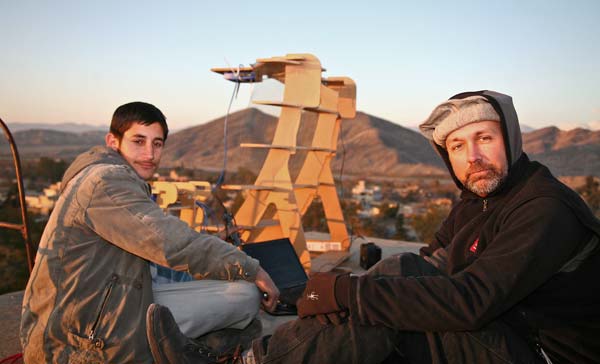
Afghans Build Open-Source Internet From Trash
06.24.11, 8:00am Comments (23)

Image Credit: FabFi

In light of events that occured in the Middle East earlier this year, many worry that in the future, rogue governments could cut off access to the internet as a way to control political "threats."

Douglas Rushkoff has championed the idea that the current corporate-controlled internet is far from the open commons we pretend it is.

"If we have a dream of how social media could restore peer-to-peer commerce, culture, and government, and if the current Internet is too tightly controlled to allow for it, why not build the kind of network and mechanisms to realize it?" Rushkoff asks.

Sounds daunting. And expensive, right? Wrong.

Funded primarily by the personal savings of group members and a grant from the National Science Foundation, residents of Jalalabad have built the FabFi network: an open-source system that uses common building materials and off-the-shelf electronics to transmit wireless ethernet signals across distances of up to several miles.

Jalalabad's longest link is currently 2.41 miles, between the FabLab and the water tower at the public hospital in Jalalabad, transmitting with a real throughput of 11.5Mbps (compared to 22Mbps ideal-case for a standards compliant off-the-shelf 802.11g router transitting at a distance of only a few feet). The system works consistently through heavy rain, smog and a couple of good sized trees.

With FabFi, communities can build their own wireless networks to gain high-speed internet connectivity---thus enabling them to access online educational, medical, and other resources.

In FabLabs, technology brings people and ideas together. FabFi embraces this same principle. The public hospital, which houses the endpoint of FabFi Afghanistan's longest link, has become a shared community resource, providing downlinks to a growing number of locations in the city center.

The shared infrastructure facilitates communication between FabFi users all over the city as they collaboratively grow and maintain the network. The FabFi user group is learning valuable skills that will soon allow them to generate revenue for themselves and the Lab by building, installing and maintaining FabFi links as part of a "FabFi Club" at the FabLab.

Fast Company reports that residents can build a FabFi node out of approximately $60 worth of everyday items such as boards, wires, plastic tubs, and cans that will serve a whole community at once. While it sounds like science fiction, FabFi could have important ramifications for entire swaths of the world (including rural America) that lack conventional broadband.

Although the Netherlands recently became the first country in the EU to pass a comprehensive Net Neutrality law, the United States and other Western countries are dragging their feet. But why wait?

If they create their own internet in a war torn country, what's our excuse? 

via Insteading

Related articles:

Rate this article

Your rating: None Average: 3.6 (106 votes)

Comments

I love this. I love this direction the world is going in.

please spread news like this... innovation by the people of the world where you least expect it.

its gods plan to unite all people using internet

Yeah!! Woohooo!!!! lets get out on the street !!! #AntiSec
Freeedoom!! william wallace, guy fawkes....its our time!!

What the fuck did Net Neutrality have to do with a bunch of Afghans building wireless gear???

Seriously get your own agenda out of my news.

Really? Who would've thought that world peace through a unified network was in his plans? Gosh, he really does work in unusual ways.

Wade, it has to do with net neutrality because for the people like these Afghan residents, building their own Internet effectively avoids the kind of problems corporate Internet in their country runs in to - government regulations, which, given the typical nature of these governments, tends to include censoring and what not. Net neutrality does include having a guarantee against such tactics, not just quality of service scheduling or lack thereof. You're welcome.

Just think

If everyone put their wireless networks into mesh mode...

Use technology like this to bridge the gaps...

This stuff is all low-power and is easily solar powered...

Pretty cool!

Kinda reminds me of RONJA http://en.wikipedia.org/wiki/RONJA

You have gotta admit... no matter what the McGyver style geeks will allway's prevail. Not to mention its rather amazing what the True Human Spirit is capable under these situations. Imagine what everyone can and will achieve if we all work together as a collective. Take our American Founding fathers, john of ark, Joseph Smith, Charles Manson, The Free Masons, and of course the holy Obama trinity. ;')

How can the founding fathers be included in the same sentence as JOHN of Ark and Obama? Go back to swallowing.

just check what have happend in greece:

http://wind.awmn.net/?page=nodes (pages might take a second or two to load)
http://wind.pwmn.net/?page=nodes
(the network map with links over 50km) using off-the-selve equipment and DIY construction, building an Open, free as air infrastructure

Wow this is really excellent. I wish we have a thing like this in Chennai, India.

This is so cool! Fabfi!

I can help with this, seriously I have a great deal of knowledge about bouncing and bridging wireless signals as well as hacking off the shelf hardware to run third part firmwares so they can then be used in a Wireless Distribution System.

Check the http://ronja.twibright.com/ 10Mbps, 1.4km.

nothing like 5+Miles 10mbps full duplex!

You probably couldn't do this in the U.S. because of the FCC. Things that transfer over a certain distance have to be regulated by the FCC, so there's your answer to why no one has done this: government intrusion.

Bullshit.

The FCC allows Up to 200W EIRP (27dBm+23dBi antenna gain) for unlicensed point-to-point links in the 5.8Ghz 802.11a band. This is sufficient for a 36Mb/s link over 12km, more with separate transmit/receive antennas and higher gain (with higher transmit gain, you are required to reduce the transmit power to not exceed 200W EIRP).

Additionally it is easy and inexpensive to obtain point-to-point licenses for licensed spectrum use, off-the-shelf licensed 70Ghz PtP systems can convey 1.25Gb/s full-duplex, and 13/17Ghz systems are affordable and will convey over 200Mb/s.

The problem is that these sorts of systems are perfect for private internets, like linking two offices together across town, but when you get to the scale of trying to connect a town of 100k people to the internet, 802.11an quickly hits a wall of available spectrum capacity, and you need a much faster connection on the backend, generally all the options are fiber-based.

You also run into the problem that you need an antenna for each peer, it would be infeasible to have 100 panel antennas on a single radio mast. Perhaps you could have a grid of nodes each with 4 PtP links linking with the nearest neighbor, but the across-town bandwidth would suck.

Douglas Rushkoff can...[moderator deleted remainder of sentence because it violates Shareable's community guidelines]

However, this article: Superb! This is inevitable of course, but its so good to SEE it happening with one's own eyes.

Its like something out of a Mad Max - Road Warrior movie...

Nice of you to offer. Will you be able to provide help with a FabFi in India? If you can't, do you know anyone with your inclination? Thanks.

Dear FabFiIndia - In fact there are several Fab Labs in India and two years ago many of the users have learned to make and install FabFi's. I don't think any of in operation as a network in the same manner as Jalalabad or Kenya, but if you contact the good people at Vigyan Ashram (http://www.vigyanashram.com/) they can help you. (The directory there can also suggest other people from elsewhere in India who had received the training at the same time that may be closer to your location.)

You can also comment on the FabFi wiki or blog for help and we will glad to assist with your questions (click my name on this comment for the website). Best of luck and I hope you let us know how your community network progresses.

sorry, I meant to say the Director at the Vigyan Ashram can help you

this is really excelent,Will you be able to provide help with a FabFi in India