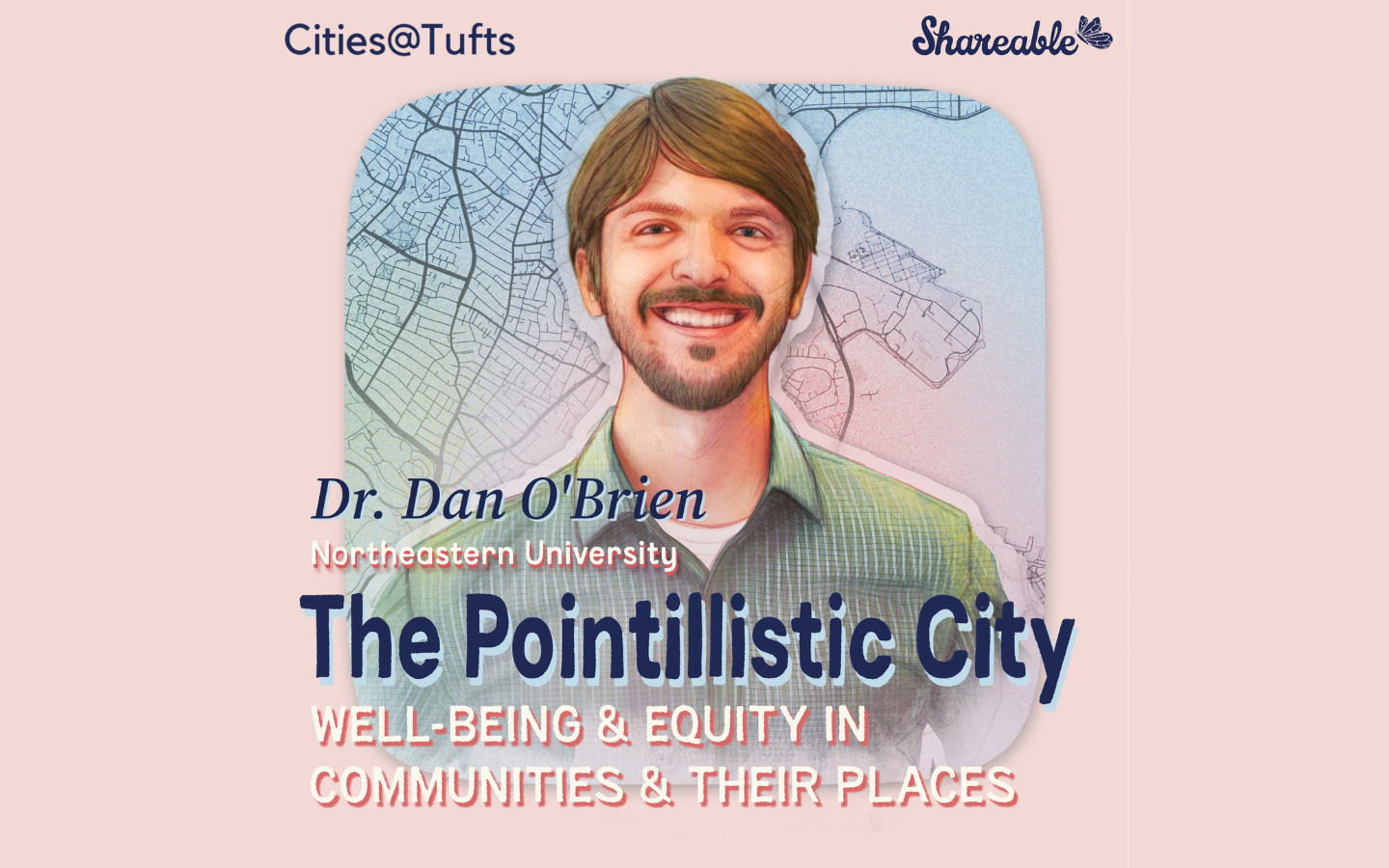
The Pointillistic City extends the classic observation that “neighborhoods matter” for health and well-being, arguing that we need to pay more attention to the other geographic scales that we live at—including streets within neighborhoods and even properties within streets—and how they each affect us. This is analogous to a pointillistic painting, which is similarly organized into dots within objects and objects within a full image. This “pointillistic perspective” surfaces microspatial inequities, or disparities between people living in the same neighborhood, as a pressing and overlooked concern for our science, policy, and practice. The book illustrates this perspective through two civic research projects: one on the impact of problem properties on public safety; and the other on the pertinence of “urban heat islets” and other hyperlocal hazards to environmental justice. It ends with guidance for designing policies and practices that address microspatial inequities, with an emphasis on putting cutting-edge data in the hands of communities.

Dr. Dan O’Brien is Professor of Public Policy and Urban Affairs and Criminology and Criminal Justice at Northeastern University and Director of the Boston Area Research Initiative (BARI). His research focuses on equity in urban neighborhoods, including crime, environmental justice, and more. His three books, The Urban Commons (Harvard University Press; 2018), Urban Informatics (Chapman Hall / CRC Press; 2022), and The Pointillistic City (MIT Press; 2024), demonstrate the value of integrating data-driven science with community-oriented policy and practice.
This year, we’ve seen Mutual Aid in Motion.
From scaling sharing hubs to Mutual Aid 101 trainings, we’re helping communities build the tools they need.
Every dollar fuels lasting resilience – proving that when we move together, we all move forward.

Video recording of The Pointillistic City: Well-Being and Equity in Communities and their Places with Dan O’Brien
Transcript of The Pointillistic City: Well-Being and Equity in Communities and their Places with Dan O’Brien
0:00:08.8 Tom Llewellyn: Welcome to another episode of Cities at Tufts Lectures where we explore the impact of urban planning on our communities and the opportunities designed for greater equity and justice. This season is brought to you by Shareable and the Department of Urban and Environmental Policy and Planning at Tufts University with support from the Barr Foundation. In addition to this podcast, the video, transcript and graphic recordings are available on our website shareable.net just click the link in the show notes. And now here’s the host of Cities at Tufts, Professor Julian Agyeman.
0:00:41.3 Julian Agyeman: Welcome to our Cities at Tufts virtual colloquium. I’m Professor Julian Agyeman and together with my research assistants Ainsley Judge and Max Sebbar and our partners Shareable and the Barr Foundation, we organize Cities at Tufts as a cross-disciplinary academic initiative which recognizes Tufts University as a leader in urban studies, urban planning and sustainability issues. We’d like to acknowledge that Tufts University’s Medford campus is located on colonized Wampanoag and Massachusetts traditional territory. Today, we are delighted to host Dr. Dan O’Brien. Dan is Professor of Public Policy and Urban Affairs and Criminology and Criminal Justice at Northeastern University and he’s Director of the Boston Area Research Initiative, BARI. His research focuses on equity in urban neighborhoods including crime, environmental justice and more. His three books, The Urban Commons, Urban Informatics and his current book, The Pointillistic City, demonstrate the value of integrating data-driven science with community-oriented policy and practice. Dan’s talk today is, unsurprisingly, The Pointillistic City, Wellbeing and Equity in Communities and Their Places. Dan, a Zoom-tastic welcome to Cities at Tufts.
0:02:01.5 Dan O’ Brien: Yeah, thank you very much, Julian. Thank you everyone for joining today and for the whole team that put this all together. It’s a real pleasure to be here virtually as it were, though I know there’s a viewing party going at Tufts. So yeah, real pleasure. And so I’m going to jump in and as Julian said, I’m going to be talking, I’m going to be giving you kind of a synopsis or the overview of the book that just came out in January, The Pointillistic City. And so, but I want to start, I want to start with a question. Where do you live? And I’d love if, you know, a couple bold souls would be willing to, actually, you know what, if a couple people want to put in the chat, where do you live? How would you answer that question? All right, we got a few good ones here. So Watsonville, California, Somerville, Massachusetts, specifically near the T, Guildford near London, United Kingdom, the outskirts of a mid-sized Dutch city on the border with Belgium, potentially anticipating that some of us might not know the name of that city. Yeah, so we’ve got lands of coastal Salish peoples, a.k.a. Bellingham, Washington.
0:03:18.8 Dan O’ Brien: We’ve got a bunch of different answers here, right? And they can cover a whole range of scales, right, and a whole range of scopes. It can be anything from something very broad, like an entire city, down to a neighborhood, or even a location. I’m going to stretch near the T into being a specific location, right? And all of those things are real, right? So we’re legitimate answers to this question, right? So you could imagine someone living on this street right here, this corner right here, saying, I live across the street from the bodega on Bowdoin Street, or I live right next to the community health center on Bowdoin Street, next to Bowdoin Park. Or they could describe themselves as living on Bowdoin Street in the community of Bowdoin, Geneva, right? Or they could describe themselves as living in the neighborhood of Bowdoin, Geneva, in south central-ish Boston, and so on and so forth, right? All of these scales are the scales that we live at. We all live at an address. We all live on a street. We all live in a neighborhood or a community within a municipality, and so on and so forth. And if you’ll bear with me here on sort of the whimsical metaphor that’s at the center of the book, this isn’t unlike a Pointillistic painting, right?
0:04:36.2 Dan O’ Brien: Thinking of your world in terms of the address or addresses that you interact with is not all that different from thinking about the little tiny dots that make up the painting. And when you zoom out a little bit, those dots make up the leg of a girl who happens to be dancing, right? Just the same way you could zoom out to the street level or starting to look at the neighborhood. And when you zoom out even further, you notice that she is just one of many different individuals and objects and elements in this broader landscape, in this broader scope. And so just as when we observe a pointillistic painting, we can interact with it at all these different levels, when we live in basically any society, but especially in a city, we are constantly interacting with it at all these different levels. Excuse me. Well, there’s timing for you. Apologies. Okay, so moving on from the whimsy and the metaphor here, the whole point of today’s talk is I’m going to make the case that a pointillistic perspective on cities is a very useful thing analytically and practically. Because urban science has focused almost exclusively on the effects of neighborhoods on well-being.
0:05:49.4 Dan O’ Brien: We’ve really thought at only one scale predominantly. And this is true across a series of sub-disciplines, and it’s rooted in the seminal and really important work of original urban scholars, folks like W.E.B. Du Bois, looking at Black American communities in Philadelphia and elsewhere around the turn of the 19th to 20th century, and around the Chicago School of Sociology, which really looked at the neighborhoods of Chicago, especially kind of the ethnic enclaves that were developing in the early 20th century as a result of immigration. Those sorts of thinking, again, seminal and deeply important, have become sort of the basis for how we think about cities, and we’ve gotten a little calcified, if you will, or channeled into one way of thinking about things as neighborhoods. I think as a result, there are processes and outcomes that are operating at lower and higher levels that shape life, too, that have been overlooked. And the particular use case or extension of knowledge, if you will, that I think is important here to highlight at the moment is microspecial inequities, distinctions in experience and outcome that exist building to building, block to block, within the same neighborhood, and we’re not seeing when we think about neighborhoods as homogeneous monoliths.
0:07:07.5 Dan O’ Brien: And from there, we have this current opportunity, thanks to this explosion of technology and data for the hyperlocal, where we can actually really see these things and study them, and by studying them, we can drive new approaches to equitable policy practice and design that takes into account these microspecial inequities. So that’s it, right? If you need to go, you can go now. You’ve got the point. That’s about all there is to it, but I will gladly elaborate for another 25 minutes to half an hour. And so that outline is going to be, I’m going to map out The Pointillistic perspective on cities, sort of the conceptual or theoretical and empirical background on it, and then I want to transition into what community-led, science-driven solutions that build on this idea or leverage this idea can look like. And because there’s nothing so practical as a good theory, I want to make sure the theory here is practical. And I will note, and Julian asked me to talk a little bit particularly about Boston Area Research Initiative, I will note the context for all this work, and then I’m not going to talk about it. And so if you want more detail on that, let’s talk about it in the Q&A.
0:08:21.1 Dan O’ Brien: But just so you know the background here, right? My previous book, textbook on urban informatics, I’m a big data guy. That’s what I do, at least empirically speaking. So I’m really fascinated and excited about ways that we can use emerging data and technology to better understand and serve our communities. That is partially at least the methodological inspiration for all the work you’re going to see me talk about. And then the Boston Area Research Initiative is a center at Northeastern. It is also a consortium across universities and public agencies and nonprofits locally that’s focused on advancing civic research in collaboration with local communities in greater Boston, with a particular focus on equity, justice, and sustainability. And it’s a big collaborative. It also makes the opportunity for me as an individual to be able to collaborate with dozens of fantastic smart people across all of those sectors and institutions. When I use the word we during this talk, I’m generally referring to a bunch of folks, whether they be research assistants working on the project or public agencies or community partners, what have you. There’s a big we there, and I want to make sure I give that at least a nod of credit.
0:09:33.5 Dan O’ Brien: And at times I’ll name those people by name. But I also want people to know that this is the context within all this work is occurring, and I can answer more questions about that at the end. All right, so let’s begin with The Pointillistic perspective. And to go a little bit beyond the whimsy of the metaphor, what are the three premises that are kind of the foundation of this approach to thinking about cities and communities? First, processes at all geographic scales matter, but more localized ones are often going to be more important for our experiences and our outcomes. And that covers geographic scales all the way down to the microspecial, as I was talking about, and all the way up to municipalities and further. But the basic logic here is things that are more immediately around you have a more immediate effect, and the further out you go, the more diffuse that effect becomes. It’s not that they don’t exist, it’s just that they’re more diffuse. Two, neighborhoods are mosaics of their places. Places are not microcosms of their neighborhoods. That is to say that these localized places that neighborhoods are composed of, street blocks, buildings, institutions, amenities, etc.
0:10:44.0 Dan O’ Brien: They each have their own characteristics that are at least in part independent of the neighborhood, and they come together to create the mosaic that is the neighborhood. Places do not necessarily embody every aspect or component of the neighborhood that we see in aggregate. Third, higher geographic scales create exposures that exacerbate sensitivities at lower ones. There’s a lot of EJ people in the community here today, so you may be recognizing I’m borrowing this one from the environmental health literature, the idea of exposure and sensitivity contributing to vulnerability. Essentially, this is also the place that we can start to understand, while even thoughI’m going to harp on microspecial issues, those microspecial issues exist within neighborhoods, exist within municipalities, and those higher geographic scales are providing the context by which those microspecial dynamics are occurring and are moderating and influencing them through that process. So those are our three premises. That’s the basis of the theory here. And now if we turn to environmental justice and pointillism, we can start to kind of set the stage. We know that climate change and other environmental transformations are global, but we also know that their impacts manifest closer to home, right?
0:12:00.5 Dan O’ Brien: And the resultant hazards, so this is a map of heat in the city of Boston, they vary across communities, right? That has been well established at this point and is pretty commonly understood among researchers and practitioners alike. And the mechanism for this classically is the idea that power and playing decisions concentrates hazards alongside marginalized populations. And here in Boston, the poster child for that is East Boston, right? East Boston is a low income or relatively low income space. It has been an immigrant community since the Irish and the Italians started moving there in the late 19th century, you know, so it has had that identity for a very long time. And as a result, it has extreme heat from high density. It has high pollution as it literally is neighbors with an airport and has highways crisscrossing it. And it has quite a bit of flooding because it’s a manmade island. Sooner or later, the sea is going to take back what once was its own. But because East Boston is the poster child, we sometimes fall into the trap of thinking that it and neighborhoods like it demonstrate that all marginalized neighborhoods experience all hazards.
0:13:14.4 Dan O’ Brien: And that is not actually guaranteed statistically, right? If even if hazards are completely independent of each other, places like East Boston would be assumed to exist just based on chance, right? The possibility that those hazards could be imposed in the same place. It also this sort of way of thinking about things, the power of playing decisions makes no note of places within communities. And so my point here is not necessarily to say that the power of playing decisions model for environmental justice is incorrect, but is to say that it is somewhat incomplete and it doesn’t entirely take into account these more localized dynamics that may be operating. And so I want to move into some empirical evidence for why. But before I do that, I have to tell a quick story. This is a colleague of mine, Aatmesh Shrivastava. At the time, he was an assistant professor in electrical and computer engineering at Northeastern, and he is now an associate professor. And at the time, I was co-director of BARI, and we had a conversation where he said, Dan, I want to install heat sensors on every street corner. He had invented a very energy efficient heat sensor, and he wanted us to install it on every street corner.
0:14:26.8 Dan O’ Brien: And he saw me as a useful collaborator in approaching that goal from the social science side. And like a good doobie who had been trained in neighborhood effects literature, I said to him, why would you want to do that? Neighborhoods are all that matter. Going local is not going to gain us anything. This is a pointless exercise that’s going to waste everybody a lot of money. To which he said, could we test that? And also being a good doobie, who is a scientist and loves to play with data, I said, sure, let’s see what we can get. And so we went out, we got some data. And so we then proceeded to test the three premises. And we did not know that we were testing the three premises at the time. The premises have kind of evolved as this work has gone on, but we set out to test something across three environmental hazards. We got heat from Landsat data. So this is remote sensed. We got air pollution as estimated from traffic levels, as provided by some colleagues at Boston University. And we got flooding as modeled by the Boston Water and Sewer Commission. So these are our three hazards that we had the ability to work with.
0:15:34.5 Dan O’ Brien: And look at their geographic distribution. Premise number one, processes at all scales matter, but more localized ones are often more important. Why would we believe that to be true? Well, it turns out most hazards are driven by hyperlocal geophysical processes. I mean, they are chemistry, literally, in action and physics in action. And so when you even just look at these maps, and these are in the Orient Heights neighborhood of East Boston, you see quite a bit of variation just block to block in that one community. And what we found was 40% of the variance in heat was within neighborhoods, between streets, within neighborhoods, and it was driven by the canopy, the pavement, and the albedo, also known as reflected light, of each individual street. When we found this, we were stunned. We were excited. We went out and we published it. And then we looked at air pollution. 70 to 80% of the variance was within neighborhoods, street to street, driven by just basically where the cars and where did the street width and the building height create an urban canyon that traps in pollution that has been released. Last, stormwater, not to be outdone, 85% of the variation.
0:16:49.9 Dan O’ Brien: Now note, this is not coastal flooding, this is stormwater flooding. So there’s a distinction there. But 85% was within neighborhoods and the drivers are pretty simple, elevation and slope. Water goes down until it comes to rest. That’s basically it. And that’s where you end up with flooding in a neighborhood. And I can tell you from my drive this morning to get to work, there are very specific places in my neighborhood that flood and very specific places that don’t. Okay, so evidence for premise one was there. Premise two, neighborhoods are mosaics, they’re places, places are not microcosms of their neighborhoods. And so this comes down to the question of should we expect hazards with different drivers to be clustered together? Because the power in policy hypothesis basically implicitly would argue that yes, because power and planning and power policy will eventually place all of the hazards in disenfranchised communities. But if these hazards have completely different drivers, do we actually expect that to happen in practice? Are planning decisions that comprehensive? And if we look first at the neighborhood level, what we find is heat and air pollution have a moderate correlation of 0.4.
0:18:04.8 Dan O’ Brien: Not an exceptionally high correlation. It generally has to do with where the major thoroughfares are because major thoroughfares have lots of pavement and they get hot and major thoroughfares generate lots of air pollution. Stormwater and air pollution have a slightly lower moderate correlation. This one I found interesting. The best explanation I can find is for Boston’s geography, right? The thoroughfares are built between the hills. And so then that is also sometimes where the water comes to rest because they’re between the hills. And then last, heat and stormwater have almost no correlation at the neighborhood level, which makes sense when you think about it. You don’t generally tend to associate places that flood with places that are hot, but this just empirically demonstrates it. But then we went a step further and we looked at block to block within a neighborhood, how strong are these associations? So that is to say, are the hot blocks in say this neighborhood in Orion Heights the same as the high air pollution blocks in that neighborhood? And it turns out it’s a pretty low correlation. It’s 0.2. That is, I mean, statistically significant when you’re looking at 20,000 streets, but not a strong relationship. Within a neighborhood.
0:19:17.6 Dan O’ Brien: You can have places that are hot, you can have places that have high air pollution, you can have places that have both, you can have places that have neither. And even more so for stormwater and air pollution and even more for heat and stormwater, which is to say within a community, the places vary considerably in their hazard profile, right? They can take on just about any combination of hazards because of these different drivers.
0:19:42.6 Dan O’ Brien: All right.
0:19:43.3 Dan O’ Brien: Third premise, higher scales create exposures that exacerbate sensitivities at lower ones. We would then anticipate that microspatial inequities from exposure will vary by a population sensitivity, right? What is an individual or an aggregate, a population sensitivity to some sort of negative outcome and exposure to hazards? And so we looked at 911 reports of medical emergencies during heat advisories, and we found that streets with higher temperatures were more likely to experience medical emergencies during that time relative to their general propensity for such events during non-heat advisories. And it was not neighborhoods. There was zero neighborhood effect. It was all the street effect. Neighborhoods were completely null from a statistical perspective. And this effect was greater, and that’s actually misstating it. This effect really only existed for streets that had substantial emergencies during non-advisories, indicating that it’s not just the heat, it’s the interaction of the heat with populations and contexts where medical emergencies are more likely to occur, sensitivity plus exposure in the context of microspatial inequities. Okay, so to summarize, premise number one, processes at all scales matter, but more localized ones are often more important. Hazards vary primarily with the hyperlocal geophysical drivers.
0:21:17.1 Dan O’ Brien: And in fact, to push that further, and we can talk about this later, it turns out that what we think of as neighborhood variation, in fact, is explained almost entirely by the hyperlocal infrastructure within the neighborhoods. Two, neighborhoods are mosaics of their places. Hazards with different drivers do not actually cluster together geographically unless their drivers are clustered together. As a result, this creates a diverse array of hazard profiles at places, right? Different combinations of hazards. Third, higher scales create exposures that exacerbate sensitivities at lower ones. What we observed was exposure across localized places varying, interacting with the sensitivity of the populations and the people who live there and play there, resulting in microspatial inequities. Okay, I want to make the pivot though. That was a damned scientist talking for a while. And I really like to nerd out on the data itself, but I think it’s really important, of course, that we then figure out, okay, how do these things that we learn about how communities work and are composed, how do we turn that into something practical? And how do we collaborate with policy and community leaders to do something with it?
0:22:37.8 Dan O’ Brien: So that’s how I want to kind of convert the second part of this talk before we wrap up and turn to conversation. And I want to do so by just kind of raising the premise of these two neighborhoods here that I have circled on the map or outlined on the map. And one of them is the one we’ve been seeing, which is the Orient Heights neighborhood in East Boston. The other one is right along Blue Hill Avenue in the middle of Roxbury. And actually a place I’ll talk about it more in a moment where we’ve been doing an in-depth collaboration with local community groups. And when you look at these two places, right, they both have hot spots and cool spots. They both have places where there’s air pollution and where there’s not air pollution. They both have places where there’s flooding. There’s a lot less flooding in Roxbury because it’s on a hill. So most of the water flows out to surrounding neighborhoods. But you have places that do and don’t. But those landscapes are unique. And nobody understands those landscapes better than the people who live there.
0:23:38.0 Dan O’ Brien: So then you have a situation where every community needs its own locally tailored solutions. Now, will those locally tailored solutions involve some generalized relationships? Like, for example, it appears that air pollution is higher along thoroughfares? Sure. But understanding what that landscape is, how it is experienced, and what the proper solutions are for dealing with it requires a locally tailored approach every time. So then we have these four design principles that come out of The Pointillistic perspective. The first one is treat neighborhoods as mosaics of diverse places, and only a small handful of which really require intervention. Really embody this idea of the microspatial and how it can help us to be more efficient and more targeted in how we’re taking action. The second one is to identify one or more processes operating in places that could be the basis for intervention. Variation is one thing. Knowing where variation comes from gives us mechanisms to actually work with, ways to target our interventions. The third one is to incorporate the tools of urban informatics into decision-making and action. If those tools are what are giving us the data and the knowledge to be able to see these sorts of disparities and microspatial inequities, then those are the tools that need to be incorporated in decision-making and action, and they need to be made fully available to all of the relevant decision-makers from policymakers down to individual community members.
0:25:14.4 Dan O’ Brien: Fourth, direct interventions according to community expertise and priorities. I’m going to highlight that one because while I listed fourth because you kind of need the other three to even set the context for that, that fourth ingredient needs to actually be involved in one, two, and three as well because every one of those stages or aspects of a design principle here needs the community element to be shaped properly, to be properly informed and driven around local priorities. All right, so I’m just going to give an example of how this might play out through the Common SENSES project, which is a project that I’ve been leading with some colleagues and a bunch of partners, Standards for Enacting Sensor Networks for an Equitable Society because the National Science Foundation really loves acronyms. So that’s what we got, Common Senses. This project has been centered on the Blue Hill Avenue Action Plan and really focusing on the northern half of Blue Hill Avenue running down to Franklin Park, for those who are familiar with the Boston geography, and where there was a housing action plan, you can see those purple kind of squares on the right there.
0:26:26.2 Dan O’ Brien: Those are vacant lots that the city is planning to develop, though very quickly the project has become much more ambitious than that and is thinking about environmental justice throughout the community and not just in these spaces that the city is developing. And this has been a partnership of Bari and a bunch of other colleagues here at Northeastern University, the Dudley Street Neighborhood Initiative, which is based kind of on the northern part of this corridor, Project Right in Grove Hall, which is on the southern part of this corridor, and colleagues at the City of Boston, specifically in the Office of Emerging Technology. And the kind of theory of change here is develop and design and install a community-designed environmental sensor network. So that’s a picture of our sensor that is in front of Grove Hall right now. Use AI-driven modeling and interpolation to generate spatiotemporally precise maps of hazards that can be tracked across space, across time, all sorts of cool stuff. Use a framework for drivers and consequences of inequities, a.k.a. What I’ve been talking about for the last 20 minutes, to identify a toolbox of strategies for mitigation and adaptation. What are the options out there?
0:27:40.7 Dan O’ Brien: What can we do? What are the processes we might target? Incorporate participatory modeling tools and workshops So really putting those cutting-edge data in the hands of community members so that they can make sense of them and actually even model out, in collaboration with the university team, what would it mean if we put trees in this place? What could that do? And really using the best technology we have available to try to answer those questions. And incorporate that into plans for green infrastructure and the housing action plan. That was the original idea. It has certainly expanded now to just broad-based solutions for the environment around Blue Hill Avenue and throughout its communities. So if we think about how these design principles that I mentioned a moment ago play into common senses, we’ve really tried to build a community data infrastructure here. So the first step, treat neighborhoods as mosaics of diverse places. The community identified places most affected by hazards. It turns out if you sit down with a bunch of people who don’t work with sensors on a daily basis and you ask them, where do you want to put sensors? That question doesn’t mean anything.
0:28:53.3 Dan O’ Brien: So you have to have a first conversation that’s just about hazards themselves. Where are hazards? What are hazards? And through these conversations, the community generated over 600 different stories about where heat is experienced, where air pollution is experienced, and everything else from rats to traffic to crime to what have you. Two, identify processes that could be the basis for intervention. And the community described causal mechanisms. And this is really important. And I think it’s been something I’ve been thinking about a lot lately, where this idea that things that quote unquote scientists do, right, researchers do, like articulate causal hypotheses are being done by people all the time, every day. They just use different words to describe them. And so as we read these community stories together as a full collaborative, right, we saw that a lot of the stories were actual causal hypotheses about the relation between traffic and air pollution or the relation between trees and heat for the effect of airplanes going overhead and air pollution and noise, right? All of these stories are their own causal hypotheses that are the very processes that the neighborhood perceives as driving the hazards that they experience.
0:30:10.0 Dan O’ Brien: And, you know, that’s eminently testable. And once you test it, if you have evidence for it, then you have a point for action. So to test it, tools of urban informatics, community and researchers co-designed the placement of all the sensors to track places and processes. We now have, I think by next week or the week after, we will have over 60 sensors deployed in the community. And they look something like that. And we have essentially a community data infrastructure. We’re finalizing our public portal for streaming all the data outwards. The air pollution sensors are available right now. We’re still working on the heat and noise ones. But this is a place where anyone can come and point and click and basically see what has been going on at that sensor today, yesterday, and back to when we installed them. Kind of as a summary here, right, this step from sensors to data to more conversations to action. Right. I’d like to argue that this really empowers community to design their own spaces. And it puts the tools that are often considered the purview of academia and private tech corporations in the hands of community and for their own, they get to govern it and they get to decide what it becomes.
0:31:24.1 Dan O’ Brien: It improves the quality of the solutions and their alignments with local interests and priorities, right? Just very simply, right, if you want to solve a problem with somebody, it probably makes the most sense to have them drive the ship. It’s kind of, it seems axiomatic at times, but it feels like something that we need to say out loud. And then I will note this before I get to my conclusions, which is, and I think many of you know this well, especially the planners, this requires proactive engagement strategies that are currently uncommon. Most planning strategies at this time are reactive more so than proactive, right? They get to a certain point in the planning process, then they have a public meeting, they basically say, do you like this or not? They don’t really take a whole lot of feedback. Maybe they take the feedback and they incorporate the things that are really easy, but the ship has already left the harbor at that point, mostly. And so it is not a collaborative process the way we do most planning engagements right now. And my argument is that this takes probably a little bit more work and it takes a little more foresight, but in all reality, you have to do that process anyway.
0:32:28.1 Dan O’ Brien: So why not imagine how we can reconstruct it in order to achieve this, which would be much more satisfying for everybody. And so that’s my standing on a soapbox moment here. And so that’s the basic that we would need to pursue because right now this thing that we’re doing is in the context of an NSF grant, which is therefore technically a one-off, right? We need to be adopted and replicated in other contexts. So with that said, conclusions. All right, if you take one thing away from this talk, or let’s call it two, it’s the premises and the design principles, right? The premises for the pointillistic perspective, processes at all scales matter, but more localized ones are often more important. Neighborhoods are mosaics of their places. Places are not microcosms of their neighborhoods. And higher scales create exposures that exacerbate sensitivities at lower ones. That’s it. That’s all you need. And if you want to go one step further, design principles, if you’re going to leverage the pointillistic perspective to design something in a community context, be it for environment or given the other version of this talk that you didn’t see, crime and public safety or anything else really, treat neighborhoods as mosaics of diverse places.
0:33:43.8 Dan O’ Brien: Two, identify the processes that could be the basis for intervention. What is actually driving this thing that we’re getting at at the hyperlocal level, the microspatial level? Three, figure out how to use the tools of urban informatics, put them in the hands of everyone who needs to be involved. Four, develop interventions rooted in community expertise and priorities. And again, make sure that that community conversation is happening from step one so that it is actually infused in everything you are doing. And if you’ll all bear with me for just a moment, I’m going to give a couple of concluding remarks. And because I think it’s sort of funny to do so, and I hope you enjoy it, I’m going to couch it in quotations from the pointillists themselves in the 19th century and their critics, just to kind of make full circle on our metaphor here. So first, the pointillists were actually quick to say that it wasn’t really about the dots. It was really about trying to capture how perception works. So they didn’t really care all that much about the dots themselves, even though that’s what got all this attention. And likewise, I’m going to make the argument that I don’t really care all that much about the places and the microspatial inequities unto themselves.
0:35:00.2 Dan O’ Brien: I think that they’re very helpful and important in a lot of cases, and I’m glad and I hope that the book sort of highlights that for people to get more attention to it. But that said, there are going to be processes out there where neighborhoods matter more. And I can talk about examples. I have a few examples that actually don’t make it into the main part of the book because I was hoping I did them empirically, and then they didn’t really fit the narrative. Suddenly, they end up in the conclusion as kind of examples, one being gentrification. I can talk about that a little bit more. Another one being academic achievement in youth. It turns out it’s more of a neighborhood process from what we can tell. But there’s also this flexibility, this willingness to not make it all about microspatial inequities, but for the theory itself of a pointillistic perspective to be about thinking about all these different scales and how they interact really creates the basis for interdisciplinary extension integration and even some synthesis around understanding when and why each scale matters for different phenomena. Two, use the brushstrokes to reveal the full image.
0:36:02.5 Dan O’ Brien: So it turns out that actually only a few years after the pointillists got started, Surat died, and the other pointillists stopped using dots because they realized that there are other ways to capture what they were going for, and really the point was to get the full image. And from that perspective, I want to go up. I went down for microspatial inequities. I want to go up and point out that communities exist within regions with overarching policy systems and networks. There are processes occurring there that are really important to all of us. Which municipality you live in matters. And I mean, the classic example of this is just school districts, right? So this is another level that actually doesn’t get as much attention in our urban science, again, because the data are hard to get. It is very difficult to get data on dozens or hundreds of cities. It’s become more common and popular in the last 10 years or so. Again, tools of urban informatics are enabling us to really go in this additional direction and think about municipal level effects and further. Last, use the science to do better art. So Surat actually started Pointillism by becoming friends with a bunch of early opticians and scientists of how the.
0:37:16.2 Dan O’ Brien: I worked in France at the time. And I want to kind of stretch that one a little bit and say that, well, if we replace art with policy, right, how do we do better here? And I think that we have, I think that the pointillistic perspective provides us with a basis for thinking about a new model for local autonomy and nested governance in the spirit of Eleanor Ostrom, which many of you are probably familiar with her work. And the idea that there’s a real need, if every community has its own unique landscape, then we have a real need to empower and enable every community to be, to have its own voice and autonomy around how that landscape is managed. We should not be having one size fits all policies. Now that can be a really complicated and scary thing for a municipal administrator to consider, but it just requires some ingenuity and a redesigning of how we think about the civic process. And so I think there’s a real opportunity here and a motivation and justification for investing that extra time. And from the other side of my work, right, the urban informatics aspect, I think it’s really important that we get all of these brand new tools in the hands of communities and allow them to own and direct where emergent data and tech are going for them and their communities and how they’re shaping their lives.
0:38:36.9 Dan O’ Brien: And I think that if you put these two things together, a new model for local autonomy and nested governance, along with the data and tech, you will start to get there. We will start to get there more assuredly. And so from that perspective, I want to end with the reverse question from how I started. Who lives there? Whenever you’re thinking about a place, whenever you’re thinking about a context or a process or a phenomenon or an outcome or what have you that has any geographic basis, who lives there? Who needs to make that decision? Who experiences that context? And who should have the power to decide what happens next? And I think that that is really where we need to go with the way we think about the geography of communities and cities. With that, anyone who wants to learn more about BARI, this book, or the last book, there are the QR codes. And yeah, I think we have about 15 minutes for conversation. Thank you so much for having me.
0:39:39.7 Julian Agyeman: Dan, thanks so much for that fantastic presentation. I’m kind of awash with so many different thoughts. And just one before we get into the questions from the audience, could you talk about any pushbacks you’ve had? Because I mean, you know, in many ways, as an academic, you’ve taken a pot shot at the organizing unit of urban planning, the neighborhood. Any pushbacks or any aha moments for people that you’ve talked to, both as practitioners and academic?
0:40:16.6 Dan O’ Brien: That’s a really interesting question. I think possibly the most interesting, so this is, I’ll tell an anecdote that’s really the other part of the talk, right, the public safety. So for those who don’t know, there’s the kind of the standard bearer of the Chicago school neighborhood effects literature is Rob Sampson. He’s a professor at Harvard in sociology. He wrote a book that came out in 20, in 2009 or so, called The Great American City. So he’s been kind of the standard bearer for that over the years. He was my postdoc advisor, right? He’s the person who hired me to start BARI. And he’s the neighborhood effects guy. And in criminology, there’s actually this ongoing feud between him and his allies and the people who have been focusing on streets and places. And when people put together panels at the annual conference where those folks are on the same panel, it’s hysterical to watch because they just, they basically compliment each other briefly at the beginning and then proceed to tell each other why they’re idiots in public. It’s really entertaining. It’s also not very productive from a scholarly perspective because it creates this sort of divide.
0:41:24.0 Dan O’ Brien: And I think I tried my best as I wrote it to give full credit to both sides in, you’re both right, you’re just wrong about the other one being wrong. And I sent it to him and I sent it to the standard bearer on the places side of things. And they both said, I really enjoyed the book. It was great how you stuck it to the other guy. And so I think that, and that’s in some ways an unnecessary anecdote, but other ways, I think it sort of illustrates how science works, which is they’ve gotten, they’ve spent 20 years arguing with each other. They’re never going to fully agree with the things that the other person is saying. But as the person who’s in the next generation of the scholarship, who’s able to talk to both of them and speak both their languages, there’s a general agreement underneath that argument that like, well, it’s both right. They both exist. They are complementary processes and paradigms. So eventually we just need to get over this. And so far that has been the majority of the conversations I’ve had. I think the only other real pushback I’ve had.
0:42:33.3 Dan O’ Brien: And it’s of the classic pushback of policymakers, which isn’t, it isn’t explicit pushback. It’s more like passive pushback, which is, no, that’s really hard to do.
0:42:44.9 Julian Agyeman: Yeah.
0:42:45.3 Dan O’ Brien: And then they just don’t do anything or they don’t call me back, right? Like if I give them an idea, like, oh, it’s a great conversation. And then, you know, it stops there. And the Wu administration is fascinating because the Wu administration really wants to do things differently and really wants to do things right. And I say that, Julian, knowing that you’ve been affiliated with advisory groups with her. And I think I’d actually be interested to see if your read is similar to mine. I think they really want to, but then once you get into office, you start to run up against political realities and bureaucratic realities. And some of those things are hard to do. Some of those things require real capital to try out. And so I see them innovating in some ways. I hope the second term will be a little bit more innovative because now you have like, you have a little bit more legitimacy, you know, you have a little bit more standing to try stuff out. But yeah, I think that similarly, right, they’re receptive to the ideas, but the idea of how to operationalize something that could be this daunting is not top of list.
0:43:45.2 Julian Agyeman: You need to do this presentation for Mayor Wu. I think she’d be very impressed with it. We’ve got a lot of questions. Crystal H is asking very specifically, did you check the stats on 911 calls with poverty data? Folks who are poor often have to wait on health care until it’s an emergency due to lack of access, lack of wealth.
0:44:07.3 Dan O’ Brien: Absolutely. We control that model. I gave the TED Talk version of the results there. If you want to check out the paper, we have tons of covariates in the model, one of which being income. So all of those effects that I talked about in terms of heat on medical emergencies of different contexts controlled for income, it controlled for race, it controlled for population density, controlled for all those sorts of things. So that’s a really good question.
0:44:34.6 Julian Agyeman: Great. Question from Kristen, if we’d chosen the other path, public safety, what factors or elements would have correlated to pollution, heat and flooding to arrive at the same principles?
0:44:47.6 Dan O’ Brien: So that side of the talk, it looks at crime as the outcome variable. So there isn’t much discussion in that of air pollution, heat, etc. But what does come out in that one as sort of the parallel is so crime, it turns out, is like even in the highest crime neighborhood in the city of Boston, more than 50% of properties produce zero crime in a 10-year period. And that’s in the most, that’s in the highest crime space. So basically what we’ve misunderstood for a very long time, and I think that unfortunately our law enforcement systems and our current president really continue to misunderstand is that a high crime neighborhood is not actually a high crime neighborhood. A high crime neighborhood is a neighborhood that has certain places that generate an inordinate amount of crime and disorder. And that’s really, really important for a variety of reasons. The simplest one practically being, right, we’re over-policing those neighborhoods, right? We tend to operate on the assumption that the crime is everywhere and that everyone’s responsible for it. It turns out it’s a very, very, it’s a shrinkingly small number of people and a shrinkingly small number of places that are responsible for the bulk of it.
0:45:58.3 Dan O’ Brien: And so there are ways to mitigate crime that are far more efficient, far more effective, and far more, shall we say, compassionate to all of the other people who live in that space than some of the things that we currently do. Now with that said, so then to get to how I’m interpreting your question, what is the process that helps there? And it turns out it’s place management, which is the idea of owners and their delegates are responsible for how a place gets used. And, you know, so like the classic idea of a bar that tends to be a hotspot for issues, that sort of bar can exist like literally a block away from a bar that has no issues. And a lot of it tends to come down to what are the kinds of activities that are being permitted at that bar, right? How is admission being handled? How are bartenders interacting with people who are starting to appear too drunk? Is there attention to people doing extra activities, if you will, in the bathroom or in the back? And so those things, those sorts of considerations all come down to the owner and his or her delegates.
0:47:03.3 Dan O’ Brien: And that’s true for landlords, right, in apartment buildings. How is the building being managed? Are parties being allowed? Things like that. There’s all sorts of ways in which owners bear responsibility for managing the space. And we did a whole quasi-experiment with the city of Boston, which has been targeting problem properties for the last 15 years or so since the Menino administration. We evaluated it, and it turns out that simply by telling owners of a problem property, right, so a high crime property, simply by telling them we’re paying attention and we need you to fix this up, crime plummets at the property, and it plummets on the rest of the street, which implies that it really was the property spilling out into the space. And so it’s really, it’s almost too clean of a mechanism in some ways because it works so well just to realize, like, you just need the people who are responsible for the space to put in place proper management techniques for the space.
0:48:05.5 Julian Agyeman: Fascinating. John says, how do you entice communities to engage meaningfully at an early stage when they’ve had such bad experiences and developed mistrust towards planners and the authorities in the past?
0:48:18.6 Dan O’ Brien: You work with people who actually have legitimacy in the community. So you build legitimacy and trust with them. And then you have to get to the point, and I’m going to say this in three sentences, so it sounds simple. It’s not. It takes years. But you basically have to get to the point where those folks, so in my case for the Common Census Project, DSNI and Project Right, those folks are excited enough about the collaborative vision that you’ve developed together with them that they are prepared to put their own capital, their own trust and legitimacy on the line in conjunction with you. So to have a community session talking about heat and air pollution, you don’t just show up with a map and hope people come. You really need to be working with a partner. It needs to be co-designed with a partner. It needs to be in their voice at least as much as it’s in your voice. And that’s really the only way you get people to show up and to want to engage. And then it has the added value that I think gets lost, which is that then there’s organization
0:49:28.6 Dan O’ Brien: There’s actual capacity for collective action coming out of it if you’re having the conversation through those channels and with people in an institutional context that they already know how to engage with and feel comfortable in and feel like they own. So yeah, the answer is simple, but it takes a lot of work and a lot of just co-design and trying to get it right.
0:49:56.2 Julian Agyeman: Karen asks, has the experience of the heat wave of July 95 in Chicago and the work of Eric Kleinberg and others played any role in your work?
0:50:07.9 Dan O’ Brien: Yeah, absolutely. Those are seminal papers and really sort of captured the neighborhood effects story for disaster management and heat waves in particular. But I think that that work opened up the door for that. I’ll digress for a moment in my answer to that because I think this might be useful for graduate students, especially those who are pursuing a PhD, right? By nature of our work, right, scholars, scientists, whatever you want to call it, we have to sort of disagree with the past in order to make a case for like, oh, we’re making a contribution here. They were wrong and I am right. But I like to think of it a lot more. This might get back to the pushback question, Julian, that you asked earlier. I like to think of it a lot more as like they were right for the moment they were in and they were advancing knowledge past wherever we were at that time. And our job is just to continue advancing knowledge. Right. So that work from the Chicago heat wave in 1995 was exceptionally important to just even opening up the door to like 15 more advances that then made it possible for me to ask the questions that I asked and to give them any reason for being asked.
0:51:24.4 Dan O’ Brien: So, yeah, it’s a great question. And it’s absolutely important to the way I think about things. And hopefully anyone who reads my book then is also using those things and so on and so forth.
0:51:35.0 Julian Agyeman: And I think this is probably going to be the last question from Conrad. Can you please talk about how your informatics reflects the hyperlocal geography landscape layers, i.e. Elevation canopy, hydrology, etc. Does it measure ecosystem services?
0:51:53.1 Dan O’ Brien: I’m not sure about the last part. I might need a definition for that. If Conrad, you want to throw that in the chat just to know what you’re looking for there. But in the meantime, I can sort of answer the first. Most of these data sets that we’re working with are inherently hyperlocal. So, for example, the heat is measured at 30 meter by 30 meter grids. Flood mitigation services, OK. 30 meter by 30 meter grids. The air pollution data was measured street block by street block, meaning from intersection to intersection or intersection to dead end. The flooding, I think it was one meter by one meter grid that the consulting company did for Boston Water and Sewer. So what I try to do is get information at the lowest possible geographic scale I can. And then aggregate up from there as necessary for the purpose of the analysis and basically find the lowest common denominator that is the lowest kind of granularity we can get at. And then the moment you have that, then so for whatever ecosystem service it is. So, for example, flood mitigation, you then have to ask yourself, OK, how do we incorporate that data into the process?
0:53:02.9 Dan O’ Brien: And is that data at the scale that we need it to be at? And sometimes you actually need it to be a little bit higher while the insight was here. Right. The action has to be a little bit broader for some reason or another. And so then, you know, it’s just a matter of being comfortable working with data at multiple levels of aggregation and taking ownership of which level of aggregation you want or need or think. And when you’re forced to a default, just knowing what the implications of that default is.
0:53:31.8 Julian Agyeman: Dan, what a tour de force. Fantastic. I’m so glad that you asked me to write a little endorsement on the book. I’m going to go back now.
0:53:40.3 Dan O’ Brien: Thank you again, Julian. I really appreciate it.
0:53:42.0 Julian Agyeman: I’m going to go back and reread it in light of the fact that you’ve now explained it to me. So thank you so much, Dan. Fantastic. Can we give a round, warm welcome, a round of thanks to Dan for this great presentation? Thank you, Dan.
0:53:59.4 Dan O’ Brien: Thank you all. Thank you, Julian, for having me. Thank you to the whole team here, Tom Ainsley and everybody else for putting this together. And thank you all for joining.
0:54:07.7 Tom Llewellyn: We hope you enjoyed this week’s presentation. Click the link in the show notes to access the video, transcript, and graphic recording, or to register for an upcoming lecture. Cities at Tufts is produced by the Department of Urban and Environmental Policy and Planning at Tufts University in Shareable, with support from the Bar Foundation, Shareable donors, and listeners like you. Lectures are moderated by Professor Julian Agyeman. Light Without Dark by Cultivate Beats is our theme song. Paige Kelly is our co-producer, audio editor, and communications manager. Additional operations, funding, marketing, and outreach support are provided by Alison Huff, Bobby Jones, and Xavier Ringer. The series is co-produced and presented by me, Tom Llewellyn. Please hit subscribe, leave a rating or review wherever you get your podcasts, and share it with others, so this knowledge will reach people outside of our collective bubbles. That’s it for this week’s show.