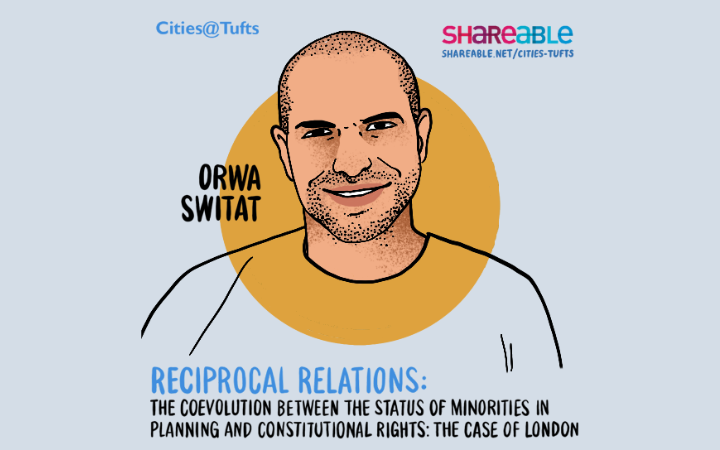
Minorities in cities worldwide confront disparities, advocating for rights within a dynamic interplay of urban planning and constitutional legal frameworks. How does the coevolution between planning and legal frameworks shape the status of minorities?
This lecture will dissect the coevolution of British constitutional rights and the status of minorities in the urban planning of London, post-WWII. It will explore how planning practices embed minority rights, shedding light on the transformation of political and legal frameworks into urban planning, and assessing their impact on state-minority relations.
This year, we’ve seen Mutual Aid in Motion.
From scaling sharing hubs to Mutual Aid 101 trainings, we’re helping communities build the tools they need.
Every dollar fuels lasting resilience – proving that when we move together, we all move forward.

About the speaker
Orwa Switat is a visiting scholar at the Department of Urban and Environmental Policy and Planning at Tufts University. He is a scholar, practitioner, and activist in the realm of state-minority relations in urban planning. He holds a Ph.D. and M.Sc. degrees from the Department of Urban and Regional Planning at the Technion – Israel Institute of Technology. His research has critically examined the intersections of urban planning and state-minority relations. Complementing his advanced degrees, he possesses BAs in both Philosophy and Political Science from Haifa University.
In addition to his scholarly pursuits, Orwa has dedicated his work to promoting the rights of Palestinian communities in Israel in the context of planning, advising planners and civil society on spatial justice and inclusion. From 2019 to 2023, Orwa served on Haifa’s municipal committee for historical preservation, influencing policies to honor and reflect the Arab Palestinian Heritage of the city.

About the series
Shareable is partnering with Tufts University on this special series hosted by Professor Julian Agyeman (Co-chair of Shareable’s Board) and Cities@Tufts. Initially designed for Tufts students, faculty, and alumni, the colloquium has been opened up to the public with the support of Shareable and Barr Foundation.
Cities@Tufts Lectures explores the impact of urban planning on our communities and the opportunities to design for greater equity and justice.
Register to participate in future Cities@Tufts events here.
Transcription
0:00:08.3 Orwa Switat: There’s an important role that we as scholars and activists who come from the south, let’s say, that we have a contribution in our perspective to what’s happening in the north. So I call it… We need to see the North from the South, and what is important in that, what is the uniqueness from that perspective? I claim that we come from the southern perspective to see that the north, we see that the state is not that innocent. Right?
0:00:38.8 Tom Llewellyn: Welcome to another episode of Cities@Tufts lectures where we explore the impact of urban planning on our communities and the opportunities designed for greater equity and justice. This season is brought to you by Shareable and the Department of Urban and Environmental Policy and Planning at Tufts University with support from the Bar Foundation. In addition to this podcast, the video transcript and graphic recordings are available on our website, shareable.net. Just click the link in the show notes. And now, here’s the host of Cities@Tufts, Professor Julian Agyeman.
0:01:12.7 Julian Agyeman: Welcome to our Cities@Tufts Virtual Colloquium. I’m Professor Julian Agyeman, and together with my research assistants, Deandra Boyle and Grand Perry, and our partners, Shareable and the Bar Foundation, we organize Cities@Tufts as an academic initiative, which recognizes Tufts University as a leader in urban studies, urban planning, and sustainability issues. We’d like to acknowledge that Tufts University’s Medford Campus is located on colonized Wampanoag and Massachusetts traditional territory. We’re delighted to host Dr. Orwa Switat. Orwa is a visiting scholar at UEP here at Tufts. He’s a scholar, practitioner, and activist in the realm of state minority relations in urban planning.
0:01:58.4 Julian Agyeman: He holds PhD and MSC degrees from the Department of Urban and Regional Planning at the Technion Israel Institute of Technology. His research has critically examined the intersections of urban planning and state minority relations. Complimenting his PhD, he has a BA in both philosophy and political science from Haifa University. In addition to his scholarly pursuits, Orwa has dedicated his work to promoting the rights of Palestinian communities in Israel in the context of planning, advising planners and civil society on spatial justice and inclusion. From 2019 to 2023, Orwa served on Haifa’s Municipal Committee for Historical Preservation, influencing policies to honor and reflect the Arab Palestinian heritage of the city. Orwa’s talk today is Reciprocal Relations, The Co-Evolution Between the Status of Minorities in Planning and Constitutional Rights, The Case of London. Orwa, a zoomtastic welcome to Cities@Tufts.
0:03:05.5 Orwa Switat: Thank you, Julian, for your welcoming and for inviting me. And thank you everyone for participating. I find this opportunity as a great opportunity actually to share with you my research and to talk about the concept of how we can see the relations between states and minorities in the context of planning. And what I want to… And of course the study will be focusing mainly on the case of London. And mainly what I wanna say, what I’m gonna talk about in my research. And then my main argument is that throughout history, the negotiation and the interplay between states constitutional and legal and political structures with the urban planning practice has shaped the status of minorities. We can’t look at the status of minorities only through the constitutional and legal perspectives of rights, or only through the planning perspective.
0:04:04.4 Orwa Switat: And this interplay actually has established the special infrastructure of inequality and mainly posing persistent obstacles that cities and minorities strive to address and tackle till today. However, city planning efforts alone seem not enough, right? And inadequate to redress these historical state induced disparities. At the same time, also the response of minorities and minority civil society has been largely directed on the municipal and market levels, employing a range of special practices and strategies from inclusion to resistance. However, but, these efforts often overlook the necessity of holding the state, its historical responsibility and its historical accountability for its fundamental part and role in creating these disparities and inequality that we face today. And actually, I want to talk through my presentation about my personal story, and then I’m gonna talk about the research and the status for groups in planning theory, and of course then to the London case and to end with conclusions.
0:05:25.2 Orwa Switat: This is my neighborhood in Haifa. And I decided to start with my personal story because I think why it’s important to me this issue. So beyond the research necessity, I started with this research in the first place because it comes from my personal background. I’m a Palestinian citizen in Israel. I’m an activist as Julian said, and a scholar and a practitioner for minority rights and planning. And coming from internally displaced Palestinian family, born and raised in Haifa, in this historical neighborhood in downtown Haifa. Haifa is a mixed bi-national city in Israel, which suffered for years, or for decades, actually, from marginalization and the destruction of the Palestinian heritage. And this has deeply influenced my pursue for social justice and equality and special rights, ’cause I grew up seeing what today, now in front of your eyes, these historical Palestinian buildings neglected, blocked, and actually demolished throughout the years. So because of that, this triggered my activism. And from a young age, I started like in 2003, I was still young and bold. I was 19 years old. We organized our community and reclaimed one of these neglected block Palestinian historical buildings to establish a youth center for our community. And from this moment, I understood that planning and historical preservation is not only a physical tool, it’s mainly a matter of rights and justice and our relation with the state.
0:07:03.3 Orwa Switat: My research and advocacy throughout the years culminated also my historic appointment to be a member in Haifa’s Municipal Committee for Historical Preservation since 2019, where I reversed actually, and I made a shift in the policies from demolition to preservation, honoring our Arab Palestinian heritage. And I managed for the first time to promote a preservation plan, what in front of you, and the historical server of my neighborhood in order to protect this heritage. And this showed me that minorities have power. Being, they can be an influential actor. And when we see a wall in front of our eyes and we see a wall of separation and marginalization, we can see also… We have to see the cracks in this world where we can enter and create a change.
0:07:56.2 Orwa Switat: This takes me to London, and this background actually sparked my thinking about minority rights and planning in the international level. And in 2017, a tragedy, as you all know, constituted in a turning point in London planning, the death of 72 residents caused by a fire in Grenfell Tower, a council, a public housing tower. Most of the victims were ethnic minorities. As such, Grenfell fire sparked many struggles of ethnic minorities claiming for their rights in London Urban Planning. And this strategy actually attracted my attention to a theoretical question about the linkages between minority rights and urban planning, a question that I tackled in my research. So political theory, of course, focused on the relations between state and minorities. But these relations and the co-evolution and the negotiation between planning theory and practice from one hand and planning a political theory and the state of constitutional rights from the other hand, how they were co-evolved or the co-evolution of these two realms throughout the history.
0:09:10.0 Orwa Switat: As such, the study aims mainly to explore the status of ethnic minorities and minority groups in urban planning and its linkages with their legal rights. And empirically, I traced their status in London planning since its first post were comprehensive city planning. When I digged actually in the planning theory, also evolution throughout the years, I found that planning theory actually treated minorities through three main concepts. Planning theory at first through its liberal or Marxist approaches, it was colorblind. It didn’t see minorities or ethnic minorities, right? It saw them only as social class groups or as individuals. In the same time when they saw minorities later on, they saw them only through their culture. So I called it as culturized. The minorities were, have been culturized through planning theory, seeing them only through their customs, through their traditions, through their culture, not through their constitutional rights and the relation with the state.
0:10:13.5 Orwa Switat: In the other hand, post-colonial theory, when it looked at minorities, it saw them only through as victims, as sub-altrant, with no power, with no looking at through a binary relation between the oppressed and the oppressor, without seeing the dynamic relations and the cracks in the wall that I started with. And I want to talk about London throughout this case. So it’s a story… What I wanna share with you is a story of the city between its political, actually its political legal conceptions and special practices towards social and minority groups. And the methods of my framework, actually, the data collection was based on three main resources. See the plans since the, in 1943 till the last plan in 2020, and also planning practice and see the laws, the state rights, and the constitutional rights, legal rights, and also to see the minority reaction.
0:11:14.0 Orwa Switat: So I interviewed also 13 planners, civil society activists. I participated in observations and planning hearings, protest events, and etcetera. This one part of the photos, this is the first mosque that was built in London. These are many activities of protest against planning issues, mainly against repopulation, against eviction and social cleansing as the activists say. And what in the graph actually that mainly, that the study has found that the approach towards ethnic minorities in London planning is an evolutionary approach, right? It developed throughout the years in different shapes. This development has been evolved due to the evolution of the British legal concept of minority rights throughout the years. And the change in the British legal rights actually expresses a dynamic continuing debate of the state actually to empower minorities and to tackle the outcomes of inequality based on different political concepts of their rights. But in the same time, it was reflected in these British legal rights. They were reflected also and transformed and interpreted through London planning, through five main stages. What I call the main state is that the post empire, the libertarian state, the liberal colorblind, then the multicultural, then the colorblind civic cohesion. And lastly, the intercultural inclusion.
0:12:49.4 Orwa Switat: So I’m gonna start like shortly talking about each period. So after the Second World War, Britain faced two main challenges, how to… The reformation of its post empire nationality and the reconstruction of its destroyed capital. This constitutive moment actually created these two main approaches and the negotiation between them. So according to the law, for example, we saw that there, the laws after the post empire, British nationality was based on mainly the duality of civic discrimination. Looking at mainly on the reforming the British nationality. But in the same time, there were a distinct, there was a distinct framework for the Commonwealth, for citizens that come from commonwealth countries.
0:13:47.7 Orwa Switat: In the same time the first London plans in the development plan in 1951, the County of London plan, and the Greater London Plan in ’43 and ’44 created this new establishment of planning. And what I saw in this planning that, the approach was mainly libertarian. It talked about the freedom of choice, talked about the meaning… At the same time it talked about the meaning of the place of a commonwealth of nations. And when they saw the groups, they related to the groups as religious groups. So they thought about Christians, Roman Catholic, Jewish, and, but the other minorities that started to come mainly from Muslim countries and Hindu countries were referred as other religions. And when I saw where these other religions are located, they had been framed as small, scattered communities. This map for me, is the whole story.
0:14:43.6 Orwa Switat: You can see that this is the first map that creates a distinct self-contained communities. And for me, this is the basis of segregation that was created in London after its destruction. And minorities were related as isolated pockets of housing cut off from the major communities. And I think that this framework that you see, this has established the infrastructure of segregation that till today London planning try to address. The second period is since the ’70s, after 1965 London, the British Constitution rights changed. And it started to look at how the, with the Race Relations Act, how we can prohibit discrimination against groups on the basis of color and nationality or ethnic origin, or national origin. And it also replaced the alien and all these commonwealth distinct categories to a British nationality, to British citizens. And so for the first time, a colorblind equality was framed in the British constitutional rights. In parallel, the liberal colorblind period, what I call also has been inflicted in planning.
0:16:06.4 Orwa Switat: So the greater London development plan in 1976 reflects clearly this concept. First, it looked at the individual, The Londoner, it erased any referring to any groups, no religion, nothing. Only the individual through also public-private partnership, a new liberal urban renewal. And this, let’s say the dichotomy that has been reflected in the plan between the individual Londoner and the nation that we gonna create a nation, a British nation, what I saw that when I dig and I traced also the different reports of the plan, and mainly the report of the panel of inquiry in 1969, what I saw that they, although the plan was colorblind in their mapping, they mapped in every borough the commonwealth immigrants as you see. And where minorities live, they frame these areas as housing problem areas.
0:17:14.8 Orwa Switat: Of course, it came with the right to buy in the ’80s with Thatcher approach of neoliberal policies that also impacted of course the public housing and all the movement of market led development. In the 2000s, there’s a shift in the plot, and this shift is also legal in the planning level, in the legal level for the first time you can see that they start to think how we can create these good race relations, how they call it in the Race Relations Act in 2000. And also how to incite hatred against any person on any background. And many reports like the PaRIS Report, the Ritchie Report, many reports after many riots that happened in that time, talked about the failure of the colorblind liberal framework, and that the need to recognize minorities through a multicultural perspective.
0:18:15.7 Orwa Switat: And this was reflected clearly in London Plan in 2004 and 2008. You can see tons of mentioning and respect and framing and categorizing the groups through the BAME, the black and minority ethnic group. This is the frame, the term that is used and to see planning as a tool of, as a tool to fight and to address discrimination against ethnic and minority and racial groups. Also, they related to refugees and asylum seekers. So this plan for the first time relates to minorities and recognize them and their rights and their identities. And also they made in through the plan many tools how to address their rights and their status through many assessment and criteria. And through monitoring indicators how to trace this concept of fighting the discrimination against black and minority ethnic communities. But in 2008 and 2010, for the first time, the concept of race was shifted in the British legal rights. They started to talk about the equality and a new law entered to the picture, it’s called the Equality Act in 2010.
0:19:44.0 Orwa Switat: That for the first time it removes the centrality of race from the British State of Rights. And it talks about different characteristics like age, gender, religion, belief, sexual orientation, disability, many categories that entered this law of thinking about how to create this civic cohesion, this new British identity between the different groups.
0:20:14.5 Orwa Switat: And also London… And throughout this London planning, it gave two interpretations to this legal shift. One interpretation was through the London plan in 2011, in 2016, what I call the colorblind social mixing. Okay? That it focused on disadvantage… It removed the whole focus on ethnic and racial groups. And it started to reframe the groups through a new term that they call it the disadvantage, mainly the disadvantaged social groups. And the plan aimed how to create this social mixing on a class level. In the same time, the Grenfell tower burn and fire and what happened with the protest after that it created again the need to address the rights of ethnic minorities. So a new plan with Sadiq Khan actually, the London Plan 2020, started to think about we need to recognize these groups. And they framed it through a new term as an equality groups or equality groups. And the plan needs to create this intercultural inclusion. So the difference is that in 2000, in the previous London plan in 2011 and ’16 looked at the class level and the social mixing between the class level and the new London plan saw their identity and saw the minorities, but also they wanted to create this intercultural inclusion between the different groups and through inclusive growth.
0:21:58.2 Orwa Switat: And after that, you can see that there’s huge struggles and minorities didn’t step aside. So this is a map of different struggles that happened in 2019 calling for justice. And the Grenfell fire actually sparked many struggles, but there were local struggles on the local borough and neighborhood level for housing and rights against eviction, against repopulate, and mainly against selling out social housing to investors. So these ongoing struggles, mainly we can see that what I saw in my research, that there’s a spectrum in their concept. So from one hand there’s an inclusionary, let’s say strategies, from the other hand you have the resistance strategies. But what I saw that was a very interesting finding to me, that the difference between the different strategies was shaped by the concept of minority rights in the civil society organizations and activists.
0:23:09.9 Orwa Switat: So if you are a Marxist colorblind, you will talk about, you will be more resistant and more, but but against, actually, against the market mainly. If you are a new Marxist the more that you see the class division. But in the same time, you see also the groups and the minorities. You will think about how I can mix through my resistance about also on class and on culture. And if you are post-colonial and you think about black rights, you will be more resistance against the racism. But if you think, if you believe in liberal multiculturalism, you will focus on the London identity, the local identity, not the British. And you will seek more inclusion, even inclusion in the market of planning. It takes me to the conclusion that the location in planning practice in London was shaped actually by the coevolution of planning concepts and political constitutional concepts. But planning practice, what I saw was more strongly led by the political concepts of social minority groups more than the planning approaches due to its negotiation and dialogue with the constitutional state of rights and its development.
0:24:39.0 Orwa Switat: And that takes me actually to why I came to London. So I felt first that I need to get out of the ghetto. Let’s start from that. And another thing that there’s an important role that we scholars and the activists who come from the south, let’s say, that we have a contribution in our perspective to what’s happening in the north. So I call it we need to see the north from the south. You know that the south and the east was investigated for centuries by orientalistic research from western academy and scholarly. It’s about time that we will do the opposite. [laughter] In other words, that scholars that come from the south need to see the north.
0:25:28.1 Orwa Switat: And what is important in that? What is the uniqueness from that perspective? I claim that we come from the southern perspective to see that the north, we see that the state is not innocent. And that the state is responsible on what’s happening today in the city. And like the state made the crime and then it took her hands off and withdrawn from its responsibility. And this created actually a situation that today you need to struggle with the market and with the municipal level, while the real responsible is not hold accountable. So if we take to conclude actually, the post world War, the Second post war World, we saw that the British state has shaped two realities. Initially when it redefined its post empire British nationality, it laid the ground also for segregation through its urban planning and spatial practices to reconstruct its demolished capital.
0:26:36.2 Orwa Switat: However, after that, during the ’70s, after the constitutional shift towards colorblind British citizenship and the anti-discrimination acts, it propelled a new liberal shift in its urban planning policies, characterized by the state’s retreat from its responsibility. Thereby it created this, or it created the social divides and empowered the exclusion of minorities throughout the market that actually covered up its role, its historical role for creating the segregation from the first moment. And these realities have cemented actually an infrastructure of inequalities and disparities that are ongoing till today. They are presenting ongoing challenges for the city leaders and planners and for minority groups to overcome. So the city planning policies hardly can struggle by itself to repair the wrongs done by the state historically. At the same time, minority civil society reaction, which has focused on the city or the market, also overlooked the state responsibility and accountability.
0:27:57.1 Orwa Switat: So the contribution mainly is to think… It’s not enough. When we talk about minorities in the city, we can’t see only their, it’s not enough to see only their legal rights and their constitutional rights, or from the other hand, to see the planning approaches and how they affect their realities. We need to see how both realities evolve together and the relationship between them and the negotiation and the dialogue between the legal and the planning frameworks. In the same time, the state is not innocent. It should be essential. And the constitutional, it’s important, but it’s also the dynamic relations between the state and minorities. It’s important. So coming back to the planning theory findings, you can’t see minorities only, you can’t be colorblind, right? This is my claim. But also you can’t see them only through the culture, and their cultural preferences or customs or traditions.
0:28:56.0 Orwa Switat: You need to see their rights and their relation with the state, even in the city. And in the same time, minority reaction can be influential and can find the cracks in the wall even in the most, as I showed in my personal story, even in the most segregated tensed relations between minorities and the state. You can make a change and you can create these change throughout the cracks in the world. But you have to see the state in the city. To sum up, what I wanna say that it’s also important in the American case that as a colorblind state with, through its laws, actually of course, and me and Julian now, we are working together on a research, on investigating planning in sanctuary cities and the role of cities in the American case, how they can protect minorities from exclusion and state policies. So I think that the city can protect minorities and the city from the state. And the city can also, has a role also to… In protecting minorities from the new tide of neo-nationalism, from the exclusionary state processes. So we can change the status of minorities and the relations between minorities and the state from the city perspective and space. But we need also to remember always where we can hold the state accountable for its historical responsibility. Thank you for allowing me and I’m open for anything. Please.
0:30:40.0 Julian Agyeman: Great. Thanks so much Orwa, that was really useful. One question that really comes to mind for me is, let’s just take a look at US planning, overt, not covert, overt segregationist and white supremacist planning through racist covenants, racialized zoning until 1917. Exclusionary zoning, redlining, discriminatory housing policies. So in the US we could have what some authors are calling racial planning and there’s now the call to move towards reparative planning. If the US then was overtly racial and racist in its urban planning, would you say London was covertly racist or what… ‘Cause phrases like colorblind, they’re interesting phrases. Where does London sit then in relation to say, planning in a US city which was overtly racist or planning in South Africa, which under apartheid was overtly racist? Where does London sit?
0:31:52.5 Orwa Switat: I think if we take the spectrum between, let’s say something like that, we have… From the other hand, minorities can have an autonomy, right, on their spaces. From the other hand, minorities can be discriminated against through laws like the apartheid in South Africa or the Israeli case where you have laws that discriminate Palestinians or minorities and etcetera. The colorblind moment is in between, right? And it’s interesting to see the spectrum on that and how planning acts on the different moments of this spectrum. But if we can say, I can say that London always needed or tried, and I believe them, the city planners [chuckle] that they need, they really wanted to fight the discrimination and they really wanted to empower minorities and to fix the disparities. But they did that without holding the state responsible and they overlooked the civic framework, and for example, take Brexit and what happened or the right to buy law in 2016 where London actually took an action and they said, “Okay, you wanna do Brexit, that’s fine, but we will protect immigrants that they live in our city.”
0:33:18.7 Orwa Switat: So I think that the London planning really tried to protect minorities, but it showed me that it’s struggling and it’s failing to do that because of the absence of the state. If you take the American case from the other hand, of course, when you have a colorblind civic framework, so it’s easier to be more racist and to move, let’s say racial and racist practices through the market, through this colorblind veil that you can cover up your practices under the name of that we are all equal. Everyone has the same opportunity. And what’s the problem? The market is open, and all these words, but of course, on the outcome, we see that colorblindness cover up the most racist practice. I think that in the American case, it’s very interesting to see because you have the different states and you have sanctuary also cities, in red states and in the blue states and all this dynamic. But I think that it shows us, in the American case, the importance of the local level in fighting, or struggling, or challenging the civic and the state level.
0:34:38.9 Julian Agyeman: Great. Thanks for that Orwa. So there’s a question from Mercy Manningham. My question, does London have a city charter as American cities do that can serve as a civic moral compass? Ooh, I like that concept Mercy. Can I borrow it? Civic moral compass. Here in Watertown, which Orwa is a kind of a town in the Boston metro area, here in Watertown, we recently revised our city charter. I drafted principles and values based preamble that voters approved in 2021 that serves as a civic moral compass for viewing all aspects of local planning, government and community initiatives, including the current redesign of Watertown Square. So does London have a city charter?
0:35:27.4 Orwa Switat: Yeah. So in every period, where I mark, yes, London has a city charter, but the city charter is… The planning charter is based on the constitutional foundations. So in every plan, the first opening of each plan, the moral ideological ethical political perspective of justice in the plan is based on the constitutional foundations. So when, because of that when, I saw that… When the law changed and the constitutional state of right has changed in the state level, also the city planning charter changed accordingly. So I think that of course, yes, and it was implemented through other plans, but in every time it was based on the constitutional foundations.
0:36:25.6 Julian Agyeman: What role this is from Paige Kelly, what role do you think the state should play in preventing or addressing gentrification?
0:36:34.3 Orwa Switat: Yeah, of course. The main thing is council housing and public housing. When, I’ll give you an example in Haifa for example, where like public housing is, has been confiscated. Our buildings, Palestinian buildings that were confiscated 70 years ago by the state and the state 15 years ago, started to sell them to the private market. And now when the issue, when the relation between the minority and the state is transformed into an individual matter through new liberal processes, the collective rise are depoliticized. So reframing that sentence, when the Palestinian, for example, if I take Haifa, when the Palestinian public housing was sold out to private companies, now the owners or the community who demanded the state to preserve these areas, to reconstruct these areas, to redevelop these areas by empowering the community and to involve them, include them in the development. Now it’s a private matter matter. Now go figure out your rights in front of the company.
0:37:35.5 Orwa Switat: So the individualization of the collective rights and turning your collective spatial rights, land rights, housing rights into a private matter, into a real estate matter. It actually, it transformed your homeland into a real estate issue. And of course, this does two things. One, depoliticizing, and the other thing is co-optation. So the struggles of minorities are also now transformed into the, an individual claims in front of the companies. So I think that the first thing that if we take the public housing issue, another thing that the state did through its history in London, in Haifa, and also in the US in many cities in the world. Mainly in the ’50s and ’60s, they created this segregation. Then it withdrawn its responsibility and it promoted the whole concept of neoliberal and private market development, the state has a responsibility to the situation that it created, and it should also do its responsibility today with empowering the communities, allowing their rights to stay in their homes, to prevent the eviction processes that happen. And especially if you take London, you have international companies that are brutal. And although you have more than eight criteria of affordable housing in London, the prices are getting more and more higher. So the state has a responsibility in order to protect these groups.
0:39:44.3 Julian Agyeman: Great, thanks. A question from Laurie Goldman, one of our senior lecturers, can you comment on tools of planning practice that can be leveraged for actualizing and expanding rights and reparative justice? Can these tools be used in resident-led planning initiatives, as well as city initiated planning?
0:40:04.0 Orwa Switat: Yeah, sure. I can give you an example from the plan that I showed in my personal story in my neighborhood Wadi Salib, Wadi Nisnas. If I didn’t do this change, and to be in the municipal committee, and in the same time, to have the power to influence the state responsibility and preventing, let’s say, and preventing this tide of selling out the public housing to protect the community, to give different privilege actually to community, and their residents and their community and public participation in this partnership, that I think is very important. So in Wadi Nisnas, the map that I showed you, since 1934, there was no planning in the neighborhood, nothing. So for the first time now, two years ago, we promoted a new plan, and because it’s an historical area, the municipality wanted to make it a touristic plan. But my responsibility was to change its concept in order to make a community empowerment plan, and a historical preservation plan. So I think that it’s a matter of preserving the heritage and the identity. It’s a matter of empowering the community ownership in the place.
0:41:24.0 Orwa Switat: It’s a matter, of course, of the social infrastructure that you create in order to empower the community to flourish. Not to think about places only through the economic, only through a real estate perspective, but also to see the social, cultural, and political rights, justice. And because of that, reframing this historical preservation, not only as a physical architectural tool, but to see it as a reparative planning, to see it through a concept of justice, a restorative justice, I think it’s very important.
0:42:00.8 Julian Agyeman: One thing you… When you talk about historical planning, and this is slightly on a tangent, but I’m thinking about the often used phrase, neighborhood character. It’s often used in NIMBYist arguments, and we know what they mean by neighborhood character. Can you comment on, you were using historic preservation as a way of uplifting your culture, but most frequently, the notion of neighborhood character and preservation of neighborhood character is not about uplifting minority groups, it’s about preventing them from coming into the neighborhood. What’s the tension there?
0:42:36.6 Orwa Switat: I think that because of that, you need to put content to the concept of neighborhood character. Which neighborhood, for whom, and what should be done, what is the good thing that should be done, what is ought to be done. And this is what is unique in planning practice. We combine between the concept of seeing the reality, and doing and changing the reality. So because of this uniqueness, we have a power, we have power in our hands. We can, through planning practice, change the reality. So I think that when you talk about neighborhood character, you need to put content to that to see which groups, who are we seeing in these neighborhoods, and then to think what are the disadvantages, what are the marginalization relations, what are the segregation, what is the civic also context that shape their status in the neighborhood? I agree with you that all these terms can be tricky. Preserving the neighborhood, it also can be preserving the elite neighborhood, or the powerful neighborhood. So we know we want change these power relations also in the city.
0:43:56.9 Julian Agyeman: Thanks, Orwa. We’ve got a question from Deandra, one of my research assistants at Cities@Tufts. Thanks for the presentation. She says, I’m curious about your interviews with social activists, and if you can speak more about how local activists have or have not been integrated in London’s planning processes throughout the decades.
0:44:17.9 Orwa Switat: Yeah, of course, London had what I didn’t mention also that the shifts also between in the planning processes and in the constitutional, also legal rights, was shaped also by different what they call riots. Riot practices of minority groups, of resisting their situation against racism, it was shaped and evolved throughout the years with different groups, actually. It started with against fascists who wanted to displace Jews from certain kind of areas or against the Irish, for example, and it continues till today with ethnic and racial groups. So I think that activism and what I saw that the problem with activism in general, that it looks at mainly on two things. One, it’s stuck on the local level. And second, it doesn’t see the civic context. It doesn’t see where’s the state, where’s the power relation, the higher, let’s say, the bigger perspective. And the other hand, it’s focused mainly on the market also, how you can change the market.
0:45:27.6 Orwa Switat: And from also my personal experience, the market is very strong. It’s very strong. It’s more strong. It’s stronger than the municipality, than the local activism because of the civic context that allowed the market to be so much powerful through new liberal perspectives. So I think that we have a role as activists to think about this incremental, small changes, but from the, in the same time to put an always on our mind, how these changes and our practices can change the power relation and the whole, the bigger picture.
0:46:12.2 Julian Agyeman: Now I’m going to put a question out here to you all that you didn’t deal with, because your research took place before this, but London was the first major global northern city to elect a Muslim mayor. Sadiq Khan, and Khan has been mayor now for maybe four something years. I maybe four or five, yeah, four years. What effect do you think he has had post your research on planning in London?
0:46:42.2 Orwa Switat: Of course, this is what I saw. I said to Julian about the intercultural inclusion period, the recent period. He gave, he led a new interpretation of the new Equality Act in 2010, taking it from the concept of let’s mix between disadvantaged class groups, into recognizing the ethnic and racial disparities and different groups, but thinking in the same time, how can I create this intercultural mutual new identity? So I think Sadiq Khan led two things. One, he came after, of course, after the Grenfell fire also issue. So he led the whole issue of recognizing the rules. But on the same time, he wasn’t multicultural, he didn’t stop in recognition. He said, okay, we need to recognize, but we need to make another step in order to create this intercultural fusion that is based on concept of justice mainly, and equality.
0:47:48.4 Orwa Switat: This was one first contribution. And another thing that he entered in the plan, in the recent plan, many criteria, he called it the inclusive design, the inclusiveness. He made it as a value that is cross-cutting all the different planning strategies, mainly also on health, because he came also with the COVID background in the same time, and also on this security because as a response to the Grenfell fire. So I think that Sadiq Khan showed that he was responsive to the struggles that were in London at the same time. And also, he gave a new interpretation to do the Equality Act to the British Equality Act, saying, okay, we are looking… We are not looking only on recognizing the groups, we need also to make this intercultural new identity that is local. The London new identity, but it’s intercultural. It’s not colorblind.
0:48:50.3 Julian Agyeman: Okay. Thanks. We’ve got a final question from Paige. Paige, this is a big question and it’s the research that Orwa and I are doing. And your question is, do you have any examples of sanctuary cities with planning practices that are delivering for marginalized people? Can I just say before Orwa has a bite at this one. So the research we are doing is look, the US and I can’t remember what year it was, but many Democrat, large metros declared themselves sanctuary cities. It was in a sense what we would call a negative declaration and that we will not allow or we will not support ICE investigations in our city. So that’s the kind of the negative, and it’s fine, but that’s a negative thing. What we’re looking at, Orwa and I is, okay, so what could sanctuary cities do in a proactive vein, through planning and other processes to make the life of new immigrants or undocumented people easier?
0:49:53.9 Julian Agyeman: And we were thinking about doing something like cities have to provide housing for the new incomers. What kind of food do they produce? And my students have been doing some research with the city of Boston on what would, what kind of food would we give? We don’t wanna just give out burger vouchers. What do we give that is more culturally appropriate? Are any cities looking at giving or fast tracking some of the immigrants to tracts of land, urban land for urban agriculture, that… So we’re looking at positive things. I don’t think we’ve got any concrete examples yet, because this is such a new idea of the proactive sanctuary city rather than the reactive sanctuary city. Or do we have any examples?
0:50:40.3 Orwa Switat: Yeah, like I can say that the concept of sanctuary city, that it is focused mainly on immigrants, like on non-immigration, but when… And it’s also mainly focused on what’s no, like saying no to the state, saying no to exclusionary or eviction or exclusionary processes or anti-immigration policies of the state. But it’s interesting to see, and it’s focused, as I said, on immigrants. It’s interesting to see what is Julian saying? What are the practices for the different groups? And is this concept of sanctuary city has also a proactive interpretation on the planning practices to different groups, to the concept of justice, to how they see the different groups, and the relation with the state. But of course, like anti eviction mainly, this is one of the most important things like creating the safe, religious also areas and also a safe places that can protect immigrants. But it’s very important to see what is its impact on other groups. For example, let’s take the Muslim groups. Okay, in the US. Are Muslims in sanctuary cities a profit and enjoy planning policies that protect immigrants also and can protect them? Like when you talk about Muslims, so you have the issue of mosques of this community centers. So is the planning, is allowing through its practices this cultural also. And cultural practices and religious practices for example, or indigenous people.
0:52:23.4 Orwa Switat: If you can take indigenous people that live in sanctuary cities or sanctuary states or in areas and counties, how this concept is protecting their land rights. So I think that it’s… Now we are as Julian said, we have no findings yet, but we are digging into this research. But, but what can I say that… Absolutely. Like when you protect immigrants, you have this drive, this spirit of protecting minorities, and it absolutely can impact other groups. It’s interesting to see how and which groups and how it evolved.
0:53:06.0 Julian Agyeman: Great. Thanks Orwa. And just to add to that, I can’t remember the names of the cities in the Sydney, the greater Sydney metro area in Australia, but several of them have now appointed what they’re calling cultural planners to do exactly the kind of work that Orwa is talking about. So I think that’s a fascinating idea. One would expect that from a country that has declared multiculturalism. One would expect Canada to do the same, because at the same time in the ’70s, they both declared themselves multicultural nations. I could listen to you a lot longer. It’s been really exciting. Can we give Orwa Switat a UEP ‘s Cities@Tufts round of applause, please.
0:53:49.0 Orwa Switat: Thank you, Julian. Thank you everyone.
0:53:51.1 Julian Agyeman: Thanks everybody. See you in a couple of weeks.
0:54:12.6 Tom Llewellyn: We hope you enjoyed this week’s presentation. Click the link in the show notes to access the video, transcript and graph recording or to register for free tickets to our upcoming lectures. Cities@Tufts is produced by the Department of Urban and Environmental Policy and Planning at Tufts University and Shareable with support from the Barr Foundation, shareable donors and listeners like you. Lectures are moderated by Professor Julian Agyeman, and organized in partnership with research assistants, Deandra Boyle and Muram Bacare. Light Without Dark by Cultivate Beats is our theme song.
0:54:44.0 Tom Llewellyn: Paige Kelly is our co-producer, audio editor, and communications manager. Additional operations funding and outreach support were provided by Alison Huff, Bobby Jones, and Candice Spivey. Anke Dregnat illustrated the graph recording, and the series is co-produced and presented by me, Tom Llewellyn. Please hit subscribe, leave a rating or review wherever you get your podcasts, and share it with others so this knowledge can reach people outside of our collective bubbles. That’s it for this week’s show. Here’s a final thought.
0:55:14.0 Orwa Switat: Planning and historical preservation is not only a physical tool, it’s mainly a matter of rights and justice.