Since the emergence of the Environmental Justice movement, maps have been pivotal tools in revealing patterns of environmental and social inequality, in legitimizing what many communities already knew – that power and oppression shape the landscape of opportunity and risk.
Mapping remains critical to Environmental Justice activism, research, and policy. Maps are often employed as tools of accountability, and as a result, mapping is both a technical and a political act, facing both technical and political challenges.
Within the current political climate, these challenges have been magnified, but they are not new. They are familiar and pernicious obstacles to the larger movement for social justice.
This year, we’ve seen Mutual Aid in Motion.
From scaling sharing hubs to Mutual Aid 101 trainings, we’re helping communities build the tools they need.
Every dollar fuels lasting resilience – proving that when we move together, we all move forward.

And they share a common root – a resistance to naming and confronting the role of racism and other forms of social and political marginalization that sustain the inequitable landscape of privilege and oppression.
This is a discussion about how that resistance is manifested, how it challenges the task of mapping in environmental justice research and policy, and reflections on what it means to meaningfully engage with environmental justice mapping as a technical and political act.

About the speaker
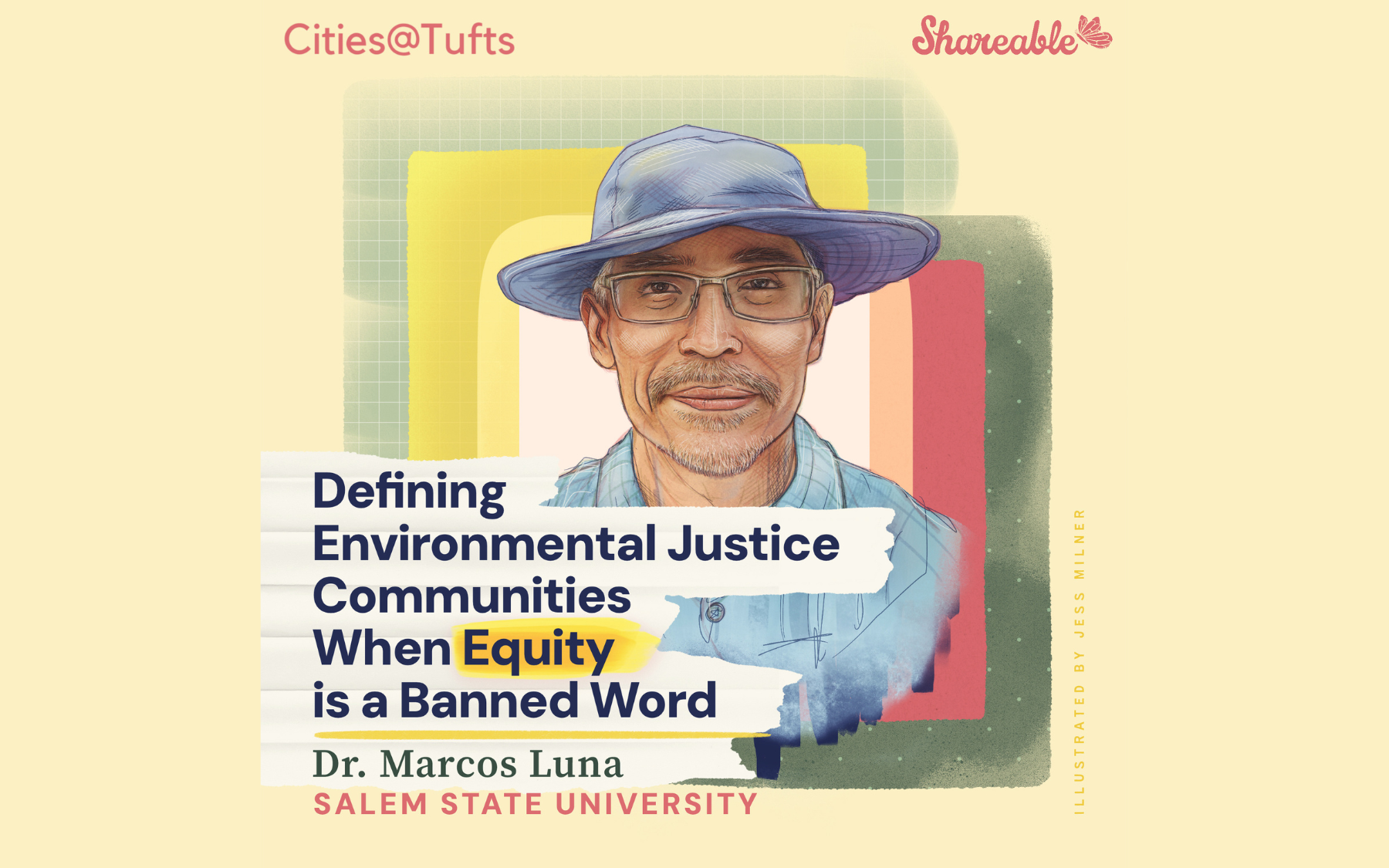
Professor Marcos Luna joined the Geography and Sustainability Department at Salem State University in 2004. I received my Ph.D. in Urban Affairs and Public Policy with a concentration in Technology, Environment, and Society from the University of Delaware in 2007. I received my M.A. in Geography from California State University, Los Angeles, in 2000. Before coming to Salem State University, I worked as an Environmental Analyst for the Massachusetts Department of Environmental Protection, and before that, as a NASA-funded GIS consultant for Native American tribes in the Southwest and Northwest. I have participated in various health and environmental research and public service projects in Massachusetts, Delaware, and California, as well as at the national level.
Video recording of Defining environmental justice communities when ‘equity’ is a banned word with Marcos Luna
Transcript of Defining environmental justice communities when ‘equity’ is a banned word with Marcos Luna
0:00:03.0 Julian Agyeman: Welcome to our Cities@Tufts Virtual Colloquium. I’m Professor Julian Agyeman and together with my research assistants Ainsley Judge and Max Sebbar, and our partners Shareable and the Barr Foundation, we organize Cities@Tufts as a cross disciplinary academic initiative which recognises Tufts University as a leader in urban studies, urban planning and sustainability issues. We’d like to acknowledge that Tufts University’s Medford campus is located on colonized Wampanoag and and Massachusetts traditional territory. Today we’re delighted to host Dr. Marcos Luna, professor of Geography and Sustainability and coordinator of the Graduate Geo Information Science Program at Salem State University. His research focuses on environmental justice and applications of geospatial analytical techniques to social and environmental inequities. Professor Luna works with community organizations and policymakers on environmental justice, housing and segregation, transportation equity and climate change adaptation. He’s a governor appointed member of the Massachusetts Environmental Justice Council and serves on the Board of Directors of Green Roots in Chelsea and East Boston, as well as the Board of Directors of Comunidades Enraizadas Community Land Trust in Chelsea, which seeks to create affordable and permanent housing solutions for the lowest income families, especially immigrant families. Finally, he serves on the Education Committee of the Boston Public Library.
0:01:30.7 Julian Agyeman: Norman B. Leventhal Map and Education Center. Marcos’s talk today is Defining Environmental Justice Communities when Equity is a Banned Word. Marcos a zoomtastic welcome to Cities@Tufts.
0:01:45.0 Marcos Luna: Thank you, Julian. Glad to be here. So, good afternoon everyone. Thank you for attending. I’ll be talking for about 30 minutes I’m aiming for and then we’ll. I think we’ll open it up for conversation and questions interest to hear what people think too. So I’m going to share my screen and we’ll get started. All right, so I’m going to be talking about environmental justice and mapping, which are two areas that I focus my personal professional life and. But before we get too far, of course we need to do some level setting and make sure that we know what is we’re talking about. So environmental justice. I won’t read the whole thing, but essentially it’s about the equal protection and meaningful involvement of all people when it comes to the environment. And it’s important to understand this policy, which is this is the Massachusetts policy from its environmental justice strategy. It’s consistent with what you’d see around the country in other states and also up until recently with the federal government as well. This is an aspirational definition. It doesn’t describe what is, it rather describes what we want to be. And in fact, most of what we’ve done over the last few decades in terms of policy and research and advocacy is to deal with environmental injustice.
0:03:05.6 Marcos Luna: Because the fact is that environmental burdens are very inequitably distributed across the country. And even here in Massachusetts. That problem is a pernicious problem. It affects environmental health and affects the welfare of lots of people and communities. And so it’s an issue. As you may know though, the current administration, the Trump administration, has targeted environmental justice and similar types of programs and policies, anything pretty much to do with the environment and certainly with diversity, equity, inclusion, with any kind of race conscious policies, those have been targeted for removal or dismantlement. And in fact, this is a list of over 300 words that the New York Times and other news agencies have identified that come through in memos and letters and emails and even used for screening grant funding for scientific grants to essentially exclude those. And so this expungement of language is censoring has been pretty profound. It’s not just about language. It’s actually affected what we can do and the programs that can run at all. But I think from my perspective as somebody who works a lot with data equally problematic has been that the administration has taken down dozens of data sets that the federal government had created and maintained.
0:04:33.5 Marcos Luna: And these data sets have been increasingly important and a cornerstone of a lot of environmental justice work across the country and within states. And a lot of these data sets are hard to replicate if we can’t even do that, because it’s hard to match the monitoring capacities of the federal government in terms of the data that’s acquired and that can be disseminated. This graphic was created by a federation of American scientists and part of a consortium or other coalition of organizations have documented the loss of that data, but also have worked to make some of that data available again. Which is really powerful and really important. But it’s also a holding pattern essentially because we’ve lost so much and it’s not clear how long that will last. Some of the tools that we’ve lost more recently that are particularly concerning for somebody like me who does a lot of mapping and data analysis for environmental justice are ones that you see on the screen, the one in the lower right, the US Environmental Protection Agency’s EJScreen particularly important because it’s kind of been one of these foundational tools as a model for how you can do environmental justice mapping, but also itself just a data distribution tool that people access.
0:05:52.3 Marcos Luna: And for other states that do have environmental justice policies and programs and data sets or tools this feeds into those. And so losing that has been a big blow, Although again, thanks to a consortium of nonprofits and universities, is available again, although it’s kind of frozen in time at the moment. All of these have been removed, except for the one in the lower left corner, the ATSDR Environmental Justice Index by the Centers for Disease Control, which was taken down initially in January, and then it’s back up again, although it has a big old banner across it that says, don’t trust anything the liberal commies say, or something to that effect. So we’re kind of. We’re still at a loss, but all is not lost. There is a lot happening across the country at the state and local level. So while the federal government has been dismantling a lot of this infrastructure, the information infrastructure around environmental justice, states across the country, over a dozen states covering a good chunk of the US Population, do have policies in place that advance or protect or advocate for environmental justice in some respect or some way, oftentimes in conjunction with policy that does affect the outcomes of decision making and also anything from permitting all the way to the allocation of resources.
0:07:16.8 Marcos Luna: And I’ll talk about one of these in more detail a little bit later on. So there is a lot happening, a lot of movement, or at least there’s a significant amount of movement on environmental justice policy in the country when we talk about environmental justice, though. The classic origin story for environmental justice as a movement starts in the early 1980s in a small community in North Carolina where a protest erupted over the siting, or the disposal, rather, of illegally dumped PCB waste. So the state had decided to dispose of this hazardous waste in a small landfill in a community that was largely poor and African-American. And what was unique about this protest, and one of the reasons that we kind of start there is because it was a unique coming together. It was a multiracial coalition that came together around an issue that was defined as both an environmental health problem, but also a civil rights issue. And in fact, the way that the protest happened was very evocative of a civil rights era event. You had people engaging in civil disobedience. Over 500 people were arrested blocking streets, trying to block the trucks. And it got a lot of media attention at the time.
0:08:34.8 Marcos Luna: But I think from looking back, what was really remarkable was it kind of connected this issue of civil rights and the environment, that the two things are related. And one of the charges that was made at the time that was really provocative was that the dumping of this waste wasn’t just an environmental issue, it was a civil rights issue, that it was discriminatory. That community was being targeted because of who they are. And so the government, the federal government, the General Accounting Office did some research on this to investigate those allegations. In about a year after that event, released a report looking at the southeast region of the country and found that, yes, indeed, three out of four of these hazardous waste landfills were predominantly in poor and black communities, which was out of proportion to their representation of the population as a whole. So you could say it’s disproportionate. So it seemed to support their allegations. A few years later, the United Church of Christ, a racial justice organization, released a report looking at the whole country and they found the exact same pattern. Crucially, what they found too was that when we looked at a variety of variables in terms of the characteristics of the communities where you find these kinds of landfills and waste facilities, these unwanted things, you find that race or ethnicity is the strongest predictor of where you’re going to find those things.
0:09:58.0 Marcos Luna: That’s a big deal because it really supports the allegations. But it also, this whole event, this coming together of a civil rights rights framing around environmental issues, and for my purposes right now for this presentation, the use of maps to get at that point sets the paradigm for environmental justice as we understand it in terms of the research that we do on it, and also in terms of the policy that we do today that this is the way that we conceive of it. We look at it as this intersection of issues and we look at it spatially. And I think it’s worth well, I believe it because this is the work I do. I think it’s worth kind of pausing for a second to kind of appreciate how groundbreaking this was from a technical perspective. I’ll get to the political later, but at the time, this is early 1980s, information and mapping technology are not at all what it was then as it is today. And so you had large agencies like the US Census who collected demographic information. You had, of course, the US EPA who monitored the disposal of hazardous waste and the movement of that waste.
0:11:03.0 Marcos Luna: You had the IRS, which collects tax information and income information, and those things existed for separate purposes in separate databases that were all, for the most part, paper based and large reports and file cabinets. And so bringing that data or trying to bring that together was a pretty, pretty big task. But this is essentially what both government researchers did and the United Church of Christ did is they figured out how to bring that data together to look, to see if there was a relationship between where this waste occurs or where it was being deposited and the kinds of people that are there. And the way that they chose to show that the way to analyze that was to look at it spatially, to look at where these things co occur in space. And what they discovered was, yes, they are related, but they also found a way to not only establish that in an empirical sense, using this data and this kind of statistical method, but also to show it in a way that was easily understood, that could be communicated to just about anybody, to understand what was going on when you looked at where this waste was and who lived there.
0:12:04.1 Marcos Luna: We take it for granted now. So here we’re looking at a map that is produced for the cumulative impact analysis process that the Department of Environmental Protection for the State of Massachusetts uses when they are evaluating air permits for facilities that require an air permit, thinking like power plants. So now, under current law, if an applicant is going to be putting in some kind of facility that requires an air permit, they need to do this cumulative impact assessment or analysis process, and they have to look at what’s around them, what’s already in that space, what are the issues that are already happening in that community. And the only way to do that is to bring that stuff together spatially through a map. But that’s the way that we see or that we can quantify the larger context of what’s going on. And so that’s how we can essentially judge is this going to be adding to the burdens of that community in an unreasonable way. So this is kind of, again, emphasizing that this is the paradigm, this is how we do, how we understand environmental justice and how we pursue that and how we’re going to continue to do that probably for some time.
0:13:10.0 Marcos Luna: For geographers, we like to say, which I’m a geographer, so spatial is special. And what we mean by that is that looking at things in a spatial way, geographically, reveal something that is not otherwise capturable, that something that you can see. It’s a relationship that matters. Walter Tobler, an early pioneer in the quantitative element of geography, is quoted as saying that everything is related to everything else, but near things are more related than distant things. And the key insight there, even though it sounds kind of trite and very obvious in some ways, the key insight is that distance does matter, that proximity matters, that when something is closer, it’s more likely to be related or to have an impact. And the simplest example of that, of course, is that it matters if you live next to a power plant that’s emitting all kinds of stuff in the air versus living 15 miles away. We know that there’s a difference, that you’re going to be more impacted, more affected by being closer. Now The specificities are going to be slightly different, and there’s a lot of science around that. But nevertheless, the central point is true and that that matters.
0:14:11.0 Marcos Luna: And so taking that into account, that means that in order to kind of capture or even anticipate what the likely impacts are of any given activity or facility that’s in a place, we look at how close it is, and that means looking at the geography of it, looking at where it is, who is there, and how close they are. This is the basic template for how we understand environmental justice and how we kind of do that sort of research. When we think about doing that, though, those of us who do this kind of work or are familiar with it, we know that this is a technical enterprise. This is a technical undertaking that we are working from data in order to produce those maps, in order to measure those things, which is essentially what we’re doing, it obviously has to follow certain rules of geometry. It’s generally going to be systematic. We take a consistent approach across producing the map. And then what we’re looking for as an analyst, a technical specialist, when we produce these kinds of maps, we’re looking to be as precise as possible, we’re looking to be accurate. But what’s often lost or we don’t like to discuss is that this is also a political undertaking.
0:15:18.2 Marcos Luna: And when I say political, I don’t mean in a partisan sense, Democrats versus Republicans. I mean political in the sense that it’s about values. It’s about what matters to us from an ethical perspective, it’s an agenda that we’re pursuing to achieve something. We don’t produce these maps just to produce these maps. We produce them for a particular purpose. And that purpose is decided by social priorities. And so those priorities are based on values, what is important to us, what we care about. Often these maps are either a reflection or an expression of power, social power, because either they are produced by the state or entities that have power and are exerting that, or else have the control of people’s attention, which is also a form of power. And saying, this is what reality looks like. This is what’s going on in the ground. Now, clearly, maps can’t show everything, so they are inherently have to be selective or partial. You can only show so many things on a map for it to be intelligible. But this selection requires choices and judgment. And that’s not just a political decision. It’s a practical one.
0:16:19.9 Marcos Luna: It’s actually a technical one. So the other part of this, too, is that the technical and the political are not opposing forces. They’re actually enmeshed. They’re interconnected. You can’t really separate them. And that’s an important thing to remember, is that we’re doing the maps for a purpose, and we have to ask, what is that purpose? Right. Because that purpose informs how we construct the map and and that that process will create a certain product. Right. That reflects those particular, particular values that we’re trying to push forward. And I want to hone on that. So this is the second big point that I’m trying to get across. One is maps are important for environmental justice research and policy and in our understanding of how we do this. But there are also these products that are both technical and political. What does this look like? Right, this, this intersection of the technical and political? Well, let me give you a couple examples. So, my first one is the Climate and Economic Justice Screening Tool, or CEJST. So this tool was created during the Biden administration in 2023, 2024, and it was part of a larger executive order that created Justice 40.
0:17:28.0 Marcos Luna: Justice 40 was a program that attempted to direct about 40% of monies from the federal government that had to do with the environment or climate investments into communities that were designated at disadvantaged. So what is disadvantage? So this is the key thing. Well, so the way that the White House defined disadvantage followed a sort of complex algorithm using about three dozen different indicators or variables describing the pollution or other kinds of indicators on the ground in communities, as well as their demographic characteristics like unemployment and wealth, things like that. And so that algorithm identified census tracts across the country that kind of met this criteria for being disadvantaged and therefore would qualify. And so all the federal agencies were supposed to follow this guidance in terms of identifying which communities their benefits were flowing to, to say that they were in compliance with the Justice 40 program. One of the interesting decisions when the White House created this tool, though, was to omit the use of race or ethnicity in the definition of those communities. So from an environmental justice researcher perspective, or from an advocate’s perspective, this seems really strange because we know from the research that race and ethnicity are key elements of how we witness environmental injustice to occur.
0:18:46.8 Marcos Luna: In fact, they’re often the leading indicators, the reliable indicators that something is going on. In fact, this is the animating factor behind a lot of the whole movement is to address this, racial inequities. Why would they leave out this key variable in this tool, in the scientific tool? The reason is it was concern, it was fear about legal exposure. At the same time they were releasing this tool, the Supreme Court had ruled in a case involving Harvard University over the use of race and admissions. And the Supreme Court ruled that you could not use race in admissions decision making. The White House was worried that this would give a grounding for a legal challenge to their Justice 40 program by saying, you’re using race in making, decision making. So they decided to leave it out for that reason. Now, when they did that, there were a lot of analyses that were done by media organizations as well as other think tanks to look at how well does that tool, when you leave out race, how well does it actually pick up the same communities, those high minority communities that we know are typically the ones who are more likely to be the victims of inequitable distribution and pollution?
0:19:58.0 Marcos Luna: They found that, yeah, you do find that the more disadvantaged communities are, the higher the proportion of minorities are. But you don’t get the same pattern if you added race in there. So you were losing something, you were losing information again because of this concern about legal exposure. Now, of course, we know, as it turned out, this wasn’t exactly a winning strategy in the long run because once the Trump administration came into power, this whole thing was scrapped. So the CEJST no longer exists, not to mention the Justice 40 program. Another example, CalEnviroScreen. So CalEnviroScreen is a tool deployed by the California State Environmental Protection Agency there, and they produce this tool. This was released in, like, 2013 or so. So it’s been around for a while. And it’s sort of like the template now across the country for how to do environmental justice mapping. They use a cumulative impact scoring method to basically rank every community, every census tract in the state in terms of a variety of different kinds of pollutant exposures and kinds of things in the community that may be problematic and how they intersect with vulnerabilities in the community.
0:21:12.7 Marcos Luna: So characteristics of the community that might make them more vulnerable or that will amplify the effects of these issues. So what’s really clever about it and really powerful is it allows us to see all communities along this continuum, along the spectrum burden. And it’s become a cornerstone of not only California environmental policy, but Also, in terms of the distribution of a lot of resources. Now, just like CEJST, California omitted the use of race, even though they knew quite well that this was a key indicator. But in that case, the reason they did was for a clear legal reason. So in 1996, the state of California amended their constitution to prevent the use of race in state agency decision making. So they were prevented from incorporating that. And so though they aren’t allowed to include it as part of the ranking of communities, they do analyze it to see what are the implications of the levels of pollution burden in communities relative to race. Not surprisingly, you find that communities with higher proportions of minority residents do have significantly higher pollution burdens. They rank much higher. It does tell us a familiar story, although California is to some extent prevented from using that directly in any kind of decision making for policy purposes.
0:22:32.7 Marcos Luna: So what we see is, again, we see this kind of collision, if you like, of political priorities with what the science of the technology and what we could do technologically would suggest that we should be doing. Those examples, CJEST and CalEnviroScreen, are kind of like high profile issues that come with the politics and technology intersection. But there’s a lot of stuff that’s more subtle, and this is what I wanted to highlight too. And these more subtle forms of the intersection of politics and technique I call forms of resistance. And I’ve identified three Ds here that are worth focusing on. The depoliticized, decontextualized and deraced. So depoliticized. So one of the values for people who are technocratically oriented is to omit the politics and what they’re doing. The point is to be as closely as they can think objective in what they’re doing. And so that’s. So political is oftentimes thought of as being the opposite of objective. But in fact, what de-politicization does is it looks to essentially avoid talking about it. But in fact, what’s often happening is that there are political values, there are social values that are being advanced regardless.
0:23:50.8 Marcos Luna: They’re just not being discussed. And oftentimes these political priorities are going to be economic rather than social or social justice oriented. They’re going to essentially paper over priorities and agendas that are still taking place even though we’re not talking about them. One of the classic ways that this happens is where the conversation around environmental justice switches from talking about justice to talking about health alone. So environmental health is clearly an important element of environmental justice, but it is not the point of environmental justice. It is an Aspect of what we’re talking about. Focusing on environmental health feels attractive because it’s very technique oriented, it’s very science oriented, it feels somewhat removed from a political conversation.
0:24:36.7 Marcos Luna: But in fact what it’s doing is it’s losing the thread of the conversation. It’s like, this is not the point that we’re after here. This is a social justice agenda that we’re pursuing with environmental justice. The other way that resistance happens is through decontextualization. And mostly what that means is taking an ahistorical approach, approaching environmental injustices as if they were aberrant, as if they just happened, as it’s a snapshot in time. And this is something to be fixed in the moment, when in fact we know from research and historical analyses that a lot of these problems are rooted very deeply in and an evolution of decisions and institutional evolutions, institutional practices that have created these problems over time.
0:25:17.7 Marcos Luna: Thinking of just residential segregation, tying back to the 1930s and redlining all the way to the way that our laws work and which communities are rewarded for the way that they’re structured and who lives there. These kinds of things are rooted in history. So if we’re only looking at a snapshot, we’re essentially dealing with symptoms rather than causes. So an ahistorical approach is counterproductive to the long term solutions that we’re looking for. It also can be sometimes for communities that are affected, it’s frankly offensive because it denies the reality that they have faced and they’ve lived with for a very long time. And so taking that ahistorical approach undermines the credibility of the entire process. When we’re going after a problem of this depth that we’re trying to fix, and lastly, deraced, There is for some quarters a desire to not talk about race. There’s a sense in a way that maybe talking about race is the problem. If we just didn’t talk about it, the problem would somehow go away. Which of course is very naive. The race problem is very real. It exists whether you like it or not, whether you want to talk about it.
0:26:22.5 Marcos Luna: Taking a race neutral or colorblind approach to it essentially denies a reality that’s already there. It’s not productive in terms of understanding what the problems are and why they exist. It also kind of leans into this idea that we’re really after is equality, where everybody’s treated the same. Which sounds nice, but equality doesn’t necessarily lead to equity. Those are not the same thing. Equity requires us to consider the inequality that exists now and how it was created. Equality kind of starts from the presumption that if we just started treating buddy nice now and going forward, we’d be fine, which is, again, naive and not very productive. Equity requires us to acknowledge that past. So history, again, plays an important part of it. It also requires us to recognize that the current systems that we’re operating under are themselves structured with certain kinds of politics and agendas that are nevertheless being pursued, whether we like it or not. So what we’re asking here is that we have to go into this thing aware what’s happening and not pretend that they’re not happening, because, again, not terribly productive. In the world of environmental justice mapping, which I am up to my eyeballs in right now, the direction that we’re heading in is to do more cumulative impact mapping.
0:27:38.1 Marcos Luna: So following California’s model, where we look for ways of using some kind of algorithmic approach to tie together a whole bunch of different kinds of burdens and issues going on in the community so that we can summarize it and provide a more holistic picture of what’s going in that community. I agree this is a very powerful way to go forward. This is the way forward to improve how we understand how we analyze. But it’s also technically, it’s very complex. In fact, a lot of what we want to do with this, we want to understand what is the intersection. How does being poor and unemployed and black intersect with some level of exposure to different kinds of toxins? Like, how do those things all come together? What does it mean for individual health and welfare? Those questions are important, but for the moment, a lot of them exceed even the science that we have on this, even though we’ve been studying this for decades. So it’s technically very difficult. But I think in a lot of ways, too, what’s hard to acknowledge is that we don’t escape the political questions involved when we go down this route.
0:28:39.0 Marcos Luna: Yes, we have the technical questions, yes, we have the scientific questions. But at the end of the day, we’re still going to be asking a very similar question that we asked before. How much is too much? How much burden is too much burden? That is not going to be revealed by the data or the science. That is a political question. That’s a social values question. So we don’t get away from that. We have to confront that at some point, and certainly within a policy context, that has to be decided. So what does this all mean? Well, I’m certainly not here to undermine what I do, which is to say that technology and the Science behind environmental justice research and mapping, that’s really important. But we have to remind ourselves about what it is that we’re doing. What is the purpose of environmental justice? This is a social justice agenda. We are trying to pursue a world in which justice is prioritized. So we need the science and we need the technology. But we have to go into it with eyes wide open, seeing that there is a political agenda here and not in a bad sense.
0:29:40.6 Marcos Luna: That we are trying to create a better world. At the end of the day, what we’re trying to do is to promote the world where we prioritize social and environmental justice, full stop. And I will stop there.
0:30:01.4 Julian Agyeman: Marcos, thank you so much for an amazing presentation. I’m not in the world of mapping, but to get an update. I’m a geographer like you, but to get an update on the kind of stuff that you’ve been doing is really excellent. We have a few questions coming up. One is a comment, not a question, but a comment from one of our alums, Axa Butt. She says there are unofficial versions of these tools through Public Environmental Data Partners. Can you just say a little bit about Marcos? I mean, you’re doing this in universities. What are some of the nonprofits doing? I can’t believe ACE and WeAct are just standing by and letting this all happen. What’s going on in the non profit world?
0:30:53.1 Marcos Luna: Yeah, well, what I’m seeing, they’re definitely not standing by. People are not letting this go quietly. People are speaking about this being a crisis in terms of threatening the foundation of a lot of what we do because we can’t… It’s harder to make arguments without access to good data. And I definitely applaud. Thank you Axa, for Public Environmental Data Partners for making that data available again. So it’s still good data. It’s still relevant to this day. I think what we’re worried about is that going forward how long will it be before we can resume updating that data to keep it up to the minute and useful for folks. So people are still government policymakers, regulators, states are still using the data. Nonprofits are still relying on that data. But I think we are rethinking about our dependence on using like federal data sets and like, what does it mean to make your organization’s priorities robust in the face of potential volatility and where that data comes from? In some ways it’s not all bad in a way because one of the conversations that’s been happening for quite some time is how do we incorporate data or knowledge?
0:32:02.7 Marcos Luna: I want to broaden that knowledge that isn’t necessarily captured in these administrative data sets that are kind of consistent across the country. How do you capture or how do you incorporate the wisdom and the experience of folks on the ground where you have issues that are unique to that place and that are not going to come in some kind of prepackaged data set that you can plug into some kind of mapping software? And that conversation about how you integrate knowledge and experience and lived experience of folks on the ground is a really important conversation to carry forward. And I suspect that that takes us in a different direction. And it makes me think too, that the mapping and that world is important and it’s one element, but it’s not the only thing. And that we are looking for other ways of bringing in more people into the conversation about, like, what’s happening in communities and what are we trying to address when we go in there. So it’s more of a qualitative component, too, that we’re trying to figure out how to better integrate that, particularly in wanting to influence policies and outcomes on the ground.
0:33:05.1 Julian Agyeman: Thank you. We got a question from Ajamu, and I’m assuming it’s Ajamu Brown, one of our great alums. Question how can cumulative impact frameworks better account for the intersection of housing, health and environmental burdens rather than treating them as separate issues?
0:33:21.4 Marcos Luna: Yeah, that’s a key question. The prevailing practice right now is to decide how to quantify those elements, those aspects. So we were looking at housing. We can kind of think about it in two different ways, at least. But the usual way is to look at deficiencies. So we might say if we have housing value or housing access or some kind of metric of the. Either the quality of the housing or the accessibility of the housing. And then with health, of course, we have all kinds of metrics of disease. Not always wellness, but disease at least. And then environmental burdens are probably the easiest in a lot of ways. Air quality and water quality and the like. Typically, what is done, at least in the mapping context, is that those are quantified in some respect. And then they’re combined either by normalizing them so they’re all similar on a similar numerical scale. And then we combine to a single value to kind of kind of capture that, the kind of overlapping burden that that represents when all of those kinds of things come Together, I think what is amongst many things that are kind of still open questions though, is how do you balance that with, like, benefits?
0:34:43.1 Marcos Luna: Like, if you have things that are positive presences in the community, do those positive presences, right? So let’s say you have a robust presence of a community land trust in a community, or you have like an active effort to create community gardens in a place. How do you account for that? Does that kind of offset the negatives or does it exist in a separate way of thinking about that? And I’m just talking about in a quantification sense, right? We’re trying to add things up in some way or multiply them together. But certainly, again, going back to the earlier point that maybe when we talk about that, maybe we’re not going to be able to reduce them necessarily to some kind of quantifiable thing. At the end of the day, maybe that’s a conversation that we’re having with community members to find out, like, what are their priorities with respect to that is, what does that mean? What do they want? Because we may be able to identify, data wise, a variety of things that are going on in the community from available data sets, but that doesn’t necessarily mean it reflects what people’s experience are on the ground.
0:35:45.7 Marcos Luna: So it may require us to talk with folks on the ground to find out what their immediate priorities are. I mean, particularly now, I think about a lot of us have been focused for quite some time on like physical environmental or ambient environmental conditions that we can kind of like conventionally think about, like air quality or water quality or increasingly like climate risks in a community. But sometimes you go into some of these places and the biggest priority folks have is housing, right? Because housing is crazy right now in terms of cost and accessibility. And so that can dominate. And you might think, well, that’s not matching what I want to do or talk about or the data I have. But then you have to confront that as a researcher and say, well, but that’s not their priority. Like, what are we doing now? Like, what are you doing in that community if you’re not attending to the priorities that folks have on the ground? So I think there’s this tension between those things about what we have data on, what we can do with the data versus what might be what people are caring about at any given moment, any given place.
0:36:41.1 Julian Agyeman: It’s a great segue into the next question from Ainsley Judge. Are there methods you’ve used or seen that can meaningfully add qualitative data or lived experiences and knowledge into a spatial analysis.
0:36:54.7 Marcos Luna: There are. There’s a lot of interesting ways that… And so I think what’s great is a lot of people are looking to do this, are looking to figure out ways of changing the conversation in particular, because, again, remembering what we’re trying to do, we’re trying to break through these practices and institutions that have kind of reinforced systems of inequity and inequality in our communities. And a lot of that has to do with what kinds of knowledge count whose voices count. And so what are the ways that we can disrupt that so that we can get closer to what people need to make their lives meaningful to protect them. So some of the ways to kind of speak to the question about, from an analytical perspective, what are people doing? They run the gamut. So I think from a pure research, scholarly perspective, mixed methods are certainly kind of the prevailing approach that folks are adopting now, which is to say that you have people, either multiple individuals or even the same individual using different kinds of techniques to understand a phenomenon on the ground, understand a community, right?
0:37:57.3 Marcos Luna: You’ve got your quantitative statistical techniques that you’re taking, but you’re also taking, you’re interviewing people, right? You’re having focus groups, you’re hearing what people have to say. You’re engaging with the community in a ways that allows them to speak the way they want to speak. And then you’re trying to reflect on that. And you’re working with community to see, am I even understanding what you’re saying correctly? Am I making sense of that? And so when you’re presenting that research, you’re offering both this kind of classic quantitative systematic or just systematic analysis, but you’re offering to also present the voices of the folks that you’re talking about or talking with, Certainly participatory action research where you’re working directly with communities to build the research in a way that serves their end in terms of what need is kind of a very fruitful way to go forward in terms of kind of bringing that forward and looking to elevate other ways of knowing that don’t necessarily come through that. And just one more, I think for those who are working in a governmental context, one of the things I see is kind of exciting.
0:39:04.3 Marcos Luna: It’s not quite research oriented, but it is looking for the way. So I’ve seen what California has done and also what Colorado has done, which want to call those out where they they work primarily with these quantified tools that try to summarize what’s going on in the community. But they’re also producing other products like story maps that integrate, like photo voice approaches, where they’re kind of working in the community and interviewing people and letting them speak and then presenting that product alongside your. This quantified map, to allow maybe policymakers, but also the community, to hear that kind of visceral experience of what it means to live in that community so that people can speak about not just the bad, but what they’re proud of what they want more of in that community. So that kind of complex narrative that can be constructed, I think is valuable because for a lot of us, it’s the narrative actually that carries more weight emotionally, in terms of what we think is going on, what’s important to us. So I think there’s a lot of really interesting ways that we can open up the conversation about how we think about what’s going on on the ground and what it might mean in terms of what decisions we want to make going forward and about who’s speaking, like who we’re listening to, whose voice is being amplified when we put these products out there.
0:40:19.0 Julian Agyeman: Great answer, Marcos. Thanks. Just one thing that’s occurred to me. You’re on the Massachusetts Environmental Justice Council, as I was a long time ago, and what are the current priorities and have they changed, or are they going to change as a result of the intransigence of the current administration?
0:40:42.3 Marcos Luna: Well, the current iteration of the Environmental Justice Council, which is a product of the 2021 legislation that created it, its primary duty from the statute is to essentially weigh in on how we define environmental justice communities in terms of what it does. What it’s been doing for the most part in its bi-monthly meetings, has been to meet with representatives from different agencies of the state of Massachusetts to hear about how they’re implementing the state’s environmental justice strategy, what they’re doing to try to address inequities as well as trying to promote the welfare of the residents of the commonwealth in various domains. And we’re one relatively small state, but we do a lot of things. And so it’s amazing. It’s a little overwhelming, I have to admit, kind of knowing, like, what different agencies are doing in terms of addressing that. And I will say that listening to that and attending that and talking with folks at the state level, it’s Astounding, the contrast from that and what you hear on national news. So Massachusetts, it’s not in a bubble, but it’s definitely one of those states that’s pushing forward on a lot of very social justice oriented and progressive agendas.
0:41:58.1 Marcos Luna: It’s definitely not perfect and there’s a lot that needs to be done, but it’s definitely moving in a different direction than what the federal government is trying to do. At least the White House is trying to do. So I think for the moment, it’s remarkable how much we are continuing down that path, particularly around renewable energy, particularly about trying to reach climate goals. And I think that the thing that’s hard is that a lot of our programs are linked to federal programs too, particularly when it comes to funding, especially with the government shutdown. And we saw how it threatened a lot of programs that are devoted to protecting the most vulnerable in our community, those who need financial assistance in particular. So there is kind of a lot of unknown about how much of that disruption will kind of play out at the state level. I think we’re still figuring that out right now.
0:42:50.9 Julian Agyeman: Question from Kelly Verrit, how do you ensure that those in the community can be engaged in these focus groups and are always. And sorry. And are aware that they’re occurring? And would it be the community leaders who are initially involved and perhaps those providing supportive networks?
0:43:07.6 Marcos Luna: Yeah, great question. I think it’s great that there’s a lot more experience and a lot more wisdom being brought forth about how to engage with community, whether you’re a researcher coming from a university or coming from, or you’re a representative of a government agency. There’s a lot of good practices now that have been written down and promoted that outline what we’ve learned about how you engage. And certainly one of the things is that when you’re engaging, it’s usually best practice to kind of start by getting to know the community and knowing who the community leaders are so that you can learn the political landscape of the space that you’re trying to get into and figuring out who should be involved and how to talk to them and engaging with community leaders and then ultimately wanting to reach deeper into a community. There’s also has to be an awareness that it’s not a costless activity, that you are asking something of the community. And in fact, you should be aware too, you as a researcher, you as a government official are deriving something from that.
0:44:10.1 Marcos Luna: And it’s only fair that you look for a way of making up for that, of either reducing the cost to the community or, and compensating them. So this is another, like, best practice about how you engage with folks to make it worth their while. But ultimately too, I think whatever it is you’re doing, it has to be in the interests of the community too. Right? It has to be clear what you’re doing. I think one thing that a lot of programs fall down in is that they, it’s hard to communicate sometimes like what the value is of participating to community members who are already overwhelmed with other life responsibilities as well as other act programs are working on. And particularly the community leaders and the activists who already engaged in a particular community, they’re usually overwhelmed with, with lots of stuff they’re working on at the same time. So asking for more attention is asking a lot. And you, want to be aware of that. So going in there respectfully, with humility, but also trying to figure out, like, how is this going to benefit them? Like, what do they need?
0:45:07.1 Marcos Luna: So what does my presence add to that? Because otherwise it becomes an extractive, exploitative relationship, which I think we don’t want to do, we don’t want to replicate. So. But again, there’s a lot of good best practices out there in terms of how one does that. And I’m really heartened to see a lot of my colleagues in government and also in universities increasingly adopting this more considerate attention to what communities are going through and what they need when they engage with them.
0:45:36.9 Julian Agyeman: Thanks, Marcos. We have an anonymous question due to the questioners at work situation. How do you define community led in the context of environmental justice? How might government and or larger NGO actors approach that term and process in this moment?
0:45:58.0 Marcos Luna: Well, community led means that the community is in a position where they are driving the goals and the process of whatever the thing you’re doing. Right? And for people who are researchers or government who are going into a community to try to achieve something, this is a difficult thing to do because it requires trust and relinquishing a little control over what it is you’re doing. Trust in the sense of trusting the community to know what they need and to define the goals and the objectives of whatever the project is you’re trying to accomplish. So that means that there has to be some flexibility because like I said earlier, it’s not uncommon that you might go into a community or work with folks and you think you know what the issue is that needs to be addressed. But when you begin to talk with folks, you find out they have a different priority of what they’re trying to go after. And you have to make a decision at that point about how you’re going to proceed. Are you going to help them work through their priority or are you going to try to move forward with your own?
0:47:02.8 Marcos Luna: And so that’s like the first thing to kind of get clear on and think and reflect on about what you’re doing. But as far as once you’re doing that, I think working with a community takes time because you have to get to know who that community is. And that only happens through through dialogue and through opportunities for developing relationships. So it’s the other thing too is it takes time. It’s not a one off thing. It doesn’t work well to drop into a community after a week and then saying, who do I work with to do this thing? What would be better is to show up regularly at community events to start just learning who’s there to get to know people and start to sense like what’s going on and start asking questions to start to figure out. Plus it gives a community time to trust you. Right? Because you are not deserving of trust just because you’re a researcher or you’re a government official. You have to earn that trust too. So certainly that’s part of it too is that you are essentially on display for those folks as well and in some communities especially, and I’m thankful for organizations like ACE and GreenRoots who are basically they’re acting in some ways as gatekeepers, right, because they’ve learned how to interact with government officials and with researchers and business to say, okay, this doesn’t sound right or this is how it should operate.
0:48:18.8 Marcos Luna: And in fact, I advocate, I often tell people you be cautious, don’t assume that that these researchers or this government agencies are necessarily have your interests at heart. Not to say they’re going to, out there to hurt you necessarily. But you know, you, can’t assume that because unfortunately there’s too many examples from the past where people drop in and they pursuing their own agendas and it doesn’t do anything for the community except you know, create apathy and cynicism later on down the line.
0:48:50.6 Julian Agyeman: It’s amazing how the questions are kind of leading on. Great question from Penn Low. How do you Navigate working with community partners to complement their existing capacities while also leveraging your expertise and positionality as an academic.
0:49:06.3 Marcos Luna: Yeah, that’s something I’ve struggled with in the decades I’ve been working here in Massachusetts. And what I’ve arrived at, and I can’t say it was something I thought out very carefully initially, it’s something that I’ve just kind of found myself in. Is that I try to put myself at the disposal of the communities I work with. So it’s very unlikely that I will arrive with an agenda for some project I want to pursue, that some amount of scientific curiosity. I mean, I have plenty of ideas all the time about questions I’d like to answer, But a lot of those go. They sit on the side. Because when I speak with communities that I’ve gotten to know over time, I try to rise to the needs that they have. And so sometimes I individually can offer expertise that’s helpful to whatever they’re doing. But sometimes what it means is that I try to use my network to find people who can do what they need to do. But what I love to see, the kind of projects or activities that I’ve been involved in over the years that are particularly fulfilling are the ones in which I’m like, one part of a much larger team of people who are working to make some kind of policy happen or some kind of action happen.
0:50:17.4 Marcos Luna: And so I am not the center of anything. I am contributing to this. And those successful projects are the ones where you have a lot of different people on a campaign working from different angles with different kinds of expertise, usually over time. And so I think that what’s going on there, in a way, is a bit of humility, again, in terms of where you are in the process. It’s like, I’m not leading anything unless people need me to stand up. And I’ll play that role, too, if folks need me to kind of be that guy with a tie, the expert, saying here’s what I think based on my expertise, I’ll do that. But again, I’m doing it very consciously in service of the community that I’m working with. And I think that’s kind of where I’m at right now in terms of understanding my appropriate role in this that we’re doing, this campaign that we’re doing.
0:51:06.9 Julian Agyeman: Thank you. We’ve got a question from Nicole. How can these concepts and tools be used in cities in decision making, in areas like permitting zoning and other developments, considering not just the impact of a proposed development Itself. But also the. Hang on, I’ve just lost my thing. But also the existing burdens in an area?
0:51:29.4 Marcos Luna: Yeah that’s a rapidly developing area right now. So Massachusetts is going to the process right now of developing regulations to implement a 2024 statute that requires energy facility sightings to undergo a cumulative impact assessment. And the proposed process for that is being vetted in front of the public right now. So it’s up for public feedback, which is a great opportunity to kind of understand how the Massachusetts is thinking about doing that. We already have a law in place that requires a cumulative impact assessment for facilities that require an air permit, like I mentioned in the presentation. And that requires the applicant to look at a whole everything that’s going on as far as we have data on in the community and to use that as part of their application to describe what’s happening and what, how that facility, whatever it is, might contribute to that. And that affects the regulators, the DEP, the Department of Environmental Protection’s decision about whether or not to allow the permit. But it also, more importantly, I think like a lot of these things do it’s kind of like forcing government and the applicant to be very open about what’s going on.
0:52:47.9 Marcos Luna: And just that open conversation is very powerful because what you don’t want is any kind of background decision making. You want to be able to see what does this mean in the larger scheme of things. One of the things that’s really powerful about these new approaches to the cumulative impact assessment is not just the requirement that applicants or proponents or even the government kind of look at that larger picture about what’s going on in a place like looking at all the existing permits for air polluting industries in that area, all the kinds of other issues like traffic and trucks and diesel using engines or other kinds of equipment in the area. It’s also that the applicant has to speak with the community first to find out what’s going on from the community’s perspective. So they have to hold open forums essentially to hear folks bring up issues that are a concern to them, which is great because one, it gives the community a heads up earlier in the process so they might actually have an opportunity to participate, which is kind of new in a lot of ways. And also it actually can change the direction potentially of how any kind of analysis goes because people again, might bring up things that are more important to them than when you might otherwise think ust looking at the data that you have.
0:54:01.2 Marcos Luna: But also might bring up things that you don’t have data on and that might require a closer look. And so I think that community engagement component of it is particularly powerful, potentially something that could change how these processes work. So in a lot of ways, it’s that component of this process. Rather than necessarily having a more sophisticated mapping approach, the community engagement approach, I think, is really where we have more to develop and more opportunity to change how things work.
0:54:30.9 Julian Agyeman: Okay, Marcos, quick wrap up question. What advice, what single piece of advice, main piece of advice, would you give to policy and planning students who are keenly aware of these issues and really want to be allies, accomplices in moving this agenda forward?
0:54:50.7 Marcos Luna: Well, one, I think we need you. We need people who bring a holistic perspective that links together the social and the environmental together. When we’re looking at these larger questions about how to move forward with our economy and how we’re going to address climate change and how we’re going to develop our economy in a way that doesn’t leave people behind. And we need people to bring in that holistic thinking because it is a complex world and it’s only getting more complex over time. So we need that. As I said, begin. I think one of the things to keep in mind is like the, the why of what you’re doing, what are you trying to do? Because it does affect how you do things and how you do things affects what the outcome is. So I am engaged in the process of employing my technical skills because I am looking to promote social justice, social, environmental justice. That is my North Star. And so I’m looking to see am I doing that? How is this leading toward that? And I suspect the folks who are attending this probably have similar sympathies at least. So I think keep that light clear in your eyes. Keep clear what it is you’re doing and why you’re doing it.
0:55:58.4 Julian Agyeman: Marcos, thanks for engaging talk and conversation. I wish we could go on longer, but we, we’ve got to finish now. A warm Cities@Tufts round of applause for Dr. Marcos Luna.
0:56:12.2 Marcos Luna: Thank you.
0:56:13.4 Julian Agyeman: Our next colloquium is November 19th, next Wednesday, when we have Charles T. Brown, founder and CEO of Equitable Cities, talking on his new book, a fantastic book, Arrested Mobility. Thank you. See you next week.