
UPDATE: We've summarized much of the series this article is part of in a new report, Policies for Shareable Cities: A Sharing Economy Policy Primer for Urban Leaders. Get your free copy here today.
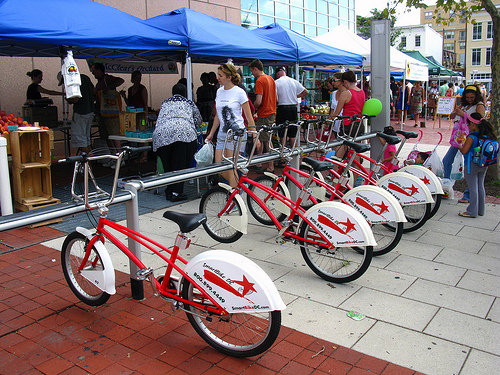
Bike sharing is now the fastest growing form of transportation. What can a city do to get with the trend?
This year, we’ve seen Mutual Aid in Motion.
From scaling sharing hubs to Mutual Aid 101 trainings, we’re helping communities build the tools they need.
Every dollar fuels lasting resilience – proving that when we move together, we all move forward.

The Biggest, Baddest Bike-Share in the World: Hangzhou China from Streetfilms on Vimeo.
-
Adopt or subsidize a city-wide bike-sharing program: Paris, France, set a great example with its impressively large-scale bike-sharing program, and now Hangzhou, China, is a model for all cities with 50,000 shareable bicycles offered throughout the city. Other cities in Europe — including Stockholm, Copenhagen, and Barcelona — also have model programs.
-
Tinker with the helmet laws: Mandatory helmet laws could present a barrier to city-wide bike-sharing programs. Bike-sharing programs have yet to solve the challenge of how to make clean and fitted helmets available to bike riders. It’s difficult to think of a perfect solution other than asking, but not mandating, that bike riders take responsibility for their own safety by carrying a helmet with them. As Sightline Institute recently outlined, the Pacific Northwest is particularly strict with helmet laws and, thus, lags behind in bike sharing.
-
Encourage biking by improving bicycle infrastructure: Even with shared bicycles offered throughout cities, many people still feel nervous about or discouraged by the prospect of biking. Bike routes are often circuitous, crowded, narrow, or unsafe. A city could encourage bicycling by increasing the number of designated bike lanes and bicycle routes, and generally improving bicycle infrastructure. Little things like bike signage can go a long way toward boosting safety.
-
Bike sharing should be included in public transit worker benefits: Bike-sharing is transit. Workers who use bike-sharing services around the U.S. should benefit from the Commuter Choice Program which allows employers to give their employees tax-free money towards commuting. Source: Paul DeMaio of The Bike-sharing Blog.
-
Real estate developers should support bike sharing: New residential and commercial developments in a city with a bike-sharing service should be required to pay for their own bike-sharing station, based on the expected demand for that location. In cities without a bike-sharing, the development proffers could be requested presently for when the city implements a bike-sharing service. Source: Paul DeMaio of The Bike-sharing Blog.
How else might a city foster bike sharing? Please post your thoughts below and help us build this collection of policy proposals. Thank you!
This post is one of 15 parts of our Policies for a Shareable City series with the Sustainable Economies Law Center:
- Car Sharing and Parking Sharing
- Ride Sharing
- Bike Sharing
- Shareable Commercial Spaces
- Shareable Housing
- Homes as Sharing Hubs
- Shareable Neighborhoods
- Shareable Workspaces
- Recreational and Green Spaces
- Shareable Rooftops
- Urban Agriculture
- Food Sharing
- Public Libraries
- The Shareable City Employee
- How to Rebuild the City as a Platform
