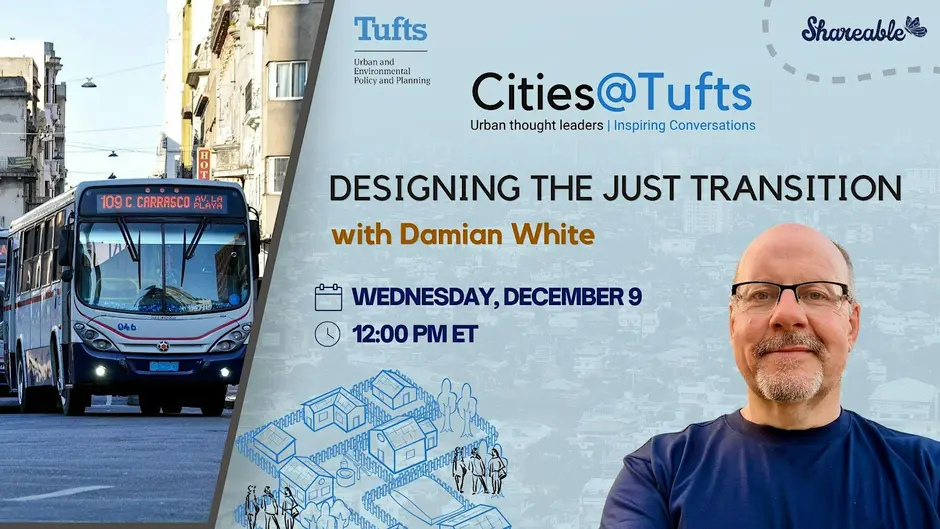
Tufts University Department of Urban and Environmental Policy and Planning and Shareable co-present this ongoing free lecture series hosted by Professor Julian Agyeman (chair of Shareable’s board).
Over the last decade discussions of labor-environmentalism and labor/ecologies have offered one of the most importance spaces for debating how we might organize, struggle and fight for just post carbon transitions that serve the interests of working people.
In this talk, Damian White draws from his new book, co-written with the landscape architecture, Nicholas Pevzner, Designing the Just Transition (Bloomsbury, 2026) to explore what the tangled and often forgotten labor and environmental histories and contemporary labor/ecology struggles occurring in design, planning, and architecture might contribute to just transitions.
Design is not to be trusted. However, this book argues that post-carbon futures are not simply going to emerge through protest and policy shifts alone. Rather, just transitions will also have to be materialized and built, coded and created, imagined, desired, and enacted on an ongoing basis by many hands and many skills. If we take this proposition seriously, and the broader proposition that the unfolding climate crisis now irreducibly throws us into a politics of ongoing worldmaking, such an observation raises critical further questions.
Damian will explore how climate-design discussions might be rendered more complex – and perhaps move us beyond tired degrowth/ecomodern binaries – by engaging with the distributional issues, uneven geographies and messy trade-offs revealed by the social science of just transitions.
We consider how a focus on design-labor might expand critical social science consideration of the range of creative material agencies that will be required to enact just transitions on a warmer, more restless, and more turbulent planet.
Finally, we consider how much a climate-labor politics that celebrates the creativity of labor, the possibilities for collective design and joyful sustainable worldmaking might provide tools to fight back against surging populist Right and neo-fascist currents, forces which as Richard Seymour (2024) observes, increasingly feed on grievance, resentment and disenchantment and offer working people the transgressive promise of deriving pleasure, excitement, thrills and validation from the suffering of others.