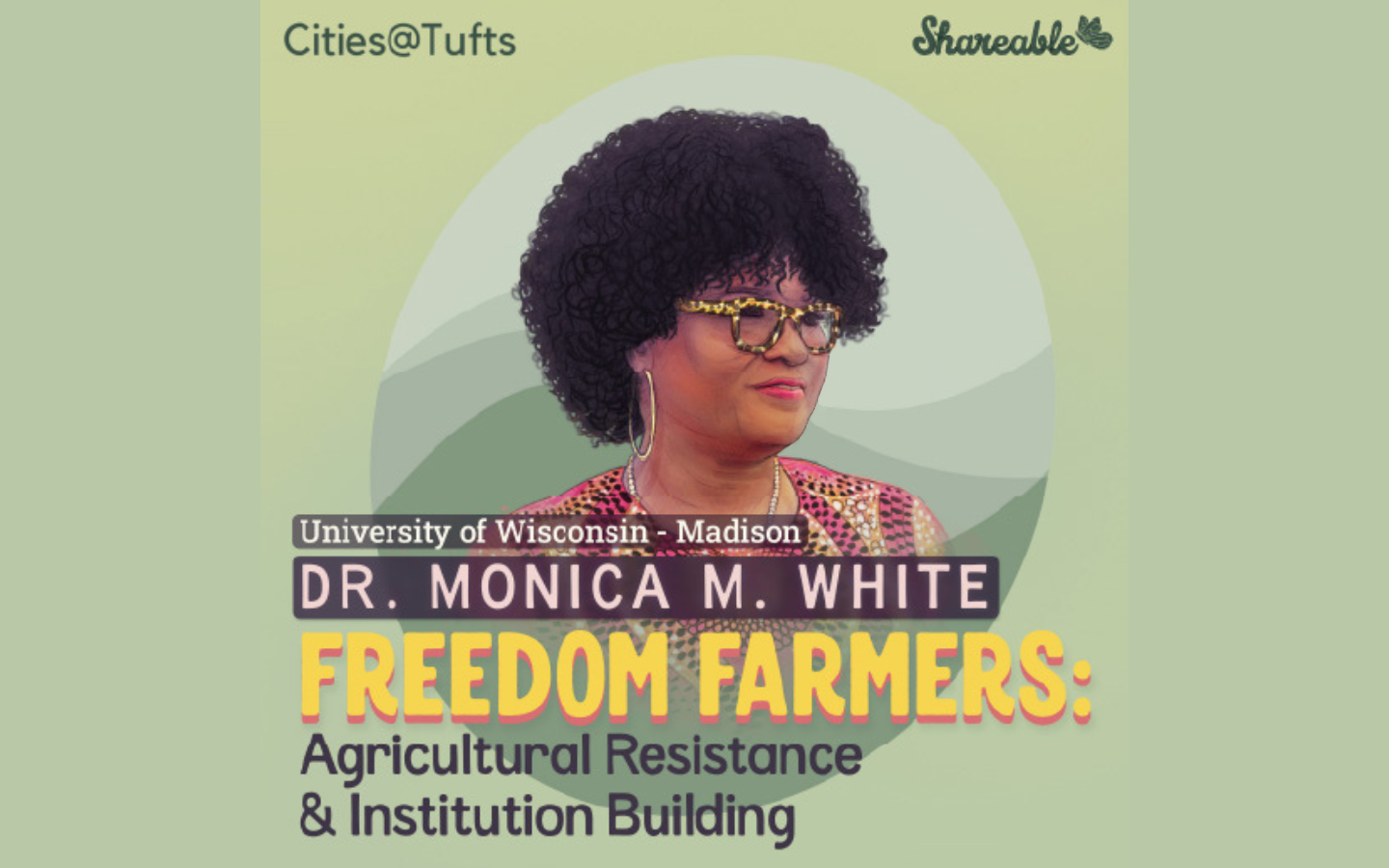
Dr. Monica M. White presented Freedom Farmers: Agricultural Resistance and Institution Building.” The presentation provided context for understanding agriculture as a strategy of resilience and resistance for African Americans. It will offer a perspective of the labor and commitment to agriculture from those in southern Black rural communities to those building community-based food systems in urban spaces.

About the speaker
Transcript of Freedom Farmers: Agricultural Resistance and Institution Building with Monica White
0:00:00.9 Tom Llewellyn: Welcome to another episode of Cities@Tufts lectures where we explore the impact of urban planning on our communities and the opportunities designed for greater equity and justice. This season is brought to you by Shareable and the Department of Urban and Environmental Policy and Planning at Tufts University with support from the Bar Foundation. In addition to this podcast, the video transcript and graphic recordings are available on our website, shareable.net. Just click the link in the show notes. And now, here’s the host of Cities@Tufts. Professor Julian Agyeman.
This year, we’ve seen Mutual Aid in Motion.
From scaling sharing hubs to Mutual Aid 101 trainings, we’re helping communities build the tools they need.
Every dollar fuels lasting resilience – proving that when we move together, we all move forward.

0:00:41.7 Julian Agyeman: Welcome to our first Cities@Tufts virtual colloquium this fall semester. I’m Professor Julian Agyeman and together with my research assistants Ainsley Judge and Max Sebbar and our partners Shareable and the Barr Foundation, we organize Cities@Tufts as a cross-disciplinary academic initiative which recognizes Tufts University as a leader in urban studies, urban planning and sustainability issues. We’d like to acknowledge that Tufts University’s Medford campus, where we are today, is located on colonized Wampanoag and Massachusetts traditional territory. Today, we are delighted to host Dr. Monica White, Distinguished Chair of Integrated Environmental Studies and Associate Professor of Environmental Justice at the University of Wisconsin-Madison and past president of the board of directors of the Detroit Black Community Food Sovereignty Network. She is the first black woman to earn tenure in both the College of Agricultural Life Sciences and the Nelson Institute of Environmental Studies, to which she’s jointly appointed. As the founding director of the Office of Environmental Justice and Engagement at UW-Madison, Dr. White works toward bridging the gap between the university and the broader community by connecting faculty and students to community-based organizations that are working in areas of environmental, food, land, justice toward their mutual benefit.
0:02:05.2 Julian Agyeman: She’s also an Andrew Carnegie Fellow for 2022-24 and received the 2024 Distinguished Career for the Career Award in the Service of Sociology from the American Sociological Association. Her research investigates black grassroots organizations that are engaged in the development of sustainable, community-based food systems as a strategy to respond to issues of hunger and food inaccessibility. Monica’s talk today is Freedom Farmers, Agricultural Resistance and Institution Building. Monica, a Zoom-tastic welcome to Cities@Tufts.
0:02:43.2 Monica White: Thank you, Julian, and thank you to your students and community partners, Ainsley, Max, Bobby and Paige. So grateful for the opportunity to talk to you today. And I think some of the work that I do will concentrate on black rural communities, but I just want you all to know that the work comes from, I was raised in Detroit and that’s where the origin of these ideas starts. So thank you all. I’m really truly grateful. I always want to, oh, whoops. Okay, there we go. I like to root my presentation in where the ideas come from. This is my grandma Pearl and granddaddy Kenneth. They were farmers in Eden, North Carolina, and really spent that generation where we spent the summers in the South, either Mobile, Alabama, where my dad is from, or Eden, North Carolina. And knowing that both my grandmother and grandfather were farmers, it was really interesting that I didn’t realize until after I had written the book that they were members of a cooperative. My grandfather started a cooperative in Eden, North Carolina. It was a place where African-American farmers could come together, be treated with respect. And he was a part of eight farmers who cooperatively owned a vehicle.
0:03:56.6 Monica White: So my book, Freedom Farmers, is about co-ops. And I didn’t realize that my grandfather was a part of a co-op. And so I sort of, as the saying goes, in search of my mother’s garden, I found my own. This is a picture of my grandfather at the grocery store that was a part of their house, the community store. And so I just wanted to start with a few of the publications that we’ve done. One is Agriculture and Academics, the Golden Door to Freedom, Past and Future. That’s in our newly released journal. It’s a Black Food Sovereignty Journal called the Land, Food, and Freedom Journal. The next piece was a Freedom Farmers, Black Agriculture and the Origins of Food Justice, that was a part of an American Sociological Association newsletter. In it, I anchor the history of food justice in the work of Black folks, Black farmers, and how members of the Detroit Black Community Food Sovereignty Network responded to COVID crisis by providing nutrient-rich foods to community members. The other piece, Feeding Ourselves in Dangerous times, was a part of the Black Food edited journal, an edited volume by Bryant Terry. In it, it allowed me to sort of stretch my wings and be creative.
0:05:03.2 Monica White: And I wrote a piece that was an opportunity to be creative in thinking about what would a conversation between Mrs. Fannie Lou Hamer, Mrs. Shirley Sherrod, and the future generation of Black women who are interested and engaged in agriculture as a strategy of mutual aid. I apologize. I live near the fire department. I hope everything’s okay. And the last is a current book that I’m working on right now, We Stay, the Agriculture and Activism of Black Southern Rural Farmers. You know, I love some George Washington Carver. And in search of sort of really anchoring my scholarship in the work of Black folks who’ve gone before us, I really love this quote that just really captures what I think is the essence of what I saw happening in Detroit in the 2000s, but even today, and just really sort of the history of urban agriculture, but also rural Southern agriculture. He says, there’s probably no subject more important than the study of food. I concur. In addition to anchoring my work in folks who have done this work, there’s a young farmer here who this was one of the first crops of Satsuma oranges, works with Mrs. Sherrod.
0:06:13.3 Monica White: But I found this quote by Benjamin Carr from 1914. It says, the reason I have always wanted to be a farmer is because I believed then and believe now that the farmer is the only free man we have in our race. And so here you really hear farmers talking about agriculture as a strategy of resistance and resilience and as a pathway toward freedom. And so I knew what was happening in Detroit as I worked with members of the Detroit Black Community Food Security Network. Their strategy was agriculture. They were engaged in agriculture. They were the Town Farm, seven acre organic farm. And really, when you ask them the question, why were they doing this work? It was more than to provide nutrient rich food. It was their strategy toward responding to the city’s bankruptcy and a lack of access to nutrient rich foods. And so just really ask the question, this is an interesting strategy. But when I looked at the scholarship that preceded them, I didn’t really hear the voice of an articulation of agriculture as a strategy in that way. And so of course, you go out and you look to see who’s doing what, where is the work.
0:07:17.7 Monica White: And I found this beautiful image of black farmers who welcomed the Freedom Riders in Mississippi to support the right to vote, integrating public institutions and demonstrating self-determination as a resistance strategy. And so these are farmers who are welcoming the Freedom Riders, but it also gives me that had me thinking about, we hear a lot about the preachers and the pastors of the civil rights movement. We hear about the churches and we hear about students and the lunch counter. But if you think about it, if you’ve got a group of folks that are coming from the North into the South to help organize for the right to vote, where were they staying? So they didn’t, so they had to stay with black farmers or black folks who were in charge of some land. And so I was really curious as to why that story had been muted. Why didn’t we hear more about the black farmers who are a part of not just the civil rights movement, but of the larger, broader black freedom movement, I would argue. And so this led me to sort of do an investigation. You should always start with your lit review.
0:08:14.2 Monica White: And I realized when I started asking the question of what is the role of black farmers or what is the relationship between African-Americans and agriculture? And what I found was really what felt like a danger of a single story, right? And so the scholarship previously really concentrated, if at all talking about black farmers, they talked about black farmers as passive. What happened to black farmers instead of what were the agency was. The scholarship really came from a deficit frame talking about aging farmers and land loss. And so looking at what was the scholarship that was there previously, I realized that that couldn’t be all there was. What was important to understand was if that was all there was, a deficit frame, then why is it during every economic downturn, do African-Americans turn to agriculture? And so that set me on a quest to really sort of broaden, ask the question all over again. And of course, as much as I love Detroit, 313 is my hometown, it’s important, you can’t start a book talking about black farmers in Detroit. At least I felt like I couldn’t. And so that then led me to the South to really sort of develop and understand agriculture from a much broader standpoint.
0:09:20.1 Monica White: And so that led me to a few research questions. So my research questions for my work were really what were the contributions of black farmers to the black freedom movement, the civil rights struggle, and how does agriculture expand our understanding of a resistance strategy? When you ask scholars or people in general, what are resistance strategies or what are the strategies that people use to resist? You often hear protest marches and boycotts, but those are all strategies that are in response to the entity that folks identify as those who are oppressing. But there are other ways that we can think about when you ask people who resist, you come up with a bigger, broader range of those strategies. And for me, working with folks in Detroit, I realized that they were using agriculture as a strategy of resistance. And so I wanted to really sort of understand the context of the work that was happening in Detroit. And I wanted to then understand the history and reframe the history from a deficit frame to one that was one of agency and was a different sort of an approach to understanding agriculture and black folks. So what was the research process?
0:10:24.0 Monica White: I spent a lot of time in Detroit black food movement spaces without even turning on a recorder. I served as a first I was a contributor attended all the meetings and all the food related events that was happening that happened in Detroit. I was a part of that. I then joined the Detroit Black Community Food Sovereignty Network, became a part of the board, eventually president of the board of directors. I was also the Thursday night crew leader and did workshops on vermicomposting, even though I don’t like worms. I know how important they are, but I’m just a little squeamish about the worms. And so my work with DBCFSN really taught me a new language. They gave me new concepts. I had learned from them food sovereignty and food justice. And so that was sort of a way that my eyes were open. And I wanted to see how could I understand what they were doing and then offer some scholarship to really anchor their work, not just in a contemporary sense, but in a historical sense, which is how I became interested in the history of agriculture for African-Americans. And so you can’t talk about a history of agriculture without talking about who I consider the three wise men.
0:11:27.1 Monica White: That’s Booker T. Washington, who started Tuskegee Institute, which is now Tuskegee University. I argue that Booker T. Washington, while complicated politically, really did a lot to support Black agriculture. Many of his students came from all over the South, and they then returned once they graduated, they returned to their home counties, their home communities, and established Tuskegee-like institutions. And those students at Tuskegee learned everything from how to build bricks, how to make bricks, how to make shoes, and just everything that they needed, Booker T. Identified as important as a part of a curriculum. George Washington Carver, of course, we have to talk about his contributions. I think he’s been reduced to the soybean and the peanut, but I really argue that his work is really sort of the foundation of sustainable agriculture. I know we like to say Rodeo, but Rodeo comes 50 years after George Washington Carver when he was already doing this kind of work. Many people think about Du Bois, and they talk about the talented 10th or the big debates that he had with Booker T. Washington. And I would argue Du Bois is so much richer and so much more than that.
0:12:30.7 Monica White: I think the work of Jessica Nymhart really anchors that idea of collectives and cooperatives. But Du Bois even argued that his biggest contribution was in understanding agricultural cooperatives as a strategy of resistance and resilience for African Americans. So I call them the three wise men, but they needed a sister to show them how to do it. And this is where we come up with the work of Mrs. Fannie Lou Hamer, who started Freedom Farm in Ruleville, Mississippi, which was a cooperative. And she did a tremendous amount of work to create a mechanism of mutual aid. She encouraged African Americans not to follow the Great Migration. She argued that everything comes from the land. If you leave the South, if you leave the land, you become beholden to someone else. So really just sort of those were the intellectual anchors of the work that I did for Freedom Farmers. And I would attend, I would go to archives throughout the South, particularly, and doing the archival work in libraries and other museums and what have you. I would do the archives by day, but I was always looking for black farmers I could talk to, learn from, and engage in the evenings to make sure that my work was, what I was reading and what I was hearing was anchored in supporting the ideas, the work, the commitment that they were doing. But I wanted to make sure that I was reading the documents in a way that was accurate according to their experiences.
0:13:50.3 Monica White: So this was the research process. What were my research methods? So as I mentioned, I spent a lot of time in the archives, and I just want to take my hat off to anybody who is a part of the archives. They’re always looking for folks to do research and work with researchers. And so I have a tremendous amount of gratitude for archivists. Also understanding there’s a politics of the archives. If somebody would like to talk about that, I’d be happy to. Interviews, life story interviews, thinking about family storytelling as method, and a lot of work on the road in terms of my research methodology. Some of the organizations that I worked with for Freedom Farmers, the book that I wrote, one was the Federation of Southern Cooperatives. We did the Southwest Georgia Project, the Nation of Islam and Muhammad Farms, the Lowndes County Freedom Organization, Southwest Alabama Cooperative, also Freedom Farm Cooperative, which is Mrs. Hamer’s project, the North Bolivar County Cooperative, the Shrine of the Black Madonna.
0:14:44.6 Monica White: These were some of the organizations that I concentrated on, even though I really wanted a book that was anchored from 1887, the Color Farmers Alliance, to 2013. And a dear friend of mine was like, Mo, you can’t do that. You got to really narrow the book down. You’ll never get finished. You have to get tenure. So I decided to concentrate on what we call the Southern Cooperative Movement of the 1960s. And I tried to do different organizations at different scale to sort of understand what it was they did, how did they do it, and what do we learn from what they did. Some of the archives, places that I’ve gone for collecting research, Mississippi Department of History, the Amistad Collection, Wisconsin Historical Society, Tuskegee University, Birmingham Public Library, Alabama State Archives, the Schomburg, and also Walter Ruther. For those of us that are members of organizations, I always want to take this moment to encourage us to help support the work by capturing organizational histories, organizational documents, and making sure that we store them in repositories, not just online, but in multiple ways.
0:15:47.5 Monica White: I just imagine how much richer my data would have been, my scholarship would have been, had I included a lot of the organizations whose names I had but no documents. And so I’m always encouraging folks to be a part of capturing the history, making sure we understand our organizations today so that those future scholars will have scholarship to anchor their work. What did I find? So I really sort of think about the work of farmers and farming in two ways. One, I argue that there’s some ways we can talk about agricultural oppression. And here I’m talking about control over the conditions of production, land, labor, knowledge, and supply chain, extractive relationships with the environment, forced removal of the indigenous, forced labor from Black people in plantation slavery, exploitive economic conditions of tenant farming and sharecropping, and also continued oppressive working conditions of migrant workers, farm workers, and other ag workers, as I argue is agricultural oppression. But agricultural resistance is something very different, right? Food production for the development of community-based food systems as an opportunity to transform our food options, neighborhoods, lives, and the world, ultimately. The ways that communities use food production as a strategy for community self-determination and community self-reliance as a way to build.
0:17:02.1 Monica White: In addition to these sort of larger constructs, I think my work also contributes to a theoretical framework to understand how it is and when do organizations engage in liberatory activities. The argument is self-provisioning leads to political options that previously probably would not have existed. With this in mind, I came up with a theoretical frame called collective agency and community resilience. Agency is often described as a psychological concept, but what happens when we have a group that comes together to sort of investigate how might we get free, right? What does that agency look like when you have a community that takes over a vacant land to create a community space for agriculture and intergenerational relationships? We often talk about resilience, and that concept is pretty political because in some ways I think we talk about the outcome. We have a catastrophic event and communities come together. I believe it’s irresponsible for us to talk about resilience without also interrogating the structural factors that lead some communities to be more vulnerable than others. And so I do use the word resilience understanding that it’s been used in many different ways, but I think it’s important for us to use resilience as a strategy, as only part of a strategy.
0:18:12.6 Monica White: So within the theoretical framework of collective agency community resilience, there are really three strategies that I’ve identified as a result of understanding and analyzing these organizations. One I argue is prefigurative politics. Organizations create a free space. That free space allows us to be self-managed and to identify and engage in political education for opportunities. What are the alternatives? What are the options that we have? In addition to that, these prefigurative politics occur that within organizations, it was usually pretty active and liberatory in that everyone had a vote. And so engaging in the right to vote, understanding why it’s important to have the right to vote was also part of what we call prefigurative politics. While economic autonomy and independence is really sort of like an infinity, right? There’s no such thing in a global economy, but some of the activities of these organizations were really working toward economic autonomy and independence. Here I’m talking about moving from thinking about ourselves as the individual to thinking about ourselves as a part of a collective. Moving from the oppressive conditions to one that is liberatory. And commons as praxis is really the last theoretical frame. What I’m talking about here is we’re all impacted by what happens in our waterways. We’re all impacted by what happens in soil. We’re all impacted by what happens with air, what happens to the seed.
0:19:36.6 Monica White: And so commons as praxis is a way that organizations function to make sure that we all have a say in the ways that we make decisions about air, land, water, all that we share. And that these strategies become a collective decision, but one that is regenerative. And here I’m inspired by the work of indigenous and first nations, where they think about first seven generations, right? Seven generations in the past, seven generations moving forward, making sure that we do no harm. And so this is collective agency and community resilience. From this work, I’ve also identified who I consider freedom farmers, right? One, I’m really sort of fascinated by an understanding of rural communities. I think that rurality is losing popularity, but there’s something very special about who’s rural, what happens in rural spaces, and why rurality is central to understanding who we are. I think that we’re currently witnessing sort of a reverse migration, where people are moving from the north to the south and heirs property returning to the south. I think that that’s something rurality is something that needs to be further investigated. I think freedom farmers are active agents. They’re not just people to whom something has occurred, but they’re active agency and need to be understood as such.
0:20:46.7 Monica White: My work really does concentrate on the Southern cooperative movement. Many people don’t know about that. And so it took place as folks were trying to encourage folks to move to the North for the Rust Belt, like my family, but there are some who stay. And how did they stay? They were able to stay because they established cooperatives, a range of different kinds of cooperatives. I think that freedom farmers really sort of includes a different analysis of who farmers are. When we think about a definition of who farmers are, how USDA defines farmers, we often think about farmers as those who own the land. But I think it’s important for us to think about the labor, who provides the labor. And that’s how I expand the definition of who farmers are. And so thinking about and including in the definition impoverished land workers and the potential to build a community with almost nothing, right, with resources that need to be pulled together that actually lead toward freedom. And so this includes the work of land workers and not just land owners, which I think a lot of scholarship does when you talk about who farmers are. What are some of the lessons of freedom farmers?
0:21:50.9 Monica White: I think that one, as a social movement scholar, how do we define success? I think that folks define success as an all or nothing, right? Here’s what our platform is. Did we achieve it or did we not? And I think that we need to be more broad in how we define success. I think that there are ways that we can understand Mrs. Hamer’s Freedom Farm as a short-lived but highly effective strategy that laid the foundation for what African Americans in urban areas today are really sort of anchoring their work in. And so I would argue that the definition of success is not an all or nothing, but it really needs to be expanded to think about how do we measure success? What does success look like? And what is the future capacity and the past just in terms of how we think about that? I think the lessons from Freedom Farmers also, how do we understand agriculture as a strategy of resistance from those who participate in it? I’m sure there are other ways and strategies that folks are engaged in that we probably would miss as a strategy of resistance, but agriculture is absolutely one that we see, particularly in urban areas and in the North especially.
0:22:54.2 Monica White: So thinking about community building as a strategy of resistance, I think it’s important to argue that it’s one thing, as my dear friend Dara Cooper says, individually we’re vulnerable, but collectively we have power. And so how do we build community? How do we care for each other in terms of mutual aid? And what does that look like? I feel like that’s a lesson that we get from Freedom Farmers. And as I mentioned before, I think the idea of a cooperative is super important. Jessica Nimhart talks about it from an economic standpoint. I talk about it from a resistance resilience standpoint. And so I think that there are ways that we can understand cooperatives, cooperatively, having people work together. I think that’s pretty amazing, and we should be also thinking about that. That’s a lesson that we get from Freedom Farmers. And so not only do we have these lessons, I think it’s also important to think about what does food allow us to do, right? So if we’re thinking about a healthy whole community, food is just the beginning of the conversation, right? And so I really hear folks in urban areas particularly talking about food.
0:23:51.4 Monica White: If we can control or at least participate in the production of our own food, what else can we do? So the question of food that lends us to asking questions about the land. What is in the land? Who owns the land? How can we use the land? What are those resources? And how do we share the decisions around that? That then leads us to a community education. How do we all participate in making sure that our children have a liberatory education? Thinking about employment in terms of a living wage, what does that look like? That then leads us to ask questions about safety and security. What about transportation justice? How do we make sure that folks have access to transportation, not just in the form of individual cars, but really sort of public transportation in really beautiful, broad ways? Safe, affordable housing, and how do we make sure folks have access to healthcare? So I think food is the beginning of the conversation, but it’s a part of the introduction to getting folks involved and active in establishing and demanding healthy communities. So in terms of the institution building, I’ll try to make this quick.
0:24:49.4 Monica White: Black institution building, I’m deeply committed to this work. I work with the National Black Food and Justice Alliance, and here we organize people, build institutions, amplify culture, and it’s a coalition of Black-led organizations working towards cultivating and advancing Black leadership, building self-determination, institution building, and organizing food sovereignty and land justice. And so here I was a member of the organization and really wanted to find a way to bring my intellectual skills to support these organizations. With this in mind, I came up with Blackademics. It is not the first time Blackademics has been used, but the research arm of MBFJA is Blackademics. And so here I work with Ashante Reese and Christina Hilton and myself, and we really wanted to make sure that there were a collective of African-American scholars who wanted to contribute to organizations in a really broad and beautiful way. With this in mind, there are two different projects that we’ve been working on in terms of Blackademics. One is starting Centers for Agroecology at Historically Black Colleges and Universities, especially land-grant institutions. And a few years ago, we started the Agroecology, the Lola Hampton Frank Pender Center for Agroecology at Florida A&M University.
0:26:02.1 Monica White: We wanted to start at FAMU because they have a law school. We wanted to make sure that we’re teaching the next generation of civil rights attorneys the importance of air property and what have you. And so the work with FAMU has been enriching. And so really these centers are to provide interdisciplinary space and a think tank for training, developing, and building sustainable future for Black regenerative agricultural farmers and land stewards. And so this is just one of many institutions that we’ll be establishing at FAMU was the first. In addition to the Centers for Agroecology, we also started this journal, a Black Food Sovereignty Journal, which is a peer-reviewed. We have a collection for academics who submit their articles, but we also have personal stories and activists who engage. We’ve also got artists in residence. Each of our issues has a playlist by an honored DJ. And so you can listen to beautiful music that celebrates Black food sovereignty. At the same time, you’re reading about the intellectual contributions of the work, but also the creative and the personal realities of the work. What is next for me? We’re currently engaged in conversation to bring the next Center for Agroecology at Tuskegee University.
0:27:13.7 Monica White: I’m looking at the time. Okay, I’m actually doing really well. And so starting the next Center for Agroecology at Tuskegee University, my book Freedom Farmers, Agricultural Resistance in the Black Freedom Movement has recently been released on Francais, hoping that that gives us the opportunity to build with Francophone countries. And also the next book that I’m working on currently is We Stayed. I’m working on the book now, but also have filmed portions of a documentary that we’re engaged in. So let me share just a little bit about We Stayed. So We Stayed, the picture you see here, two brothers. The fur, in the front is Reverend Wendell Paris. In the back looking at us is his brother George Paris. These are two brothers. Their father was an early USDA loan officer based in Tuskegee. And he was really responsible for making sure that African Americans, tenant farmers, sharecroppers, and landowners had access to the resources that were offered by USDA that African Americans were often disenfranchised from. And so their father taught them the importance of agriculture and activism. They then come up in their youth, and they are part of the civil rights movement. This is when they’re standing in line for the Selma to Montgomery march to demand the right for African Americans to vote.
0:28:26.0 Monica White: And so this book, We Stayed, A Black Farming Family’s Journal Through Civil Rights, really just sort of anchors the story of agriculture and activism in a really beautiful way. I remember meeting Reverend Paris when I was collecting the data for my previous book. And one of the things he said to me was, you can free yourself when you can feed yourself. How profound a statement was that? And so I’m listening to him tell the story of his father, an early USDA loan officer, and the ways that their parents taught them the importance of agriculture and activism, and realized that this was a book that needed to be told. Here’s a picture of our interview. And so the two brothers are sitting here. They were very vivid, beautiful storytellers, and that was what really made the book interesting. And also what I wanted to hear were the stories that we didn’t necessarily remember. And so as a part of the data collection, I asked them to come together, pull out all of the family pictures. We organized them by decade on the table, and I asked them to tell me the stories through the pictures that they have here on the table.
0:29:25.2 Monica White: Here is a picture of us doing a documentary. Ignore the blurriness. That was an iPhone. I’m an Android. No, I’m just kidding. But yes, so we’re actually in the process of trying to get the resources together to continue the documentary. And so this is the next project that I’m working on right now. And I just really thank you for your time. How did we do? Yeah, we did it.
0:29:53.0 Julian Agyeman: Monica, do you want to come and teach my food justice class at 1:30? That was a tour de force. And you’ve given me so many more ideas, things that I was kind of aware of, but not fully aware of. This is absolutely amazing. And we’ve got a few questions, but I’m going to take the…
0:30:15.9 Monica White: Oh, look at all the hearts. Thank you all. That’s so sweet. Thank you. That’s beautiful.
0:30:21.5 Julian Agyeman: I’m going to take the moderator prerogative and ask you the first question. And it’s an obvious one. We are in, shall I say, strange times. What does resistance look like going into the unknown?
0:30:37.5 Monica White: Yeah, so I think that going through COVID was one of those examples. It was sort of a trial run, right, to see what happens. African Americans are used to going into neighborhood stores and seeing empty shelves. But I think COVID really helped the rest of us sort of understand and really take seriously our food system and understanding that food is not an endless supply, nor is it just a matter of choice. What do you feel like eating? Sometimes it’s really an issue of what’s available. And so I feel like the current moment requires us to think more broadly about how we eat, from whom, and really making it more local. And how might we support more local food? How might we come together to do things like the Detroit Black Community Food Security Network just recently opened up the Detroit People’s Food Co-op. And so part of the early generation of that co-op was a food buying club. And so we would come together and we would say, okay, well, I need three cases, three cartons of soy milk and somebody else wants it. So we bought together collectively.
0:31:40.7 Monica White: So I think part of it is thinking more collectively, thinking about each other in really beautiful, broad ways, thinking about what can we grow, what can we preserve, and how can we look after each other? I think that is long something that we’ve done in some ways in the food justice movement. But I think that this moment is going to require us to do that more vigorously. And I just realized, one of the things that I thought was really profound when I started doing this work, I would ask people, if you had access to nutrient-rich, culturally appropriate food in your neighborhood, would you still participate in this urban agriculture? And they were like, absolutely. I don’t know where those seeds came from. I don’t know how it was grown. And I also found a lot of people talking about not only their own children’s nutritional options. I heard them saying, I see kids going to school drinking soda and eating Takis, and I just want children to have more greater options. So I think this conversation around food and food justice is much more expansive. And so thinking about how we look after each other, how we care for each other, that work has already begun.
0:32:42.0 Monica White: And so we were 15 years ago asking, if Kroger, that’s one of our stores, if Kroger closed their doors, how will you feed your family? And so now we see people really engaged in these strategies of feeding their family, but not individually, but collectively.
0:32:59.3 Julian Agyeman: Great. Thanks for that. So we have a question from M. Wexler. I live near the Salinas Valley and have lived near rural small-scale farms in mountains. How would the strategies differ between community building between the two? I’m not sure what you mean between the two, M. Wexler. Do you want to clarify for Monica? Is M. Wexler in the house? Do you want to stab at that? Do you understand that, Monica?
0:33:33.5 Monica White: I don’t. And you know, the thing is, so I’ll be honest I’m a sociologist. I’m not, and so I’m really good at what I do and what I know. And so taking what I know from Detroit, and you know, I mean, I can take a Detroit conversation and talk about Georgia, Alabama, Mississippi, because those are farmers with whom I work, but I don’t know how to expand that to a California model. Like, I don’t know enough about California agriculture to really be able to make those sort of associations. I do have a former colleague, Sarah Rios, who does work in the Central Valley. She’s an amazing scholar who’s now at a California university, and so she may be someone who can answer that question. But I stick to my lane. I don’t dip my toe in other people’s.
0:34:16.1 Julian Agyeman: Yeah, I’m sure. Thanks for the advice there. Jason L. Asks, what are some of the main obstacles or even adversaries to this kind of resistance, political or otherwise?
0:34:28.0 Monica White: So on the surface, I think that what I’ve learned about being a part of food justice is that there are the strategy of growing food brings people under the same umbrella that you would never, ever imagine, right? So there are folks from the far, far forest of the far right to the far, far forest of the far left, and everybody is growing food. I think that there are obstacles that we’re familiar with accessing soil that is arable access to water, making sure that we have seeds that you know, what I’m saying, like so there there’s a resource kinds of questions that also may include labor. Labor is very expensive, and I think that we have never, as a nation, we’ve never truly paid the cost for our food. It’s always been subsidized in some ways, and so it’s often that folks say, well, can urban agriculture really do this and be sustainable? Well, every form of agriculture, as long as we have been farming collectively, has always been subsidized. So it’s not fair to ask something of urban agriculture that you don’t ask of rural farmers, and I see that really in the conversations that we see happening for rural farmers today, really sort of looking at what’s happening to how we spend and the funds that are available, and I think that’s an issue.
0:35:45.3 Monica White: So part of it is a resource issue. Part of it, because I study small family farmers, is that the parents have worked so hard to maintain, retain the land, and use what they have made the money, the funding that they’ve had on the land to send their children to college. Now, once they send their kids to college, it’s brain drain. Those kids often don’t want to return back to the land. They often don’t want to return back to agriculture, but I think that some of the work that the National Black Food and Justice Alliance is doing is really insightful here, because what we see happening is these conversations that are taking place. So in the South, you’re thinking about Southern, rural, aging farmers who have all the knowledge and the land. In the North, you have Northern urban youthful farmers, and so really sort of bringing together the skills of the North to provide resources for the farmers, And one person’s work I can think of is Reverend Heber Brown, who’s of the Black Church Food Security Network, based in Baltimore.
0:36:42.2 Monica White: The work that he’s doing is really sort of providing resources to farmers to put their crops in, also providing resources for the harvest, and in the process, then bringing that food from those farmers up to Baltimore so that the folks in Baltimore have access to nutrient-rich food. So I see a lot of really amazing things happening. There are all kinds of issues that stand in the way, and I’m sure that somebody else will probably give you a more concise description of what the barriers or boundaries are. But you know, I’m a half-full glass kind of person. I really think about how tremendous the work is, how amazing it is. I really approach my work from an asset-based approach and not a deficit approach, and so I see a lot of possibility in what’s happening today in cities and in rural communities in North and in the South. So thank you for that question. Tanya? I see you, Tanya. I’m sorry. Yes, go ahead. I’m sorry.
0:37:33.7 Julian Agyeman: Question from Aisha Farley, who’s a Tufts student. How do we lift up ancestral practices around cooperatives in the age of the rise of Black capitalism, excellence, and wealth?
0:37:46.8 Monica White: Yeah, I see a lot of organizations engaged in rooting and anchoring this work in just thinking from traditional medicinals and foraging and what have you. So I really see a lot of organizations that are anchoring their strategies in these kinds of techniques. I think that it is a big hurdle. How do you address individualism, individuality, and capitalism? But I also know that when children are raised in these communities where folks are engaged in agriculture, you really see them embracing the work in a really generative and beautiful way. I think it is a huge hurdle to overcome the allure of just sort of glamorizing fame and all of that kind of stuff. And I also feel like there are some for whom that may come, but for the majority of us that will not. And so they will need options and alternatives to exist because every social media influencer will not be influencing sufficiently to feed their families or feed themselves. And so I think that there’s a harsh reality that comes when you really sort of interrogate that and creating the option and the alternative so that when children realize or just recognize or just communities, not just children, that there’s some options out there for wellness, community health and wellness.
0:39:09.2 Monica White: I think that makes it much more attractive.
0:39:12.5 Julian Agyeman: Second part of Aisha’s question, which I think is really relevant. What have Southern Black cooperatives been doing in preparation around climate crisis since we know the South will be more affected by the crisis?
0:39:25.8 Monica White: Yeah, I don’t think I have the answer for that. I don’t. I mean, I know that it is a part of the conversation, but I can’t say, I think the issue of maintaining, retaining the land, I don’t know if Dania could speak as part of the work with the Federation of Southern Cooperatives, but I have really been sort of uni-focused on just the unearthing our agricultural history so that I know that there are things that are happening. I just don’t know that I have my finger on the pulse of that. I do know that indigenous communities are absolutely talking about climate change, climate resilience. And so I feel like there are lots of ways that our conversations could cross pollinate, pardon the pun and so I just, I personally can’t speak to what strategies folks are doing in terms of climate change. Unfortunately, I’m sorry.
0:40:16.5 Julian Agyeman: Question from Johnny, can you share any prompts for reflection that came about during your interviews, field work for individuals or communities who may be looking to re-examine their relationships to food, its production and the land?
0:40:30.5 Monica White: Yeah, so the question that I asked earlier was one that we were trying to recruit members for the Detroit Black Community Food Security Network. I mentioned it earlier. And so we would go to the African World Fest or any place there was a group of people and just sort of ask the question, if the grocery store closed tomorrow, how will you feed your family? I feel like that is one that really gets folks to sort of think about what happens when the store, when the store no longer has what we need and it addresses an urgency. Mama Abba, who’s a member of DBCFS and one of the co-founders, she would say to people, she’s like, I can teach you how to grow tomatoes on your windowsill and just sort of really asking and engaging with folks to try to get them to think about it’s not a far distant reality. And so right now it becomes a more urgent reality. You said, what kinds of prompts would I use to get folks interested? Yeah, I mean, I think asking people where they are now and what their access to nutrient rich foods are and what are the barriers or boundaries?
0:41:27.6 Monica White: And then asking them about some of the organizations that are actively engaged in this, some of the community partners who have like churches, almost every church has a wellness program, their community projects and other kinds of ways that folks are engaged to try to connect them to what it is that they’re asking for, their concerns are to really sort of unearth some of the regenerative relationships that are available to them, to ask a specific set of survey or interview questions. I probably need a little bit more time to do that. And so I just think initially, that’s just my knee jerk sort of thought in terms of what we do.
0:42:01.7 Julian Agyeman: Sure. Next question comes from Bobby Jones from Shareable. Bobby, I know you’re online.
0:42:06.2 Monica White: Hey, Bobby.
0:42:07.4 Julian Agyeman: Bobby, you know Monica, and I didn’t realize, Bobby, you are a recovering farmer. Do you want to ask your question, Bobby? Because I think you could ask it better than I can.
0:42:24.6 Bobby Jones: Hey, yeah, here I am. Yeah, I was a farmer for about 10 years in Georgia. And no, it’s really cool to see, to hear about a lot of your work and know some of the folks involved. And so really appreciate it. And so I guess the question was aside from the work that the National Black Food Justice Alliance is doing, can you talk a little bit about like, what some of the organizations you studied are up to now? Because I know like Federation of Southern Co-ops is still doing some really great work. And I know Shirley Sherrod launched a new project not that long ago. So it feels sometimes so removed historically when you’re studying it, but a lot of this work is still happening and there’s still those through lines. So if you could just share with everybody.
0:43:10.9 Monica White: Yeah, Bobby, that’s a great question. And let me just say that I don’t know that I have the full answer to it. Because when I was working on Freedom Farmers, I was really sort of examining those particular organizations in the 60s. So I didn’t bring it to a current contemporary sort of analysis. And now that I’m working on the three generations of the family and working with the HBCU project, I don’t know that I could fairly accurately tell you. I know that Detroit Black Community Food Sovereignty Network is doing just really tremendous work in Detroit. As I mentioned earlier, we started when I was the president of the board, we started with a feasibility study that was some over 10 years ago. And people were asking us, well, there’s no way that a co-op in Detroit will work. And you’re in the hood and not really in the suburbs. So there was just this really just sort of a really disparaging, you won’t get the funds, you won’t get the market, just really naysayers. And so to see the Detroit People’s Food Co-op open, to think about the ways that folks are moving, including urban agriculture, agriculture broadly defined, but also establishing food hubs, creating alternative food systems to make sure that folks are moving around the national organizations and entities distribution and what have you. I think that’s pretty amazing.
0:44:23.5 Monica White: But in terms of like, what is the federation currently doing? Dania Davy could really speak to some of that. I’m just sort of now I’m trying to work on full. So it’s just really, I am more than a playful, a buffet full, and really doing a lot of work both in community and university. And so being able to really respond to what’s happening today, I don’t want to do a disservice and would really encourage you to sort of look at those organizations and to see how they’re really engaging in work now. I’m sorry, I can’t answer that, Bobby.
0:44:53.3 Julian Agyeman: We got a question from Devin Rubin. It seems like there needs to be a cultural shift away from consumerism towards more rural agricultural practices, the importance of unprocessed food. How can we work toward that change? What’s a sociologist perspective on that, Monica?
0:45:15.7 Monica White: I do think that the work of many of the organizations with whom I work with are engaged in whole foods, right? So food preservation just identifying, as I even mentioned, urban foraging, what have you. I see that as a part of the organizations that are currently engaged right now. And so I would argue that if you look at the organizations, what they’re doing, that they’re probably doing quite a bit of this. I mean, I think that’s a part of the conversation, right? How do we move away from processed foods to more whole foods? That also recognizes that there are regional differences and it’s complicated by, I’m in Wisconsin. We may get sun November through April, two days out of the winter, right? And so there are realities that are part of it. And so these traditions of food preservation, I think are part of whatever we see happening. Folks, some folks may call it homesteading, but I see it as a part of what organizations are doing now. And so I do think that that is a part of the conversation, the debate. I do see it as moving away from buying to growing and preserving. I see that happening.
0:46:19.5 Julian Agyeman: Great. We have a question from, strangely named Zoom user. We’re all Zoom users. What are some of the key lessons you’ve learned from your grandfather’s generation, i.e. Fannie Lou Hamer, et cetera, in terms of organizing to get our needs met and what do we need to do to be more effective?
0:46:42.0 Monica White: Zoom user, thank you for that question. You know, when I mentioned the importance of rurality, I think about my summers in the South and I think about sitting on my grandparents’ porch. And every time somebody drove by, they spoke. And I think that the communities that I study, both in terms of my own family experience, but also looking at Mrs. Hamer, there was this real sense of community. Like a farmer may know how to fix a tractor and somebody else may know how to repair something else. And so just really looking at how rural communities were not distant from each other. Like I think in urban areas today sometimes we don’t even wave or speak to the people next to us. Sometimes we don’t know who they are. But I think my parents’ generation, Mrs. Hamer’s generation, there was this really genuine and sincere connection, a sense of connection, a sense of community that warms me and inspires me. And that’s why I as a child I would, anytime somebody started up a pickup truck, I was sitting right there. I wanted to go and see what they were doing.
0:47:40.4 Monica White: And I think that in addition to the ways that communities come together, I think there was a genuine respect and love of the land. I know that not just my my dad also grew food in Detroit. My grandmother had a container garden before they were popular. And so I feel like there are these generational conversations and it’s really sort of an organic part in that just the real sense of what that community looks like, but also the importance of food production, protecting the soil and knowing that there’s a symbiotic relationship between our bodies and our soil, what we eat and what we, you know what I’m saying? And so this is just really, those are two things that I think are super important that come from Mrs. Hamer. I also think that I honor and respect and appreciate Mrs. Hamer’s brilliance in so many ways, because I feel like while she didn’t have a formal education, she was really able to bring people together to talk about the issues that were of concern and to motivate folks to do things that they probably would not have done otherwise.
0:48:39.0 Monica White: And so I am inspired by the work of Mrs. Hamer and her influence on the Paris family and thinking about what does it mean to have an organic intellectual, right? And not one, to honor not just those who are formally educated, but those who are engaged in and demonstrate intelligence in a broader sense of what that looks like and are able to get folks I love the rah-rah Mrs. Hamer. I just think about her work and just that sense of real community, organic intellectualism in that. I think those were, so thank you, Zoom user.
0:49:13.1 Julian Agyeman: M. Wexler, we have another question from M. Wexler, who that person, whether that person is, given the often unsustainable practices of large-scale agriculture on the land, including damage to our ability, is there a conversation regarding regenerative agriculture in community farm circles? Well, you kind of almost answered that. Maybe it’s not framed as regenerative agriculture. Maybe it’s given a more colloquial name, but can you speak to that a little bit, Monica?
0:49:38.9 Monica White: Yeah, no, we’re at a really critical moment right now for farmers, agriculture. We see farm foreclosure happening here in Wisconsin. You see dairy farmers really going through it and you see commodities farmers, large-scale farmers really have often worked with small family farmers and realized that a lot of the food that just, the food that I eat, I’ll speak for myself, really comes from small family farmers, especially the food that comes from farmers markets. And I am seeing people embracing sustainable agriculture. Our Centers for Agroecology are often coming into extension and offering education and training for converting agriculture from conventional to sustainable and regenerative. So I do hear people asking and answering the question. I do want us to be careful though, because when you talk to generational farmers, especially those in the South, what does it mean to be organic? What does it mean to grow in a region? You know what I’m saying? And so these concepts really become complicated because there are all kinds of ways you can label it organic, but you still use, you know what I mean? Like, so there’s a really sort of a, like, what does it mean to be regenerative? We understand what that is.
0:50:49.2 Monica White: What do we mean to be organic? How expensive is it? And what does that mean in terms of a generational farmer who’s able to maintain the income so that he can keep a crop and the labor intensive strategies and that kind of stuff. So I’m asking us to be more thoughtful about how we use the concepts. And then when we engage in farmers who appear to be against, they sound like I don’t trust or believe, or, you know what it means, you know? And so I think that the conversation needs to have a more neutral language so that we can sort of talk about some of those strategies, but I absolutely hear and see folks engaging in it. Small family farmers, especially, I can’t speak to large scale farmers.
0:51:30.6 Julian Agyeman: Okay. And what will probably be the final question, great question again, Bobby, can you share a little bit about the intersection of faith and this black cooperative movement?
0:51:41.3 Monica White: Yes.
0:51:42.1 Julian Agyeman: Well, hang on, Bobby says, I’m thinking about Charles Sherrod, who was an ordained minister and the nation of Islam’s agricultural programs. You know, in my book, Cultivating Food Justice, we have a chapter on the Pan-Africanist National…
0:51:58.2 Monica White: Priscilla McCutchen.
0:51:58.5 Julian Agyeman: Priscilla’s work, yeah, yeah.
0:51:59.6 Monica White: Come on now.
0:52:01.4 Julian Agyeman: What’s the intersection there?
0:52:02.4 Monica White: Yeah I’m not the person to have that conversation. I would lead you to talk about, look at Priscilla McCutchen’s work, really brilliant scholar who does this in a beautiful way, and also Reverend Heber Brown is one of my I mentioned his work, the Detroit, I’m sorry, the Black Church Food Security Network. Since COVID, we’ve been meeting weekly as a part of our book club. He’s preparing a book that really unearths a liberatory theology. I mean, it’s a must read when it comes out. He really anchors the work that he’s doing in the now ancestors and the religious sort of spiritual connection to food sovereignty, food, urban agriculture, agriculture more broadly. So I would lead you to ask those questions from Reverend Heber Brown and Dr. Priscilla McCutchen. They are the ones who really do that religiosity and talk about faith-based organizations and agriculture. They do a much better job of it, Bobby.
0:52:56.5 Julian Agyeman: That’s great. Thanks so much. Monica, this has been a tour de force. It’s been an uplift in trying times. To hear the positivity and your glass half full approach is amazing. Can we give a warm Cities@Tufts round of applause to Dr. Monica White?
0:53:19.6 Monica White: Thank you. Thank you all. So grateful for your joining us and listening to me. Thank you so much. Thank you for the invitation, Julian.
0:53:30.5 Julian Agyeman: Thank you, Monica.
0:53:34.3 Tom Llewellyn: I hope you enjoyed this week’s presentation. Click the link in the show notes to access the video, transcript, and graphic recording, or to register for an upcoming lecture. Cities@Tufts is produced by the Department of Urban and Environmental Policy and Planning at Tufts University in Shareable. With support from the Barr Foundation, Shareable donors, and listeners like you. Lectures are moderated by Professor Julian Agyeman and organized in partnership with research assistants Amelia Morton and Grant Perry. Light Without Dark by Cultivate Beats is our theme song, and the graphic recording was created by Anka Dregnant. Paige Kelly is our co-producer, audio editor, and communications manager. Additional operations, funding, marketing, and outreach support are provided by Alison Huff, Bobby Jones, and Candice Spivey. And the series is co-produced and presented by me, Tom Llewellyn. Please hit subscribe, leave a rating or review wherever you get your podcasts, and share it with others, so this knowledge will reach people outside of our collective bubbles. That’s it for this week’s show.