
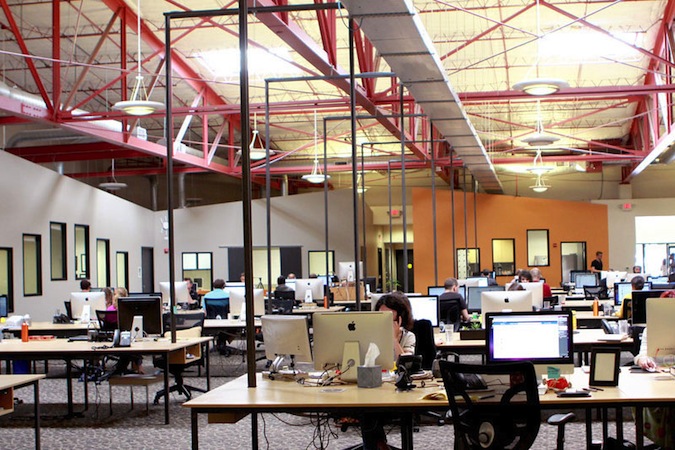
In 2011, Software Advice expanded rapidly, and we found ourselves outgrowing our office. As we started looking for a larger space, one of our top priorities was to create a collaborative and creative environment for our employees. We didn’t want to just stick people in cubicles.
Unfortunately, most of the office spaces we found were bland and compartmentalized. For example, traditional office layouts require you to reserve a conference room in order to collaborate with your colleagues. So we decided to think outside the cube: instead of simply moving into an office building, we took a former concert venue–the Austin Opry House–and turned it into a wide-open workspace (pictured above).
One of the crucial components of our office is our custom, “farm table” workstations. These multi-person desks, modeled after French farm tables, allow team members to communicate easily, yet they are big enough to give everyone their personal space. In the spirit of collaboration, I decided to “open-source” the plans for these workstations, and share some of the lessons we learned while creating our open office space.
This year, we’ve seen Mutual Aid in Motion.
From scaling sharing hubs to Mutual Aid 101 trainings, we’re helping communities build the tools they need.
Every dollar fuels lasting resilience – proving that when we move together, we all move forward.

Key considerations for an open office
When building our open office, there were a few important factors we needed to consider:
Collaboration. Again, one of our top considerations was fostering collaboration among team members. We seat four team members at every 5’x8’ workstation so that everyone has enough room for personal space, but they can still communicate easily with the group. There are no cubicle walls preventing employees from freely exchanging ideas or asking each other questions. This fosters teamwork and creativity and keeps projects constantly moving forward.
Momentum. Momentum is critical to success. Since we have an open floor plan, the dull roar of our sales team serves as motivational background noise for the rest of the company. We all feed off of their energy, as every call they make is a tangible opportunity for revenue. It reminds us that we must constantly move forward: if a revenue opportunity is lost, we dust ourselves off and go on to the next. As a small business, lost opportunities have a greater impact for us than they do for larger corporations.
Budget. Operating within budget is also crucial for small businesses. We worked with Wendy Dunnam Tita, an architect at Dunnam Tita Architecture + Interiors, to create workstations that would provide the functionality we needed without breaking the bank on materials. For example, using medium density fiberboard (MDF) instead of wood to construct the tables gave us more bang for our buck. Using these tables in an open floor plan also allows for easy scalability. We can have the tables built on an as-needed basis when our company adds new team members.
Community. Some companies embrace a traditional corporate hierarchy, where the higher-ups are separated from their subordinates. Instead, we encourage a sense of community, where everyone can contribute equally to the success of the business, and our open office has helped us maintain this element of our company culture. Team leaders sit side-by-side with team members at their workstations, instead of locking themselves away in a corner office. This also makes our employees feel more comfortable approaching their managers for help or sharing suggestions for improvement.
Potential problem areas
Of course there were some potential challenges we had to consider when building our open office. A few of these included:
Noise. When everyone shares the same space, noise can be an obvious concern. Since our sales department is on the phone most of the day, we were worried their conversations might be distracting for other departments. So we made sure to find a space with high ceilings to dampen the noise traveling across the room. We also provide our employees with fancy headphones and noise-canceling microphones to mitigate any background noise issues that might interfere with their work. And, of course, if you’re worried about too much noise, make sure you’re not packing too many people into your office space. Allow enough room between teams and people that they can still hear themselves think.
Food. Smelly food wasn’t a problem we’d even considered in our previous office. But in our new, open space, we quickly learned that if one person brings in greasy or strong-smelling food, the whole office will soon be enjoying it (or not!). So, out of common courtesy, we created the “no stinky food” rule: if you have to eat something smelly, take it outside. We also have a fast-food ban.
Messy desks. An open office layout keeps employees accountable for maintaining clean desks. They can’t hide towering paperwork or a mountain of empty Starbucks cups behind cubicle walls. Sharing space also keeps the number of desktop items each person can have limited to the necessities. We’ve tried our best to be a paperless office, too, which helps cut down on clutter.
Personal space. Privacy is an obvious concern when it comes to open space. I didn’t want employees to feel like they were always being watched. We give each team member eight feet of room at their desk to make sure they still have some personal space, and we also stagger the computer monitors so they’re not looking right at the person across from them.
Find what fits your culture
While there are many benefits to an open floor plan, it isn’t a good fit for every company. If you manage a law practice or financial consulting firm, for example, an open office probably isn’t a good place to deal with confidential client information. But we’re not lawyers or accountants, and an open office floor plan aligns perfectly with our culture of transparency, collaboration and creativity.
If you run a small business driven by teamwork, community, and momentum, you too might benefit from an open office layout.
