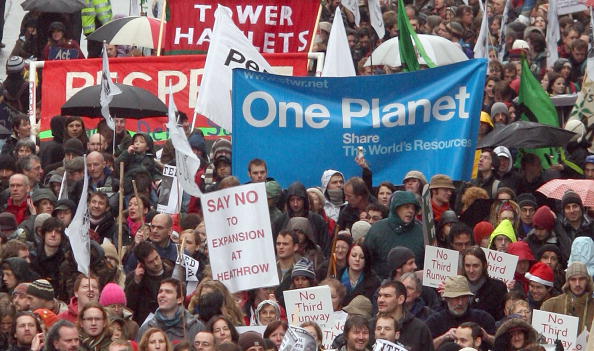
We are all painfully familiar with the plethora of statistics that illustrate how unsustainable modern lifestyles have become and how humanity is already consuming natural resources far faster than the planet can produce or renew them. In a bid to reverse these trends, increasing numbers of people are attempting to consume less, reduce waste and recycle more regularly. The rapid growth of the sharing economy over recent years reflects this growing environmental awareness and commitment to changing unsustainable patterns of consumption. The possibilities for sharing are already endless in many parts of the world, in everything from cars and drills to skills and knowledge. The sharing economy is undeniably taking off - and rightly so.
But can sharing the things we own as individuals really address the environmental threats facing Planet Earth? To some extent the answer is likely to depend on which resources are being shared and how many people are sharing them. However, given the urgent sustainability challenges we face – from climate change to deforestation and resource depletion - it seems unlikely that even well-developed systems of collaborative consumption will, on their own, constitute a sufficient response.
Share, Unite, Cooperate from Share The World's Resources on Vimeo.
While the sharing economy is an extremely exciting and important development in consumer behaviour, it has done little as yet to change the politics, structures and institutions that underpin and promote unsustainable lifestyles. Creating a truly sustainable world will ultimately require policymakers to enact much more radical reforms to the way we manage the world’s resources and organise economic systems. As many people involved in promoting the sharing economy recognise, it is becoming increasingly important to also support these wider goals for economic reform and world rehabilitation.
Transcending self-interest
The pivotal events of 2011 demonstrated that there are already many millions of people in diverse countries advocating for transformative systemic reforms, from the Occupy movement to the Arab Spring. These movements, alongside many other civil society groups and engaged citizens, recognise that it will be impossible to create a fairer and more sustainable future world unless we reform the policies that underpin and maintain the status quo. For those championing the sharing economy who hold a similar view, it is worth reflecting on some interesting research from the field of social psychology that could have a bearing on how the sharing economy should be promoted as an emerging trend.
Research eloquently expressed by Common Cause highlights the need for campaigners to promote those values that are more likely to create the end results they desire. In this light, there is currently some debate around how much emphasis should be placed on the financial benefits of sharing. There is little doubt that sharing does save money and the financial advantages can be an important factor in a person’s decision to share. But according to numerous studies, promoting ‘intrinsic’ values that go beyond concerns about oneself are, in the long run, far more likely to encourage sustainable lifestyles than a focus on ‘extrinsic’ values such as personal financial gain.
In other words, the evidence suggests that those who share because they are told it will save them money are less likely to engage in other environmentally beneficial activities, compared to those who are encouraged to share out of purely environmental or social concern. Moreover, by emphasising these intrinsic values in campaign messages, the evidence clearly demonstrates that similar values will naturally be stimulated. For example, encouraging awareness of broader environmental issues is more likely to stimulate concern for social justice, and vice versa.
The implications of such findings are clear: if those promoting the sharing economy agree on the need for a shift in public awareness that can effect real change in society, we need to emphasise the wider environmental and social benefits of sharing and not the purely personal benefits, such as financial savings. Stimulating values that go beyond self-interest in this way is far more likely to encourage social and environmental activism of the kind sorely needed today. Without much more effective public engagement in the politics that maintain unsustainable lifestyles, it will be impossible to address the long term solutions to inequality and climate change.
Putting intrinsic values first
The sharing economy is still very much in its infancy and, given the variety of stakeholders involved, its emergence as a force for good is being discussed from a wide variety of different perspectives. On the one hand, there are those who see the sharing economy as a tool for addressing pressing social justice or environmental issues - such as people establishing time banks, food sharing schemes or those pursing alternative, low carbon lifestyles. At the other end of the spectrum, there are many entrepreneurs who stand to make millions of dollars from their new sharing platforms, mainly by encouraging people to rent out the underutilised goods they own.
Could grouping these quite diverse activities together under the umbrella of the sharing economy be in any way problematic? One danger is that by attaching too much emphasis on self-interest and personal gain in relation to the concept of sharing, the altruistic aspects of sharing could be undermined and the more benevolent motivations of those who share could be increasingly ignored.
A recent article in Forbes Magazine perfectly illustrates how this is already happening in the mainstream media. The article focussed almost entirely on the significant financial potential of the sharing economy and barely mentioned the more ‘intrinsic’ values involved in its pursuit. The article serves as an important example of how those who reinforce extrinsic values in society (such as wealth generation) have the power to overwhelm the voices of those who pursue forms of sharing for more altruistic reasons, such as social justice or environmental protection.
Many proponents of the sharing economy would perhaps diplomatically argue that there is room for both perspectives and that most people are motivated by a combination of financial and social/environmental concerns. While this is certainly true in many cases, it is also worth bearing in mind that humanity currently faces what can only be described as a global emergency. There can be nothing more urgent today than reducing inequality or preventing runaway climate change, and the real solutions to these problems have little to do with wealth generation.
At this crucial juncture in the evolution of the sharing economy, it behoves us to think very carefully about how and why we pursue and promote sharing in society – both in our campaigning activities and in our engagement with the mainstream media. Given the urgency of the many crises we face, it is essential that social and environmental concerns remain at the forefront of the public discourse about sharing and the sharing economy.
Rate this article
Comments
Great post Rajesh,
It I totally agree that we need to put intrinsic values first. It's those types of motivations that all people can relate to. Not all wish to chase extrinsic incentives like those stuck in a money-minded mentality do. But everyone can relate to and align with a common set of intrinsic values, that, if honoured, could improve the quality of life for millions, if not billions around the world.
Thanks for sharing your insightful perspective :)
Thanks for this important post, Rajesh.
In addition to being an keen advocate of the 'share economy'/collaborative consumption - and someone who recognises the value of both the share/swap/gift economy (particularly as it relates to building social connections) and the 'leverage your un(der)used assets for cash' - I also write a blog on sustainability communications to help people become more effective communicators (www.cruxcatalyst.com), so this sits right at the nexus of two of my main areas of interest.
Firstly concerning values - there is an intriguing (sometimes fierce) debate going on between the proponents of the Common Cause approach, and the proponents of Values Modes (see http://cultdyn.co.uk/).
In my heart, I believe that the only way we are ultimately going to prevent ourselves from bringing about our own demise as a species is for values to shift to the intrinsic ones Common Cause is talking about.
However this is where the approach diverges - as I understand it, Common Cause is concerned that appealing to extrinsic values may reinforce the value rather than shift it.
Conversely, Values Modes believes that the shift is a progression, and you have to enter the conversation through the door people have open to get them engaged.
It's interesting to note the results of recent research undertaken using the Values Modes approach:
http://threeworlds.campaignstrategy.org/?p=186
'This blog shares the results of values surveys run in five countries in 2012. Each was conducted by asking over 2000 people a set of questions used by CDSM, which can generate the values segmentation. Apart from the UK, the surveys were all commissioned by Greenpeace.'
The research shows that approx 70% of both (urban) Chinese and Indians are 'Prospector' (outer-directed). Many people in these countries are just getting their first taste of consumer lifestyles and all the trappings that the West has been indulging in. I wonder would North America, Europe etc have been open to current 'sharing' ideas in the 1950s-80s?
The report states: 'The implications for campaigners are clear: to engage wide support in those societies, the default communication needs to be Prospector-friendly, and any social issue which results in a values clash where Prospector aspirations are threatened, is likely to be very problematic.'
So - do we endeavour to start where people are, and risk possibly entrenching the value we are trying to shift? Or do we attempt to communicate 'Pioneer' values to those in 'Prospector' mode, risk pushback, and hope that this creates a shift to intrinsic values by 2 billion people - in time?
As for the grouping of activities, although there are some that don't involve personal financial interest (read: exchange/making of money), and some that do, I think it is absolutely legitimate to include them all under this umbrella. Car-sharing schemes involve an exchange of cash, but if it results in less people needing to buy a car, it has the same result as many of the no-cash platforms - people don't need to spend unnecessarily, and don't accumulate stuff they don't need. Conversely, even with no exchange of money, there is still an element of self-interest in food swaps - getting something you need in exchange for something you don't.
The 'personal gain' and 'self interest' side of the sharing economy is not mutually exclusive from broader environmental/social justice issues. Aside from Airbnb and a few others, there aren't fortunes being made in developing sharing platforms (and if people do come into great financial benefit for making life easier, cheaper and more environmentally responsible, then good, they deserve it!), and the people I know who are creating these absolutely do have a social and environmental ethos driving them.
The stories coming out of the US, where people who've been made redundant through the circus that is the existing economic modus operandi and are now able to generate an income from whatever via these platforms, are just as much part of the social justice story. I think Airbnb bringing in tourism dollars to areas that aren't 'tourist' is social justice. The whole disruption of a broken political economy by collcons is social justice!
All of them in some way help people save money and/or supplement and earn income; all have the potential to create new social connections; and all contribute to less demand for resources and associated carbon emissions.
Many thanks for your insightful thoughts and the link you included Sharon. The question you raise about whether campaigners meet people ‘where they are’ or push for ‘pioneer values’ strikes me as a key point. When it comes to most campaign initiatives, I can see how meeting people where they are is an effective strategy for delivering campaign results.
But perhaps there is a slight difference when talking about advocating for systemic change on a global scale. As we all know, a campaign for global reform is not an easy one to get off the ground (let alone win) – especially in a world where so many people remain oblivious to the need for transformational change and are encouraged instead to aspire to owning and consuming more material goods.
While collaborative consumption is an important part of the solution, it cannot create the changes needed on its own. Since rich countries disproportionately consume the world’s resources, collaborative consumption within these countries can only be of real value if the international community first establish new systems to regulate resource use globally. Global limits on resource use are inevitable if we are to create a sustainable world, and this will require a massive shift in awareness, human behaviour and business models.
To make this shift happen, it might be important at this stage to focus on education and communicating right social and environmental values rather than pursuing quick campaign wins. I agree that there is a values clash in this approach with so-called ‘prospectors’, but I am not sure that this can be avoided at a time when a transformation in values and understanding is urgently needed. Maybe we should challenge the values of prospectors even more directly (if not the very fact that we live in a society that creates prospectors), rather than pandering to their motives.
The other issue raised is around the use and misuse of the word sharing. I find it hard to condone labelling renting and selling goods, services or skills as ‘sharing’ even when this happens on a peer-to-peer basis unless they are primarily geared towards providing substantial social or environmental benefits. Are eBay and Amazon marketplace sharing platforms? Are those who sell their creations at local markets part of the sharing economy? And what about other rental companies that have long been around – have they been sharing too? Moreover, are the business models employed by companies operating within the sharing economy really commensurate with the principle of sharing, or do they undermine it?
At the very least, businesses that consider themselves part of the sharing economy should be organised on a not-for-profit or social enterprise basis where there are clearly defined social or environmental objectives into which any profit is re-invested.
Sharing is far more than new forms of commerce facilitated by the internet; it is fundamentally part of the human condition and is perhaps far more closely related to the act of giving. That’s not to denigrate businesses operating within the sharing economy which are all very worthwhile, but to realise that if expressed in the right way, sharing has the potential to end needless deprivation, prevent climate change and reduce conflict over the world's dwindling resources. And this means fundamentally rethinking the values, politics and business practices that currently underpin society.
I recall how the phrase ‘green’ has been co-opted by those with an interest in maintaining business as usual, and suggest that the time is fast approaching where we need to be vigilant about what we label as sharing and why.
Rajesh Makwana
Director
Share The World's Resources
P.O. 52662
London
United Kingdom
N7 8UX
P: +44 (0) 20 7609 3034
E: rajesh[at]stwr.org
W: www.stwr.org
Rajesh,
Thanks so much for your considered reply and thoughts - this is such an important discussion (this thread could be a blog post in and of itself!). It's one that I am grappling with right now in my work re: defining criteria for what should be included on a 'sharing asset map', with the intent of showing people what can be accessed in their community without needing money, like food swaps; and contributing to reduction of resource use and waste.
For example, we've debated whether or not to include second hand clothing shops as well as clothing exchanges - after all, second hand shops *are* a redistribution market (one of the collaborative consumption typologies), but not P2P. Does e-bay count, and if it does, what about every other classified ad site? We've decided no to all of these except the free clothing swap events organised by and for citizens, because even though the others redistribute and extend the useful life of material things and lessen pressure to some extent up supply chains, it's not 'sharing' in the same way swapping clothes and giving excess produce is.
Do we include toy lending libraries which help 'share' the useful life of a toy across many families, even if they are run by volunteers but charge a small membership fee to cover costs because they are not run by local government? If we include hackerspaces and community gardens as 'shared spaces', what about every other shared space, community centre, etc? Should they be included? Once you actually get down to the practicalities, it's tricky - are your goals less resource use/waste? Access to what is free/shared? They seem aligned but they do not always overlap, and its muddy territory for me right now.
From a 'zero waste' point of view of resource efficiency, any kind of sharing is good, be it for profit or not - and where this results in a reduction in the ecological footprint of consumption, it is likely to reduce stressors on habitat and resources everywhere. I see the monetised kinds of sharing as leveraging idle/underused (ie. wasted) assets. I strongly feel that one of the best ways we can begin tackle the consumption footprint, and the disproportionate demand for the world's resources by consumer societies, is by encouraging people to better use what we already have. If people are accessing, rather than owning, that shows there may be a willingness to shift away from the need to own and live materially intensive lives, which in itself represents a marked shift in values that have prevailed for at least the last half-century. It also can help set a precedent for aspirations which are emulated.
Mille Rooney's recent post on Shareable made an interesting point that non-monetised sharing can also be self-interest as much as altruistic - the rewards are just not always financial (http://www.shareable.net/blog/why-is-it-harder-to-ask-than-to-give).
I feel some kind of taxonomy would be useful, and I think both yourself and Sven (in his Shareable post http://www.shareable.net/blog/sharing-for-profit-im-not-buying-it-anymore) also make a critical point on the co-option of the concept and language, although I'm not sure how it can be saved from the same fate as 'green' and 'sustainability'.
I *also* agree that collaborative consumption/sharing on its own is not going to shift the cultural DNA, change the 'operating system' designed in such a way that it has resulted in the social and environmental tragedy of varying degrees of poverty, and that we need to challenge a society that 'manufactures' prospectors. I've been mulling over the pros and cons and public debate between Values Modes and Common Cause, and investigating Gravesian theory that informed Spiral Dynamics (which I am still trying to get my head around) - what can it teach us about how to successfully challenge 'orange' worldview values in people who may have just entered that state?
By all means, we should give transforming values our very best efforts. I think there is also room for efforts to secure a shift in outcomes, regardless of values or reasons, and I say that because I am worried we will not have the time to effect transformation of billions of people who've just had their first taste of consumer culture to the 'right' values. If a critical mass of Americans or half a billion Chinese decide car-sharing is preferable to ownership, it might or might not open the door to initiate some kind of changes that affect system levels. But it would certainly give us some breathing room. I think the question of whether sharing involving monetary exchange erodes or builds community (as Charles Eisenstein puts it, community is woven from gifts, and monetary exchange 'breaks' this), encourages a wider empathic worldview and develops the conditions for that global systemic change among diverse groups is a worthy question - not sure if that's been done, or is being researched, or if its even too early to gather evidence.
I'd support your point about the ethos and business model of 'sharing' as a not for profit model (deep blue sharing?!) - you may be aware this approach is a key project of the Post Growth Institute, which I co-founded http://postgrowth.org/learn/how-on-earth.
Wow, Shareable is giving my brain a real workout lately, which is great! Thanks to Shareable and people like yourself and Sven for raising these issues. I appreciate the opportunity to work through this stuff as I grapple with it, and discuss it with likeminded people who all have common concerns for people and planet.
Sharon Ede
Co-Founder, Post Growth Institute http://postgrowth.org
Founder, Cruxcatalyst http://www.cruxcatalyst.com
Founder, Shareability SA http://www.facebook.com/shareabilitysa
Great points Rajesh and Sharon.
Sharon, your description of the decisions you were making about which assets to map is illuminating. I think you're right that the decision of what to include depends on the goals. So if the goal is primarily less resource use, then it makes sense to use a broader lens than if the goal is primarily creating a more equitable, democratic, cooperative world. As I think I've said before in the comments, Shareable has tended to lead with a broader lens because there is a benefit to opening people's eyes to the many ways that we share. But there can also be a need to think and talk about these questions more critically, as all of the people on these recent threads and articles have been doing. And I tip my hat to those of you who are struggling with these questions and figuring out the answers through real-world practice.
Related Articles
- A Case of Global Coworking Serendipity
- Rural Coops Show the Way to Urban Job Growth
- Can Trust Systems Build a New Economy From Ruin?
- For All We'll Ever Need: A Family's Transformation
- Fear and Loathing in the Coworking Space
- What if Lena Dunham Coworked?
- A Coworkers Guide to Slaying Procrastination
- Making MacGyver Proud: Rapid Ingenuity to the Rescue
- My Year of Coworking
- Is Social Entrepreneurship the Rich Saving the Poor?
Community Blog Posts
-
By Drew Little
-
By Tim West
-
By Liz Elam
Recent comments
-
6 hours 28 min ago
-
20 hours 15 min ago
-
1 day 11 hours ago
-
1 day 22 hours ago
-
2 days 21 hours ago


"the evidence suggests that those who share because they are told it will save them money are less likely to engage in other environmentally beneficial activities [or social justice activities], compared to those who are encouraged to share out of purely environmental or social concern"
This is a critically important point, Rajesh. As you discuss, how we talk about sharing and its benefits can help determine how successful we are in realizing a better world -- for starters, a resilient world with more equality, and free of the worst-case climate change scenarios.
"Many proponents of the sharing economy would perhaps diplomatically argue that there is room for both perspectives and that most people are motivated by a combination of financial and social/environmental concerns."
I'm curious to see what other sharing advocates think about this. Perhaps people will chime in in the comments.