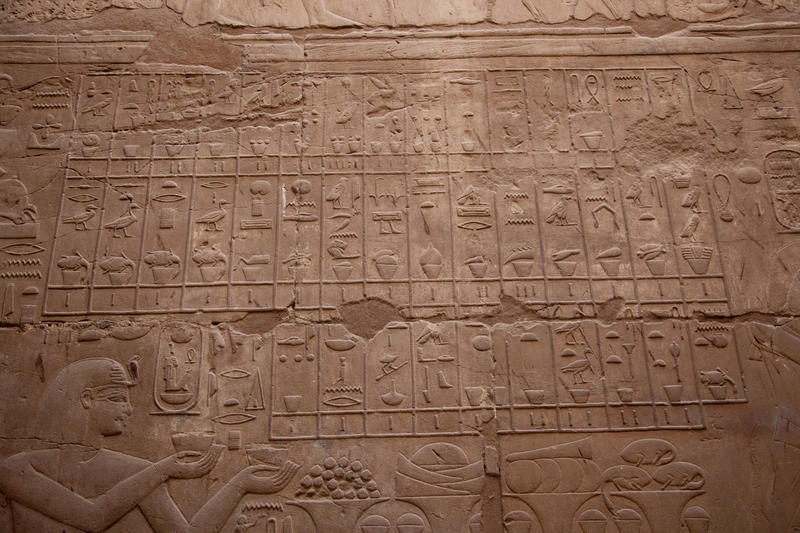
An ancient Egyptian calendar in Luxor, Egypt. The Egyptians were the first to create a twenty-four hour day. Credit: Peter van den Hamer.
As the holidays and year comes to a close, I find myself asking again a long asked question. What kind of holidays should be celebrated by a citizen, sharer, and commons advocate?
The need for an answer seems more urgent that ever for what we have is partly rotten and personally speaking, I need something different. As it is, many holidays have been hopelessly co-opted by corporations or they're no longer appropriate for public observance in a pluralistic global society. I've long restrained my participation in certain holidays, but abstaining is no longer enough. I seek a world that the makes sense to me, a complete world. One I belong in. This includes a calendar that celebrates the most important things to me and millions of others - democracy and the commons; the institutions that help individuals and communities provision themselves, get along across differences of all kinds, and strive for self-determination.
It's time to occupy the calendar. It's time to celebrate all that we share, our commonality and our commons.
I have a proposal at the end of this post to do just that, but let's reflect for a moment on the value of redefining the calendar through the lens of the commons and global civil society. Occupy and its inspirations redefined geographic space and social relations through reclaiming public space and consensus decision making. It reminded us that space and the political process should be for all people, not just the monied few.
This has had an enormous impact on political dialog across the globe. Occupy has served as a credible rejection of the current order. There's now broad public recognition that social contract is broken and something entirely new is needed.
If something entirely new is needed, then it follows that a new calendar is needed. To observe old holidays or observe them in debased ways supports that which oppresses and drains energy needed for change. And if occupying physical space and redefining social relations on a peer basis has had such a profound impact, imagine the power of occupying time.
Also, consider that calendars reinforce a social order. Take for example the Catholic calendar. You can celebrate 22 of 31 days in December alone. In fact, a large majority of calendar days are significant for one reason or another. Among these are feast days for saints. And since there are over 10,000 saints, each feast day commemorates multiple saints. Each saint represents a unique facet of the Catholic experience. Through feast days and other commemorations, which occupy almost the entire calendar, a complete world is signified.
Another powerful example is the industrial-era imposition of railway time and how that changed the way people experienced everyday life. The coordination of railway service depended on standardizing time across geographies. Railway service and standard time were essential to creating national and international market economies.
So, if we're to create a new civilization that works for everybody, then we need a calendar that speaks to the experience of making that world real on a weekly if not daily basis.
That said, I know only a few days to celebrate the commons and global civil society. While I want a new calendar, my existing ideas still reflect a religious, patriotic, and consumerist worldview that I've left or I'm leaving behind. So if you share even a tiny bit of what I'm feeling, please share in comments ideas for days to celebrate citizenship, the commons, and sharing.
Note that I don't see these days replacing existing holidays, even if that was possible. Rather a calendar of the commons can run parallel offering new celebratory options for those that want to strengthen the commons.
Below are some ideas to get us started. Things to celebrate might include birthdays of significant commons advocates, types of commons, or social innovations that help us share like families or cooperatives. Or add to potential holidays "this day in sharing history" ideas. All ideas are welcome. If we get enough responses, Shareable's editors will begin mentioning significant days in our weekly "This Week in Sharing" posts.
Suggestions for a Calendar of the Commons:
- July, each first Saturday - International Day of Cooperatives
- September 15th - International Day of Democracy
- September 17th - Constitution and Citizenship Day (U.S.)
- October 29th, the first link on ARPANET was establish on this day in 1969, perhaps the birthday of the Internet.
- December 21 - the opening of the first modern consumer cooperative by the Rochdale Society of Equitable Pioneers in England.
- Election days should be holidays so market activities do not interfere with voting. Election Day is already a civic holiday in Guyana, some US states, and probably other places too.
- Need a day to celebrate the Free and Open Source Software movement. Any suggestions?
UPDATE March 5, 2012: Just heard from Nancy Roof of Kosmos Journal. The UN apparently has an extensive calendar celebrating days, weeks, and years with issues that are important to their work. Here's a list of days:
January
27 International Day of Commemoration in memory of the victims of the Holocaust <http://www.un.org/holocaustremembrance/>
February
20 World Day of Social Justice <http://un.org/esa/socdev/social/intldays/IntlJustice/> (as of 2009)
21 International Mother Language Day <http://www.un.org/Depts/dhl/language/index.html>
March
8 International Women's Day <http://www.unac.org/en/news_events/un_days/women1.asp> and
United Nations Day for Women's Rights and International Peace
21 International Day for the Elimination of Racial Discrimination <http://www.un.org/depts/dhl/racial/>
21-28 Week of Solidarity with the Peoples Struggling against Racism and Racial Discrimination
22 World Water Day <http://www.unesco.org/water/water_celebrations/>
23 World Meteorological Day <http://www.wmo.int/wmd/>
April
4 International Day for Mine Awareness and Assistance in Mine Action
7 World Health Day <http://www.who.int/world-health-day/>
23 World Book and Copyright Day <http://www.un.org/Depts/dhl/book/index.html>
May
3 World Press Freedom Day <http://www.unac.org/en/news_events/un_days/press.asp>
15 International Day of Families <http://www.un.org/esa/socdev/family/>
17 World Information Society Day <http://www.un.org/events/infoday/2006/> (formerly World Telecommunication Day)
21 World Day for Cultural Diversity for Dialogue and Development <http://www.un.org/depts/dhl/cultural_diversity/>
22 International Day for Biological Diversity <http://www.biodiv.org/programmes/outreach/awareness/biodiv-day-2005.asp> (formerly December 29, changed in 2001)
25-June 1 Week of Solidarity with the Peoples of Non-Self-Governing Territories
29 International Day of United Nations Peacekeepers <http://www.un.org/events/peacekeepers/>
31 World No-Tobacco Day <http://www.who.int/tobacco/communications/events/wntd/2005/en/>
June
4 International Day of Innocent Children Victims of Aggression
5 World Environment Day <http://www.unep.org/wed>
17 World Day to Combat Desertification and Drought <http://www.unccd.int/publicinfo/menu.php>
20 World Refugee Day <http://www.un.org/depts/dhl/refugee/index.html>
23 United Nations Public Service Day <http://www.unpan.org/dpepa_psaward.asp>
26 International Day Against Drug Abuse and Illicit Trafficking <http://www.un.org/depts/dhl/drug/index.html> and
International Day in Support of Victims of Torture
July
First Saturday International Day of Cooperatives <http://www.un.org/esa/socdev/social/intldays/IntlCoops/>
11 World Population Day <http://www.unfpa.org/wpd/>
August
9 International Day of the World's Indigenous People <http://www.un.org/events/indigenous/>
12 International Youth Day <http://www.un.org/esa/socdev/unyin/iyouthday.htm>
23 International Day for the Remembrance of the Slave Trade and its Abolition
September
8 International Literacy Day <http://www.un.org/Depts/dhl/literacy/index.html>
15 International Day of Democracy
16 International Day for the Preservation of the Ozone Layer <http://www.uneptie.org/ozonaction/events/ozoneday/main.html>
21 International Day of Peace <http://www.un.org/events/peaceday/2005/> (formerly the opening day of the UN General Assembly, changed to a set date as of 2002)
During last Week World Maritime Day <http://www.imo.org/About/mainframe.asp?topic_id=320>
October
1 International Day for Older Persons <http://www.un.org/depts/dhl/olderpersons/index.html>
4 - 10 World Space Week <http://www.oosa.unvienna.org/wsw/>
5 World Teacher's Day
First Monday World Habitat Day <http://www.unchs.org/whd/2005/default.asp>
Second Wednesday International Day for Natural Disaster Reduction
9 World Post Day <http://www.upu.int/world_post_day/en/index.shtml>
10 World Mental Health Day <http://www.wfmh.org/wmhday/about.html>
16 World Food Day <http://www.fao.org/wfd/index_en.asp>
17 International Day for the Eradication of Proverty
24 United Nations Day <http://www.unac.org/en/news_events/un_days/un_day1.asp> and
World Development Information Day
24-30
Disarmament Week
November
6 International Day for Preventing the Exploitation of the Environment in War and Armed Conflict <http://www.un.org/depts/dhl/environment_war/index.html>
14 World Diabetes Day <http://www.who.int/mediacentre/events/2006/world_diabetes_day/en/>
16 International Day of Tolerance <http://www.un.org/depts/dhl/tolerance/index.html>
Third Sunday World Day of Remembrance for Road Traffic Victims
20 Universal Children's Day <http://www.unac.org/en/news_events/un_days/children1.asp> , and
Africa Industrialization Day
21 World Television Day
25 International Day for the Elimination of Violence against Women <http://www.unifem.org/campaigns/november25/>
29 International Day of Solidarity with the Palestinian People <http://www.un.org/depts/dhl/palestinian/index.html>
December
1 World AIDS Day <http://www.unac.org/en/news_events/un_days/aids1.asp>
2 International Day for the Abolition of Slavery <http://www.un.org/depts/dhl/slavery/index.html>
3 International Day of Disabled Persons <http://www.un.org/esa/socdev/enable/>
5 International Volunteer Day for Economic and Social Development <http://www.unv.org/infobase/facts/04_08_17DEU_fs_IVD.htm>
7 International Civil Aviation Day <http://www.icao.int/icao/en/aviation_day.htm>
9 International Anti-Corruption Day <http://www.un.org/depts/dhl/events/anti_corruption/index.html>
10 Human Rights Day <http://www.un.org/events/humanrights/>
11 International Mountain Day <http://www.mountainpartnership.org/imd/imd.html>
18 International Migrants Day <http://www.un.org/depts/dhl/events/migrants/>
19 United Nations Day for South-South Cooperation <http://www.un.org/depts/dhl/events/south/index.html>
20 International Human Solidarity Day
Rate this article
Comments
Hi Neal,
We're excited about the 2nd annual Free Money Day in 2012 (15th September). More at: http://freemoneyday.org.
Donnie
I'd suggest the equinoxes.
The equinoxes are of course already celebrated in various cultures, but I think they're especially appropriate for this context. At the equinoxes, all people around the world experience 12 hours of day and 12 hours of night (technically with the exception of somebody spending the equinox at the North or South Pole - they will see the sun traveling around the horizon for 24 hours, i.e., they'll see half the sun all the time). This can remind us that, despite all of our differences, there are things we all have in common. We all experience our ups and downs, we all die one day, we all walk this Earth and breathe air of the same atmosphere, we are all totally dependent on this planet and on the sun (even if we make believe we're not), we all need food and love and water and trust and a sense of belonging and shelter and care.
Wolfgang
Some responses from Facebook:
Anthony Lawlor: Celebrate solstices & equinoxes, sunrises & sunsets, new moons & full moons, planting & harvesting, migrations, threshold crossings, births & deaths...
Hildy Gottlieb: ...imagine the results of just one mindful moment per day to consider democracy, cooperation, diversity, citizenship, what it means to live truly open source... (vs. the soon-to-be-forgotten meaning in an artificially set-aside day of celebration).
David Hodgson: lunar and solar calendars..
Bert-Ola Bergstrand: At this stage I know of two dates 16-22 of january, Jelly Week and 9-12 of november Social Capital World Forum. 100 percent celebrations of the commons!
Hi Neil,
great idea, we need to celebrate *our* culture, not theirs!
what about Software Freedom Day? I think it is every 2nd or 3rd Saturday in September. http://softwarefreedomday.org/
Then there is also the Document Freedom Day, coming March 28th 2012. http://documentfreedom.org/
cheers,
Wouter
more suggestions from David Bollier, author of Viral Spiral and one of the most articulate commons advocates around:
A great idea. I have two dates to nominate -- One Web Day, September 22 every year (www.onewebday.org) , and Public Domain Day, January 1 (http://www.law.duke.edu/cspd/publicdomainday/2012/pre-1976). I'm sure I could come up with other suitable dates if I gave it some thought and research:
The dates that....
--the CC licenses were first released.
--Teddy Roosevelt created the national parks system.
--the Charter of the Forests was signed by King John (see Peter Linebaugh history).
--genes and living organisms could first be patented (the Chakrabarty decision in 1980 or 1981).
--Social Security was enacted.
--Aldo Leopold wrote "Sand County Almanac" and Rachel Carson wrote "Silent Spring"
--Elinor Ostrom won the Nobel Prize in Economics
I fully agree that a "reoccupation" of our relationship with time is fundamentally needed. I think this needs to extend beyond annual holidays that are nationally celebrated to a RELOCALIZATION of time.
Inspired by a friend who spent years living in the Czech Republic, where the month names actually still mean something (for example, one of them is called "Animals in Heat," 'cuz that's what happens at that time of year), i have evolved localized names for the months in the place where i live, and i encourage others to do this as well. I live in Eugene, Oregon, which is in the Cascadia bioregion. The 5th month is called Rhododendrons, the 8th month is Blackberries, and the 6th month is Anishnalya, which was the Kalapuya (First Nations) name for it and means "when the camas ripens." The Czechs have a month called Icy; it doesn't get Icy here, instead we have months called Foggy and Rains Return.
While you are in the process of collecting those national dates, however, please don't forget International Women's Day on March 8. Completely ignored in the US even though it originally started here, people in many other countries actually pay significant attention to it.
Cheers,
--Tree
Really great idea beautifully expressed Tree, thank you! Would you like to turn this into an article for Shareable? I think you have the gist here, so it would be fairly easy. It might take another hour.
Hi Neal,
I would love to, and realistically, i have enough other commitments right now that i don't know when i'd get to it . . . along with all the other topics i might happily write on for Shareable: the newly available card deck Group Works: A Pattern Language for Bringing Life to Meetings and Other Gatherings (http://groupworksdeck.org), now available for free download and sale; running my facilitation practice on a gift economy basis (see http://treegroup.info/services/D5-gifting.html); and so on. Let's stay in touch?
Cheers,
--Tree
Hi Tree, great story ideas, yes, let's stay in touch. You have a lot helpful knowledge to share. Look forward to that whenever it emerges for you, Neal
Great thoughts, Neal. I have found myself in a different but not altogether dissimilar situation. Recognizing that the standard calendar of the United States with government and corporate holidays didn't really work for me, I have been rediscovering the history of church calendars. While this solution will obviously not be particularly attractive to people who are not Christians, I have found the thoughtful re-appropriation of time to be both beneficial and helpful in meaningfully orienting my life. For instance, on church calendars the new year does not begin on January 1 but on the first Sunday of Advent, which means that for Christians the year is not treated as a discrete taxable unit but as a cycle that begins every year remembering that Jesus was born in the equivalent of a motel parking garage.
If my experience means anything, I second your opinion and encourage you and others to push on in occupying your calendars. I am all for an Open Source Day and really appreciate Tree's relocalization suggestion
Hi Sam, really appreciate your perspective, as always. And in fact, it was church calendars that inspired this post. I found it fascinating how churches in the middle ages (red letter days and such) ordered time with almost every day have some sort of religious significance. That touched me, the idea of infusing meaning into every day and ordering the year.
With technologies like Google calendars you can create multiple calendars so it's possible to create separate calendars for say the commons, celestial events, localized time, and also your religion. You could toggle between them or view them all at once too.
Thanks, Neal.
It's funny you mention that. My particular Christian tradition doesn't actually have a church calendar of its own and I have been working on an ongoing project to put together a relevant calendar based on other traditions as well as with new days (and new saints) that are particularly relevant to us.
You can check out the Google Calendar I've crafted so far here if you are interested: https://vineyardprayer.wordpress.com/church-calendar/
Yeah, I was looking at the Catholic calendar and European medieval calendars. Cool project. It's getting really rich, lots of entries. I'm thinking of doing the same for the calendar of the commons.
If you are still wanting it set up as a Google Calendar in May and don't have it started, let me know. I'll have free time around then and would be happy to transfer the dates over.
If we're talking about different religious traditions, then we should also recognize that different traditions start their calendars in different years. The hypothesized year of Jesus' birth is not of particular relevance to non-Christians. So we could discuss what starting year for the calendar might be of more world-wide significance. Maybe something like the beginnings of agriculture, though that is extremely fuzzy (what counts as agriculture, and how precisely can we date any specific artifacts from early agriculture?). Or maybe some astronomical events, such as the one that serves as the basis for the ancient Mayan calendar (which is ending one cycle and beginning a new one this year).
Wolfgang
A theme that keeps popping up for me as I explore sharing is the idea of plurality - a plurality of economic modes, religions, cultures, ways of doing things, etc. And how beneficial that can be.
Technology can help us manage this complexity. For instance, in the Google calendar example where you could keep numerous calendars at the same time, and for religions, celestial movement, civic stuff, and more. Plus mix and mash them. Create your own.
Many sociologists (and market researchers) have noted that people have more complex identities and belong to many communities both online and off.
I agree that Google Calendars is excellent for that sort of thing. I have distinct calendars that keep track of my schedule, US Holidays, my church calendar, birthdays, and anniversaries of key events in my relationship with my wife. It would make sense to add a calendar for the commons as well as one for my local community.
As a side note, does anyone know of any printing companies that can print paper calendars to order from Google Calendars?
Apparently January 11 is Human Trafficking Awareness Day. If there is a good day for a civil calendar to call for fasting, that may be the one.
-Sam
http://leakyjar.wordpress.com
@SamuelGreenlee
Make a $10 tax deductible donation to Shareable before the new year and recieve a free Crowdfunding Nation e-book.
Related Articles
- Crowdfunding Dinner Bridges Campus-Community Divide
- Is Social Entrepreneurship the Rich Saving the Poor?
- How to Rebuild the City as a Platform
- The Commons as a Transformative Vision
- Wikicare: 5 Leading UK-based P2P Healthcare Initiatives
- Mais Oui, We Share
- Remembering Elinor Ostrom
- Open States: Bringing More Transparency to Government [Video]
- Shareable Australia Launch Wrap-up
- How to Share Memes to Reach Climate Action
Community Blog Posts
-
By Drew Little
-
By Tim West
-
By Liz Elam
Recent comments
-
4 hours 12 min ago
-
15 hours 16 min ago
-
1 day 13 hours ago
-
1 day 15 hours ago
-
1 day 17 hours ago


Hi! some suggestions to add:
1/1: Public Domain day
3th saturday of September: Software Freedom Day (http://en.wikipedia.org/wiki/Software_Freedom_Day)