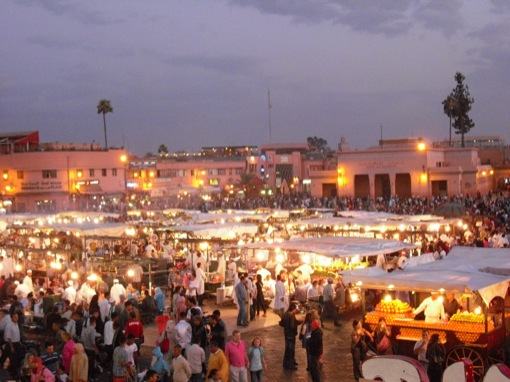
Jamaa el Fna, a marketplace and public square in Marrakesh's medina quarter. Photo by Neal Gorenflo.
From the actions of the Egyptian government to the policies of Facebook, the monopolies of central banks to the corporatization of the Internet, we are witnessing the potential of a peer-to-peer networking become overshadowed by the hierarchies of the status quo. It’s time for us to gather and see what is still possible on the net, and what, if anything, can be built to replace it.
I have had a vague misgiving about the direction the net’s been going for, well, maybe 15 years. But until recently, it was more like the feeling when another Starbucks opens on the block, a Wal-Mart moves into town, or a bank forecloses unnecessarily on that cool local bookstore to make room for another bank.
Lately, however, what’s wrong with the net has become quite crystalized for me. It started with the corporate-government banishment of Wikileaks last year, and reached a peak with Egypt shutting off its networks to stave off revolution. The Obama administration seeking the ability to do pretty much the same thing in the US, Facebook’s “sponsored stories,” and the pending loss of net neutrality don’t help, either.
Here on Shareable, and then again in an OpEd for CNN.com, I suggested we “fork” the Internet – that we accept the fact that the net is built on a fundamentally hierarchical architecture, surrender it to the corporations who run it, and consider building something else for ourselves. The Internet as built will always be subject to top-down government control and domination by the biggest corporations. They administrate the indexes and own the conduit. It has choke points – technological, legal, and commercial. They can turn it off and shut us out. A p2p network protected only by laws – that exists but for the grace of those in charge – is not a p2p network. It is a hierarchical network allowing itself to be used in a p2p fashion, when convenient to those currently in charge.
If we have a dream of how social media could restore peer-to-peer commerce, culture, and government, and if the current Internet is too tightly controlled to allow for it, why not build the kind of network and mechanisms to realize it?
I received literally thousands of emails in response. Some people simply wanted to know if it was really true – could a government really just “turn off” the net? Yes. It’s true. Others wrote to let me know there’s no alternative; there’s no such thing as an unstoppable network. Even if we use ham radio or wifi “mesh” networks to connect to each other, they can always be jammed by governments. True, but by that logic the authorities also can prevent us from speaking to one another by shooting us. At least the tyrant would be in the position of attacking the people’s network, instead of simply turning off the network he already controls.
Finally, though, the vast majority of emails came from people who wanted to get started actually building a new net, developing p2p currency, or figuring out how to promote deep democracy through social media. What should they do? Where should they go? And those kinds of questions can’t be answered in an email, an essay or a column. It’s not something you click on. These challenges can only be answered over time by people actively collaborating on solutions.
That’s why – with some encouragement from a few great organizations including Shareable - I’ve decided to convene a summit called Contact. Contact will seek to explore and realize the greater promise of social media to promote new forms of culture, commerce, collective action, and creativity. I'm inviting technologists, artists, activists, businesspeople, funders, and other stakeholders in the networked future, to come together to hatch new ideas, connect with new collaborators, and forge an ongoing community for innovating social media and beyond. Some of them, like Michel Bauwens of the P2P Foundation, Paul Hartzog and Sam Rose at the Forward Foundation, have been working on these questions for a while. Others come from NGOs and even corporations looking to support and become part of whatever is next, rather than spending money resisting it.
From the development of a new non-hierarchical Internet to the implementation of alternative e-currencies, the prototyping of open source democracy to experiments in collective cultural expression, Contact will seek to initiate mechanisms that realize the true promise of the networking revolution.
The first summit, to be held October 20, 2011 as a MeetupEverywhere and centered at the historic Angel Orensanz Center in New York City, will be a participatory festival for ideas and action, consisting primarily of meetings convened by attendees. Featured participants will deliver brief "provocations" on stage, sharing the greatest challenges they are facing in their particular fields. But their primary contribution to the day will be to join in the meetings convened by other participants, sharing their experience, insight, and even connections to help bring these ideas into reality.
If it’s not the only thing of its kind in the world, so much the better. Let’s connect, conceive, and conspire. Contact isn’t a way of competing with those efforts, but supporting them.
Topics I’m opening for discussion include:
TECHNOLOGY
- Can we build an alternative Internet that can't be turned off?
- Alternatives to top-down registries and corporate-controlled access
BUSINESS AND ECONOMICS
- New net-based currencies and transaction networks
- Net-enabled Local Activism and Job Creation
CULTURE
- Arts networking initiatives
- Decentralized social networking platforms
GOVERNMENT
- Proxy voting to expert friends
- open source democracy
- "Filter Bubbles" and how to prevent them
MEANING
- What Factors Facilitate Collective Intelligence?
- The Reclamation of Public Space
But please feel invited to bring your own. I may be initiating this thing, but I am by no means in charge.

Akihabra Station via Wikimedia Commons
At the epicenter of CONTACT will be the Bazaar - a free-form marketplace of ideas, demos, haggling, and ad-hoc connections. If you have visited the Akihabara, Tokyo’s ultra-vibrant open-air electronics market, or the under-the-highway open-air jade market of Kowloon, or even the Burning Man festival, you understand the power of combining commerce, physical location, and serendipity. A decidedly unstructured counterpart to the convened meetings, solo provocations, and the MeetUpEverywheres, the Bazaar will bring p2p to life, encouraging introductions, brokering, deal-making, food-tasting, and propositions of every kind. It is where the social, business, political, and spiritual agendas merge into one big human agenda.
Contact will hope to revive the spirit of optimism and infinite possibility of the early cyber-era, folding the edges of this culture back to the middle. Social media has come to be understood as little more than a marketing opportunity. We see it as quite possibly the catalyst for the next stage of human evolution and, at the very least, a way to restore p2p value exchange and decentralized innovation to the realms of culture, commerce and government.
Content was never king. Contact is. Please join us, and find the others. More about Contact, for now, at http://contactcon.com/contact/.
Rate this article
Comments
What about a Darknet ?
http://en.wikipedia.org/wiki/Darknet_(file_sharing)
i highly recommend "the master switch" by tim wu who puts a great perspective on the cycles our communication/media networks have been going through the last 150 years. invite him
Stan, great recommendation. Our tech editor Paul Davis is reading it now. And we may interview him.
Hey Douglas,
The Brazilian Digital Culture, under siege (http://www.vgrass.de/?p=638), is ready for the CONTACT call. You can count on us. Thanks for what you do.
While I whole-heartedly agree with the intent spoken to above, this fight has been happening since ownership contracts first emerged. These battle lines are reminiscent of the fight Native Americans were constructed within. This is not how you break the back of the power structure you are prepared to fight.
1 point, 1 strategy:
The Civil War was fought in order to move from a socio-economic system utilizing 'enslavement' to fuel its growth, to one using 'employment' to fuel its growth. The clear winners in this epic fight were the Owners, not the slaves. 1 plantation of 1000 slaves will always be dominated by a market structure composed of 1001 free markets.
Today, we are all data-slaves. Citizenship enforces it, Facebook capitalizes on it.
The answer to the problem we are all pointing to is to equalize the infrastructure the global economy is constructed from. Owners own the world. It is time to universally distribute private ownership of the socio-economic system to the Individual.
Corporate structures are tools; the fact that they have more Rights and empowerments today than Individuals is obviously a problem. The answer is not to make our tools weaker, but to make our Individuals stronger.
We do not need to fight 'Corporate Personhood'. Let it be.
The fight is for the structure of your IDENTITY. Every Human baby should be constructed as an OWNER_ENTREPRENEUR by default, and exchanges in the global socio-economic system should be empowered by universal corporate empowerments. Individual Sovereignty must be structured into every IDentity by default. America's administrative bureaucracy MUST be reconstituted to place ownership in the right context. John Hancock had it implied in his signature, you dont.
Don't repeat the mistakes of the past by leveraging a fight you can not win. Change the future by changing the formula of socio-economic existence forever.
Ownership is superior to every other form of socio-economic existence. It is the structure of accountability. W2's with plausible deniability are destroying the world with choice structures that are not sustainable. If you are a W2, you are part of the problem.
Own Yourself.
Open Knowledge Conference (OKCon) 2011
* where: Kalkscheune Berlin, Germany
* when: 30th June & 1st July, 2011
The Obama administration didn't take a position on the Internet Kill Switch bill.
The bill, "The Protecting Cyberspace as a National Asset Act of 2010 (S. 3480)", was introduced by Senators Joe Lieberman, Susan Collins and Tom Carper.
I'm supporting you Doug in this project and want to be part of the conference. By all means, let's build new territories... a real open source digital terrain. that's what "How to Mutate & Take Over the World" was about.
But also please stick with the Internet proper. It's where the people are. Fight for it to be the best internet we've dreamed. And whatever the flaws, Wikileaks and Egypt are great successes... the first incursions of radical transparency onto the global stage and a democratic people's revolution (not the first) enhanced by twitter, the net, even the dreaded Facebook.
Google, Amazon, YouTube, Facebook... big Wall Street businesses that don't want the net to be killswitched. It's still a dynamic terrain, in flux. The flesh world is also under total domination, in theory, if you push the analysis far and deep enough, but it's also a dynamic situation that's in flux.
Anyway, congratulations! I want to be part of this thing.
R.U.
I think you don't know what you're talking about Douglas. The internet was designed to be shutdown proof and so far the experience in Egypt has shown that it is. Within a few hours, they still could not keep updates from reaching the www.
It was designed to be that way and there are many, many engineers out there who intend to keep it that way no matter what any government tries to do.
The fact that your email is contactCON - makes me suspicious as to your real motives.
Go back to the drawingboard and learn a little GNU. Maybe, then, speak again.
Froggit, the idea that the Internet was designed as a redundant system capable of surviving a nuclear attack is popularly overemphasized. According to Where the Wizards Stay Up Late, a history of the Internet, it's primary purpose was to network institutions engaged in military and basic research to increase collaboration and reduce redundancy of effort. In other words, to save the government money.
It's also worth pointing out that in an age of peak energy, the Internet most likely relies heavily on fossil fuels to operate. Its current energy source represents a vulnerability that can be reduced by innovations in renewable energy. That's a potential track at Contact.
In any case, the Internet and as well as human society, are systems stacked on top of an ecological system, and if the underlying system goes, then humans and the Internet go with it. Bottom line, the Internet is nested in other systems so is vulnerable to failure if related systems fail.
Finally, I'm not so sure your Egypt example supports your argument. There are many ways to move information besides the Internet. Once the four Egyptian ISPs were shut down, much news likely passed through mobile and landline phones and broadcast communications and then made it onto the Internet.
The question at http://Quora.com/What-are-the-fundamental-requirements-and-building-bloc... seems to be associated with this conference.
My answer to this question is:
----
The most important issue we must address is the difficulties faced during co-ownership of shared physical resources required to host that production.
1.) The users themselves must have real ownership, and so must be the initial and ideally the only investors.
2.) The 'return' the users will receive for this investment is at-cost access to the outputs of that production - in this case, internet connectivity.
3.) For late-coming users who want to buy any surplus product (network bandwidth, data storage, CPU cycles), we should charge price above cost (profit) for as much as "the market will bear".
4.) All profit collected from non-owners must be treated as that payer's investment in more physical sources - so that each and every user incrementally becomes a co-owner in the material assets required to host that production.
When any user pre-pays (whether as an up-front investment, or when
paying price above cost (profit)), they receive two items:
A.) A title of ownership over those co-owned physical assets.
B.) A book of "Scheduling Tickets" or "Allocation Tokens" that the
owner would use to prove ownership of and therefore collect the
outputs of that production.
Great work Douglas. Excited about the vision you paint, and the future of a connected, adaptive humanity.
I am the founder of an organization called the Free Network Movement. We have been working on just such a system for some time, and feel that we have developed a workable alternative to the corporate internet.
Please visit us at www.freenetworkmovement.org, look at our wiki, and help with the greatest project in the history of our civilization:
grow your own network.
I think as we look at the term "data slave" clearly we all are somewhat slaves to our government. Now it seems that there are several standards that the government is controlling related to business information that is available over the internet. Companies like StoredIQ and Anthem, as well as various healthcare providers that provide data over the internet are now implementing government strategies to maintain security and minimize risk. So I do believe in many ways it is top down controlled and we all will just continue to adjust based on vulnerabilities. Adding social media in the mix should be interesting!
Douglas Rushkoff just released a new and updated version of his critically acclaimed book, Life, Inc., about the corporatization of everday life and how to reverse it.
The new version includes a resource guide – 70 pages of people, organizations, and businesses that have moved beyond corporatism and are thriving by using new peer-to-peer models for value creation and exchange. Learn more about and buy the book here.
Also check out Rushkoff's most recent book, Program or Be Programmed, which explores self-determination in media and technology.
Related Articles
- Hacking the Commons: How to Start a Hackerspace
- Diaspora: A New Beginning or a Crowdfunding Cautionary Tale?
- Turkey Puts DIY Twist on Clothing Swap
- How Big Retail Could Mainstream Collaborative Consumption Overnight
- Open Tech Forever Challenges Proprietary Innovation
- Making it Happen at Maker Faire
- Is Social Entrepreneurship the Rich Saving the Poor?
- This Week in Sharing: Creative Destruction!
- The Future Proof Enterprise
- All Too Present: An Interview with Doug Rushkoff
Community Blog Posts
-
By Drew Little
-
By Tim West
-
By Liz Elam
Recent comments
-
22 min 39 sec ago
-
2 hours 16 min ago
-
1 day 2 hours ago
-
1 day 8 hours ago
-
1 day 8 hours ago


I took the picture of the Jamaa el Fna in 2008. Would love it if Contact's bazaar has a similar energy, though the aggressive selling of some Jamaa performers and vendors can be off putting to visitors.