
Credit: insaevans
Bicycles shine today as the symbol of vibrant cities—they pop up in fashion spreads and movies having nothing to do with transportation as signifiers of youthfulness, coolness and sexiness.
Copenhagen and Amsterdam win worldwide kudos for their fabulous network of bike lanes. Paris, Lyon and Montreal have demonstrated the efficiency of bikesharing systems. Portland and Minneapolis have put themselves on the map as “happening” towns, in part because of their blossoming bike cultures.
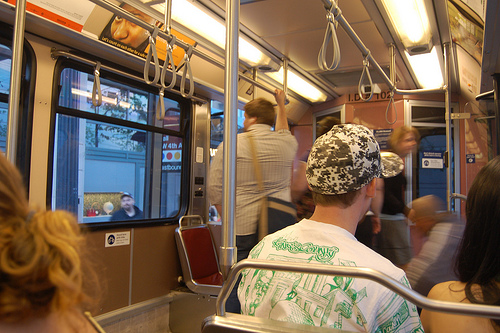
But great cities also depend on public transportation. Images of buses and trains may never be as sexy as fashion models astride two-wheelers, but they are just as important to the future of sustainable, shareable, livable cities.

Public transit has experienced a quiet renaissance over the past two decades as the number of transit systems nationally has jumped from 1044 to 7700. Transit use began climbing in the mid-1990s as light rail systems sprang up in many cities and bus service was beefed up in other places. Before the economic slide in 2008, public transportation was carrying more passengers than any time since automobiles began to rule American cities a half-century ago.
But, unfortunately, public transportation now faces an uncertain future. Many cities are slashing service or raising fares due to budget woes, and even more drastic cuts loom in Congress. Transit systems depend on public funding to give people of all ages and incomes a way to get around each day, which means the anti-tax, anti-government mood driving decisions in Washington and many state capitals could cripple service in places across the country.
At a time when gas prices are passing $3.50 a gallon for the second time in three years and global warming remains a catastrophe on the horizon, cutting back buses and trains seems the height of folly. Especially in the midst of an economic crisis challenging most American households. The American Public Transportation Association estimates families in large metropolitan areas saves $9656 on average annually by taking transit instead of driving, citing January 2011.
So, to celebrate the potential of public transportation (which among other virtues is a commons shared by all) here’s a list of the 10 Best U.S. Cities for public transportation from U.S. News & World Report a magazine famous for their college rankings. Also listed are the three worthy runners up. (Accompanying color commentary is from yours truly.)
1.) Portland, Oregon. (No surprise here. Portland’s expanding light rail and streetcar lines make it the poster child for livable cities.)
2.) Salt Lake City (A surprise, but this underrated city has aggressively built light rail lines.)
3.) New York (Life here would unimaginable without transit. It’s the only major U.S. city where more than half of all households don’t even own a car.)
4.) Boston (The birthplace of subways in America, Boston’s compact settlement makes trains and buses a way of life.)
5.) Minneapolis-St. Paul (A shocker to me, and I live here. A good bus system now augmented with light rail. U.S. News awards it extra points for a stellar safety record.)
6.) San Francisco (Charming cable cars, but also the BART subway, an extensive network of light rail, commuter rail and buses.)
7.) Los Angeles (Even more of a shocker than Minneapolis, but Angelenos have been quietly assembling a respectable network of rapid transit alongside one of the world’s most extensive bus systems.)
8.) Honolulu (A 20-mile elevated rail system is in the works.)
9.) Denver (A little-low on the list, I argue, for a city where voters have said “yes”to an impressive network of light rail lines.)
10.) Austin (I’m skeptical, but must admit it’s been seven or eight years since I last visited.
11.) Washington (Way low for a city with some of the most walkable suburbs in America thanks to its wide-ranging Metro system.)
12.) Seattle (For a city that built a demonstration monorail in 1962, Seattle was late in the game in expanding transit beyond buses.)
13.) Chicago (The Windy City should demand a recount. The el trains and buses go everywhere you need to go.)
Teaser courtesy of Christian Mehlführer.
Rate this article
Comments
How is Dallas not on this list?! Already the largest light rail network in the United States, opened 28 miles of new line this year with another 20 miles under construction. Forty-four light rail stations just in the City of Dallas. Expansive bus network as well. Existing McKinney Avenue streetcar line in booming uptown neighborhood. Winner of the first round of grants for the Oak Cliff streetcar project, with a comprehensive 40 mile network in the planning stages. Commuter rail connecting downtowns Dallas and Fort Worth.
As a transit frustrated resident of Austin, I am actually angry that my city is on this list. Even L.A. and Dallas have better public transit than we do.
As a Portlander, allow me to say, What the hell?
Portland's transit system is great, as long as you're going downtown or back home. Very few bus routes (and no light rail routes) go between non-downtown neighborhoods unless they are on the way downtown.
As a recent transplant to Portland from the midwest who read all the great things about Portland's public transportation, let me debunk the myth of Portland's magical public transportation system. The light rail runs excruciatingly slow and stops every 10 feet, making any trip take 3 times as long as it should. The recent cuts to bus service make any trip that requires a transfer just not worth it, yet Trimet continues to propose light rail solutions to places that don't need or want it. Can you live in Portland without a car? It's possible I suppose, but I don't know anyone who does. Many people have 1 car and try to bike everywhere possible, instead of using the overrated public transportation system. Comparing Portland to New York or even Philadelphia is a travesty.
The UN&WR authors must not use - or even understand - public transportation. Honolulu above DC? Seriously? Did they take The Bus on a vacation to HI once, and have a good time? Nuts.
Why so shocked at Minny? Ridership is obviously a huge priority and the numbers keep climbing. The city just added the Nice Ride program to offer yet another commuting option and buses manage to run pretty much on time, everywhere you need to go despite the absurd amounts of snow.
I don't want to dispute the highly legitimate USNWR rankings (hardee har) but have no doubt that Minneapolis belongs on the list.
Ditto to the commenter above ripping the Portland ranking. TriMet has absolutely savaged bus service at the expense of funding light rail expansion to outer suburbs who are outright hostile to the very concept. I feel like this is a trendy ranking, but doesn't really match the reality of living here and trying to get from point A to point B on mass transit in a way that is any way compatible with a scheduled life.
Austin? What a JOKE! That one is an insult and makes me suspect this whole list. I agree Dallas is a million times better for public transport than Austin. How did Austin get rated higher than DC or Chicago? Not even in the same league! I don't know if Portland (my new home) is overrated, but I agree the light rail, while it beats the heck out of riding a bus, seems to take forever. I live within walking distance (3 miles of work) and even though my employer reimburses for public transportation, I just walk because it's not even worth it to ride for free most of the time.
As for Light rail, the Beaverton stops have not much development around them besides parking lots, and the downtown lines and lines to north portland move frustratingly slowly. I have yet to try the streetcar lines.
You list a city (Honolulu) that hasn't even finished its first system and you leave Philadelphia off the list. What a joke.
OK I've lived in NYC all my life so I suppose I'm prejudiced. But I' work in the transit industry and have travelled all over the world and travelled most of the premiere transit systems: London, Paris, Berlin, etc. But Portland OR and - WTF - Salt Lake City have better public transit than NYC? You can't be serious.
You forgot Philadelphia. Silly.
I think the person who wrote this article has never actually ridden any public transit in the cities mentioned. With its coverage and frequency, Seattle clearly has a better public transit system than Portland. Salt Lake City might be O.K. as long as you never actually have to ride a bus; if you do, better be home by dark and mostly on Sunday. At my website http://publictransport.about.com/od/System_Profiles/tp/Ease-Of-Going-Car... I am currently working on a long term project of attempting to rate how easy it is to get around without a car for all American and Canadian cities over 100,000. Visit it and let me know your thoughts.
San Francisco might make this list if you look at the route maps. By any other measure, we're probably south of Somalia in level of technology, cleanliness, and creative thinking about transit. It's very sad to be a transit user here - we all wear the big "L" for loser. - PS I'm writing this from a shabby BART train, using my own wireless connection.
this list is ridiculous. in terms of level of service and coverage Boston, NYC, SF, DC, Chicago, LA and Philly should fill out the top of the list. It's a joke to compare a city with two or three light rail lines to a city like Philadelphia with 14 regional rail lines, 3 subway lines, 4 light rail lines and 6 streetcar lines.
Shabby BART. Having been in SF and on BART just a few months ago I find that supremely amusing. I think the only people who don't universally badmouth their own transit system are people in NYC and DC and maybe Madrid and Paris.
I'm a life long New Yorker and life long rider of the NY subway. As good as it is - and needless to say it could be better - people here complain continuously and bitterly about how allegedly awful the subway is. Of course few have bothered to travel and ride other systems with any degree of regularity and thus find out how much worse many of the other transit systems really are.
Actually, portland has an abhorrent transit-use share considering their investment. Baltimore has nearly double the ridership of portland and many other cities on the list. Why are we not included when so many cities that are auto-dependent are?
I can tell you one thing. The state of New Jersey never made the list. I wonder why? Oh yes, the bus service especially is not spaced out properly and a lot of bus lines could make substantial improvement, but instead constantly complain how broke they are and raise fares constantly. Also, did you know according to the last governor Corzine that New Jersey is broke.
Enough said. NJ Transit, the way not to go.
Having lived in Portland, Chicago and Denver I would have to say that Chicago has the best public transit (by far out of these three). Portland however, wins the contest if you count the ability to travels as a pedestrian or on a bicycle. Try to be a bicycle commuter in Chicago - only for those with a death wish.
I live in Ann Arbor. Public transportation is not very good, especially if your work out of town. It's my biggest complaint about living in this lovely place.
I am sick of driving. Everyone in my family has to drive if they want to get where they need to be. The amount of time and money we spend on our cars is obscene.
And this is from someone who walks whenever she has a chance!
No New Orleans? The streetcars are beautiful and fun to ride.
Denver's light rail is great for those traveling to and from downtown, and the new expansion will be even better. My only gripe: it's expensive! For a roundtrip trip from Lincoln/I-25 to downtown it's about $10 and a monthly pass is $175...
people who complain that Portland transit doesn't work are those who live in the fleeting suburbs...sorry but you chose to live there and just because light rail doesn't stop at your door doesn't mean its a great asset to those who live close to transit lines.
People who value and utilize transit actually consider it a high priority to live near an existing line. This helps support transit oriented development and the local economy. I use transit to get around Portland proper and bike and walk everywhere else when the weather is great.
I'm not surprised Portland is on the top of the list not just because of light rail, but streetcar, commuter rail, bicycle infrastructure and most arguably the creation of 20-minute neighborhoods.
I would have to agree, Portland and Seattle both have way worse transit systems than NY, Boston or Chicago as far as their usefulness and layout. Not sure who paid them off but there should be a recount.
I travel all the time and am moving every couple years because of my job, so I know most of these cities pretty well. As far as public transit, the best is New York but I love San Francisco. I love taking the trolley. One of the worst cities is Pittsburgh. All the roads criss-cross at weird intersection and it takes forever to get anywhere on a taxi.
I agree! Dallas is continues to add more rail lines and is the largest rail line in the nation. I also wondered why it was not listed. The newest, in Rowlett will connect the east side of Dallas County.
I couldnt agree more about austin.
Related Articles
- Interviewed: David Harvey on Rebel Cities
- How to Map the New Economy in Your City
- Have Your Cake & Eat Someone Else's Too!
- Is Peer-to-Peer Bikesharing Viable?
- Asheville: A Shareable Mountain Town
- Adventures in SideCar-ing
- Complete Streets Are For Everyone: the Top 10 Policies of 2012
- Innovations in Governance: An Interview with Gianni Dominici
- 7 Ways To Reinvent Your City, Burning Man Style
- MoRUS: A Museum for Urban Reclaimers in Manhattan
Community Blog Posts
-
By Drew Little
-
By Tim West
-
By Liz Elam
Recent comments
-
11 min 43 sec ago
-
11 hours 16 min ago
-
1 day 9 hours ago
-
1 day 11 hours ago
-
1 day 13 hours ago


I'm surprised at Denver's low showing. The light rail expansion has been slowed down by the economy a bit (which is a shame since it would probably increase economic activity in the region if it were finished), but we still have one of the most reliable and robust bus systems in the country. Maybe after the Gold Line is finished next year or after the Union Station remodel with the new commuter rail and light rail lines we can place ourselves a little higher.
It's probably worth mentioning that a lot of us just ride our bikes too, since we have an extensive network of off-street bike trails and a nation-leading bike sharing system. You need a little less public transit when you have pedal power.