Making Do
01.17.12, 2:59pm Comments (3)

In consumer society, stuff goes quick. Whether it's through planned obsolence, changing fashions, or just because it's plain old plastic crap, our things need replacing a lot. This process of constant commodity renewal locks us into a compulsory work-buy-work lifecycle. But it wasn't always quite so, in times of resource scarcity (even in America!) learning to make do with what you already owned was considered a virtue. "Thrift," I think they called it.

Once again we're in a period of scarcity, not of resources (there's plenty of stuff) but their distribution. Web veteran Meg Hourihan is giving thrift another try in 2012 with a new project she calls Make It Do. Here's how she describes her inspiration:

In December, 2011, something clicked. I realized that going even three months without buying anything would just defer purchases. Going a year would require some real change in how I operated. And those changes could involve some of the other things I’d identified as important to how I wanted to live my life. Also I read Little House in the Big Woods to my four-year-old son and was reminded how little people can have and still lead a very rich life.

She sets an ambitious goal: buy nothing in 2012 but stuff she uses up and can't repair. Since consumerism changes people's expecations, Hourihan had to define her program specifically and adhere to it. It's broken down into different regulations:

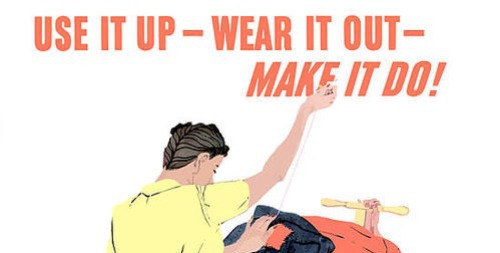
  • Use it up
    "A product that is used regularly and gone can be replaced, a 'wander around Sephora and get three new lipsticks' is not allowed."
     
  • Wear it out
    "If all my underwear falls apart during the year, I suppose I can buy some more. Seems unlikely. I don’t anticipate much wearing out, at least that can’t be mended and made to do."
     
  • Make it do
    "This will be my life. Mostly I expect to make do."
     
  • Do without
    "If I want a book, I can go to the library or borrow from a friend. I can accept gifts, though gifts can’t become a backdoor to getting tons of stuff. Maybe I can barter a piece of fabric for a skein of wool, or something along those lines."

There are a few exceptions for experiences like the occasional meal out or movie rental, but that's pretty much it. When she phrases it like that it almost sounds easy - I mean what else do we really need? At the very least following Hourihan on her journey via her blog makes her readers think about where the rest of the things in their lives come from.

Rate this article

Your rating: None Average: 2.5 (2 votes)

Comments

I very much like the idea of this. I recently bought some more RAM for my 6-year-old MacBookPro (I don't even know what RAM is) instead of buying a new computer. Now my computer still works perfectly. And it felt great. I felt like a gamed the system.

But, for me, as a grad student, this is more of a necessity than a way of life I chose based on principles. I would like to say that I would chose to "Make Do" regardless of my financial state, but I'm not so sure about my resolve. I wonder if Hourihan is also making a "value" out of a necessity--nothing wrong with that!--or if this is a case of someone really choosing to break the work-buy-work cycle that doesn't "have" to. That would really be something!

Liz Kofman

This has become pretty much the norm for me over the past 3 or 4 months. Prior to this, I was espousing these ideas enthusiastically and somewhat theoretically. But then, a serious downturn in my business made living this way the only choice I had.

As long as I don't let myself flounder in a lame sort of victim-mentality, "I can't..." attitude, everything's actually fine. I don't really need STUFF. (Except coffee.) In fact, during this period of nouveau poverty, I've been giving away more stuff than ever, or selling it on eBay, or looking into ways to swap it for stuff that would be more useful/meaningful to me.

There's a wealth of info and extreme creativity on the internet of people refashioning, upcycling and mending clothes (and other stuff) that's pretty inspiring, once you start looking. I even started collecting images (on Pinterest... great place for sharing!) of clothes that have been beautifully darned and look better than when they started.

I'm hoping that business will look up and I'll get back to having some disposable income someday — but I'm pretty sure I won't be "disposing" of it the same way I used to. I'd much rather have the freedom to pay for experiences (travel, taking time off to volunteer, etc.) than stuff. Or to save or donate, or do creative projects. Oh, and buy coffee.

Getting your money out of your pocket into theirs ( their clients) is the marketeers mantra. What has "informed" USA Inc is based on an ideology that is no longer scientifically relevant. We are on a limited planet of limited resources and "Consumer Economics" is eating its way through the world, leaving waste, pollution, dis-ease of mind, heart and body and we have 10,000 jelly bean flavors but have to fight for "real" food. Save your $ and invest in the world you want to see manifest. There are co-ops, groups etc and creating a diverse, scintillating new economic ssystem is necessary if humans and other living things are to bloom and thrive.

Add comment

Sign in to comment if you’ve registered. If not, consider registering.
Kept private.
Type the characters you see in this picture. (verify using audio)
Type the characters you see in the picture above; if you can't read them, submit the form and a new image will be generated. Not case sensitive.