Are Algae the DIY Answer to Fuel & Food Crises?
09.07.10, 10:54am Comments (36)

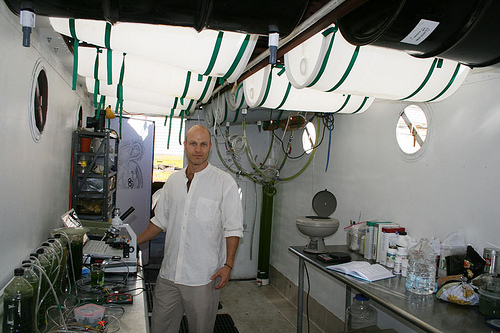
Aaron Baum at work. All photos courtesy of The Algae Lab

Microscopic spinning orbs and spirals of green goo are the answers to our planet's energy crisis and arable land shortage. At least that's what Aaron Baum, a 40-year-old Harvard graduate and Stanford PhD, has concluded.

And Baum should know. After a mid-life crisis of sorts, he spent months researching the types of science that would most benefit the world and concluded that algae are it. Now, he wants to share his passion with the public by creating communities of people with their own algae farms. Imagine that – you can have a personal algae tank that provides fresh, ultra-nutritious food on a year-round basis.

Baum is a research consultant for NASA's OMEGA project, whose mission is to create massive amounts of algae for biofuel, fertilizer and food. The San Rafael, California algae-phile knows not everyone has access to professional grade equipment – which can cost tens of thousands of dollars – so Baum has started teaching seminars on how to raise spirulina inexpensively and in one's own home. The day-long workshops cost $150 and he'll also provide you with a kit that includes a tank, spirulina starter stock, a nutrient mix and other equipment for $200. Through these workshops, Baum hopes to continue forming a collaborative community that shares knowledge about algae farming.

The seminars grew out of Baum's first venture in algae. In 2008, he created what he says was the world's first communal algae farm. The project was based in Berkeley and consisted of more than a dozen 55-gallon tanks of algae. It eventually got so massive that it would've required full-time staff, so Baum closed it down when he traveled around the world last year to attend algae workshops and visit algae farms. When he returned, he thought it would be more manageable to have the farms in people's homes. I talked with him about his adventures in algae, and his plans for the future
IMG_2802

Alice Chen: How did you get interested in algae?

Aaron Baum: As a scientist, I'm completely committed to doing good things for the environment. I earned my Phd in applied physics from Stanford in 1997 and worked for several years in Silicon Valley as a program manager on technologies I developed in graduate school. I realized I was working my butt off to make computer chips run faster. I kind of lost faith in what I was doing.

I dropped out of that field, worked as an artist for several years and realized I miss science -- the intellectual challenge and making contributions and changing peoples' lives. I decided to get back into science on my own terms.

I thought about it for a long time and decided I wanted to work in a field where I could be sure I was doing something good for the world. I started doing a lot of research four years ago and after a few months, algae started to stick up out above everything else. Back then if you searched for algae, what came up was how to kill algae and how bad it was because of algae blooms. That was happening for a while but now it's exponentially worse. I started working in that area. Now if you search for algae (online), about half of what you find is good.

AC: What's so great about algae?

AB: Algae is a way to grow really high quality food in a small area, on the surface of a body of water or in wastewater. Or you can grow algae in dilute urine which is an easy way to get the right nutrients and reduce your impact on the environment.

Most marine biologists consider that the number one danger to marine life is eutrophication, an excess of nutrients in the water from agricultural runoff due to application fertilizer. When it hits the ocean or lake, there are massive algae blooms. When they decay, they wipe out oxygen and everything dies.

If you can find a way to keep nutrients out of water, you reduce the size of dead zones. You can create controlled algae blooms, harvest algae and eliminate nutrients that way. Or you can take wastewater, give it to algae directly and absorb nutrients. You come out with clean water, fuel, food, fertilizer and extra oxygen. And on a small scale in your own house if you grow it in dilute urine, you reduce the fertilizer load on the local ecosystem.

IMG_5964

AC: Tell me about algae as food. Why are people so into it?

AB: The idea was first proposed in the 1930s in Germany. They were trying to develop it for growing food. You can grow a lot of food in a small area. It's extremely nutritious on a gram-for-gram basis. You can mix it in with other food. It didn't take off until spirulina in the 1970s. Now there's chlorella.

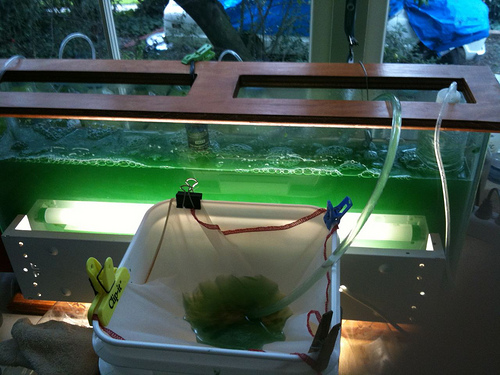
Normally you get spirulina in a powder or pill form. It's grown in large outdoor ponds normally, and you sieve it out of water. It's kind of special. It grows in corkscrew filaments making it relatively easy to strain out of water using a special fabric. Most other kinds of algae are too small and roundish, very difficult to filter.

Algae as a food is extremely healthy. It's high in complete protein, antioxidants, omega-3 fatty acids, and it's effective against infections. It has defenses against viruses and you can acquire defenses as well. It's good to protect against environmental toxins. There were dozens of experiments where they fed rats a regular diet and another group with spirulina. They exposed them to mercury, lead, pesticides, radiation and mutagens and found that spirulina-eating rats do much better.

In powder form, spirulina's great, but when you want to eat a blueberry, you don't want it powdered. You want it fresh. You can eat fresh spirulina that's basically alive. It tastes better.

AC: What does it taste like?

AB: The problem with most algae is it tastes like seaweed. A lot of people are not turned on by that taste. I think it's really good in certain dishes. When you eat it live, fresh, the taste is much lighter, creamy, and buttery. You can spread it on crackers. We mix it with brown rice and guacamole so it's vegan. The easiest way is in carrot juice.
IMG_0198

AC: Is anyone else doing what you're doing?

AB: We're at the very beginning of growing it. A few people have worked on it. Some people in France grow spirulina on a small scale in their house. Outside of France, there's been very little work. I'm not aware of anyone in the U.S. working on it other than us.

AC: Why haven't more people already started growing algae in their homes?

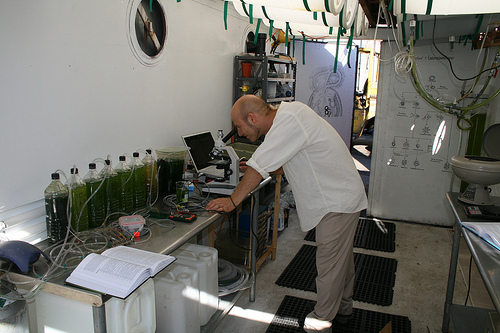
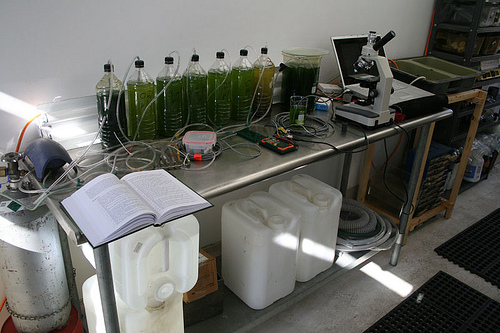
AB: There are technical barriers. You need to grow live spirulina. You need a seed reactor, a nutrient mix to put in the water and a special cloth. You must maintain proper balance between acidity and alkalinity, and the proper temperature. What I'm doing is putting together a kit to provide live spirulina.

AC: How is this a communal project?

AB: I'm starting out by building the community and showing people how they can do it themselves. We'll do it together and share information through our website.

Previously we built a whole algae lab all based on volunteer labor. We built it for about 1,000 times less money than what we spend in places like NASA. What we're aiming to do is cultivate algae based on free material. We grow algae and are investigating it as fertilizer, biofuel, and growing it in dilute urine.

We'd like to create an international network of people growing all kinds of algae in their homes in a small community scale, sharing information, doing it all in an open source way. We'd be like the linux of algae – do-it-yourself with low-cost materials and shared information.

I get emails from all over world. There's been a huge wave of interest in algae, driven by biofuels and by the growing awareness of the lack of farmland. If you want to make new farmland, you have to destroy ecosystems. The biggest impact humans have on the world is through agriculture. If we want to grow more food so people can eat better, we either destroy the last remaining ecosystems on the planet or find a new way to do things.

AC: What's the market like for spirulina?

AB: The world consumes about 100,000 tons of spirulina a year. It's used for animal feed and it's a nutraceutical (that is, a food that provides health benefits). It's kind of expensive, usually about $80 per pound for powder. It's a very nutrient dense food. When I eat spirulina – I eat vegan – I don't have cravings for meat or sugar. Food is more satisfying when it has spirulina. I eat a lot, 15 grams a day. Most people would consider 5 grams a day to be fairly high. If you're eating 10 grams a day, you're spending about $200 a year on it.

AC: How did you transition into algae as a career?

AB: I got interested in algae and decided to create an algae farm project at Burning Man in 2007. I got together a community of people and we created an installation on a trailer. We had 16 bioreactors with live algae that was eating the exhaust of a generator. They grew great – it was very successful. We had a lot of educational material. There were big posters jammed full of text explaining what we were doing and why it was interesting.

I've worked at the Exploratorium. They'll tell you that anything beyond one to two sentences, there's no way you're going to get anyone in the public to read anything more than that. On the night of the Burn, the craziest night of all with partying and dancing, I went to the installation. We had forgotten to turn the lights on. In the dark, I was surrounded by people all using headlamps, leaning close and reading every single word we'd written. As soon as they knew I was part of it, they started peppering me with questions. A guy from NASA was inspired by this project and then joined the OMEGA project. And then he gave me a call.
LabBench

AC: What are you doing for NASA?

AB: We're developing large-scale systems that are combining biofuel and fertilizer production with wastewater treatment and production of fresh air and fresh water. We're using large membrane enclosures floating in bodies of water. It's a low-energy, low-resource way of growing algae.

One budding thing of NASA technology – we're working on a clever way of removing algae from water.

We're focused on the biofuel aspect at NASA. For biofuel, you want a species that produces a lot of oil. Many species of algae can produce huge amounts of oil -- they can be more than 50 percent oil by weight, compared to normal plants that only produce a few percent.

Algae can produce about 100 times more than typical oil plants like soybeans, on a per acre basis. You can grow enough algae to replace all of the fossil fuel in an area that's small enough to be manageable. You don't need to use farmland, there's not much remaining in the world ready to be used, and you don't need fresh water. The nice thing about algae is while they cleans water and air, they can produce very valuable things like fuel, fertilizer and food. They're precursers for bioplastics, cosmetics and medicines.

It's a new kind of farming, potentially very low impact and sustainable.

img606

AC: So what's your vision -- to see every household have algae?

AB: I don't see why not. It should be easier than a vegetable plot. Algae is such a super food. It's so productive on a daily basis that with one tank in a window you can significantly supplement the diet of one person. If you use a whole window, you could probably do two to three tanks year round and have even more. Every day you could be eating algae.

Algae is an incredible resource we haven't tapped into. Human beings haven't gone there yet because it's microscopic. I didn't know what algae were until quite a bit later in life. They don't really teach you about it in school. It produces approximately 70 percent of the oxygen we breathe. It's the basis of 95 percent of life that's in oceans.

Even people with no dirt can grow fresh food for themselves. If you're in an apartment complex on the 25th floor, you can still grow fresh food.

##

Similar Stories:

I Made an iPad eBook In One Weekend (And You Can Too!)

A Factory in Every Home (a desktop factory that can reproduce itself)

Aquaponic Transformation (growing fish & food in a symbiotic system)

Augmented Cities: A Q&A with Bruce Sterling

Can We Design Cities for Happiness?

Rate this article

Your rating: None Average: 4.3 (27 votes)

Comments

I was just thinking about algae in the middle of the night last night. It really is the way of the future with its nutritive qualities, sure, but also as a source of biofuels and wastewater treatment. It's stunning that resources like this aren't all the rage.

To learn about the fast-track commercialization of the algae production industry you may want to contact the National Algae Association, the trade association.

If you really wish to help the world upload the information to youtube and share it with all instead of exclusive workshops.

I was reading a sci-fi book recently that touches on some of the same ideas, CHON food. https://secure.wikimedia.org/wikipedia/en/wiki/CHON It would interesting to see what comes from this experiment.

Saltwater fish breeders have been using this system for decades. I have a similar setup in my basement window right now. It really is easy and doesn't take more than two or three minutes per day to keep a culture alive.

I also believe that for this to be a truly open source movement that this knowledge should be shared and not restricted to workshops.

Yeah...but I dont want to eat algae. Keep your future, Im going to continue to live in the past...with beef, pork, poultry, fish, shellfish, and any other tasty meaty animal i can kill and cook.

"I eat a lot - 15grams a day".
No, you don't.
You're advocating this as a significant part of the diet.

The first link I found gives for 15g of dried spirulena around 40 calories.
This is 2% of the energy you likely need.
If it's not dried, and that 15g is wet, it's _way_ under 1% of your daily calorific requirement.

15g a day is not a food. It's a spice, a flavoring, or a supplement.

Soilent green is made out of peeee-ple's urine!

This sounds wonderful! I'm also vegan and this sounds like quite a fun, interesting, and productive project. I may try it in the near future.

@SpeedEvil: I'm sorry, but you're just being...I won't say "dumb," because I'm betting that violates this site's community standards...so instead I'll only say that you weren't reading very carefully. In that passage, Baum is very clearly describing spirulina is one small but regular part of his diet, as a kind of health supplement and additive. So you're not putting him or it down to call it a supplement or flavoring; you're just repeating what the man said in a derisive tone, likely in an effort to make yourself look smart compared to this guy who is obviously brilliant (and also a bit eccentric, I'll grant). In any event, the dietary stuff is secondary; the most important and interesting parts of this Q&A mostly have to do with his NASA research.

No, he's not advocating this as a significant part of the diet. When he says "...you can significantly supplement the diet of one person," I'm guessing he means exactly what he says; that it can _supplement_ the diet, not replace it. Try reading the article again.

@umber
Given that throughout the article 'will algae solve world hunger' - is asked in various forms - I don't think it's unreasonable to be critical if the person purporting that algae is an answer says they're eating 'a lot' - when the quantity they are eating is so truly minute.

So where's the open source material? A $150 seminar is mentioned, a $200 kit is mentioned, a community is mentioned. The "Linux of algae" would be available to people haven't gone to the seminar. Plans for the kit wouldn't have a price (although a pre-made kit with a pricetag is perfectly acceptable)

On a different note, there are scholars that believe the old testament story of the Israelites 40 years in the desert was made possible by an algae machine - Manna from Heaven anyone?

You know, Michael, I have a feeling that if you wrote to Baum and proposed helping to create the "Linux of algae," he'd welcome the participation. I suspect very strongly that it's just a matter of time until the community reaches enough critical mass so that it goes truly open source.

Jeremy Adam Smith
www.jeremyadamsmith.com

I know this is selfish of me, but, why does it take a guy like this to say, 'Algae is the way'. Everyone then says, "It must be so!!!!!". I say years ago, "Algae is the way.". And people say, "Who do you think you are? What do you know about anything?"

Eh, I hate people.

Keep on keepin' on, Anonymous.

Jeremy Adam Smith
www.jeremyadamsmith.com

so a green fish pond is good, not bad?!
-
where is the easiest place to get a
"spirulina seed"? i'm in thailand.

I expect this to go no where for the food market and perhaps even no where for the fuel market. A trendy experience among a certain (and rare) type of individual maybe but I'm certain nothing else.

There is one thing bothering me: How do we "wash" the algae of nutrients (organic waste) when we are about to eat them fresh? They come from a tank filled with diluted septic water.

With macroscopic plants it is obvious and even though we fertilize our lettuce with animal excrete, we don't get contaminated when we eat lettuce.

I have been an algaephile since high school.

The man is right. Have you ever wondered where the world oil supply came from? Or how this planet's atmosphere changed from mostly CO2 and nitrogen?

The true goal is to reach a combination of algal and bacterial systems that can provide a human's entire food supply.

Time, effort, money, and innovation bring things about, but only when people embrace them.

The money for the course is barely time and materials. And you'll actually learn something, unlike high-school biology.

I want to thank Aaron.

I'm with SpeedEvil on this one.

15 grams of dried spirulena per day is about 14240 calories a year.

A 1 square-meter box on the balcony can grow 10-15 kilos of potatoes per year, and give about 16000 calories of ready-to-cook potatoes. And they taste good.

I want to mention a resource for growing the community larger around this project relatively easily. The one word answer is home-schoolers. It's a science project, and the rest of the benefits all at the same time. I was home schooled from the 3rd grade up, and my mom was always getting us to do experiments. It's a great hands on way to learn, then on top of that my mom is very health conscious as are a lot of home schoolers that I have met. I have already sent the link to my mom who has several children still at home that may be doing this soon. I can't wait to see what she thinks and they come up with.

Enjoy,
Jarvis

I've wanted to get this going myself, for years now, if not decades. Every time I see hungry people, I think of this. Thank god this guy came along. I hope he gets the proper push of support, and he almost has to...

Just curious,
I'm assuming that a successful algae 'farm' would still require large amounts of water (waste or otherwise). Is this something that could be successful in the arid areas of the world (Zambia, Congo, etc)?
Is there a way to separate and harvest the 'clean' algae from the waste water and recycle or reclaim enough to be sustainable if there isn't enough potable water for the current population in an area?

This article is very interesting. Kudos to the scientist who wasn't satisfied "making computer chips run faster" as his life's mission. He is trying to shift the course of his life and do something significant that can dramatically help humankind and our planet.
I have eaten "spirulina balls" that I purchased from our local health food store. They are a rich green color, and the spirulina is mixed with other ingredients like honey, brown rice, oats, sesame seeds, and peanut butter. They measure about 3 inches in diameter, they taste amazing, and are kind of a soft, chewy, dessert delicacy. Because of the high protein content, however, you don't get the high and low that you might get from, say, a doughnut. Rather, it's a sustained, wonderful form of energy. You really get the feeling like you just ate something amazingly healthy, but delicious. After my husband 1st bought me one, I raved about how amazing they were, and told him that I could easily eat 3 or 4 of these a week as MEAL REPLACEMENTS. That's how satisfying they are! I would totally be interested in purchasing a "kit" to make my own algae. In reference to the Linux bit, if you want a version of Linux, like Red Hat, you purchase it with money. There is nothing wrong with this scientist trying to market a premade "algae kit". That doesn't mean Joe Schmoe can't go figure out how to make his own algae kit/lab. That's what makes it "open source".

Nice article, but: How does it work?!

I'm a bit concerned about the sanitary issues, and I don't know how well it would be accepted by the mass public of eating algae that grows in one's urine... Also what would a tank of diluted urine in your house smell like?

@SuzyHomemaker Red hat linux costs money because you are paying for support. Red hat also has Fedora which is free to use. If he wanted to truly make this open source. He should try making some how to videos available online for free, which one would learn how to build and maintain such a system. This would allow for a community to develop all over the world and not just where lectures are given (for a hefty price I might add). I believe the selling of premade kits fits perfectly into the open source mentality though.

I hope to hear more about Algae in the future from him.

With reference to individual cultivation, there are a great many homes in temperate or colder regions that are heated via natural gas or propane. These fuels generate very little toxic soot or byproduct other than CO2 and water. Perhaps a way to harness this waste output safely without violating building code standards for exhaust would help boost output of the algal harvest.

One reason that there is ample evidence that algae is the way is nori, that black wrapper around your sushi.

A LOT of people eat that stuff everyday. There is a huge international market in it. There are quality segments ranging from just OK, to luxury melt-n-your-mouth awesomeness. There are large farms where it's grown on nets in the ocean. It's macro algae, but it is algae.

Most western folks don't keep it around the house. I was an average kid at the school lunch table, back in the 60's when I was 6, when I pulled some nori (seaweed) out and started munching it down. My mom put it there because I liked it. They nearly sent me to the hospital to get my stomach pumped.

@Peter Anderson
Speaking as Suzy Homemakers significant other I would say that her point, that this is open source, is correct just maybe not in perfect alignment with the GPL that Red Hats is largely bound to. I am in no way attacking you as you sound like a good and logical person. I just want to clarify what she was getting at as I am the giant nerd in this house and she doesn't understand all the finer details of each open source license. She definitely does however understand many of my rantings on the value and definition of both freedom and open source.

You are correct that this may not directly correlate to Red Hat because Red Hats source (but not binaries) can be downloaded for free (CentOS is grateful) but I would argue that Stallman, ESR, and Torvalds would all call this Open Source, just not GPL. No one is placing an NDA on what you learn, you can go home and tell all your friends exactly how it's done, make your own YouTube videos, you end up with the full source (i.e the whole parts list and recipe is yours), you can give the source to your friends, and nobody will stop you from forking the whole thing and making your own better system. Some of these are not even hard requirements of open source. Free as in beer != Free as in Freedom.

Urine is bacteriostatic, and people have drunk it in survival situations. "Unclean" comes about once it leaves the body. similarly, rainwater doesn't naturally have Cryptosporidium as its make up. Sterile filtering sorts that issue out. You could even pasturise!

Urine (aka "urea" in gardening parlance) is an excellent source of nitrogen. Put on my grass (dry form) greens it up. Its not unlike using fish waste (in the form of "fixing" nitrates) in Aquapoinics for plant growth. The algae simply suck up the nitrogen as part of their food intake.

I don't think the suggestion is to take ALL your septic as source for this. you'll need to seperate your "solid waste" prior to reactor somehow - especially if you want to evenutally eat it ;) (in NASA, I believe the normal response to the toilet question is "a vacuum" - you might want to try "clean bucket").

There also seems to be a lot of mis-understanding what "opensource" means.
"opensource" should really read "community developed".
If you have the source on how to build something - and its put public - you can use it as you want. Of course, if you infringe a patent you are no longer an "opensource" project either (google "GPL")!
Being opensource does not mean either "free" or "easy" of course..
eg. DIY BioDiesel: I know HOW to split triclycerides; could follow many plans on the 'net - but I have no easy access to Methanol or KCl to do so.
Aquaponics: I know how to grow fish, and use their waste to feed the plants; but have limited resources to do it myself.
Likewise, I believe I might have trouble getting access to the live "seed" spore of this algea (in australia I wonder what customs would say if I imported a dry tablet labelled "to seed my reactor"?!).

Good on him for 1) developing this method 2) isolating the productive spore 3) generating interest 4) proposing how to do it at home 5) giving a good reason for doing it all. and 6) kudos to him for actually doing it!

I'm interested in the fuel aspect but I suspect making 70 litres/week of it for biodiesel to pour in my truck using this method might be a strech - but worth the read. I read with interest.

I saw on the Discovery channel that a group in Israel is building a large scale algae system to turn the CO2 output from a coal burning power plant into BioFuel. Instead of considering the CO2 a liability that must be sequestered at an expense, they are turning it into a valuable asset. I'm not sure how efficient/scalable etc. the project has become at this point.

Most assuredly, it is the love of money and power that got humanity knee-deep into this petroleum goo. I understand that it takes money to do all of this algae research. Rest assure, if one algae company wants to withhold valuable information from the rest of the , it will eventually come forth from a completely different source. Give thanks now that you already have it, and go to sleep believing it to be true. And then stay loyal to that unseen realm with a confident expectation that these answers are on the way...and then some!

I drew this fanciful "kiddie pool"-size spirulina home-grow system way back in 2002: http://darinselby.1hwy.com/images/algae.jpg

When she started talking about going to Burning Man, I started having my doubts. However, if they ever produce a spirulina and pecan Baskin & Robins ice cream, I'll buy into it.

I had no idea how beneficial algae could be. Algae would grow in my fish tanks all the time growing up. I even grew some for a project and tested filtrete water filters against other filters. But I guess there are a lot of things that we can learn from them. Hopefully this study turns out something useful!