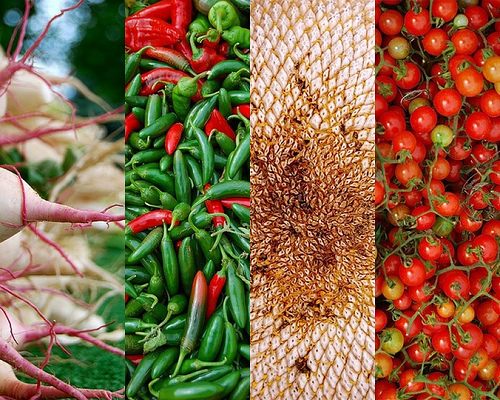
Credit: Rachel Pasch
Food is more than just a way to stay alive. It’s also a force that ties the human community together, through universal need, border-crossing commerce, kitchen gossip and dinner table conversation, potlucks and picnics, restaurants and cafes, all the places and times when we come together as friends, families, communities.
Human relationships—and our relationships with our food—have always been shaped by technology. And today, the Internet and mobile technologies are revolutionizing our communities and food consumption to degrees we are only just starting to understand. Technology has created many problems in the way food is grown, distributed, and consumed. But could technology offer solutions as well?
To help answer that question, Shareable.net teamed up with the research consultancy Latitude to study how digital connectivity shapes food choices. On Tuesday, we described how mobile technologies are now helping people interface with food; on Wednesday, we revealed participant ideas for how connectivity might help us make better food choices.
Today, we explore what our study suggests about new opportunities for local sharing and community building. “No matter what information we're after, community (and therefore trust!) seems to be an important part of it,” wrote study leader Marina Miloslavsky in a comment on Tuesday’s installment of this series. She continued:
“Personally, I buy my fruits and vegetables at a local farmer's market, and I trust what my grocer is telling me about that produce. And I trust him to tell me when he doesn't know certain information, too. Examining all of our entries for this study, people certainly mentioned shopping at farmer's markets, co-ops, and other places where building that community is easier than at a traditional supermarket.”
Thus our participants simultaneously recognized the limits as well as the promises of technology. An iPhone app might help us to navigate a world of consumer choices in a way that's more environmentally and nutritionally responsible, but we're also seeking real community. The closer the information source, the more it is trusted. For example, only 14 percent of participants mentioned that they’d like to receive background/product information from suppliers, but 51 percent said they’d like to receive this type of information from stores where they shop (response options were not mutually exclusive).
In addition to real contact with stores and co-ops that seem to share and reflect the values of shoppers, and provide a sense of neighborliness, some participants suggested that “objective” information is increasingly established through aggregating many, often diverse, perspectives. That’s where technology can prove helpful. As one participant put it:
“Blogs, blogs, blogs. Ranking systems, rating systems, investigative journalism, I get it all through the Internet. I have apps for my iPhone like 'don't eat that' and 'good guide' that help me at the store too. I learn as much as I can at home, and then carry reference systems in the form of seafood guides and price checkers for my phone.” – Participant submission, "The Interactive Future of Food"
Another participant emphasized that the information should best come through diverse sources, and that each point of access should touch the others and form a kind of dialog:
“Some sort of a kiosk with internet access, store-provided information, and a local shopper's community would have been possibly quite helpful. As what I needed were product reviews for subjective qualities, it would have been important for me to know that people were free to speak their minds (within the limits of respectful language), so the equivalent of moderated message boards with a commitment to free expression could have worked. Also, some sort of prompting for customers who left reviews to describe their experience as a user, not just rave or complain, would help; as would some rateable items, such as 'flavor' and 'mixing', depending on the items in question. This could also be nice if it could be accessed from home, and perhaps encouraged participation with coupons or special deals of some sort.” – Participant submission, "The Interactive Future of Food"
These perspectives suggest that stores—both chains and independents—can improve shopping experiences by helping to aggregate information and provide more nutritional and environmental information for customers.
These combined notions lead to a superficially paradoxical conception of the grocery store as both a node in a wider network and a focal point for local community, where members can congregate, share information, and aggregate their information with other communities. “The store of the next generation will look like a combination of the local farmer's market and the food cooperative owned locally by the community,” wrote one study participant, who continued:
“It will not only be a place to buy food, but a place to connect with your local community in real ways. There'll be some layers for Internet information sharing, many of these are already in place. Food co-op and many farmer's markets utilize the internet to keep customers and members up to date and even giving them the opportunity to pre-order a farmer's market delivery...giving the farmer more specific information for how much needs to be picked (less waste). In the end, local food and sustainability will be best served by appropriate use of technology and information, not information and technology overload (people may already be experiencing that with digitized self-checkout scanning carts and neon lights all a glow).” – Participant submission, "The Interactive Future of Food"
Rate this article
Comments
Thoughtful post by Liz . My small contribution is that while any imposition of transparency in the food supply will be bottom up, technology enabled, I believe it will also require a detente to create anything resembling trust between Big Ag and the public. Farmers markets and Co-ops are vital and the most desirable platform for trust and community, but these are not likely to address all of the needs nor all of the segments of society. A true solution requires vigilance, but not necessarily villainizing. In short, Big Ag is here to stay. So is fast food and many other things you might like to see go away.
But technology expertly wielded, within an awareness of economic realities, cultural sensitivities and the Trojan horsing of private sector practices driven by market opportunities and incentive (ROI) puts you into the game. Maybe even into the drivers seat. Transparency helps to impose accountability by arming customer influence.
Fast food, Big Ag, etc. can, thus should be, a part of the solution.
Adding to what Robbie says about fast food being part of the solution, I think it's interesting to look at the burrito fast food chain Chipotle, which now supposedly serves all free-range chicken and pork and 50% free-range beef. This video about Chipotle was a special feature on the DVD of Food, Inc., which Chipotle sponsored free screenings of last year:
http://www.youtube.com/watch?v=IAAFI9WH_Mk
It's interested that Chipotle has drawn some criticism for trying to peg itself at the forefront of the sustainable food movement, but because of its approach to human rights issues, not animal rights issues.
http://www.grist.org/article/2009-07-23-chipotle-FoodInc-sponsorship-dra...
I hope that study participant is right and the grocery store of the future is a "a combination of the local farmer's market and the food cooperative owned locally by the community." That sounds like a store I'd like to shop in.
Telling the truth is not "villianizing" - If Ray Anderson can do it about the carpet industry we can do it about Big Ag.
Big Organics - is now "in the game" - but the game us no longer system change but 'serving the niche' while not undermining business as usual.
Exxon never cleaned up it's mess in spite of promises made. That is not an attack on Exxon that is the truth. Koch Industries funded junk science to undermine public trust of science. That is not my opinion, that is documented history with a paper train.
Plastics were promised to change the world in wonderful ways - and yes they have but now we find that some of them have been disrupting the hormonal systems of beast and man - to rather tragic consequences. The plastics industry has pushed back and pushed back and pushed back rather than concede that they may be a problem.
I did not mention fast food - but the way it is done now makes people sick and is not sustainable if we are not going to dilute the term to meaninglessness as multinationals have done with organics...This is not opinion it is the history of the market.
So while I agree they must be part of the solution - That only works if they acknowledge their practices and business models ARE the problem.
Liz McLellan
hyperlocavore.com - a yardsharing community
because everyone loves a homegrown tomato!
@hyperlocavore
I appreciate the passion in this discussion! Thoughtful, engaging, edgy, yet respectful.
One point I wanted to make about big ag. Right now, it's hard to see how it could go away.
I would just add that while the economic and political strength of this block is undeniable, you could make the case that the underlying condition of the industry is fragile.
I did a consulting gig for a large foundation which involved a good bid of research on the industry. What struck me was the fact that the key inputs are seriously threatened - oil for pesticides, fertilizer and machinery; water; and capital.
Here's a scary stat - 14 of the top 40 cities in terms of unemployment in the US are in the Central Valley of California, the vegetable, nut, and fruit basket of America. There are two primary reasons. The collapse of housing. And because they're draining the water table. One county in the region has 40% unemployment because there's no water. No water, no jobs.
So my question is, what happens to big ag as water shortages get more acute and the price of oil rises?
Those with me on the consulting team were totally changed by seeing the situation this way. The client had brought us in to help them see how farming could be made less environmentally damaging - but we left the project thinking that that should not be the primary concern. We believed strongly that the primary concern should be food security - better ensuring that we can feed ourselves no matter what.
We couldn't convince the client of this, probably because they have to stay within the boundaries of their charter. They were not in the food security business.
My reaction? I planted my first garden as an adult the following Spring.
Very astute Neal! Especially "not in the food security business"...there is a good chance they won't be in the money making business if they don't stop listening with ears plugged with the words "hippy" and "dippy."
I don't think I ever said it was going away. It's here to stay - unless it fails to recognize exactly what you point out...that it's current trajectory (good, bad or neutral) is simply not sustainable...less in the green sense of the word than in the sense that what it relies on will be disappearing soon. As an industrial model it will collapse because it relies on cheap oil. That said - there are some larger growers that do get it and are making conversions as fast as they can.
You planted that garden for the same reason I started Hyperlocavore!
I am sorry that I seemed to have diverted the discussion a bit, not intentionally. I am constitutionally incapable of not commenting on certain things. And the oil spill has me extremely fired up.
I think there is TREMENDOUS opportunity for systemic change if we can bar or stop those that would make this an argument between 'hippies' and 'commerical ag.' It's not and in never has been.
Those that understand the moment - have a change to make serious change - in both senses of the word.
I look forward to a lot more ways to eat much better with less hassle!
Can we get back to high tech/low tech question. I see a lot of people looking for to solve problems with technology that to me were solved a while ago in a lower tech way.... magazines for instance.
I do think there is a lot of opportunity to create the killer food app or apps... So I don't mean to pull away from that...
I personally after nearly 30 years in tech - want to get offline a lot more than I do!
Liz McLellan
hyperlocavore.com - a yardsharing community
because everyone loves a homegrown tomato!
@hyperlocavore
Oh, and I forgot to mention another threat to big ag: colony collapse disorder. A third of bees did not make it through the winter. This is the fourth year in a row such a large decline has happened. Some fear a terminal decline. A third of everything we eat depends on bees.
http://www.guardian.co.uk/environment/2010/may/02/food-fear-mystery-beeh...
I really enjoy the story that goes along with food. Certainly, the connections we make with family and friends when enjoying it, but also the stories of how that local food came to be and the community involved in its growth and dissemination. There is nothing like the experience of a Farmer's Market-Especially of bringing your own basket, and bringing it home, just like it was done back in the day. Food is love. I have here sitting on the counter beside me, a flier for an organization called Harvest: Locally grown Foods delivered to your home.. where You shop online for a selection of seasonal products year round. It is local to Pennsylvania, but the ease of getting locally grown things through the internet- reconnects us in some way to that very core-level need we have for nourishment and story.
Check it out: Its: www.Harvestlocalfoods.com They are partners with 30 local Family Farms and Food Artisans.
Food is Art, and i do think Technology can in some way both connect us to the core level value that locally grown foods can give, and connect us to the people and their stories, building not necessarily virtual communities, but the desire to commune with our local merchants face to face, having heard their stories on line. If we can explore a website of a local business at our own convenience, perhaps when the business is closed for the day, we are so much more inclined to want to see it and engage first hand--All because we got an in depth opportunity to see the story-- where it all began. We all have a story and story connects us all.
Latitude is an international research consultancy exploring how Web technologies can enhance human experiences; its people-driven research approach unites generative, media-based methods with robust quantitative analysis to identify future opportunities for Web-based innovation. Latitude's 42s are a series of open innovation studies covering diverse topics, unified by a common digital thread, which address everyday problems of great personal and societal relevance. Visit life-connected.com for other 42s, or email ischulte@latd.com to learn more about working with Latitude.
Related Articles
- Facebook Poses a Far Greater Threat to the Web than Apple
- Policies for a Shareable City
- Top Sharing Tweeps from the Twittersphere
- Are Maker Spaces the Future of Public Libraries?
- More Than Books: Libraries Strengthen Communities in Uncertain Times
- iPhone and Android Apps for the Car-free Life
- Crowdfunding Social Change
- Libraries Aren't Dying, They're Evolving
- Mapping a World of Human Activity
- How to Be an Urban Change Agent, Shareable Style
Community Blog Posts
-
By Gary Horvitz
-
By Liz Elam
Recent comments
-
11 hours 23 min ago
-
13 hours 19 min ago
-
15 hours 45 min ago
-
1 day 1 hour ago
-
2 days 14 hours ago


I've really enjoyed this series. And Jeremy - I love that first paragraph! Thank you for asking me to participate and for putting together the information.
About "trust" - for me the multinationals need to earn it and they are very very far from it. Perhaps it's the BP spill in the news, or the under reported news that after 20 years the Exxon Valdez spill area is still completely traumatized in spite of promises and 'clean up efforts.' To me a corporation is not a person and never will be because it is an amoral entity - a fiction. And until we have verifiable systems so are their corporate "Sustainability/ Environmental Impact Reports"
If Exxon/BP/Shell/Koch Energy had to be honest for instance, about their 40 year long effort to undermine the impact of environmental and climate science on the public discourse, - a traceable effort by the way to undermine the public's trust in science - The numbers in dollars and time lost would leave us all stunned. We now have a population that believes Glenn Beck over say Cal Tech on matters of scientific import.
"Good info" is not all we need. We need the capacity to restrain the flood of lies.
I bring this up because of what Marina says about Farmer's Markets and trust. Big unsustainable growers are starting to place themselves in Farmer's Markets - among the growers committed to sustainability. This is but one tiny example.
For me and I hope for everyone interested, there is an explicit understanding that we need to route around Big Ag's attempts to coral yet again another aspect of sustainability - to in effect - empty the word of meaning as they have with the organic standard in the mind of many of us.
We are at the dawn of the transparency age and already - multinationals seek to obscure the truth of their operations at every turn. But we are many and this is just the beginning of what is possible when we are actually empowered with valid, verified and verifiable information. But it is not just a 'data' problem.
So as we consider tools - let us consider that technical fixes are only part of the solution. There is much work to be done - and I am so so excited about all the amazing people who are now focusing our attention on these issues...
and now to the garden - as Margaret Atwood said paraphrasing - In Spring, at the end of the day, you should smell of dirt.
Thank you!
Liz McLellan
hyperlocavore.com - a yardsharing community
because everyone loves a homegrown tomato!
@hyperlocavore