
Cross posted with permission from Resilient Communities.
How do you help a community transition from passive consumers of energy into active producers?
One way to accomplish this is to start a neighborhood solar co-op.
This year, we’ve seen Mutual Aid in Motion.
From scaling sharing hubs to Mutual Aid 101 trainings, we’re helping communities build the tools they need.
Every dollar fuels lasting resilience – proving that when we move together, we all move forward.

That’s just what the Mount Pleasant neighborhood of Washington, D.C. did. How did they do it?
- A neighborhood couple did the all of the work required to successfully install solar panels on their home. Naturally, they wanted to share the benefits of that research with the community. So, they formed a co-op and rallied the neighborhood (signs, fliers, etc.).
- They then interacted with people in the neighborhood to understand what their objectives were and whether solar could help them. One good tip: They did a survey that got people to look at their kWh usage and think about potential savings.
- The group grew to 350 families, the installs began, and the group was able to lobby the local government for an increase in incentives. The success of this group spawned solar co-ops in eight other neighborhoods across the D.C. area.
So, Why Is a Co-op Necessary?
It’s simple. The biggest stumbling block to purchasing a solar system is navigating the government incentives that make it affordable. Here’s an example from the Washington D.C. area (incentives are all over the map):
- A 3 kW solar panel system costs ~ $20,628 installed.
- The D.C. incentive is – $6,426
- The Federal Tax Credit is roughly – $6,188
- The final step is to forward sell your renewable energy credits for five years – $5,552
This leaves a final cost of $2,462 for the system. That’s a very affordable system at a little under $1 a kW. This results in an estimated savings per year of $559, and it will only grow over time. The pay-off period is a little over four years.
The Ideal Solar Co-op
This example suggests that an ideal co-op would do three things:
- The co-op would negotiate group rates for the purchase and installation of solar panels, driving down costs. Optimally, the co-op would have employee members who live in the neighborhood. The co-op employees would install and maintain the solar panels for customer members.
- Employee members or volunteers would help co-op members navigate government rebates, tax incentives, and the sale of renewable energy credits.
- It would lend members the money required to purchase the panels at a rate that is less than the annual rate of pay-back on the system from cost savings. Community financing methods could provide the start-up capital required to make these small loans. It’s also likely that this fund would generate a rate of return much higher, with lower risk, than the returns seen on almost ALL retirement funds.

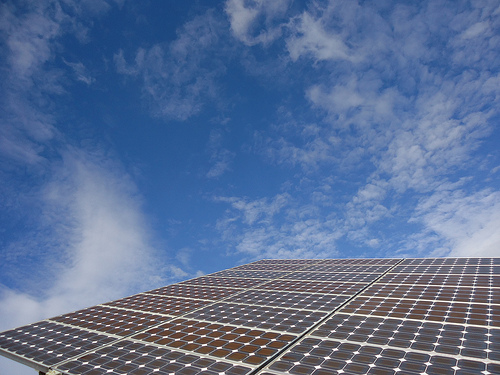
A solar-powered home in Austin, Texas. Photo credit: Garreth Wilcock. Used under Creative Commons license.
Here’s a final thought. In some places, the incentives available won’t be as aggressive as the example above. This means that community financing will be needed to bridge the gap. If the investment could be packaged in the right way, I suspect there won’t be a shortage of people willing to invest in their neighborhood’s energy system.
PS: Here’s a suggestion on timing: Take advantage of these government incentives while they are still available. A financial crisis that will sweep all of these incentives away (in both the U.S. and the EU) is right around the corner.
PPS: An alternative to the co-op business is a micro-public company made possible in the U.S. by the recent JOBS Act. This is so new, we don’t have examples yet.
##
Related articles on Resilient Communities:
