
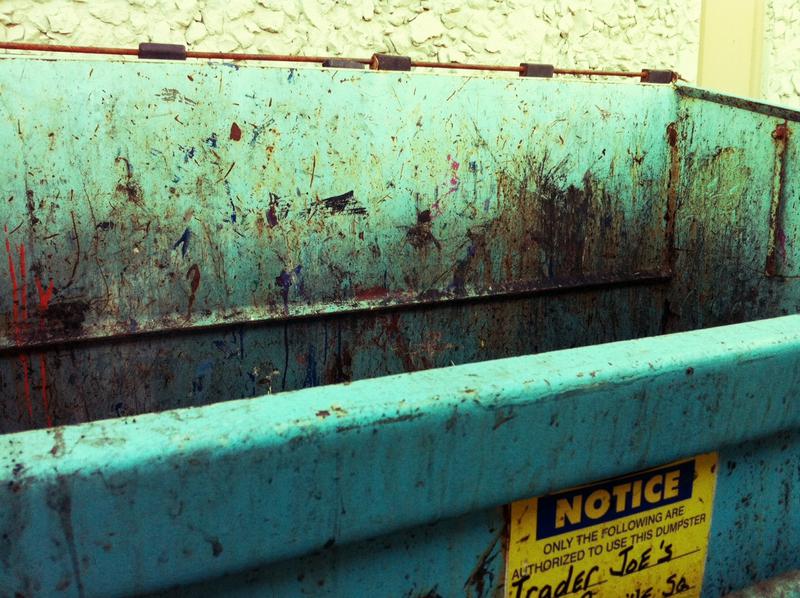
Would you climb into this? What if there's good, organic food for your family within?
Today, I pulled some bags out of a dumpster and dug through them for food, and I plan to do it again. There’s lots of goodness going to waste, and getting what we can use from the castoffs makes a difference for my family while we struggle to cover our grocery bills. And although it marginalizes me, I would rather root through these dumpsters than buy my family the kind of processed, low-quality food that better conforms to our budget.
Two years ago, I was staying in hotels that were so fancy they had subtle “signature fragrance” wafting gently from the air vents. I strode purposefully through airport terminals with my high heels clicking, and pulled my carry-on bag while holding four-dollar coffee drinks. I admired leafy lobbies from glass elevators, and shook hands firmly with company presidents. My fingernails were expertly groomed, my hair elegantly highlighted and bobbed. I could get macadamia nuts and a mimosa from the mini-bar, on company dime. I resisted that most of the time.
The first month of the Great Recession, my commissions from working as a salesperson in the natural products industry were reduced by about two-thirds. Within six months, I was making one-tenth of my typical income, and ultimately, the companies I represented abandoned the independently-contracted sales rep business model altogether. I scrambled and took what I could get to bring something—anything—into the bank account, but for almost a year, we were forced to live on our savings while we reconfigured.
Some of the skills that served me in my professional incarnation have translated well to a life living on the economic edge: cheerfulness, ability to network, persistence, and being willing to turn over every rock to find the treasure. And surprisingly, it has been a natural evolution to this thing that I’m doing, this sifting through what is rejected as imperfect, in order to take care of my family.
I’ve gotten tips from those who have gone before me: check on the legality of dumpster diving in your town. Bring a box-cutter with you. Tuck your pants into your socks. Try to befriend a store employee for insider information, and you may have to be patient in your searching, as dumpsters that “give” are hard to find. Bring a partner to provide lookout, and a long stick for dragging out treasures. Don’t go behind a closed fence to access a dumpster, leave everything neater than when you arrived, and leave graciously if requested to by a store employee or a cop. Also, you can just ask at most places for day-old bread, no diving required.
Other things to look for in addition to bruised and imperfect produce are just slightly out-of-date packaged foods. Much has been made about the arbitrariness of these expiration dates, and indeed, they are unregulated by the federal government. Terminology is so inconsistent as to be troubling: “best if used by . . . ?” “sell by . . . ?” The best rule of thumb is to refrigerate perishables as soon as possible, and utilize your common sense as well as your other senses in order to assess whether something is good to eat. Much of the risk is in deterioration of the quality of the nutrients in food, and less about true acute risk of illness.
Peering through a bag of rejected broccoli from the garbage for signs of brown or yellow patches is something I couldn’t have imagined doing just a few short years ago. Before my work got downsized, I was the kind of consumer who shopped with an eye for quality alone, without much thought to price at all. Back when I made an embarrassingly-good living, my view was that food is underpriced and undervalued in our culture, and that since I could afford it, buying the best was not only good for my family, but good for the farmers and manufacturers. I joined the Facebook page: “I’d Rather Spend More Than Shop at Wal-Mart.” Food, Inc. was my manifesto, and Michael Pollan and Morgan Spurlock my high priests. Nothing entered the house that wasn’t free-trade, free-range, sustainable, grass-fed, organic, or ethically-produced. Oh, and of course, local if possible. If it could have been blessed by Tibetan monks, I’d probably have opted for that, too.
And now, for the last two years, we’ve been living far below the federal poverty level. We sold our family car, canceled the cable and Internet, and stripped ourselves to the bare minimum of comforts to ride out these tough times. Even with that, we still rely on food stamps and the WIC program to bridge the chasm between our grocery budget and what is actually required to fill the larder. Until our youngest two are in school and I can find some sort of work that’s biking distance, this is our lifeline. Still, it’s nowhere near enough. Food stamps are only sufficient if you feed your kids ramen noodles bought in bulk quantities, cheap meat, Doritos, and non-organic milk. Giant, cheap crates of cereal, not those precious little boxes of flax flakes they sell at Whole Foods. The WIC program allows for a couple of organic and vegan choices, which is astounding progress. However, it’s all just a drop in the bucket for the needs of your average family.
What was once the territory of gutter punks and urban squatters, dumpster diving has become less-taboo for the parental set. One young woman I talked to says she dumpster dives with her mother; it’s become, for them, just another family resource for living a healthy lifestyle. And it’s not just about the free food, it’s about living in a way that’s in harmony with your values—saying “no more” to our culture of conspicuous waste. “I do it in Berkeley,” one diver tells me. “There’s a dumpster here that’s like diving into a big salad.” She took up juicing and eating a mostly raw diet to keep up with the cycle of abundance, not too bad for being “poor.” Others have a cooperative of sorts, where certain gatherers do the diving and then distribute. “Because it needs to be secret,” says Jessica R., “people only share information with close friends and those with whom they share food. I once lived in a household that survived largely off a weekly ‘delivery’ from a nearby store. But only the people who actually went to pick up the food knew where it was, and they wouldn't tell the rest of us.”
Dumpster diving is just one of the ways the New Poor are trying to survive. There’s also growing your own vegetable garden (food stamps pay for seeds,) and sharing information with your neighbors about local fruit trees (called “gleaning.”) You can trade harvests with each other, and many trees are even on public property. Some communities have informal groups on meetup or craigslist where they share information about local micro-crops. In our Northern California region, you could probably live on blackberries alone in late summer. And I have plucked pomegranates and grapefruit on walks to the park with the babies more times than I can count. We’ve registered our fruit trees at neighborhoodfruit.com, so that our harvest is available to share, and so that we might reap part of someone else’s.
I search for deals on healthy food. I no longer have an aversion to Costco, where you can get a gargantuan box of organic raw spinach for three bucks or so, as well as apocalypse-sized bags of organic brown rice and steel-cut oats. It’s easy to preach against big-box stores and faux-organic agri-business when your family has plenty of food money, but when times are very lean, you have to make some hard choices. Though we used to get CSA delivery, we had to give it up due to the precipitous cost and the fact that we couldn’t use our food stamps to pay for it. We were also practicing vegans for awhile, but have let that go as well, in favor of what we can get more cheaply. My rationale is that, at least, most of what we bring in is fairly wholesome and minimally-processed. Well, okay, except for the Cheerios and government cheese.
There is a strange sort of shame in wanting the best when you have so little allotted for your family’s needs. I’ve talked to so many moms who’ve suffered reproving looks or even disparaging comments when they’re buying organic, high-quality food using a food stamp card. The judgment being made is this: how dare you opt for quality over quantity? How dare you want better food even if it means less food for your family? I think a lot of people want to see us cliché Whole Foods snobs get our comeuppance, now that the economic downturn has leveled the living standards playing field. They want to witness us realize that the way we’ve been eating is an elitist luxury, and that, indeed, it’s not feasible for a family that’s struggling financially to make these ecological, ethical, and political choices with our grocery shopping. I know that I was raised by parents who roll their eyes at what they perceive as organic snobbery, and that my years as a strict vegetarian were seen as youthful arrogance.
And I’m late to this party: there are communities, websites, and documentaries on the subject: notably, Dive! by filmmaker Jeremy Seifert, which has won accolades in scores of film fests and green events. Jeremy says, “Experience that initial rush, shame, fear, and exhilaration of ‘stealing’ trash and eating it will change you in good ways.” In an NPR interview, Seifert asserts, "if you Dumpster dive and actually eat trash, it becomes normal for you.” Waste is built into the food chain at all levels, so there is a connection to issues related to pollution, soil depletion, pesticide abuse, and utilization of fossil fuels. Put it all together, and, says Seifert, “the devastation to the environment is immense." In a short, entertaining forty-five minutes, Dive! also points out some hard realities regarding the shameful waste of over 96 billion pounds of food every year in the US, while so many families go hungry in our communities.
Today I was thwarted in my searching through a usually abundant dumpster by the addition of landscape compost on top of the normal refuse. This particular dumpster is beyond disgusting, make no mistake. It takes psychological coaching to overcome the streaks of grunge and rust that coats the walls. I wear gloves and change clothes the moment I get home, leave my boots outside, and scrub my hands thoroughly.
For me, there was a gradual shift to what I found embarrassing as I went from being affluent to being poor. Of course there’s the waiting in government offices and applying for food programs, taking the bus, and shopping only at thrift stores. Many of us are sharing these experiences as we slide down through this Great Recession (oh, wait, isn’t it supposed to be over?) But still, obtaining food from a dumpster is a radicalizing act, and I was excited to take that step. Our family has used this time to reassess our values, and I think we’ve been doing a better job teaching our kids to question our culture of waste and over-consumption. Much of the last two years has been about regaining perspective on our own family’s wasteful habits, and at how we took abundance for granted. You can make all kinds of politically-correct choices with what you choose to buy, but it’s the buying itself that is such a big part of the problem. Feeling hungry has been motivating, and humbling. Having the chance to learn about and talk with “freegans” made me more comfortable with crossing the taboo of scavenging for food.
My favorite dumpster today yielded a small haul: organic, fresh basil in a sealed package, and a bag of organic gala apples that was open at the top, but otherwise in perfect shape. I pull it out and head for home. I keep a brown paper grocery bag with me for hauling it in my bicycle basket. I investigate everything for evidence of bugs, mold, or spoilage. I arrange the produce in an attractive pile in the refrigerator crisper.
I’m hoping that, ultimately, I can gather enough extra food to donate some to the homeless people who frequent our neighborhood. We live in a little square of paradise bordered by the rail yards, a large shady park with welcoming benches, a greenbelt that runs along a creek with well-concealed homeless encampments, and a Salvation Army that provides food bank groceries, showers, and hot meals for those who are down-on-their-luck. But what I’ve seen from this nearby food bank is all highly-processed, nutrient-poor, low quality boxed and canned goods. We have pear-, apple-, and orange trees in our yard, and I bring bags of extras to the park; sometimes I leave them the grass near a sleeping body. There’s just so much.
Why can’t we gather and redistribute to those around us? Grocers should be taken to task for throwing anything fresh or high-quality into the dumpster. The Good Samaritan Food Donation Act that President Clinton signed into law in 1996 was designed to relieve grocers of liability for any incidental harm that may come from sharing their food waste. I’ve printed a copy of it, I’m carrying it with me from now on, and I’m tempted to gently confront store management if I start noticing abundance in the dumpsters near us. I feel like I just might be waking up to true food activism: beyond the “locavore” movement, past Monsanto’s crimes and the battles for organic standards, there is the reality that our garbage cans are full of good food, while people—families, children—go hungry.
It’s been a long, humbling road from driving my gorgeous, silver, piously “fuel-efficient” SUV with the leather seats and satellite radio, parking at fancy grocery stores and spending three hundred dollars on a cart full of provisions, the most exalted groceries money can buy. I’d toss in ingredients to make the world’s most rarified smoothie out of acai and goji berries, frozen wheatgrass juice, hemp seeds, a three-dollar organic peach, and raw cacao nibs. I thought I was voting with my dollar. I’m starting to realize that taking the dollar out of the equation altogether might be a better solution. Now I bike around to the back of those stores, and pull out from their trash what we can make use of. What might be useable to someone else, I take out and carefully place it alongside the dumpster. I have to be alert so as not to run into a raccoon or an angry store employee. And I pedal back home to my family.
Rate this article
Comments
Corbyn, what a great article! I just read it aloud to my husband and twelve year old son. Many people, ourselves included, overlook others struggles for even the basics of feeding their family. Thanks for sharing your story and for reminding me to not take for granted all of the abundance in my life.
Love your article....:)... and i'll definitely print out your article to share it with my daughters...we're in similar boat, the had and now trying to adapt to still living healthy within whatever means... keep writing...you have a gift in a lot of ways besides sharing your beautiful writing, smile, and everything...:)
Corbyn, I think your article is seriously awesome!! I think you've done a great job of showing what knowledge is shared among people in a community working together to reduce waste and help each other. I also think you've shown how fragile the lines between the classes are in this country and how overall greed and lack of community has led to a larger and larger gap between the haves and have nots. Kudos to you, my dear. Keep up the good work!! It's also natural for people reading your story to feel a sense of concern, stress and guilt over their own waste and try to displace these feelings onto you...so feel free to ignore them since you know you're a good mother with your children's best interests at heart.
This was an incredible read. What is happening to your country is horrible. Thank you so much for sharing this, and showing the world what the American Dream is turning into.
What a fabulous read!!! I admire your candor. I think it is really interesting how much waste we have and what the quality of said waste is. This is a fabulous article. I was a bit struck by the comments of Kristen though--- It scared me actually. I can only assume that Kristen has a home and a family and food and water etc. I say this, because anyone who has truly had to experience the results of the economy on the level you are talking about here, Corbyn could not say the things she is saying. Basically, ironically in long format " get a job" .
I have traveled extensively throughout the country experiencing first hand with families and individuals such as yourself who are doing WHATEVER they can to push through. It is not a matter of " getting a job" We are so past that mindset for so many people right now.
I am sure those living in tent cities who used to work at a " JOB" would have a few choice words for Kristen.
I hope kristen has read your other posts as well about the other options and things you are doing and has not summed you up by saying you are not working and choosing to feed your kids out of a dumpster. The concept of helping our "country’s economy if we don’t continue to produce things of value? " makes me want to scream from the rooftop. This is EXACTLY why we are in the situation we are in! Our country has been on a track of pushing toward progress and innovation for over 100 years now, and yes.. in that 100 years we have managed to do more damage to our planet than the 4.5 BILLION years previous to that. We certainly do not need to produce another thing. NOT ONE MORE THING. The only focus should be on becoming sustainable by growing our own food, which Corbyn does, ( aside from dumpster diving which in my opinion is helping clean up the mess).
I do not discount your ideas about what might be viable solutions, but I think you are living a much different reality. One that... mark my words you are closer to than you think. It is those like Corbyn who will survive in the long run, those that feel that a JOB is the answer to survival have some serious waking up to do. I have spent too much time with people who are actually spending their days just trying to EAT and SURVIVE lately to know that this country is in a situation that is so much more dire than most of us are willing to SEE.
Those living in the bubble of suburban safety should not judge or condemn ANY idea those pushed to the brink of simple human existance are making---- to ... well ... SURVIVE.
You simply do not have the right. Sorry but you do not. Unless of course you live in a tent city... and if you do... let's talk... I have some work for you.
The thing that alarms people perhaps, especially family members is the fear that poverty and "desperate measures" are somehow contagious. You are crafty, creative, strong and HAPPY and that is threatening...no one wants to examine their own lives and find them lacking.
When you decide to go off the beaten path it's easier to judge you than to cheer you on because that would be confronting ideas like valuing money over time and things over family. I am personally shocked that your sister of all people doesn't know the measures you have unselfishly taken to keep your family afloat. And you are the happiest I have ever known you.
You and Larry are a good team and you adore your children and the fact that you have made it through such massive changes intact speaks volumes for your character. You have lived several lifetimes and each of them have been fascinating. I can't wait to see what the next few years hold, please keep blogging about it! It takes huge courage to write the things you do and I applaud you.
Kirsten: don't dumpster dive, it's fine. But please toss all your perfectly good unwanted, expensive items in the dumpster of your choosing (in sealed bags, please) and then let us all know the location of said dumpster. K, thanks.
I guess I'm the only one commenting that cringed at the idea of eating something that came out of a place where she had to wear gloves and change clothes after exiting. (Yes, I know that if she were farming she'd have to do the same, but dirt is a lot cleaner than those dumpsters!) Ugh!
You are not the only one. I found this repulsive, esp. if she feeds this food to her children. There are other ways to feed your children, and food stamps and WIC DO provide rice, beans, whole wheat bread etc...it isn't all processed food as this story claims.
As far as the "GREAT Depression" Our Grandparents lived through that and what we are going through now is nothing compared to that. Please stop using that term, it isn't the same.
Alison: wow, what a hurtful comment. :( Do you realize there is a living, breathing author on the other side of this article? Wow. Anyway. Mushrooms are grown in cow dung. All garden and farming supply stores sell manure such as bat guano, chicken poop, and steer manure. Commonly believed to be the best source of fertilizer, and used universally. Animals are slaughtered in deplorable conditions, often contaminated with disease and/or their own fecal matter. Not sure where you're getting your SANITARY food, but here at my house, we wash. We wash our food, avoid meat and dairy, and keep our home, bodies, and clothing healthy and scrubbed.
In regards to using the term Great Recession: are you a frequent reader of shareable, or any of the majority of news websites out there? This is the standard term adopted by the Associated Press. From Wikipedia: The term was periodically used to refer to recessions in the post-World War II era.[1] Only more recently did the term gain acceptance in media and academia as exclusively referring to the late-2000s recession and the anemic economic growth that has followed in its wake, as well as a general term for the ongoing financial crisis.[2] In 2010, the Associated Press added the term to its style guide as the official title for the "late-2000s recession."
Thank you for your worthwhile remarks, though.
Corbyn
What is hurtful? That feeding your kids out of a dumpster is repulsive or that comparing what you consider the "GREAT Depression" isn't really that? If you are going to write articles you need to be open to opinions that are not exactly like yours without getting "hurt" by them.
Hey Corbyn,
Just want to say thanks for sharing this with such honesty and clarity. You are like any great American writer making the most of your life and your experience. Your kids are lucky to have you with them. You are teaching them all sorts of great things chief among them is that they are not alone, that they are loved and that there are more important things than money or the pursuit of it or appearances...or producing more shit no one needs at a cost no one can afford. It astonishes me how some people measure "worth."
I suppose Allison is right - no one that blogs should fear being judged...that's what folks do as a matter of course. Allison just know you are being judged and found wanting as well...
If you need any seeds for that garden you know where to find me - I have a ton and would be very happy to send some!
You are kind, Ms. McLellan. And thank you. I needed that. xoxo and <3, and write to me privately if you mean it about the seeds. :)
Allison, if you read carefully, Corbyn says Great Recession, not Great Depression.
And while dumpster diving makes for an interesting headline, the story is really about the imbalance between food produced and people fed, and the unnecessary human suffering and environmental damage that result.
Corbyn's personal story illustrates a larger problem, one that's easy to ignore if talked about in the abstract. But it's hard to ignore Corbyn's story. She brings some uncomfortable social truths close to home.
So while I understand your disgust (I've eaten dumpster fare, not always a comfortable experience), consider saving a portion of that disgust for the stupidity of our food system.
And in any case, I'm all for dumpster diving. Dive proud! And legal and safe.
Neal
Corbyn, as always we are humbled and inspired by your candor and your genuine, authentic, fiercely brave and ultimate mission to keep your family afloat. Another incredible piece. xo
Thank you, Corbyn. And many, many of us think the name "Great Recession" is a euphemism and Newspeak. My parents lived through the real Great Depression and it was different - mostly in that the dumpster people took care of one another and that there was less shame, because the television had not coopted people's minds. I work in a thrift store (and also am living just above poverty and used to stay in luxe hotels), and I can tell which generation my customers are. The ones from pre-WWII are outraged at the gas companies and big banks. The baby boomers on down are outraged at the poor and at those "greedy union workers who won't take less." Today I finally realized - it was television that has colonized the minds of the younger into believing in a world based only on money and consumerism. I haven't gone thru dumpster yet but am friends with the one who goes through our store one (and have placed things there for her). I look forward to the Great Shift and whenever it reaches Indiana - probably last - My Depression survivor parents absolutely never tolerated attacking the poor in our household, however well off they became. So very, very different from the entitlement (and here I do not mean Social Security) of my generation, who think worth is measured by the size of one's stock portfolio. Go, Corbyn! I'd love to read a blog by the "New Poor," actually ... and share some of my own stories ...
Allison - you can't read. She says Great RECESSION not DEPRESSION and she did not invent that phrase. Many articles use it to describe what has happened. Too bad your family who survived the Great Depression never taught you compassion. It is a shame you spend your time leaving silly shallow remarks on intelligent articles that only reveal your small mind.
OK Judy and Allison. Let's be excellent to each other. It's OK to disagree, offer different perspectives, share information as long as it's done at a minimum respectfully, though we encourage inspiring levels of compassion and grace.
Let's model the world we want to live in.
That's a very funny comment. You do realize that there is an acceptable amount of *feces* in ground meat, right? My point is not that meat is bad - but rather that the "clean" food you believe you're getting from a store is not that clean. You can wash vegetables that came out of a dumpster, they are no more dirty than vegetables you buy in a store.
Further to that, I would rather eat vegetables from the dumpster than processed food with all kinds of artificial colors, flavors, stabilizers and more.
Corbyn,
Excellent read, and something I've been thinking about quite a bit recently. What are you doing now? I'm in the natural foods industry - send a way for me to contact you, I'd like to talk.
Best of luck to you!
I have difficulty with this. As someone who eats well on LESS than you are probably getting on food stamps, I know it can be done. We did the food stamps thing before. We had half the children we do now and I spend HALF now than what we received on the dole. I make food from scratch. I use coupons. And contrary to what people seem to think, you CAN get coupons for meat, produce, organic, gluten free. It's out there! I often get soy milk and almond milk FREE. There is plenty of waste, I will give you that. But our local stores sell their blemished fruit, dairy products close the sell by date and that sort of thing at up to 75 percent off. Not all stores throw it away. Some even donate it.
I liked the story. I think it's funny that she's still trying to hold onto her old ways of living. Sorry, but even when most of us were making our most money, we still couldn't shop at Whole 'Paycheck'. This woman is a food extremist; She doesn't understand moderation. I think she needs to stay poor for a bit longer. I don't think she actually appreciates it. To her it's a game, a joke.
I'd like to see her turn her head at a can of Spaghetti Oh's if she was actually starving.
I'm going to laugh at her when I get home from work tonight :)
I applaud you and your amazing spirit. So resourceful, so brave. A courageous mother doing the best for her family. Your positive attitude will see you through this and when you get back to a more comfortable place your personal growth undetaken will propel you to great things. This is true American spirit. You have gumption. Truly you do. So many don't. You are a winner. Your children are so lucky to have you as their mother.
Yes! to the person who commented about making food for less than the amount on food stamps. Millet, brown rice, dry beans, whole grain pastas, cabbage, onions, carrots - these are all fairly inexpensive (they could be free for everyone...) and easy to find. You could make whole grain porridge with dried fruit for your kids by soaking millet overnight in 5 cups water with fruit and boiling and simmering with a pinch of salt in the morning for around 40 mins. Make bean stews from scratch. Cereal isn't that nourishing anyway and people have been living on whole grains and beans for thousands of years (with some animal products). Your health would probably improve!
As for the American Dream commenter, it's up to us to create it. So maybe we have an opportunity to revise and make what we really want happen. Did anybody really want white picket fences and tiny yards? Cynicism is a waste of your energy and you're doing it on your parents' and grandparents' dime. Contribute or go build something else.
Good luck to you and your family, and good luck to everyone posting.
Hi again - one more thought. The price of cooking oil gets to me so I bought a bunch of unhulled (tan) sesame seeds. You can sort, rinse and toast these and then grind them up and put them in veggies and grains for a good quality fat. Another thought - join a buying club from a distributor. Ask at a food co-op (Mariposa in Philadelphia, for example) and buy 25 lbs of rice and beans of several different kinds at a time. You put more up front and you also save in the long run. With a family you could buy 50 lb bags or go in on this option with neighbors. Store the food in food grade plastic buckets (Home Depot has 5 gal. buckets for a couple of bucks plus the lid). Line the buckets with mylar bags - you can find them online. Foods like miso (from mitoku, Miso Master, South River or another distributor/ maker who ferments without the chemicals one finds at east Asian markets), homemade pickles (sauerkraut, non-vinegar pickles in ume vinegar or shoyu or a salt brine), and soups and seaweeds (also from healthfood stores or bulk distributors - Maine Coast Sea Vegetables has decent prices) add a lot of nutrients and improve your ability to absorb nutrients for a worthwhile cost. I wonder if you could use food stamps for the buying club. You can get great food from those distributors. UNFI, for example. I think you can organize buying clubs through them. Check them out online. Have fun!
Clearly a subject important to me.... Thought I'd also mention Food Not Bombs. Worth checking out and also a way to help distribute food in addition to getting great food and meeting great people.
Since the conversation has turned toward the viability of eating healthy food affordably, this Ask Metafilter thread is a great resources of ways to eat cheaply when shopping at the specialty grocery stores: http://ask.metafilter.com/175011/Hacking-Whole-Foods
eeerm... I don't know. I don't buy it.
I mean, as one who has never had the affluence to be a member of Costco, I don't quite understand, "overcoming the aversion to Costco." Aldi, and bring your bag.
All power to you, but let's not get ridiculous. I worked at Whole Foods--they give their extras to food banks, where it should go. It's important to be frugal, but one can do so in multiple fashions that don't involve "diving for food."
So...what's the real agenda here?
I love Costco. I don't have an agenda. I have made $43 in donations today thanks to the New York Times publicizing my website, and I have sold two of my little "books." I don't want to go on Oprah. I don't want anything except to be a good person (better person, every day,) and to write. And to raise good children. And to learn from my mistakes. That's all. No agenda.
After reading most of the comments in this blog, i finally found one that was able to capture what i think about this whole business of diving into a dumpster to feed you 3 kids vs giving them cheese, bread, or canned tuna from a WIC certificate.
Corbyn, I know you've been through hell and back, but you seriously have to rethink your strategy here. I have a feeling if by some miracle you get to back to your 6-figures salary overnight, you'll still end up diving in dumpsters when another recession hits because you haven't learned from your mistakes. My husband and I were able to survive at $11,400 a year for 3 years when we were grad students. We even had monthly savings then! Granted we didn't have kids, but those difficult years allowed us to learn.. like how to live below our means. thinking 10x before spending a $ or how to adjust and choose the difficult path when we had to. Even now that we have more than enough money for our daily needs, we still cling to those methods of spending. My hope is that you will learn what is essential, and forget about these childish freegan thinking. These stories are entertaining, and may sell some books -- but what are you teaching your kids? Please think about that too. I mean well dear, and I am deeply concerned. I hope things will work out for you and your family. Good luck.
Hi Corbyn
What a fantastic article. Might you be interested in being interviewed about your experiences for a UK magazine?
Cheers
Claire
Oh! Yay! I'm writing, cleaning, and doing childcare. I also find myself car-less and taking care of my preschool-aged children while my husband works. What do you have in mind? Write to me at corbynhightower@gmail.com
great. what's the best way to talk about it - email?
I'm handling the needs of multiple children right now and most all day, every day. Can you email me with the details, and we can make a date for a phone call?
absolutely. talk soon
Good day Corbyn,
Your story is amazing and heartwrenching. As a company that likes to support others who are in need, we would love to feature this story on our new blog. Please email me at your earliest convenience.
Thanks,
Moya Watts
www.partyofpurpose.org
I'd originally thought to talk to you about working again in the natural foods industry - we are a young company with huge demand, and could always use the experience. However, when I didn't hear back (and for some reason my follow up didn't post), I checked out your site and the follow up comments - you're clearly doing better here, and you're a lovely, lovely writer.
Best to you and your family!
Crap! I'm so sad I missed the opportunity. I need income, I don't earn nearly enough from writing. I'll do any job, nothing is beneath me.
It's sad to hear that you're not finding fresh, healthy food at your local food pantry. My husband works for a small national social NGO and regularly picks up fresh produce (often organic!) which he and the volunteers then distribute to families living in motels. Unfortunately, he's found that he can give away canned peas all night but people are hesitant to take the organic baby greens and mangoes. There are so many levels of new poor and we hope to soon be able to offer nutrition and cooking classes so that we can feed people and feed them well.
Hi Moya,
You may republish as long as you attribute Shareable Magazine and provide a link back to the original story.
Thanks for participating in our community, and sharing our work.
Neal Gorenflo
Publisher, Shareable Magazine
This makes me curious to go look in the dumpster behind our supermarket.
I applaud you for maintaining your food values as best as possible despite financial hardships. I've been blogging a lot lately about our challenges to keep below our grocery budget of $65/week (or $3 per person, per day), which is only slightly higher than the food stamp budget. Last month I was under budget, despite buying only organic milk/butter/yogurt, free-range eggs, and mostly organic produce (I do make concessions here for the "clean 15"). We save money by not buying bread (I bake it), maintaining a vegetarian diet, and not buying snacks/prepackaged items or beverages (aside from juice & milk). We always do a CSA, but we make it possible by only spending $20-30 per week on other things (basics like flour, milk, cheese, juice, beans) when we are receiving a share It is definitely do-able; it just requires the ability and willingness to prioritize real food over junk.
Corbyn, thank you so much for this article and your honesty. After a complicated series of events (I'll sum it up by saying "divorce"), I went from being part of the SUV-driving, suburban-living, well-employed "upper middle class" to being unemployed, without a car, and getting food stamps for myself and my two children. I can not tell you how many times I have been at the checkout of the local "natural foods store" with my cart of bulk foods (things like organic rice, flour, beans, etc are cheapest to buy in bulk there) having a pleasant chat with the cashier until that pivotal moment comes for payment and I say "This is an EBT." Suddenly they will no longer look me in the eyes, and I don't get a "Thank you" or a "Have a great day" as I push my cart away. (And yes, I am sure that is their problem, because if I go into the same store and pay cash, it is a totally different experience.) I see a number of commentors here who have the same attitude. They would do well to remember the old adage not to judge someone until you've walked a mile in their shoes. I am not so proud as to allow the discomfort and judgment of others make me conform to their idea of how I should live and raise my family. Kudos to you for having that strength as well. We will survive, sister <3
this is a fantastic article, and i'm so glad you were brave enough to share it, especially with a less than enlightened audience.
there is SO MUCH waste from our food system. i know someone who farms, and feeds his animals solely from food wastes obtained from local supermarkets (and hay, from his fields). it's truly nauseating to think of all that food going to landfills to sit and sit and sit and never decompose, when so many people could get so much good out of it, if only we opened our minds just a little.
good luck to you and your family, and please keep sharing stories like this one.
Thank you for writing this article and giving us the perspective that nothing is impossible. Your limitless thinking and fearlessness is inspiring.
Thanks for the article!! It really sparked something in me. We've managed decently on one salary for the past four years, but without being able to pay down our large debts. We're now thinking about going down to one car and cruising by our local dumpsters on a regular basis. I don't think it's repulsive at all to feed ourselves from a dumpster, but I'm having trouble finding a good one. We did go out on our first non-food adventure to see what we'd find. We scored a really good storage box full of goodies from a college, a brand new guitar case and amp cords, and a brand new xl dog kennel. I was amazed that we found that much good stuff in just a couple hours. Thanks, again!!!
Are family went through a very simmiler transformation, although we were always in more the radical community being anarchist, we had a very high income because my husband,s job and had in a sence become food snobs. Forgetting alot of our core value so when the resetion hit and we were forced into a state of quote unquote poverty it gave us back something amazing , our community, our values ,our souls really, and I would never go back , my children now help with foodnotbombs like I did as a street punk kid and I couldn't be prouder
Wow. Thank you for sharing. It makes me sad that stores can just leave out expired, "cast" away food for people, and instead, they need to dive the dumpster. You are so right that the waste in our food chain is a shame. It is indicative of most major systems in this country, ie. energy, healthcare. Your articles is a lot of food for thought. No pun intended.
Correction: I meant sad that stores just CAN'T leave out expired food, etc.
Amen!
And that was supposed to be an Amen to knuspermuesli's comment.
Dumpster diving rocks! I've seen better stuff in a dumpster and sometimes very dangerous stuff still IN the store!
Just be safe!
Thanks for the article Corbin. I think America has way too many germ-phobias....
Next comes humanure!
Related Articles
- The Ultimate Guide to Traveling Without Money
- 9 Ways to Kick Off a Shareable 2013
- How to Make a Party Box to Share with Neighbors
- Help Us Improve Shareable (Takes 2 Minutes)
- Is Living in Your Car a Viable Way to Save Money?
- How I Saved $17,000 in One Year By Sharing
- Live Aloha in Your Neighborhood (or Making Friends with Mangos)
- "Shift Change": Doc on People-Centered Business
- 6 Online Services Making Food More Shareable
- How to Host a Great Sharing Event
Community Blog Posts
-
By Drew Little
-
By Tim West
-
By Liz Elam
Recent comments
-
4 hours 36 min ago
-
1 day 1 hour ago
-
1 day 5 hours ago
-
1 day 6 hours ago
-
2 days 4 hours ago


Great stuff Corbyn, my college house was near an Odwalla dumpster - my friends and I would fill our fridge with hundreds of bucks worth of free juice all the time. And Trader Joe's doesn't do the environment much a favor with all that unnecessary packaging, but it does help dumpster divers.