
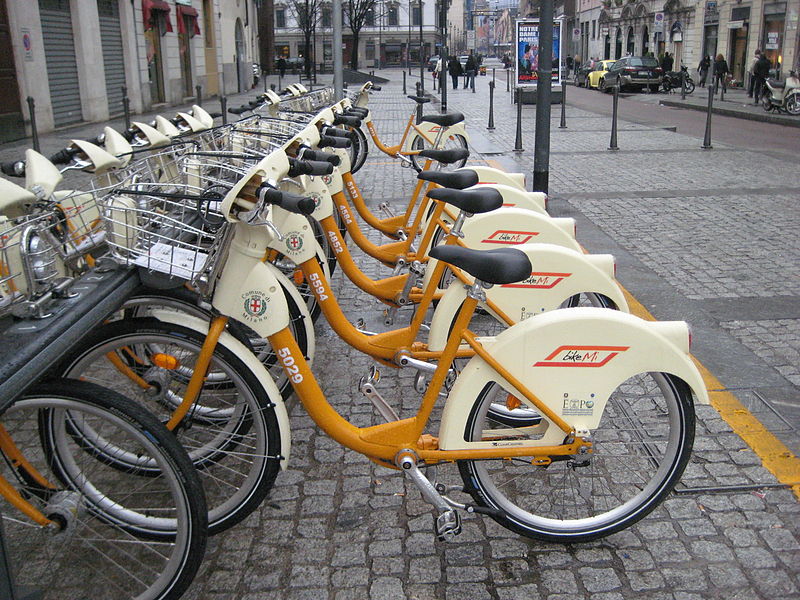
Bike sharing is a two-wheeled transit service — call it bike transit — which started in 1965 in Amsterdam and has since spread to nearly 250 communities around the world. The service allows individuals to rent a bike from one of many unattended stations, or docking points, and return it to any station. Before implementing a bike-sharing service, it’s important for public officials and staff to consider the following:
1) Be a bike-friendly community first.
Your community should be bike-friendly first with a dense network of bike facilities such as cycle tracks, bike lanes, and trails. This network of bike facilities will enable bicycle riders and your future bike-sharing customers to easily and safely travel through your community by bike. The League of American Bicyclists’ Bicycle Friendly America Yearbook offers examples of what other communities have done to become bike-friendly. Communities with bike-sharing services also have high Bicycle Friendly Community ratings and include: Arlington, VA (silver), Washington, D.C. (bronze), Minneapolis (silver), and Denver (bronze). Before implementing a bike-sharing service, a community should be at least a bronze-level Bicycle Friendly Community.

A Capital Bikeshare station.
This year, we’ve seen Mutual Aid in Motion.
From scaling sharing hubs to Mutual Aid 101 trainings, we’re helping communities build the tools they need.
Every dollar fuels lasting resilience – proving that when we move together, we all move forward.

2) Bike-sharing is not cheap, so secure sufficient funding.
By implementing a bike-sharing service, you’re launching a new transit service. It may be less expensive to purchase and operate than a bus or rail service, but sufficient funding is required to make it successful. While the types of bike-sharing systems vary, costs can be up to $5,000 per bike for capital, and operating expenses can range from $100-200 per bike per year. A service with a couple hundred — or thousand — bikes is pricey. However, while implementing a service is not cheap, bike-sharing can be a cost-effective public transportation option.
3) Size and density matter.
A bus service with a solitary bus or just a couple of stops will only be accessible to a limited number of people — those living, working, or playing near the stops. The same can be said for bike-sharing, as the greater the number of bikes and the wider the network of stations translates into a more successful service. Station density should be such that a customer can find a station every couple of blocks. In fact, a bike-sharing service’s usefulness will increase exponentially with each additional station, as each station expands the reach of your service by better connecting places into this new transit system.
4) Build public-private partnerships.
Bike-sharing lends itself to public-private partnerships. Private organizations can assist the implementing agency by sponsoring the service or purchasing a station for outside their worksite. They also find bike-sharing good for providing their employees a healthy commuting option, making their location more accessible to customers, being environmentally friendly, and promoting a green service. The public benefits by having some of the costs of buying and operating a service covered by private organizations. Whether the implementing agency is a local government or non-profit, both have successfully taken advantage of sponsorship to help expand their service’s reach. Barclays Bank sponsored Barclays Cycle Hire in London to the tune of $40 million; BlueCross BlueShield of Minnesota sponsored Nice Ride Minnesota in Minneapolis with $1.75 million and has offered up to a $1.5 million match for expansion of the service. For bike-sharing implementers, private engagement can expand a service in a cost-efficient way — creating a win-win for both parties.

A Melbourne Bike Share station.
5) Don’t do it alone, work regionally.
Bike-sharing can produce the greatest benefits when done regionally, which is why the Paris and Washington, D.C. areas have regional services. For commuting trips, bike-sharing is ideal for the first-mile/last-mile challenge of getting folks to and from longer haul transit services. Implementing a service takes a lot of work, but sharing the workload, and expenses among multiple jurisdictions is a great deal. Additionally, it’s important that jurisdictions within a region have the same, compatible service, so riding from one jurisdiction to another is smooth and makes for a pleasant customer experience.
With the number of bike-sharing services in the U.S. and worldwide rapidly increasing each year, bike-sharing has proven effective at serving the public well for short urban trips, as well as complementing other modes of transit. However, like any other transit mode, there are pitfalls — both shared with other transit modes and unique to bike-sharing — which should be avoided to ensure a successful, well-used service. Following this advice will get your jurisdiction rolling in the right direction.
Paul DeMaio is the founder of the bike-sharing consultancy MetroBike, LLC and co-author of The Bike-sharing Blog.
