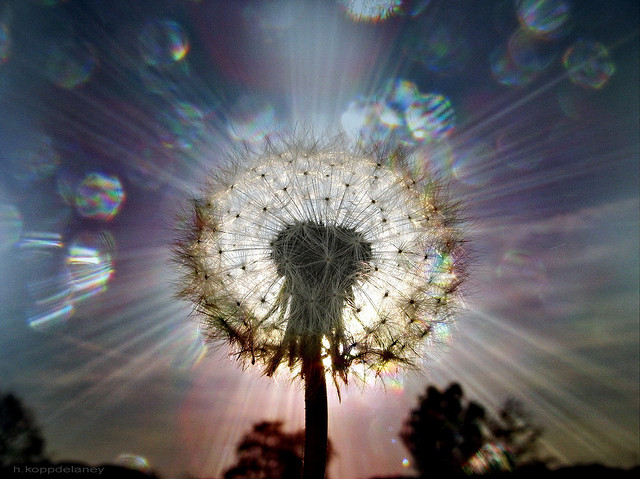
Credit: h.koppdelaney
“God is dead,” famously proclaimed Nietzsche. Driving by a local church sign recently, I read the words: “Nietzsche is dead.” - God
Cheeky indeed. While I assume the church sign was meant as a rebuttal to the idea that God has become irrelevant, unfortunately, merely by framing the statement in similar terms reveals the post-modern nature of our current social reality.
We live in a world of mythologies that appear to contradict each other. After all, on the bedrock of science, we've been taught that either something is true, or not true. It cannot be both. (Or course, while quantum theory has shown differently, we have yet to integrate that reality into our mainstream discourse).
Therefore, when studying various creation myths from around the word, either one is true or not true. The world cannot have been created by an omnipotent and wrathful God (Christian), and yet also have no initial creator (Buddhist). The planet is either 6000 years old, or 6 billion. To be a good citizen, work hard and shop. Or reduce your environment footprint and live off the land.
This incongruity has become more obvious as our economic, environmental, political, and educational systems are breaking down, revealing what Jonah Sachs (Winning the Story Wars) calls “the myth gap – the space between the realities of our moment in history and the shared stories to which we turn for explanation, meaning, and instruction for action.”
Our culture desperately needs to update our shared myths, to allow us the inspiration and courage to rise to the challenges of our era. But how will these myths be constructed? And who is qualified to even propose them?
Enter Marc Erlbaum.
Marc is an earnest filmmaker from Philadelphia, with a number of films already under his belt, including “Everything Must Go” starring Will Ferrell and “Café” starring Jennifer Love Hewitt. One morning, he had an epiphany in the early hours before dawn: what if our new cultural myths could be gleaned from the myriad of voices around the planet? What if a universal truth about the meaning of life could be crowdsourced?
The Life Means What project was born.
The first step (appropriately) is a crowdfunding campaign to raise the funds for the project. Already over two-thirds toward their $150,000 goal, and with 2 weeks to go, you have time to help manifest the dream.
The next step will involve pairing with talented and visionary filmmakers and creatives to produce an ongoing portrait of our new mythology, from a variety of perspectives. Content will include interviews with known inspirational figures, but also many characters from across the spectrum of life, from all countries and all continents.
After all, history was most often written by the privileged few who controlled access to the information and tools. The new story of humanity will be authored by the collective, through celebrating our individual diversity, just as every mature eco-system in nature values every leaf, every tree, and every seed.
If God is dead, it's only because she knew it was time for us to grow up.
To help fund this project, visit Life Means What and add your funds today.
Rate this article
Comments
Thanks for your comment Laodan. I'm not sure I grasp what you're saying... I argue that our myths create our world. Those of us who agree that humanity has gone off the rails realize that we need to develop and apply better myths to allow for us all to rally to the cause.
To simply know "how" civilizations, worldviews, and culture interact is not enough. I think there's plenty of scholarly material on that... it's putting great myths into practice that is the hard part.
That said, I suspect you might perhaps be in line with what Thomas Hubl is saying in this clip from my interview with him. He suggests that humanity doesn't need "new stories" we need to see through stories... https://vimeo.com/39867656
@Ian
I understand what you're talking about Ian.
"Those of us who agree that humanity has
gone off the rails realize that we need to
develop and apply better myths to allow
for us all to rally to the cause. "
Comprehending "how" civilizations,
worldviews and culture interact is a
very complex subject and contrary to
what you stated there's not "plenty of
scholarly material on that". Fact is that
the research on this subject remains
at an intolerably superficial level.
Coming back to the subject now. No I
don't follow Thomas Hubl's argument.
His position is akin to the early teachings of
Buddhism, Taoism, and animism. He speaks
about raising individual consciousness towards wisdom. Sure with wisdom the sage does not need a story any longer, for as Don Juan Matta would say, he is seeing "reality" or at the least the big picture of it.
But "raising individual consciousness towards wisdom" has never succeeded to enlighten more than a small minority. The majority has always followed the story told by the sages among them.
In this sense, yes you are right, to navigate the transition from modernity to what comes "after modernity" societies will need stories shared by all in order to solifify the necessary societal cohesion to possibly bring us to the other side of the bridge...
But once that necessity is recognized we soon find out the following:
1. Sure a story, shared with those in one's environment, gives peace of mind and quietens the individual which smoothens his societal integration. But this brings us to ask what is the societal group in which
we envision the story to be shared by all? Is it the whole of our present society or is it a smaller gouping?
2. in the context of complete atomization of our present "late modern" societies, how could a new story or for that matter any past story as Buddhism or Taoism or the Religions of the Word or even Animism, possibly find acceptance by the great majority of individual atoms in the societal body. This is rather implausible.
Only under sheer necessity of survival will we, consumated individualists, willfully share a story in order to unite in a societal group.
In other words stories and groups are intimately inter-connected.
Once our societies break down to the point that we can't satisfy any longer our most basic needs then the sheer necessity of survival will impact us frontally and
only then will we "follow" the best
societal group opportunity available to us and as condition of our insertion in that group we willgladly share the "foundational story" of that group.
This is what I meant in my initial post by "this all will be taken care of by the principle of reality or the natural rebalancing of societies".
Having said that I'm still grappling with "will"
or that voice in my mind that says that we
should be taking the initiative and
voluntarily change society and our lives.
It is at this juncture that to me appears the
necessity of understanding how civilizations,
worldviews and culture interact. It is indeed the wisdom procured by the mastery of that understanding that gives us to "see" the big picture about the whole of reality.
This concept of "seeing" brings us back to
your original statement: "Those of us who agree that humanity has gone off the rails realize that we need to develop and apply better myths to allow for us all to rally to the cause. "
Why is it we need such a story for being able to rally to the cause?
It is because the majority among us does not attain the "wisdom to see" and consequently the "whole" remains thus utterly unattainable which gives us to think that we are insignificant particles in it. But by sharing a foundational story about that whole with those around us we "as per
magic" eliminate the insecurity that the thought about our insignificance instills in us and also "as per magic" we substantiate a shared meaning of life that gives us the assurance to walk forward with enthusiasm.
Such a foundational story is no more than a
simplified version of the vision "revealed"
by the wisdom procured by the mastery
of the understanding of "how civilizations,
worldviews and culture interact". This is why I firmly believe that what we most urgently need in late-modernity are sages who tell simplified foundational stories for all to share...
Thanks Laodan - much to consider... especially the last part "what we most urgently need in late-modernity are sages who tell simplified foundational stories for all to share..."
can you offer anymore illumination on this? what it would look like? thx.
The world cannot have been created by an omnipotent and wrathful God (Christian),
So true! Great peace of text
Looks like it'll be an interesting movie! I like the fact that people can choose who gets interviewed.
Related Articles
- The Ultimate Guide to Traveling Without Money
- How to Date Without Money
- Kicking off a Year of Open Source Everything
- Help Us Improve Shareable (Takes 2 Minutes)
- Is Living in Your Car a Viable Way to Save Money?
- The Abundant Life of an Intentionally Homeless Cat Lover
- "Shift Change": Doc on People-Centered Business
- Crowdfunding Dinner Bridges Campus-Community Divide
- Share this Book! The Free Version of Share or Die
- Getting Hip to Brooklyn Sharing Culture
Community Blog Posts
-
By Jordan Mann
-
By Kelcy Smith
Recent comments
-
6 hours 15 min ago
-
7 hours 52 min ago
-
11 hours 56 min ago
-
11 hours 58 min ago
-
16 hours 59 min ago


Great.
This subject will indeed determine how we, as individuals and societies, are going to navigate the waters of this transition from modernity to what is coming after modernity.
"Our culture desperately needs to update our shared myths."
But in reality:
- our culture is how we live in the present
- the myths you speak about are part of the "worldview" all citizens share amonst themselves within their society. (fact is that modernity did not supply us with a worldview... and thus our societal troubles today in late-modernity)
- from their early origins civilizations established axioms upon which are then built the successive worldviews that the individuals share within societies. Culture as the formal expression of societal life in the present is thus ultimately driven by those axioms and also the worldviews we share.
But are we conscientious about the existence of those civilizational axioms of ours?
What is most urgent is not to define a new worldview, nor foundational myths, (this all will be taken care of by the principle of reality or the natural rebalancing of societies) but to understand how civilizations, worldviews and culture interact.