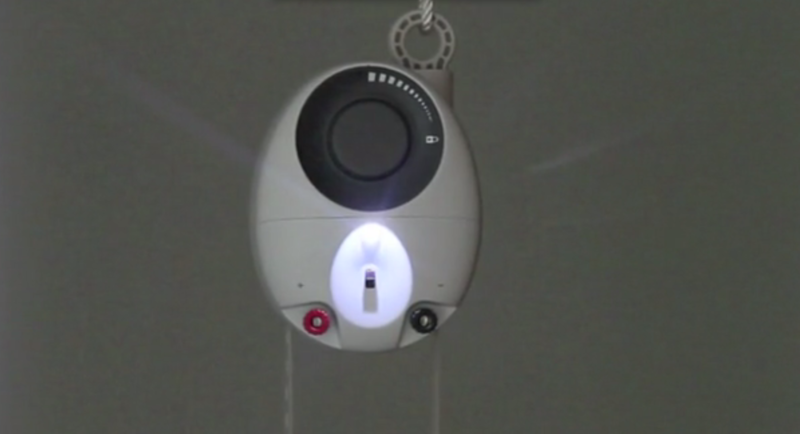
This IndieGoGo campaign for the Gravity Light is also an eloquent reason why crowdfunding, with all it's youthful troubles considered, is so important. It lets everyone fund their own skunk works to solve problems that are important to them.
Thankfully, crowdfunding is put to good use here with an inexpensive, clean, durable, elegant solution for household lighting in the developing world. Meant to replace expensive, dirty, and health threatening kerosene lamps found everywhere in Africa, the Gravity Light requires no fuel or batteries -- it powers LED lamps using gravity with an ingenious mechanism reminisent of pendulum clocks. The light is to cost $10 and will pay for itself in fuel savings in three months. There's zero running costs.
The more support they get, the more homes in Africa can be lit in a inexpensive and environmentally sound way. Pitch in today.
Rate this article
Comments
Interesting that you choose the gravity light as an example of the power of crowd-funding, because those in the rural electrification space are using it as an example of its failing. i.e. how a sexy or novel idea can gain traction when it wouldn't gain investment anywhere that tough questions get asked.
When a Real Estate ad fails to mention the location of a house, we assume there's a good reason. We should apply the same skepticism to a lantern that fails to mention how much power - in Lumens or Watts. Its not just the articles - and there are others all over the net (someone generated good PR) but also on the Indigogo and their own deciwatt.org site it neglects to mention the power. (The indigogo says it won't charge a cellphone and refers to Deciwatt which says nothing about it).
An engineer friend who has done the math says it would take a weight over 100kg being lifted every 30 minutes to achieve the light output of a typical solar lantern. That's the weight of a heavy human, so its unlikely which means this light is going to be low illumination, but still expensive (note its $5 estimated manufacturer cost, which translates to $20 in the field, not the $10 mentioned on the video - most solar lanterns cost about $7-8 to make and sell at about $30)
I'd love to be proved wrong but in the absence of meaningful info from either the company or the "journalists" who covered the story it has to be assumed a non-starter.
Mitra Ardron,
Natural Innovation: www.naturalinnovation.org
Blog: www.mitra.biz
Mitra, I hope you're proved wrong, for the cause's sake. But from the research you've done and knowing your background working on solar power in developing countries, I'm afraid you're probably correct. And if you are correct that's a cautionary note about the potential pitfalls of crowdfunding. Thanks for the feedback.
Not just the perils of crowdfunding, but the perils of social media as well . This project got widely re-tweet/like/etc-ed by people who basically had no idea whether it would work but liked the PR. And its far from the first to cause a lot of damage to people actually working in a space because of PR for something that could never work.
Notable examples would be: The Plastic to Oil machine (works but financial nonsense) - the Sodium Nitrate solar cooker (photoshopped images made people think it was real) - a couple of cheap water filtration devices and the list goes on. We almost need an equivalent of Snopes for debunking them.
Mitra Ardron,
Natural Innovation: www.naturalinnovation.org
Blog: www.mitra.biz
The combo of crowdfunding and social media seems particularly powerful. When used for worthy causes, a wonderful thing. But, as you point out, they can bring funding to projects that should never be funded in the first place.
Last time I checked, Snopes seems to focus on debunking emails. Maybe SMopes for social media? ;-)
Thanks Mitra for chiming in with useful context. I blogged this innovation at face value, but I should have at least raised questions. And remind myself that crowdfunding is in a wild west stage.
I've in no way been one for conveying my views but yet I've got
to express that sometimes whenever I read articles like this it can make me
think about the beloved of my past. I am unable to
help but to think about what could have been. Our present-day world is so different now.
Different in a good way.
Sample calculation...
Raising two 22-pound weights (44 pounds or 20 kilograms) two meters against gravity, the energy stored is approximately 400 joules. How is this calculated? Energy=acceleration due to gravity X mass X height or 10 m/s2 X 20 Kg X 2m .
A watt is a joule/second so, there is enough potential energy to run a .2 watt LED light bulb for 4000 seconds or 30 minutes including 10% for friction, minimal in a device like this.
LED bulbs are quite efficient. A .2 watt bulb would softly light an area, a bit dimmer than a kerosene lamp.
Double the weight and you can run a .8 watt bulb for 15 minutes.
I softly light a large living room in my fancy Scottsdale house with a 2.5 watt LED bulb. Other areas are softly lit by .6 watt bulbs developed years ago. Since then, LED efficiencies have increased.
20kg is a LOT of weight to be lifting, and in the video it shows them being lifted a couple of times, and it looks closer to 4kg. I'm not an expert on the conversion in this kind of mechanical/electrical device but I'd expect closer to 50% not 90% as you suggest.
4kg at 50% efficiency would be closer to 3 minutes than 30 minutes which would explain the estimate someone else did challenging this devices claim of 18 minutes power. Its unlikely to make financial sense compared to small solar lanterns, and probably has a similar lifetime to the batteries in those lanterns given the mechanical wear inherent in similar mechanical wind-up or lever actuated generators.
Mitra Ardron,
Natural Innovation: www.naturalinnovation.org
Blog: www.mitra.biz
Is brightness increased when weight is increased with the gravity light ?
Right,Good to see these useful info here..Thanks a lot for sharing them with us….
Related Articles
- A Case of Global Coworking Serendipity
- Fear and Loathing in the Coworking Space
- What if Lena Dunham Coworked?
- A Coworkers Guide to Slaying Procrastination
- My Year of Coworking
- Coworking in the Ancient Town of Matera, Italy
- Crowdfunding's Future in Latin America
- Hacking Home: Coliving Reinvents the Commune for a Networked Age
- Spacehive Crowdfunds Public Spaces
- From Green New Deal to New Economy
Community Blog Posts
-
By Drew Little
-
By Tim West
-
By Liz Elam
Recent comments
-
9 hours 56 min ago
-
12 hours 22 min ago
-
14 hours 46 min ago
-
16 hours 4 min ago
-
16 hours 41 min ago


Why not publish the plans so they could build it themselves?