
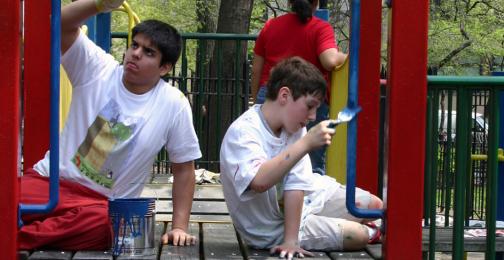
Everyone has a role to play in making a better neighborhood. (Photo courtesy of Project for Public Spaces).
The neighborhood is the basic building block of human civilization, whether in a big city, small town or suburban community. It’s also the place where you can have the most influence in making a better world.
These suggestions, drawn from my book The Great Neighborhood Book (a collaboration with Project for Public Spaces) are focused on strengthening the sense of community and spirit of the commons by providing people with ways to come together as friends, neighbors and citizens. That creates a firm foundation that enables a neighborhood to solve problems and seize opportunities. This is drawn from a presentation I regularly give to community, civic, academic, professional and business groups. For more information, see Jay Walljasper.com.
-
Give people a place to hang-out
-
Give people something to see
-
Give people something to do
-
Give people a place to sit down
-
Give people a safe, comfortable place to walk
-
Give people a safe, comfortable place to bike
-
Give people reliable, comfortable public transportation
-
Make the streets safe—from crime
-
Make the streets safe—from traffic
-
Remember the streets belong to everyone—not just motorists
-
Don’t forget about the needs of older neighbors
-
Don’t forget about the needs of kids
-
Let your community go to the dogs
-
Reclaim front yards as social spaces
-
Remember the best neighborhoods, even in big cities, feel like villages
-
Plan for winter weather as well as sunny, warm days
-
Don’t fear density—people enjoy being around other people
-
Don’t give up hope—great changes are possible when neighbors get together
-
Build on what’s good in your community to make things even better
-
Remember the power of the commons: people working together for the benefit of everyone in the neighborhood.
-
Never underestimate the power of a shared meal to move people into action
-
Start with small steps—like planting flowers
-
Become a community booster, watchdog, patriot
-
Learn from other neighborhoods in your town and around the world
- Take the time to have fun and enjoy what’s already great about your neighborhood
Rate this article
Comments
Oh, but not the dogs! Like children at the park, dogs can be great conversation-starters. Our local dog parks have become social spots for dogs and owners alike, and more than once I have enjoyed the company of a sweet canine. BUT . . . if all the dogs in city up and moved to Uruguay or some other far-away locale, I'd be delighted. The dogs here have been more of a neighborhood detractor than an asset:
- It's hard to enjoy a park, a trail, or even one's own front yard (as miniscule as it is) when I have to worry about stepping in doggy doo. Class or age does not predict what kind of dog owner will let their dogs leave smelly presents around my neighborhood. The doggy doo doesn't bother those shelter themselves in cars, behind tall fences and closed windows, or who hire someone else to clean up the yard once a week, but it disgusts the rest of us who try to spend time outside of our house and engage with the community. (And yes, dogs are not allowed in some parks and in all schools, but this does not prevent pet owners from being their dogs in to play.)
- Dogs have run into the way of my bike on the street, and bitten my son's hand for holding a danish at the park (he was just standing there and the dog ran up from behind, so no, it was not provoked). It's hard enough for my neighbors to mind their children (those few who have children), why should I encourage my neighbors to let their dogs--like naughty children, and with sharper teeth--to run amock? It's NOT cute.
- As diverse as my city is, it is difficult to observe how within mile of my house I have Petsmart, Petco, numerous doggie daycares and groomers, grocery stores with fresh, organic pet food in the freezer section, and vets in huge shiny buildings, but within that same mile there are children and the elderly on meager incomes who need friendship, support, and a hot meal. How must it feel to be those people and watch Fifi walk by with her freshly-combed coat, soft bed and A/C at home, and belly full of food?
Seems like at least in my part of my city the image of a pup dragging an owner by the leash, and the dumb affection only a Boston Terrier can display is being prioritized over the health, comfort, and compassion of our environment, our children, and our human neighbors.
These are good ideas! But does the book explain how to do all of this? Because I don't think I have the authority to do most of these things.. :(
You might be surprised how much authority you have when you join with your neighbors. But the book does discuss a variety of strategies, from fighting City Hall to working with City Hall to ignoring City Hall to taking over City Hall
Related Articles
- Interviewed: David Harvey on Rebel Cities
- Public Spaces Make the World Go 'Round
- How to Map the New Economy in Your City
- Have Your Cake & Eat Someone Else's Too!
- Is Peer-to-Peer Bikesharing Viable?
- Asheville: A Shareable Mountain Town
- Adventures in SideCar-ing
- Complete Streets Are For Everyone: the Top 10 Policies of 2012
- Innovations in Governance: An Interview with Gianni Dominici
- 7 Ways To Reinvent Your City, Burning Man Style
Community Blog Posts
-
By Drew Little
-
By Tim West
-
By Liz Elam
Recent comments
-
10 hours 9 min ago
-
21 hours 13 min ago
-
1 day 19 hours ago
-
1 day 21 hours ago
-
1 day 23 hours ago


Thank you for highlighting such easy ideas to create a healthy neighborhood. I checked out the link to your book. It's so true that creating a place that neighbors love to hang out doesn't need to cost a bundle. Remember the saying, "A house doesn't make a home?" Taking care of what one has - primarily each other, is what is most important. I look forward to reading your book.
Heather Villa