
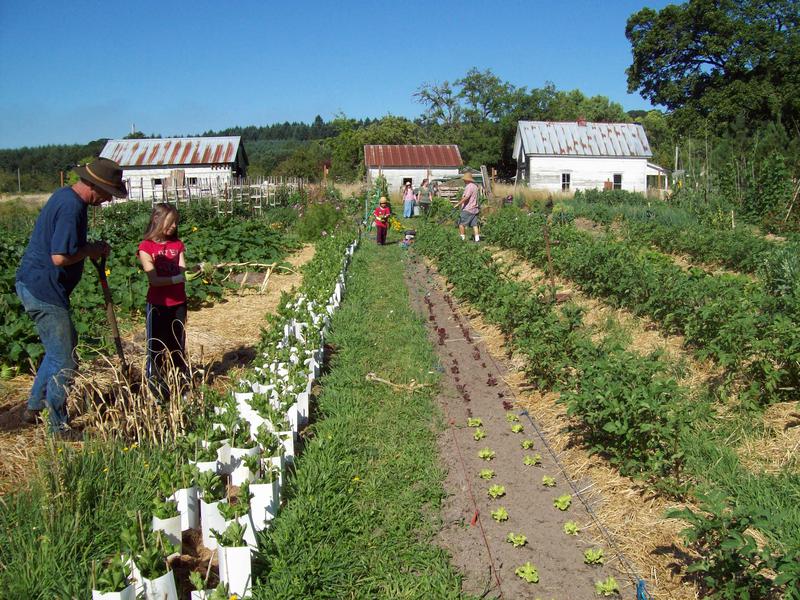
photo courtesy of the authors
Here in Monroe and Alpine, Oregon, we have created a solution that is helping people learn about gardening, grow their own food and lift the burden on our local food-bank to provide for its ever increasing customers. We call it a “Sharing Garden”.
How it Works: Most people are familiar with the typical model of community gardening: multiple, separate plots, rented by the gardeners in which each person grows and harvests their own produce. In a Sharing Garden, the crops are grown collectively. The funds, materials, water and use of the lands have been donated, and participants come together one to three times a week to grow the food. Everyone shares in the harvest, the joys of learning to grow food together, and a genuine sense of community through joining in this meaningful activity. The extensive surplus is donated to people in need (through food banks and other charities.) No one is ever charged money for the food that is grown. This model is easily replicated anywhere there are vacant lots and people with enough gardening experience to oversee the project and does not require a large input of money to make it work.
Harvest Totals: In 2010 we were able to grow and give away over 3,500 pounds of food at a market-value of about $9,950. In 2011 we grew over 4,600 pounds at a local market-value of about $14,500. All of the harvest was shared amongst volunteers, our local food bank, the senior lunch program in Monroe and a local gleaner's group.
As of spring 2012, we have two garden-sites in cultivation. The original garden, in Alpine, Oregon is 100 feet x 110 feet. It was started in 2009. Our second site is in Monroe, Oregon, It is 110 feet x 170 feet and was started in 2010. The two gardens total approximately 2/3 of an acre.
Benefits of a “Sharing Garden”
There are many benefits to growing food in the sharing model. You can:
-
Grow the maximum amount of food: Sharing Gardens use the garden space more efficiently. There are fewer pathways between garden rows and all of the same kind of plants can be grown together.
-
Water more efficiently: Plants can be grouped together with similar watering requirements.
-
Manage weeds and pests more easily: In a typical community garden setting, herbicide or pesticide applications in one plot can lead to a mass exodus of the offending bugs or weeds into adjacent plots. This can lead to a mini “arms race” between garden plots to bolster plants against pests. In a Sharing Garden, if pests/weeds appear, they can be managed selectively without the need for ever-accelerating methods of eradication.
-
Save pure seeds: Many plants will cross with their neighbors, or hybridize. This means that, in a typical community garden neighboring gardeners would need to coordinate so their seed-stock doesn't cross with neighbors. In a Sharing Garden, you can plan your crops to keep strains from crossing and save enough seed to last for a few years till you get around to growing that particular variety again.
-
Build community: Though some community gardens have regular work parties and social gatherings, the emphasis is on each gardener doing his own thing. In a Sharing Garden, the focus is on cooperation and sharing a common goal. Having a meaningful shared purpose builds great camaraderie.
-
Share knowledge: Sharing Gardens become a place where gardeners can share their experience with each other. We garden organically, using no chemical pesticides or herbicides. We rely on heavy mulching and fertilizer derived from compost and other natural, local materials. We also have an extensive seed-saving program. Participants are also learning about food preservation, gleaning and other ways of increasing local food security.
- Live more lightly on the planet: An additional benefit of this style of gardening is that we use salvaged material whenever possible. This keeps these materials out of burn-piles and the land-fill while providing new life for tools, leaves, grass clippings and building supplies. By encouraging people to share their surplus we build a tangible sense of community and networks of relationship that can be drawn from in times of crisis.
Help local wildlife: Each of our gardens is designed to create habitat for local beneficial wildlife as we believe it is important to "share" the earth beyond our human family.
Learn more about Alpine and Monroe's Sharing Gardens
See our site with extensive info on organic gardening, seed-saving and starting your own Sharing Garden
Watch a video interview with the founders of the the Sharing Gardens
Rate this article
Comments
Seth - thanks for the warm welcome. It seems that 2012 just might be the year when a critical mass of people realizes the importance of creating food-security at the local level. Exciting times! Llyn and Chris
Sharing Gardens
Chris Burns and Llyn Peabody
Monroe, Oregon 97456
www.AlpineGarden.blogspot.com
www.TheSharingGardens.blogspot.com
Thank you so much for this article, and particularly the reference links. I have been thinking for some time that churches would do well to replace decorative landscaping with a shared garden meant to feed the church and surrounding community with fresh produce, but I didn't know of any existing approaches.
Thank you!
Yes, it's exciting, Llyn and Chris, and I hope you're right about 2012!
That seems like a good fit for churches, Sam. I haven't heard of anything like that, but there's got to be some religious institution out there doing that already I would think. The closest thing I can think of is Todmorden, England, where the community is working to make the city "entirely self-sufficient in food production by 2018" by planting gardens everywhere possible and making the food freely available to anyone. There's an article in the Independent (http://www.independent.co.uk/environment/green-living/todmordens-good-li...) and the Daily Mail (http://www.dailymail.co.uk/femail/article-2072383/Eccentric-town-Todmord...).
Yes, churches and gardens are a natural match! Many churches have, as part of their "mission" to feed the hungry, AND they have land that's just lawns and ornamentals. Here in Oregon (specifically Corvallis and Portland), there are many examples of these kinds of partnerships.
The challenge is finding a coordinator, with enough gardening experience, to oversee it; someone to organise the volunteers etc. We have a draft of a handbook for creating a "Sharing Garden" and would be happy to email it to you if you drop us a note. Llyn and Chris
P.S. We have a Post about Todmorden, England on our site too with several links to articles about the village. Very inspiring! here's the link: http://thesharinggardens.blogspot.com/2012/01/inspiring-village-todmorde...
Sharing Gardens
Chris Burns and Llyn Peabody
Monroe, Oregon 97456
www.AlpineGarden.blogspot.com
www.TheSharingGardens.blogspot.com
Chris and Llyn, please keep Shareable in mind when you finish that handbook! I'd love to be able to link to it from the comments in this article.
We'd be happy to! It might be a few months as the garden season is just picking up and we have less time for being on the computer as the weather warms. Meanwhile, we have lots of DIY posts on the "How To's" of organic gardening and seed-saving right on our site: http://thesharinggardens.blogspot.com/
Sharing Gardens
Chris Burns and Llyn Peabody
Monroe, Oregon 97456
www.AlpineGarden.blogspot.com
www.TheSharingGardens.blogspot.com
Chris and Llyn,
Thank you very much. I will definitely take you up on your offer for any resources to help. I am a seminarian right now, but my hope for a future church community is to use the commonly-held church property for such a garden and to encourage and equip homeowners within the congregation to contribute to the effort by converting suburban yards to garden plots as well.
Again, I am very grateful for your guidance!
Great, thank you both! I took a peek at your blog and there are a lot of great tips and articles. It's helpful that you have the categories as an easy way for people to find seed saving tips, how-tos, etc. Best wishes for your growing season this year!
Sam, that's a fantastic future project! I hope you get a lot of support from your future church community. I have a friend who teaches in at a theological school and will send him a link to this comment thread to see if he knows anyone doing this.
Seth - let us know if you ever want to post any of the DIY articles directly on Shareable, or put links to them from your site. We can write short intros describing the Sharing Gardens model to tie it in more directly to your theme.
Sam - just get in touch with us when you're ready for the next steps. We'd be happy to help in any way we can.
Sharing Gardens
Chris Burns and Llyn Peabody
Monroe, Oregon 97456
www.AlpineGarden.blogspot.com
www.TheSharingGardens.blogspot.com
Thanks, Seth. There are so many Shareable things that churches already do and are in the position to start doing. I'm hoping this summer to write some of it out and send it in to you guys.
That sounds like a great article topic, Sam. Let me know when you've got something. Also, if you want to contact me via the contact tab on my profile I'd be happy to send you some tips for writing articles for Shareable's Community Blog channel.
Growing Food and Faith Training (http://growingfoodandfaith.wordpress.com/) is a conference that addresses gardening from an Episcopalian point of view. Their tagline is "Everything you need to learn about being a Christian, you can learn in a garden." It looks like it took place in 2011, not sure if they're planning to hold the conference again. Hat tip to my friend Dan who got this lead from one of his Facebook friends.
Dirt Wise: A Gardening Guide for Congregations is from Georgia Interfaith Power & Light. (http://www.gipl.org/content/Dirt_Wise.asp) It's "a garden curriculum designed to help your congregation start a garden while you learn about sustainable food." Hat tip to Dan's friend Rachel for this resource.
And here's a comment from Dan's friend Jonathan via Facebook:
"In my experience where I've seen this thrive is in communities where the church needs something to latch onto, and the community is in real need of assistance. See St. Jame's in Yuba City, CA for example (google will show you). Rural community with small parish, lots of farming expertise, but it took the church looking hard at its own mission to really get a farm started. Another Episcopal organization has gardens as a learning/educational tool as well: http://www.er-d.org/children The program makes a statement for kids that growing food is just 'human' and it provides a gateway to education about other cultures and also some solid eco-theology in terms of what we know about faith coming from the soil. my 2 c."
You can find photos and a brief description of the garden at St. James here: http://stjamesyubacity.com/garden_photos_summer_2009
Related Articles
- The Ultimate Guide to Traveling Without Money
- Shareable's Best Alternative Vacation Ideas
- Help Us Improve Shareable (Takes 2 Minutes)
- Hacking the Commons: How to Start a Hackerspace
- Pick Up and Play: a DIY Guide to Building Community Through Music
- Is Living in Your Car a Viable Way to Save Money?
- 4 Ways To Make This The Summer Of Sharing
- Bicycle Nomad, Where Did You Sleep Last Night?
- "Shift Change": Doc on People-Centered Business
- 6 Online Services Making Food More Shareable
Community Blog Posts
-
By Drew Little
-
By Tim West
-
By Liz Elam
Recent comments
-
9 hours 38 min ago
-
14 hours 58 min ago
-
14 hours 58 min ago
-
15 hours 24 min ago
-
19 hours 10 min ago


Llyn and Chris's profile has lots more information about the simple, small-footprint, gardening-based lifestyle they've created for themselves. They're even offering to create Sharing Gardens in other communities. Maybe yours? Check out their profile (http://www.shareable.net/users/share-in-joy) for details!
Lyn and Chris: Thank you for your inspiring story and welcome to Shareable! I'm wondering whether there are particular systems or resources that have inspired you? Perhaps permaculture (http://en.wikipedia.org/wiki/Permaculture) or Path to Freedom (http://urbanhomestead.org)?