
UPDATE: We've summarized much of the series this article is part of in a new report, Policies for Shareable Cities: A Sharing Economy Policy Primer for Urban Leaders. Get your free copy here today.
Commercial spaces – where communities engage in commerce and trade – provide an important gathering place for local economies, and would ideally be created by and for the communities they serve.
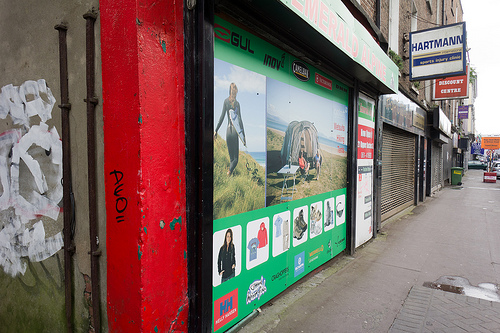
Empty commercial spaces are a sign of urban depression on Ellen Street in Limerick, Ireland. Photo credit: William Murphy. Used under Creative Commons license.
This year, we’ve seen Mutual Aid in Motion.
From scaling sharing hubs to Mutual Aid 101 trainings, we’re helping communities build the tools they need.
Every dollar fuels lasting resilience – proving that when we move together, we all move forward.

Here are some ways a city could incentivize shareable commercial spaces:
-
Facilitate the establishment of community-owned commercial spaces: Market Creek Plaza in San Diego, California, is a model for community-owned commercial spaces. On the surface, Market Creek Plaza may look like most shopping malls; yet, the primary shareholders of the mall are a local nonprofit and individual members of the local community. When the mall was developed, 50,000 shares were offered to local community members at $10 per share. Generally, state and federal securities laws present some hurdles to community-ownership of local businesses. However, cities can help grease the wheels of community ownership by offering priority, subsidies, and streamlined permitting processes for commercial developments that are to be community-owned.
-
Facilitate the use of otherwise empty commercial spaces: Empty commercial spaces are a wonderful opportunity for sharing, and now many otherwise vacant store windows are being used to display art and other exhibits. However, taking it deeper than just the store windows, every city should create a program to help bring more productive temporary uses to empty commercial spaces. In Newcastle, Australia, a community organization has successfully facilitated the use of 30 otherwise empty commercial spaces by local community groups and small enterprises. One thing that cities can do to facilitate the use of such spaces is to help landlords feel assured that a use of their space is truly temporary, and that they won’t be stuck with a tenant they cannot remove. To this end, cities might create astreamlined eviction process for the landlord to use in the event that the temporary tenant does not vacate when a regularly paying tenant comes in.
-
Create special permits for temporary and “pop-up” uses of commercial space: Generally, as dictated by a city’s zoning ordinances and permitting processes, each commercial space is allowed to house only certain types of businesses. However, cities could enable creative and resourceful use of spaces by granting special permits for uses that are temporary, but which would normally require a conditional use permit or zoning variance. For example, a space that is permitted to house a grocery store or sell meals to-go may not be allowed to house a full-service restaurant without an expensive and time-consuming conditional use permit process. But given the popularity of underground and pop-up restaurants, for example, a city, in this case, might consider granting a much simpler permit, given that the use will be temporary.
-
Create disincentives for waste of commercial spaces: In California, some cities are taking a stand against banks by fining them $1,000 per day for holding on to abandoned and blighted properties. Similarly, cities could impose fines on banks or other property owners that allow commercial spaces to sit empty. By creating a disincentive for waste, cities thereby create an incentive for property owners to share their spaces with community groups or small enterprises.
-
Zoning for shareable marketplaces: Farmers' markets, flea markets, swap meets, and gatherings such as Really, Really Free Markets and Underground Markets are all highly shareable commercial spaces, in the sense that they are accessible to and provide a forum for even tiny enterprises to offer their goods and services. Cities can encourage such shareable marketplaces by designating city-owned properties for such gatherings, and by streamlining the permitting procedure for such markets.
How else might a city foster shareable commercial spaces? Please post your thoughts below and help us build this collection of policy proposals. Thank you!
This post is one of 15 parts of our Policies for a Shareable City series with the Sustainable Economies Law Center:
- Car Sharing and Parking Sharing
- Ride Sharing
- Bike Sharing
- Shareable Commercial Spaces
- Shareable Housing
- Homes as Sharing Hubs
- Shareable Neighborhoods
- Shareable Workspaces
- Recreational and Green Spaces
- Shareable Rooftops
- Urban Agriculture
- Food Sharing
- Public Libraries
- The Shareable City Employee
- How to Rebuild the City as a Platform
