

That crisp hint of Autumn in the air means it's time to head back to school whether that's on campus or the school of life. Here's Shareable's reading list for the Fall. Please add your selections in comments.
 What's Mine is Yours: The Rise of Collaborative Consumption, by Rachel Botsman and Roo Rogers (HarperCollins): Rachel is a good friend and an editorial advisor here at Shareable where we've been anticipating this release for months. The authors describe collaborative consumption as "when people come together through virtual and real-world communities to share, barter, trade, rent, gift, lend, and swap to get the same pleasures of ownership with reduced personal burden and cost and lower environmental impact." From car-sharing to DIY venture capital, Botsman and Rogers investigate real-world examples of these consumer sharing practices, painting a picture of peer-to-peer consumption as a growing movement. In addition to the book, the authors chronicle the activism and entrepreneurship of collective buying at their site, Collaborative Consumption.
The Art of Convening: Authentic Engagement in Meetings, Gatherings, and Conversations, by Craig and Patricia Neal with Cynthia Wold (Berrett-Koehler Publishers): The Art of Convening is a manual for transforming productive interactions. Drawing from years of experience with groups and meetings of all size and type, the Neals offer people the tools they need to "convene" effectively. The authors describe the importance of their project this way, "There is a methodology to truly successful engagements. Convening is the new leadership capacity. How we gather, communicate and deliver the desired outcomes through our meetings is critical to the long-term vitality and success of our organizations and communities and the people within." Instead of traditional models of meeting facilitation which attempts to make decisions easier, conveners attempt a deeper level of engagement among participants. With The Art of Convening, the Neals attempt to transform the way groups work together, and what they can accomplish.
This year, we’ve seen Mutual Aid in Motion.
From scaling sharing hubs to Mutual Aid 101 trainings, we’re helping communities build the tools they need.
Every dollar fuels lasting resilience – proving that when we move together, we all move forward.

 Common as Air: Revolution, Art, and Ownership, by Lewis Hyde (Farrar, Straus and Giroux): This is the awaited follow-up to Hyde's classic work on the commons, The Gift. In Common as Air, Hyde launches an attack on the defenders of restricted intellectual property, joining pirates and sharers on both sides of the law. The author examines the role the intellectual commons played in America's foundation and deputizes Thomas Jefferson and Ben Franklin – who he calls the "founding pirate." While Hyde focused on traditional gift-exchange rituals and folklore in The Gift, Common as Air is about the present and future. He suggests a model of intellectual property devoted not to the private gain of a few, but to the production of social innovation and value for the benefit of society as a whole. Hyde is a gifted story-teller, and here he artfully stitches together a constellation of history, theory, and polemic in defense of the commonality of knowledge. Common as Air has a real chance to enter the public consciousness this Fall and thereby change the intellectual property debate permanently.
 Working Together: Collective Action, the Commons, and Multiple Methods in Practice, by Amy R. Poteete, Marco A. Janssen, and Elinor Ostrom (Princeton University Press): For those interested in economic theories of the commons, this book on methodology from Nobel-winner Ostrom and her colleagues is not to be missed. Working Together is a piece of meta-research: the authors investigate and evaluate different research models and practices academics use to understand common resources. The authors look at the benefits and limitations of statistical analysis, case studies, comparative perspectives, and other tools, yet they conclude that no one model in isolation can accurately describe collective action. Instead, they argue for a multi-methodological investigation across traditional institutionally mandated lines. Although some readers might find a book largely on comparative methodology too dry, Working Together is an attempt to address persistent questions around academic research on collective action and will be valuable to anyone who wants to deepen their knowledge on the commons.
Things We Share: A Field Guide to the Commons, by Jay Walljasper (New Press): Shareable.net contributor Jay Walljasper is a fellow and editor of onthecommons.org, editor at large for Ode Magazine, and the longtime editor-in-chief of the Utne Reader. His new book hits the Shareable bullseye: "In an accessible field guide format—replete with illustrations, charts, and other visual materials—Things We Share offers an engaging entrée into a broad range of key topics and concepts from the commons movement, which touches everything from natural resources, art, and the environment to technological knowledge, the digital realm, economics, and politics. Veteran progressive journalist Jay Walljasper frames each chapter around a single idea, with additional contributions by other distinguished activists, politicians, and writers." Released last month, Things We Share is a great book for readers getting interested in ideas of the commons and looking for an introduction to the movement and its ideas.
Program or be Programmed: Ten Commands for Digital Age, by Douglass Rushkoff (OR Books): Media theorist and cultural critic Rushkoff attempts to transcend current debates over the internet and technology in this new release. The question in Program or be Programmed is not whether the internet is good for people; the reality is that the web is here, for better or for worse. Rushkoff treats both better and worse as distinct possibilities and offers the titular commands as a way to achieve the first and dodge the second. The question for humanity now, the author argues, is whether we will control or be controlled by our inventions. “Choose the former,” writes Rushkoff, “and you gain access to the control panel of civilization. Choose the latter, and it could be the last real choice you get to make.” Program or be Programmed threatens to do us all a favor and shake up stale debates over the future of the web and humanity's relationship to technology.
Mashed Up: Music, Technology, and the Rise of Configurable Culture, by Aram Sinnreich (University of Massachusettes Press): Music as an element of the cultural commons figures in a lot of these books, but USC lecturer Sinnreich makes it his door into a rapidly changing culture. In Mashed Up, the author explores the often antagonistic relationship between music and those commercial agents who would control its flow. He sees a natural affinity between China's Office to Harmonize Sounds and copyright-enforcing American record labels and associations: they both stand opposed to what Sinnreich calls "configurable culture." Artists today, the author argues, produce in relation to each other by nature – a mental feature he calls "DJ Consciousness." Configurable culture based in abundance and sharing is coming soon, Sinnreich writes, government and corporation alike better get used to it. Mashed Up attempts to blur the lines between private and property, between ownership and social production and its thesis resonates beyond the world of music.
 Big Citizenship: How Pragmatic Idealism Can Bring Out the Best in America, by Alan Khazei (PublicAffairs): Khazei is most famous for starting the youth service program City Year and his advocacy for public service initiatives, and in Big Citizen, he takes what he's learned and suggests a bold new plan for America. The book is partly Khazei's story, from Harvard Law School graduate to the founding of City Year and beyond, through his fight to protect AmeriCorps. But Big Citizen isn't a memoir or autobiography, it's a plan for action. "Pragmatic idealism" is the name the author gives to an ideology based on a balance between the vision of a better world and concrete steps individuals can take toward its achievement. Khazei dismisses the acrimony of partisan politics in order to focus on ways people can improve their communities. Like many other books on this list, Big Citizen is about the collapse of the traditional boundary between public and private action and the possibilities of the space between the two.
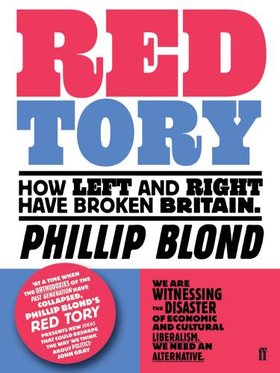 Red Tory: How the Left and Right Have Broken Britain and How We Can Fix It, by Philip Bond (Faber and Faber): The title of this one might go over the heads of an American audience for whom "red" no longer means communist and "Tory" never meant much at all, but Bond's curious mix of social conservatism and progressive economic values could find fans on this side of the Atlantic. The author calls for a transcendence of Britain's political parties and a decentralization of power into the hands of communities. He is skeptical of both corporate monopolism and government regulation, but not of what we might call "family values." As an Anglican theologian, Bond offers more than just lip service to social justice and sees both the market and government as threats to families and communities. Red Tory is the author's attempt to re-center Britain's politics on the community. Although the closest American analog to Bond's conservative communitarianism might be the progressive bugaboo Tea Party, maybe some on the left will be more willing to listen to someone British.
Great Public Squares: An Architect's Selection, by Robert F. Gatje (W.W. Norton & Company): Great Public Squares is a self-descriptive work. The book is a collection of 35 full-color maps of public squares in cities around the world. There isn't much explanation with the pictures. Gatje, the selecting architect mentioned in the title, lets them speak for themselves. The bird's-eye views give insight of the way people relate in public spaces, even if there are no people in the maps. Gatje travels from Italy's canonical piazzas to the new urbanism of Portland and Santa Fe as they reveal their similarities and differences. Great Public Squares would make a nice coffee table feature for any map lover or city enthusiast.
 Local Money: How to Make it Happen in Your Community, by Peter North (Green Books): Local currency hasn't received the same level of attention as other community-centered sharing practices, but Liverpool University Geography professor Peter North thinks the adoption of alternative money is a way for people to provide for each other in the face of economic depression. North looks at track records of success and failure of local currencies around the world. These local moneys free up productive potential when larger market or governmental forces move too slowly. By re-examining currency outside its government-controlled form, North can view it as a tool for social organization. Local Money is a comprehensive and actionable book, even suggesting environmental benefits communities could reap though the use of alternative currencies. Integrating money and community sharing is a tough job, but the author attempts just that with this book.
The Abundant Community: Awakening the Power of Families and Neighborhoods, by John McKnight and Peter Block (Berrett-Koehler Publishers): This book is a different look at the limited role of community in contemporary American politics. McKnight and Block propose a new politics centered at the level of non-state collectivities. They contend that neighborhoods have the productive resources they need to care for themselves if they're willing to organize themselves around those lines. The lie of consumerism, the authors hold, is that a satisfied life can be purchased. Instead, they propose that people within their organic communities can and must provide for support – material and spiritual – for themselves. The Abundant Community is part of a larger body of theory and practice devoted to renewing the place of neighborhoods in our system of production.
The Mesh: Why the Future of Business Is Sharing, by Lisa Gansky (Portfolio Hardcover): Internet entrepreneur Lisa Gansky gives her own twist to changing patterns of consumption. Like Botsman and Rogers in What's Mine is Yours, Gansky sees buyers and producers tending toward collaboration in what she calls "mesh" companies. Corporations based on the paradigmatic division between consumers and sellers are fading, while new organizations of users, makers, and sharers are on the rise. The authors analyze the role of technology in the birth of mesh organizations by looking at successful examples, including some of today's most visible businesses. The Mesh (which will be released September 23) belongs on the bookshelf of any would-be entrepreneur or forward-looking CEO trying to keep up with a changing marketplace.
Where Good Ideas Come From: The Natural History of Innovation, by Steven Johnson (Riverhead Hardcover): The author of the bestselling Everything Bad Is Good For You, writer Steven Johnson turns his pen to a history of new ideas. Following innovation throughout history, from Darwin to YouTube, Johnson searches for the social conditions that produce ground-breaking thought. Although he approaches from a different angle, the author's conclusions share a lot in common with the rest of the book on the list. In the contemporary productive environment, Johnson argues, the tools for innovation are more widely dispersed and accessible than ever. This upcoming release, out in October, should provide a nice companion to Hyde's Common as Air, as Johnson arrives at the nexus between the intellectual commons and innovation from the second direction.
 Infinite City: A San Francisco Atlas, by Rebecca Solnit (University of California Press): This beautiful book won't be released until November, so it can be this list's Thanksgiving break suggestion. Infinite City is a collection of maps of the city of San Francisco made by the Bay Area native, prolific author, and activist Rebecca Solnit and a band of cartographers, writers, and artists in conjunction with the San Francisco Museum of Modern Art. I was lucky enough to see Solnit present the entire project at SF MoMA, and the maps are dazzling. By combining different aspects of the city in single maps, Solnit and her confederates bring out San Francisco's contradictory aspects. In one map, Solnit plots the development of film technology along side the shooting locations of Alfred Hitchcock's Vertigo. Some are more directly political, in true Solnit fashion, she takes on housing rights, racial division, and the military industrial fashion. For anyone in the Bay Area who can't wait until November, SF MoMA has been putting on release events for the individual maps all around the city. The next event, looking at Solnit and artist Guillermo Gomez-Pena's map "All Identity is Local," is scheduled for October 7.
 Plenitude: The New Economics of True Wealth, by Juliet B. Schor (Penguin Press). Plenitude is a timely and arguably dramatic departure for one of the most articulate critics of consumer culture. Schor's prior books include Born to Buy and The Overspent American. While Plenitude does not lack Schor's keen critical insight, it's primarily a visionary book outlining a way forward based on a new understanding of wealth. I think this is a useful and superbly done turn. Plenitude proposes a collection of solutions including shorter work weeks, a green economy supporting local job growth, and lifestyle choices including sharing that can simultaneously help global society avert environmental catastrophe and stabilize the economy. Her recommendations are practical, well within reach technically speaking, and are couched in language that could appeal to both ends of the political spectrum. Importantly, her take on sustainability is not based on a paradigm of sacrifice. In fact, she believes a better way of life could be birthed from crisis. As a founder and board co-chair of the nonprofit The Center for the New American Dream, I can't imagine a better calling card for her and her organization.
Teaser image credit: Patrick Gage
##
Other book-related posts:
Eight Books We're Looking Forward to in 2010
The 15 Best Shareable Books of 2009
Green Metropolis: A Q&A with David Owen
Cory Doctorow Releases New Book Under Creative Commons
