
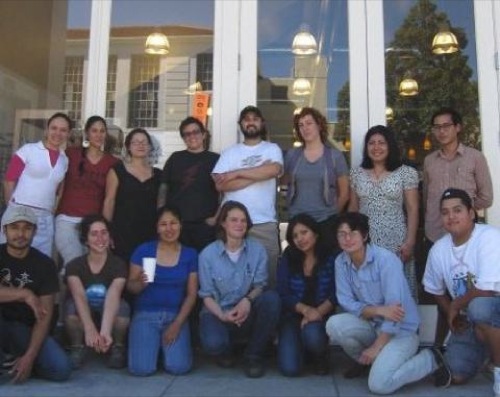
While mainstream America is hoping for federal economic reform, some social justice organizations have a radically different idea, and are organizing low-income communities to build a new economy from the grassroots up. Tired of asking for change from the top down, they are taking their economy into their own hands. Social justice organizations, having a strong membership base rooted in community, are ideal spaces to cultivate alternative economic projects, as relationships of trust and solidarity have been nurtured over time through education and a history of taking action for justice. Here are some exciting examples of grassroots alternative economy projects for social justice.
Social Justice and Alternative Economics

Photo of the Greenfield Gardens housing coop via ADP.
Alliance to Develop Power (ADP) is social justice organization based in Massachusetts with a membership of 10,000 low-income African Americans and Latinos. According to Sally Kohn of the Nation, ADP has stated that “at the end of every issue campaign, our goal is to create an institution that our members control.” This a lofty goal for an organization that fights for basic necessities, like housing, on a regular basis. ADP is creating a 1,200 unit tenant-owned housing cooperative, a worker coops to provide landscaping, construction, building maintenance and weatherization for the homes, as well as four volunteer-run food coops for local health food access.
In what appears to be an emerging trend, San Francisco's PODER (People Organizing to Demand Environmental and Economic Rights) expresses similar goals. Oscar Grande, Community Organizer for PODER, said they “aspire to be ADP when they grow up.” Every year, PODER fights to get City Hall to allocate funding for its economically disadvantaged community. It's a battle that consumes most of its energy, and in the end the community rarely gets what it needs. This year, PODER moved beyond reactive social justice campaigns to explore the uncharted territory of proactive alternative economics with its members. It leveraged a strong community base to get funding to plan a work force development center in the neighborhood with the membership’s input. Based on members' interests, PODER is developing an exchange group through BACE Timebank, which members hope will help support their Semillero worker coop incubation project. And the organization is investigating participatory budgeting as a tool to shift power to its membership in the municipal budget-making process in order to fund more community-driven initiatives, like worker coop training programs.
Self-Employment for the Working Class

La Cocina photo by Jun Belen.
A common path to a living wage and dignified job is self-employment through starting a small business, but this avenue is rarely available to working class women. Catering to this demographic, San Francisco's nonprofit La Cocina provides food business planning and development, as well as access to costly resources such as a licensed commercial kitchen, a fancy retail space at the Ferry Building, professional advertising, and more. La Cocina incubates a wide variety of small businesses from packaged food producers to food carts, catering companies to restaurants. With an industry average failure rate of 60% even in a good economy, La Cocina gives struggling first-time entrepreneurs crucial support to get a business going without taking a huge risk many of them can not afford.
Worker Cooperative Incubation and Development
Meanwhile, a more communal twist to entrepreneurial development is popping up across the country: worker cooperative incubation programs for low-income folks. Third Coast Workers for Cooperation, a new nonprofit in Austin, is helping start-ups through a through a mentoring and 16 week training program, the Cooperative Business Institute and Co-op for Community Development program. In their first year, it helped incubate a women's catering cooperative called Yo Mamas, a food cart coop in Houston, and the Workers Defense Project, a construction coop. Operating on a shoestring budget, TCWC uses volunteer but experienced worker-owners and professionals with technical skills to give these new coops a much needed boost.
Green Worker Cooperatives is another social justice organization “dedicated to incubating worker-owned and environmentally friendly cooperatives in the South Bronx.” Their website states, “Our approach is a response to high unemployment and decades of environmental racism. We don’t have the luxury to wait for new alternatives. That’s why we’re creating them.” Green Worker Cooperatives offers an aggressive 80 hour coop boot camp, which includes a combination of training, coaching, and technical support like legal incorporation, graphic design, and website development. IDEPSCA, an immigrant and worker rights organization in the Los Angeles area also incubates green worker cooperatives such as Magic Cleaners, a green home cleaning service, and Native Green, a sustainable landscaping service focused on native plants.
The Cooperative Association Model

Photo courtesy of the Arizmendi Association of Cooperatives.
Inspired by the Mondragon Cooperative Corporation of Spain, the Arizmendi Association of Cooperatives in the San Francisco Bay Area focuses specifically on one type of replicable restaurant. Their successful chain-like model is responsible for 125 jobs and $12 million in annual sales. Each Arizmendi Coop is autonomous, but receives training and substantial start-up funding from previous restaurants. In return, once the restaurant turns a profit, it returns some of the proceeds to the Association to seed more worker cooperatives. The restaurants share recipes, accounting, legal and other services, similar to corporate chains. True to their social justice mission, Arizmendi hired 4 out of 15 new worker-owners for their new Mission location from PODER's membership and other Latinos from the neighborhood.

Clementina Paramo, a founding member of Emma's Eco-Clean in Redwood City. Photo courtesy of WAGES.
WAGES, a nonprofit that started with the mission of “promoting the social and economic wellbeing of low-income women” organizes low-income women of color to collectively own green cleaning businesses in the San Francisco bay area. Over 100 cleaners earn “50-100% more in hourly wages than before” with benefits and business equity, according to Deborah Warren and Steve Dubb in the study Growing a Green Economy for All [PDF]. As former director Hilary Abell clarified in a recent GEO article, WAGES operates on a chain model with a year-long startup phase and three years of significant nurturing. While managed intensively by WAGES in the beginning (governance, finance, administration, recruitment, training and business management) chains become more autonomous over time, allowing workers to focus on providing good service and supporting their families. They remain connected and share professional services after spinning off, and seed new coops from the profits of the collective.

WAGES Training Group. Photo courtesy of WAGES.
With support from the City of Cleveland, University of Maryland, the Cleveland Foundation and $5.8 million dollars in grants and loans, Evergreen Cooperatives created three large worker coops focused on solar energy, industrial green laundry, and urban farming. Evergreen intentionally hires from economically disadvantaged neighborhoods, in particular people coming off welfare, recently out of jail, or having other barriers to employment. The wages are good for the laundry industry and worker-owners are expected to build equity in their businesses, which could yield $65,000 over eight years of investment. One of Evergreen's coops, Green City Grower Cooperatives, has acquired 10 acres of urban farmland, a packing building, offices, green energy, and the “largest urban food-producing greenhouse in the country” in an area that could be called a health food desert. Crucial to the success of their cooperative start-ups is a revolving loan fund, the Evergreen Cooperative Development Fund, supported by 10% of their cooperatives' annual pretax profits, reports Warren and Dubb. Being part of a larger, successful association also helps secure business loans, which can be difficult for coops.
Worker Coops for Local Job Creation
Other cities with skyrocketing employment such as Richmond, California are showing interest in emulating Evergreen and Mondragon. The Mayor of Richmond recently went to Spain for a study tour of Mondragon and hired a Coop Developer for her office. Worker coops are increasingly seen by legislators as being a serious avenue for long-term, local job creation.
Since worker coops are owned and managed by workers, there's no worker exploitation, excessive executive pay, or outsized investor payouts. Therefore, worker coops can provide more stable, living wage jobs with benefits and equity than conventionally-modeled businesses, according to the Canadian Ministry of Industry and Commerce. Coops can adjust salaries in lean years, typically have flexible and favorable long-term financing, and are less likely to lay off or close up shop for the sake of profits. They are also more likely to take care of the local environment and their patrons because they need community support to survive.
However, as PODER's members quickly realized, without initial support from nonprofits, government or foundations, starting a worker coop can be an overwhelming, almost impossible challenge. The long-term benefits of these social justice missions are clear. Local governments and community foundations need to step up to the plate and support these social justice organizations' new and innovative job creation model.
Nonprofit Co-production
On the nonprofit side of the economy, co-production — a philosophy and practice that incorporates cooperative principles — is being integrated into service provision. Co-production refers to the inclusion of service recipients in the design, decision-making and delivery of nonprofit services. Normally, there exists a chasm between a privileged class of professional service providers and their clients.
St. Louis' Member Organized Resource Exchange (MORE) thinks and does things differently. MORE is “shaped and operated by the…same individuals it exists to help,” reported Louis Wright in a Case Study of MORE. Residents of East St. Louis are trained to help provide community childcare, education, eldercare, healthcare and social work support to each other while being paid in Time Dollars and then train others to do the same. As one resident put it, “finally, I can ask for help without feeling like I'm asking for charity, because I earned it. I helped somebody else and now I can buy service with my Time Dollars.” Residents provide community needs assessments, offer direct services, serve as community resource people for neighbors on their blocks, and design new service programs with the support of staff, sometimes becoming staff themselves.
Local Government Participatory Budgeting

Photo of the Chicago participatory budgeting vote by Austin Smith, courtesy of Gapers Block.
Change is brewing on the local government front too. While residents of other municipalities around the country complained about city budget cuts this year, Chicago's 49th Ward let its residents directly vote on their Ward's capital budget. Residents, including undocumented people and youth, held neighborhood assemblies, formed issue committees, created proposals and directly voted on budget proposals. It’s a drastic departure from corrupt back-room business deals and poor people left begging for crumbs from a budget that's already been decided. Even the process of designing the participatory budgeting process is controlled by the residents themselves from the bottom up.
When describing his experience of participatory budgeting to San Francisco legislators, Chicago's 49th Ward Alderman showed what his budget looked like before and after the process. The budget graph showed an astounding increase in diversity and creativity of funded projects with community participation. Through this process, he realized he only had a tiny piece of the picture of what his community needed and what they could come up with through collaboration. Bottom-up budgeting processes may be slower, but if they get the right results, they are surely worth the time and effort.
A New Path to Economic Freedom
Folks at the bottom of the economic pyramid are not only finding ways to individually climb the path to realizing the American Dream. They are building ladders for others and organizing to flatten the pyramid, sharing a collective dream in which no one is left out and everyone is happier because of it. It is also becoming increasingly obvious that for most poor folks, the only way up is together. What would the economy look like turned upside down? As these experiments demonstrate, it might look a lot greener, more cooperative, participatory and fair.
