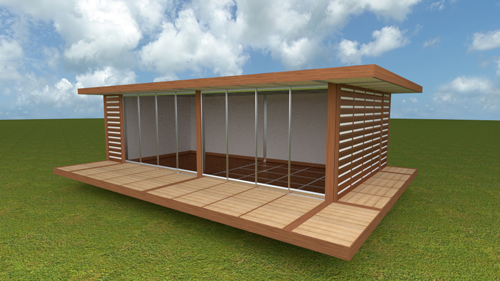
The open source model truly knows no bounds. These days anything can be concocted as an open-source project — from a mobile app to a city. Utilihab steps into the fray with a project to open source new home construction. As defined on the website, “Utilihab is a sophisticated open source modular building system for homes and utility structures that affords for housing the same ease of assembly as a PC, allowing structures of most any size to be built by one to a few people using simple hand tools.”

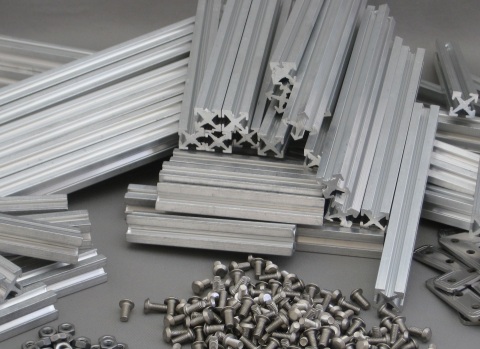
Envisioned by futurist Eric Hunting and developed by Jonas Allesson, Utilihab utilizes building material from the world of industrial automation - the extruded aluminum T-slot. T-slots are flexible to say the least - they can be used to build machinery, homes, greenhouses, and even factories.
As is often the case when a simple principle is applied to a universal problem, corporations make their move toward proprietary technologies to reap the most profit. Utilihab takes a different tack with its open-source system in hopes that architects, designers, and developers will add their contributions to a pool of designs for the benefit of all.

The Utilihab end-game is a system for building simple, modular, affordable, structurally sound housing to shelter our ever-growing global population. That goal was expressed by designer Constant Nieuwenhuys who hoped someday to see “a new intelligent and dynamic human habitat freely and spontaneously self-adapting to our needs, desires, and environment.” Utilihab is doing its darnedest to see that dream realized.
Toward that end, the project is competing for funding in the second round of a Swedish entrepreneurship contest. They also have plans to crowdfund a prototype house. Check out what they are scheming and lend your vote!
Rate this article
Comments
Most homes in the developing world would be considered "temporary", yet they are used for years and lifetimes. And of course this is only one aspect of the global challenges we face. But it's a solution to a huge problem.
I am looking for a modular home that someone can start for under 10,000 USD and then as they are able to save more money they can add another unit and then another to build the home of their dreams in stages or build a dynamic community with their family and friends and continue to build without debt.
This design seems interesting. I am wondering what the cost is, how it can scale up and what is the diversity of the design?
On 21 and 22/09/2012 I attempted to vote but the web site was not found. I won't use facebook. Also advertisements for building plans and roof tiles popped up into the video while it was playing.
Also I could not get the web site through you tube.
Is its a very interesting concept, it can be used for people without home, like those who dont have a home any more in Syria.
Aluminum is among the most energy intensive materials used in the building industry. In this particular design does not seem to be any advantage to the use of aluminum over wood (from well managed forests). There is currently a surplus of construction wood in Europe which would therefore be also cheaper. The aluminium industry is global in scale and not environmentally responsible by any measure. Try this using wood products only.
Thanks for the feedback on this. There are many reasons for the choice of aluminum. Top of the list is that aluminum T-slot framing is already on the market as an industrial product used commonly as framing for automation and factory production systems. It is ubiquitous world-wide. A common problem of proposed modular home building systems of the past has been a need to bootstrap mass production when Capital is chronically reluctant to invest in the large tooling costs needed to produce their parts when no market has been proven. This has been the core obstacle to the dream of 'industrialization' of housing going back to the start of 20th century.
Taking a lesson from Post-Industrial designers like Ken Isaacs, Utilihab repurposes an existing industrial product/technology for new uses. No new industry needs to be created to realize this system as this application simply adds market to an established industry that exists worldwide. No need for the crutch of Big Capital. As a bonus, T-slot offers us radical savings in labor, especially if we use it's features to enable pre-finishing. No question T-slot is currently more expensive per unit area than wood, but in the US as much as 80% of the cost of a home is labor overhead, spent mostly on interior finishing. So we leverage the virtues of modularity and factory pre-fabrication against a moderately higher materials cost to radically reduce those huge labor costs and enable a radical new ease of home-owner sweat-equity. Utilihab's goal is a comfortable resilient home that can be custom-built by one to a few people with nothing but simple hand tools.
Most aluminum used today is recycled and its energy overhead in that is lower than for steel since aluminum, obviously, melts at lower temperature. Yet it is still a very strong 'high performance' material that needs less material mass to do the same job as wood. Walls are non-load-bearing in Utilihab. Utilihab is also completely demountable. Everything can be taken apart as easily as it's put together without damaging the parts.
The idea of architectural permanence is, today, an anachronism. We commonly renovate our homes and repurpose buildings more frequently than ever in history, generating vast amounts of landfill waste because wood frame construction is a 'destructive' assembly process. We damage the materials nailing, screwing, and gluing them together and make them un-recyclable covering them with paint and sealants or infusing them with rot and pest resistant chemicals. Re-use is the most efficient form of recycling and all the components of Utilihab are intended to be directly re-usable, re-purposable, and re-furibishable so as to create a components after-market that enables low-cost housing without the discrimination-triggering stylistic cues of purpose-designed low-income housing. Nails, screws, paint and glue are architectural sins.
Wood is a great gift to our civilization and has great aesthetic beauty. Yet we squander that hiding it behind walls of sheetrock and plaster. Wood is so over-utilized today that the general quality of lumber has been in slow decline since the middle of the 20th century. There is a long-established industry in sourcing 19th century wood from old buildings and river bottoms because it's so much better than what the lumber industry can now produce and prized for furniture-making. With a Better Living Through Chemistry ethos, lumber companies have sought to compensate for this decline through the advance of polymer-dependent engineered lumber products that utilize wood in progressively more elemental forms. Houses today are evolving toward papier mâché, or even plastic. The Disney/Dupont plastic house of the future is, indeed, where we're heading--or we can change our approach to how we build and treat wood and the forests they come from with more respect.
Utilihab generally seeks a net-overhead approach to sustainability rather than the more common focus on the up-front source-based sustainability of typical green architecture. It's still Levittown even if all the houses are made out of straw bale. The lion's share of impact is in the lifestyle.
Eric Hunting
Thank you for posting this informative response here, Eric. I'm sure this will add to more thoughtful discussion.
Related Articles
- A Case of Global Coworking Serendipity
- Fear and Loathing in the Coworking Space
- What if Lena Dunham Coworked?
- A Coworkers Guide to Slaying Procrastination
- My Year of Coworking
- This Week in Sharing: Creative Destruction!
- Coworking in the Ancient Town of Matera, Italy
- One Girl’s Wish to Share a Few Awkward Pieces of Metal
- From Green New Deal to New Economy
- Interviewed: Michael Keating of Scoot, the Zipcar of e-Scooters
Community Blog Posts
-
By Drew Little
-
By Tim West
-
By Liz Elam
Recent comments
-
1 hour 7 min ago
-
5 hours 56 min ago
-
1 day 34 min ago
-
1 day 21 hours ago
-
2 days 1 hour ago


Concept maybe nice, but can work only for temporary shelter or social buildings. And if we talk about overgrowing population the shelter problem is not even main problem.