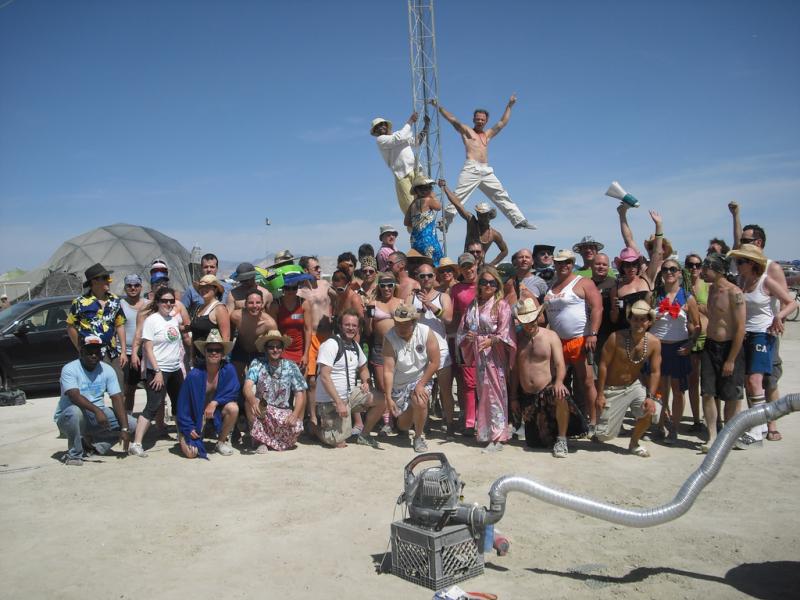
Shareable publisher Neal Gorenflo at this year's Burning Man, where sharing is a way of life.
Shareable.net has an editorial strategy---and we want to know what you think of it. Is there anything we've missed? Is there anything here that just seems redundant with what's already out there on the web? Leave a comment and help take Shareable to the next level.
What is Shareable?
A new peer-produced economy and culture is rapidly emerging where the more you share, the more respect you get from your peers. Our goal is to get more people to organize their lives around the logic of this new world where contributing to the common good is the priority.
Towards that end, Shareable looks at culture, cities, the economy, and daily life through the lens of sharing. We look for how people are sharing and we ask ourselves how the world can be made more shareable. The website is a place to learn about this new world where sharing is important and to access helpful sharing tools, tips, and how-to’s.
To whom does Shareable speak?
We call our audience the sharing community. These are the people who engage in sharing activities all the time. They’re members of City Car Share, they go to Burning Man, they live in cohousing or dorms, they organize potlucks and food clubs with friends, and they share code, videos, and news over the Internet. They’re also people who share professionally: designers, architects, scientists, nonprofit workers, digital journalists, sharing service employees, and so on.
Our audience reads Shareable because they are seeking new ways to share—not out of virtue, but as a path to a better, fuller, more successful life and career. They’re also looking to discover the meaning in sharing, to discuss and understand the values that facilitate sharing. Sharing is not a style or a fad. It’s a philosophy and a way of living, one that helps all of us to thrive in the twenty-first century.
What makes us valuable to this audience?
There are five key editorial goals: to build a strong, clear voice and brand; provide a platform for the ideas and creativity of the sharing community; generate original content that creates engaging, unique experiences; develop expertise and authority; and influence offline and online behavior.
Build strong, clear voice and brand: Shareable is aiming at a tone that is quirky, smart, slightly geeky, hopeful, casual, personal, warm, and authentic. We are not snarky, commercial, or ideological. Our goal is to cultivate a community whose members care about each other and the world. Our designs are simple, friendly, and navigable, and should suggest a wide-open feeling of possibility. No other website will combine these values and this orientation with a commitment to good storytelling, both visual and textual.
- Metrics: When people talk about Shareable, are they able to articulate right away who we are, what we stand for, and what they’ll find on the site? Is it obvious who should partner with us?
Provide a platform for the ideas and creativity of the sharing community: Shareable will extend an invitation to readers to write this exciting new story with us, so that the story of a shareable world is peer produced. We provide to open space for the audience to contribute to creating this vision through the Shreable blogging community (coming in late November 2009), comments, assigned contributions, and features such as “The Shareable Café”—and we will amplify their story through promotional and marketing efforts, events, and so on.
- Metrics: Number of posts in blogging community; number of those posts promoted to front page and channels; commitment of individuals bloggers as expressed in them promoting Shareable on their own; number of community members.
Generate content that creates engaging, unique experiences: We will connect readers to the people, projects, and places where the vision is coming to life, and offer readers ways they can make this world real in their lives today. Toward these ends, Shareable will strive to build a psychographic profile of our audience: where they shop, what other sites they visit, where they vacation, what cars they like to drive, and so on. This profile will inform how Shareable covers sharing activities.
- Metrics: Number of comments, site traffic, bounce rate, return visits, number of community members, blogging community contributions.
Develop expertise and authority: Shareable aims to accumulate expertise without experts, and to build authority without being authoritative. In the age of information overflow, curation is king. Our expertise and authority derives in part from our ability to sift the web and discover new ways to share, providing a lens that allows visitors to see sharing happening in our world. The content itself will be knowledgeable, but not necessarily definitive or authoritative—the conversations we foster will serve as a mark of our authority. Our authority will also derive in part from the movers and shakers we attract into the site through Q&As and essays. Some names will be famous, but we also want to amplify the work of people who are sharing quietly. As Shareable matures, no other website will have our depth and range of resources; no other website will have a community of people rooted in the belief that sharing (ideas, opportunities, stuff) is a way to achieve the good life.
- Metrics: Links, tweets, and search engine rankings; free media; positive reviews and comments in blogs, magazines, etc.
Influence behavior: We want people to share in the both the virtual and material worlds—share bikes, cars, housing, code, art, lives. In addition to providing tools and how-to’s, we will influence behavior is by creating a kind of fantasy image of the shareable life, an ideal that our community will strive to meet. This will entail, for example, features on cohousing that resemble “dream house” magazine spreads—but these cooperative living spaces will be presented as nodes, not islands, and gateways to the shareable good life.
- Metrics: Measurements of behavior must be qualitative, not quantitative. Toward this end, we will solicit stories from the sharing community (primarily in the DIY feature) and amplify their stories through the site.
How will we make ourselves even more valuable to our audience? What mechanisms will we use to improve our content?
- Follow traffic: What types of content on Shareable are getting the most traffic? Do more of that.
- Track search engines: What types of search terms are drawing the most traffic? Optimize those and tailor content to meet the needs suggested by the search terms.
- Build profile of readers: What type of reader is Shareable attracting? Where are they coming from? Track who joins, where they came from, gather demographic and psychographic information, and provide content that meets their values and needs.
How can we reach and mobilize the sharing community?
In addition to SEO, GoogleAds, and other methods of Internet promotion, Shareable must also meet the sharing community where it is in the real world. Sharing is an action, and sharers take action by building and living in cohousing, going to Burning Man, lending through Kiva, and so on.
Thus Shareable should craft partnerships and target outreach toward people inside these networks, through e-list sharing and purchase, direct marketing, paid advertising, content sharing, and so on. In addition, the content of Shareable must be crafted to appeal to people active in these offline networks.
Over time, Shareable should build ancillary programs designed to build our community, build a more shareable world, enhance our brand, and, in some cases, generate revenue. Ideas include:
- The Shareable Lab, which will bring people from many backgrounds together to discuss how to make something--housing, streets, schools, government--more shareable.
- Walking tours that reveal what's already shareable in cities around the country.
- Shareable conferences and workshops (e.g., “How to Build Cohousing in the Bay Area)
- One-shot panels, social events, and performances.
The CommonSource project will need to embark upon a process of prioritizing and developing projects like these, even as it builds the audience of Shareable.net.

Rate this article
Comments
I'd echo the other comment. Make sure that the notion of "shareable" extends beyond typical lefty/granola type stuff. I'm glad you mentioned potlucks. I'm thinking about all of those church dinner type things in the Heartland. A similar ethos perhaps - and a way to build cultural bridges around a shared value?
Worth articulating the ways shareable practices what it preaches. That it uses Drupal open source software. Is it offering anything back to the drupal community? How is shareable sharing its content? Is it using a creative commons liscense to encourge reuse of the content? Seems like a critical metric is how many people are using the share this links on articles to share them with friends. If you are using the addthis module for that functionality, they recently released an integration for that metric to appear in your google analytics account.
Great, succinct and clear write-up, full of useful illustrations. I also love the juxtaposition of metrics with the goals. One point that I'd be interested to see fleshed out is what if any external metrics you could come up with -- improvements to community knowledge that go beyond the confines of the organization and the Web site. How many books, workshops, open-license or Creative Commons works are spawned by the brainstorming and exchange of ideas on the site. That's at least as important as how well the site does itself.
Thanks, folks, for the feedback. Interesting thoughts on metrics. You know, my mother recently moved to a retirement community, and she was listing to me all the ways that it's shareable. We'll definitely cover this area--I think it would be really cool to have someone blog regularly from a retirement community.
I would defend us so far from the charge of being left-coastie, but we are definitely guilty of being coastal--the other cities frequently mentioned so far are Boston (where big things are happening with bikesharing) and New York (which is New York). I will be making a serious effort to expand our geographical scope...though I admit that I'll need help from readers like you. During a recent trip to Omaha, I tried extremely hard to locate shareable-type projects--and the only thing I found was a collaborative work of public art that came down two years ago, plus a childcare coop. Which doesn't mean that people aren't sharing in Omaha, just that sharing is more obvious in some places than others, and sometimes it takes some searching to find it.
Jeremy Adam Smith
www.jeremyadamsmith.com
I worked for a think tank that studied the rural US when I was in grad school. The rural Midwest is the center for cooperative business in the US. The amount of commerce generated by these cooperatives is staggering. It dwarfs the coop sector elsewhere in the US. We're talking billions of dollars. There are cooperatives for electricity, telecommunications, agricultural production, commodity marketing, and cooperatives built on top of cooperatives. For instance, groups of agriculture coops frequently co-develop agricultural processing or food products companies. And phone cooperatives have done the same to bring Internet and mobile phone service to rural areas
These are true coops, not coops by name. Some of these developed because of thin markets or market failures, the electricity and telephone market being prime examples. In the early 20th century, neither power nor phone companies wanted to serve the most rural areas. It's not profitable. The Rural Electrification Administration, and a similar federal department for telephone service, were formed during the depression to get electricity and telephone service to rural areas. The solution was the formation of consumer cooperatives. There's still about 500 telephone coops in existence. These are nonprofit entities owned by users whose charters instruct them serve the community, where any surplus revenue is paid back to users, and where the users have a say in how the enterprise is run. The importance, size and democratic nature of the cooperative sector in the Midwest is generally not recognized by the alternative economy crowd. It was truly eye opening to learn, and quite inspiring.
The trick, I think, is to find a way to tell the story of rural coops that will be interesting and useful to our readers--people in the midwest and prairie states already know about this stuff and people on the coasts might have a hard time seeing the relevance. So we'll need to develop a journalistic hook.
Jeremy Adam Smith
www.jeremyadamsmith.com
Comments e-mailed in by Michel Bauwens of the P2P Foundation sharing ideas about how Shareable can have more impact:
"well, at some point, perhaps the creation of local clubs centered around sharing practices, and some kind of sharing festival would certainly help ...
I think it is also important, at some point, to transcend the local roots and go also beyond the U.S.,"
Related Articles
- Share New York Panelists
- Swap.com Energizes Team by Sharing Space With Other Startups
- Pop-Up Coworking: A Way To Work Anywhere [Photos]
- Just in Time
- Crowdfunding Nation eBook Now Available In ePub and Kindle Formats
- Should Products Be Designed for Sharing?
- Indie Bands Thrive with Fair Trade Music Sharing
- Ezio Manzini on the Economics of Design for Social Innovation
- Shared Mobility: Welcome to the "Age of Access"
- Sacred Economics with Charles Eisenstein [Interview]
Community Blog Posts
-
By Gary Horvitz
-
By Liz Elam
Recent comments
-
9 hours 55 min ago
-
11 hours 51 min ago
-
14 hours 17 min ago
-
1 day 16 min ago
-
2 days 12 hours ago


I think you are getting close. I would gut check the tendency to be "my gen" and west coastie.
Some of the most important sharing is happening in the world of seniors who for whatever reason live very differently from the way they did a time ago. Necessity breeds change and for ex. the home sharing program in NYC for my money is far more important than co-housing, which to date, are little more than sophisticated gated exclusive ghettos.
I think most of the people i know are looking for back doors. They don't commit, or when they do it is after a set of calculations designed to keep their alternatives in place ( i really will be able to drive a beemer, get the corporate job I want, get my investments back). For this movement to grow it has to mean it. To become the dominate, enthusiastic way people live..
To that end you can serve as the great validator. The examples of people in the center, particularly ones that have options and choose to share are going to be your most important message.
I think your readers need some perspective. Sharing was and in some places still is the dominate form of existence. What we suffer is the interruption of that long tradition. We have to get back to it. To do that people have to trust it will work for them. Not as a fad, but for the rest of their lives. How we build in that trust is critical.