
In a 2011 TED Talk, neuroeconomist Paul Zak attempted to answer a question that had haunted him since youth, "What drives our desire to behave morally?" The son of a nun, Zak had long been fascinated by morality, an interest that carried over into his professional life.
Zak noted, "…taking on Morality with a capital M is a huge project. So I started smaller. I studied one single virtue: trustworthiness. Why? I had shown in the early 2000s that countries with a higher proportion of trustworthy people are more prosperous. So in these countries, more economic transactions occur and more wealth is created, alleviating poverty. So poor countries are by and large low trust countries. So, if I understood the chemistry of trustworthiness, I might help alleviate poverty."
Throughout the course of his lecture, Zak illustrates why he calls oxytocin "the moral molecule." To test his hypothesis, Zak recruited participants to a study that involved the transfer of money between strangers as a means to measure trust and trustworthiness. What they found was that "those on oxytocin not only showed more trust, [but] we can more than double the number of people who sent all their money to a stranger — all without altering mood or cognition."

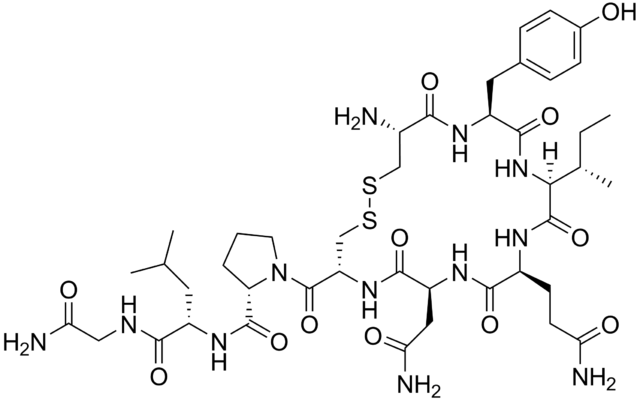
The chemical structure of oxytocin.
Taking the experiment into the non-pharmacologic realm, Zak tested massage, dancing, and praying as means to boost oxytocin levels in the body. Generosity ensued. Further testing concluded that "the change in oxytocin predicted their feelings of empathy. So it's empathy that makes us connect to other people. It's empathy that makes us help other people. It's empathy that makes us moral."
In the end, Zak's research indicated that this hormone is, indeed, responsible for human morality, including trust and empathy — key ingredients for prosperous, stable — and shareable — societies.