Do shared items have a shorter life span?
08.10.11, 8:48pm Comments (14)

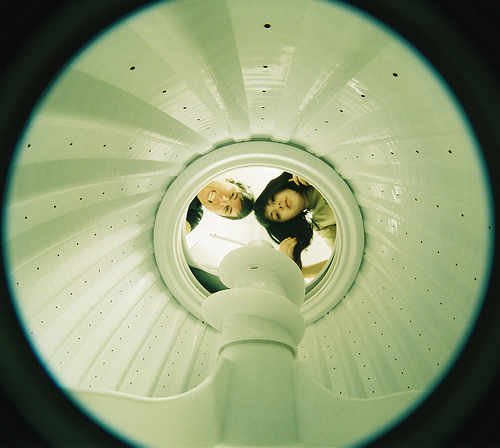
Yours truly, an avid sharer, ponders the utility of sharing "durable" goods. Photo credit: Ikayam on Flickr.

This question is a bit heretical but it's important: When we share items, does the increased wear & tear mean that the item wears out beyond repair and must be replaced sooner than if we didn't share it. Let's  say, for example, my neighbor and I share a washing machine: Instead of that machine doing 1 load of week, it now does 2. Won't it wear out twice as fast? And, if so, is there an environmental/financial benefit to sharing anyway? 
Sharing

Rate this article

Your rating: None Average: 1 (1 vote)

Comments

Sorry if my last comment was too off topic.

Goods depreciate at different rates. There will be winners and losers. It's normal to expect that people will learn to game the system. For instance why not borrow all of your highest depreciation items and purchase and loan out only your lowest depreciation items?

Also, placing your item into "the commons" may subject it to people overusing it since they feel it's in their best interest to do so and assume that others will as well. If many overuse those things they borrow, obviously, people will have to replenish the sharing commons with new items through either enticing other people to join (pyramid scheme?) or purchasing new items with the expectation that others will be using them and again depreciating them at an accelerated rate.

Jason

I'm not worried about people gaming the system. I'm just wondering how much we actually reduce our environmental footprints by sharing items instead of owning our own if you factor in the fact that the shared item will have to be replaced sooner than if that same item were not shared.

Hmm... That's a tough question.

One thing that came to my mind is that shared items will reduce new purchases which should mean that the average amount of wear for all items in use at any one moment will increase (e.g. most people will be driving cars with slightly higher miles on the odometer).

If the items we are sharing pollute more the longer they have been used (e.g. say most car engines pollute 10% more for every additional 50k miles), then, I would guess there could be some minor increase to the gross amount of pollution.

However, this may be offset in the long run by the fact that each new model of the items we buy are increasingly environmentally friendly. If we choose to share instead of buying new, it would mean putting fewer of the current (and presumably less green) models on the road.

I'm sure there are many other factors we could explore, but, I thought these were neat. Maybe we should strategically share items that are scheduled to improve in the near future to minimize the number of the high pollution models that make it into circulation. This could also put some urgency into bringing out new environmentally friendly models at the factories since we stall new sales on polluting models.

Maybe this is a new form of boycott ;)

When it comes to "stuff," sharing is almost always more efficient, for a variety of reasons. Take the washing machine you mention here, for example: firstly, one washing machine takes up less space than two, thus freeing up space for another use. From an environmental perspective, this could mean using those 9 square feet to store something inside your garage/basement that might otherwise be stored outside, thus freeing up space for an outdoor garden.

Secondly, the inevitable depreciation/deterioration of products over time is a huge factor that makes sharing efficient. Again using the example of the washer, consider that even a washer that receives no use will still fall apart in an entropic fashion over time; bolts will rust, plastic will become brittle, and random electrical surges will wear down the inner workings of the machine *regardless* of how many people are using the machine. Of course, use will wear it down faster, but sharing addresses this basic level of wear inherent in the passage of time by reducing the number of "idling" machines sitting around and collecting dust (literally!)

There are other factors that make sharing more efficient in cases like these, though I feel the two above (space-saving and minimizing entropic loss) are the most salient. I hope this clarifies the issue somewhat for you!

Thanks,

Nathanael O'Donnell

I think in order to make much sense out of many questions regarding sharing we need to define a "use" metric for each sharable item and then start collecting things like the following:

"maintenance cost per use"
"depreciation cost per use"
"depreciation cost per year owned"
"potential number of uses before discarding"
"average number of uses before discarding when unshared"
"average number of uses before discarding when shared"
"total cost per use"

"environmental impact when manufactured"
"environmental impact when discarded"
"environmental impact per use"
"lifetime environmental impact"

Once we have numbers like this, we should be able to ask things like "how many fewer drills are manufactured and subsequently purchased when the average number of uses before the drill is discarded has been increased through sharing?". We could then go on to ask things like "what is the environmental impact of using every shared drill for a maximum number of uses since this would reduce the number of drills manufactured, purchased and discarded?".

An interesting thing to note is that the definition of "use" will vary from item to item. For a car it would be measured in miles. For a bottle opener it would be measured in number of bottles opened. For a computer it would be measured in the number of hours used. These metrics should be chosen to make it easy to calculate the above values and others I haven't accounted for.

Btw, it would be amazing to design an online sharing system that made it easier to track and share these types of metrics :)

I agree with Jason--the feasibility of increasing "per use" efficiency (and decreasing environmental impact) by sharing items must be addressed on a per item basis. I do like the idea of developing a set of metrics that can be used to test and compare the "shareability" of different items; the task will be complex because, as Jason points out, definitions of even simple metrics such as "use" and "lifetime environmental impac" (OK, that one's note so simple) will have to accommodate the various natures of the items in question.

I am optimistic, however, that as the art and science of sharing is (re-)discovered, we will become more comfortable using standard metrics to compare the viability of sharing schema.

Thanks for this thoughtful framework, Jason!

I never heard of this concept of "entropic" deterioration -- thanks for explaining it, Nate. And Jason, I think you're really on the right track with the need for item-specific metrics. To carry on with our trusty washing machine example (I'm obsessed with washing machines having just bought a new one--don't shoot--I gave my old (moldy) one to someone else who was thrilled with it)...

Let's say the typical machine lasts for 15 yrs of regular use before it's beyond repair. And let's say I'm sharing the machine with my neighbor so it's getting twice the normal use. Under Nate's argument, the machine getting twice normal use will last for longer than 7.5 years, but how much longer? 7.7 years? 12 years? In deciding whether to offer to share my machine, it would really matter to me how long I'm postponing a new purchase by doing so.

I think it's important to think about the fact that most devices are made up of many replaceable parts. It's unclear to me that entropy would cause an entire devices to be ruined in most cases. There is a chance that parts that are under constant stress, like say a rubber belt or even some screws, might become worn with time.

We may get good results by thinking about how sharing affects the need for maintenance and repairs. What if not sharing a washing machine meant that you had to perform minor maintenance or repairs 3 times instead of 2 times before you discarded it?

From a market perspective, the longer that an item is owned the less valuable it often is, even if it works perfectly fine. This can be attributed to the fact that cheaper, more stylish or functional models are constantly entering the market. Something else to think about is that the lifetime of an item may partially be based upon the expected availability of repair parts and trained technicians.

So, back to your example, I would look at the price of replacing standard components and estimate the resale value of washers that are 15 years old and those that are 7.5 years old and then see if it makes sense to share the item for 7.5 years and then sale it. I would guess the combination of doing less maintenance (assuming this savings is real) and selling the item before it experiences extreme depreciation due to age would probably save you and your friend some money (you should probably split the water and electric too!). As for the environment, you avoided the purchase of an unnecessary washer and you have a chance to switch to a more environmentally friendly washer at 7.5 years instead of at 15 years.

It's hard for me to imagine the exact effect this behavior would have on the used washer market, but, I would guess that the average age of used items would go down and if each new generation of washer is greener than the last, then, it could mean that more green washers enter the used market sooner.

I'm not a trained economist, but, I hope these ideas are useful. Discussing this topic with you has certainly helped me clarify some ideas :)

My husband and I share a washer and drier with my son and his wife. Also, mower, freezer, power tools, ladders, special kitchen items like the pressure cooker, bikes and we even mix up who uses what car. Two cars are small, low gas mileage models, one is bigger and useful for hauling but uses a lot of gasoline. All the cars are older clunker types but my son does the maintenance and many repairs. The washer and drier were used to begin with and again, my son can do repairs. We all work on bikes. Other tools we share would never be used up since they aren't used often and are shared within a larger community of friends and family.

A special note though, any tools etc. that are owned for anyone's work or livelihood are only shared under the most extreme situations and one ALWAYS asks first and offers to pay a rental fee to use them. We also rent needed tools from a rental company. (Another type of sharing.)

You guys are over thinking this. Especially when you talk about newer items coming out that are fancier or more stylish than older versions since in my family we are trying to avoid the consumer life style and wouldn't buy for those reasons anyway. If you are planning on greater numbers of people sharing something like a washer, a more industrial version should be bought in the first place and could be afforded if several families or neighbors bought it together. My grandmother had an early singer sewing machine that had no problem handling several generations of women making and repairing clothing and other household items though it didn't do any fancy stitches or have a computer. They don't make 'em like that any more. After 50 years, it needed a new motor. But you can buy industrial versions, especially used and reconditioned.

The truth is, manufacturers haven't been making products to last in quite some time. The sooner an object wears out, the sooner it must be replaced and therefore the company can make larger profits. Haven't you seen a rounded, 50 year old refrigerator in someone's garage or the "break room" at work? However, I bought a new one around 1985. After six years I moved into a warehouse loft with no AC. The compressor died and the repair man suggested we get a new fridge since they were no longer designed to hold up without air conditioning!

Be realistic. Start serious sharing with people you know and trust. Work things out and plan ahead. My brother just borrowed our electric mower and ran it over a stump, trashing it. Again, not an industrial strength version. We all still aren't sure how we want to handle it. Obviously, he shouldn't pay for a new one since we had been using it on our small yard for five or six years. But we might talk about going together on a tougher model if he is going to start mowing his own yard. Wonder who else we can get to go in on one?

chris rodgers

Erica,
You posed a simple, but important, question to examine. Let's consider two things that cause an item to require replacement (certainly there are more, but I'm going for the obvious and unavoidable): age and usage. Despite the old saw - which I've heard applied to cars and knees - that "it's not the age, but the miles," I actually think that both are important.

An object's age is fixed - it has to do with the normal breakdown of materials over time, just because they interact with oxygen, sunlight, moisture, etc. Number of users or amount of use doesn't really change an object's age, so that for the age factor, sharing has no considerable impact.

The amount an object can be used before it deteriorates and is no longer usable might also be thought of as fixed. Let's say that the VroomVroom car will go 300,000 miles before it's kaput and needs to be replaced. One owner, driving 10,000 miles/year, will have to replace her VroomVroom after 30 years. If the VroomVroom is shared among 10 drivers, each of whom drives 2,500 miles/year (car-sharers tending to drive less), then the sharing group racks up 25,000 miles/year and will replace the Vroom Vroom after 12 years. That same car-sharing group will have gone through 2.5 VroomVrooms in the same 30-year period, and will have driven 750,000 miles.

Sounds like a bigger footprint, right? 1 car vs. 2.5, 300K miles vs 750K? Except that footprint is spread among 10 people, so it's more like 1 car vs 0.25, 300K miles vs 75K (per capita). That's pretty awesome. Of course, I made up all the numbers in this illustration, but it's still pretty awesome to think tangibly about environmental footprint reduction through sharing.

Now consider that the VroomVroom is expected to last 300K miles at an average of 10K miles/year, but might actually last more miles over a shorter period due to less aging, then the car sharing group has yet another advantage to reduce its footprint. Suppose it doesn't need to replace its VroomVroom until the odometer hits 350,000 miles, at which point it is only 14 years old - the dashboard hasn't yet cracked due to UV exposure, rubber seals haven't gotten brittle and caused oil leaks, the frame hasn't developed cancerous rust.

Huh. Maybe the VroomVroom'll make it to 400,000 miles. We just need to recruit another member or two into the group so that those extra miles get driven before age overtakes usage on the road to the scrap yard!

Incidentally, I think that environmental footprint serves as an adequate short-hand for "valuable resource consumption" - environmental, material, financial.

VroomVroom!
- Valerie

I'm curious why it would matter so much how long you're postponing a new purchase. Assuming that you've devised a fair way to share the costs of ownership and use, then wouldn't any postponement be an improvement over not sharing? If you have a fair indication that one option will lead to a more desirable outcome than another option, do you need to know beforehand how much better it will be? Or are you looking to establish a likelihood that the benefits will outweigh the likely drawbacks of sharing (inconvenience and such) by more than a slim margin?

Seems like the answer to the question I posed is that it depends on the nature of the item. Something highly durable like a hammer could be borrowed infinitely without hastening its demise to any measurable extent. A washing machine, by contrast, would wear out approx twice as fast if shared with another family b/c it would get double the use. But a car shared with that same family wouldn't wear out twice as fast b/c the family's driving habits would probably shift, thereby decreasing collective wear and tear on the car.

To answer Valerie's question, the reason I'm contemplating this issue isn't so much about saving $ by postponing purchase: I'm looking at my and my community's lifetime environmental impact. If sharing a car with 3 neighbors means that, over the course of our lives, we'll collectively purchase 4 cars instead of 8, then this our environmental impact is lessened. But if I share a washer with those same 3 families, then we'll probably together purchase 8 new machines over the next 30 years (if we don't share, we'll each purchase 2 more machines over the next 30 years for a grand total of...8 new machines....same enviro impact).

Great question, and one I get asked of a lot. Really good points have been raised as well. Two additional thoughts at the moment

1. Wear and tear is a definite reality when it comes to product based sharing. Hopefully our collective concerns for the rapid deterioration of products cause producers of consumer goods to create more durable or upgradable products - I'm sure many in the sharing economy would vouch for paying slightly more for higher quality products that get much more usage.

2. One of the benefits of products deteriorating quicker - at least in our current rapid paced economy - is that as you share you're able to complete the lifecycle of the product and 'upgrade' for the 'latest' (should that interest you). So over the course of your sharing lifetime, you're able to maximize utilization of assets, while sharing the latest (gaming system, lawnmower, even car, etc.)

Lon

http://unstash.com - Own Less, Live More
http://twitter.com/lon

All good points here so far. And I'll add this: Lets not forget, most people throw away items before they reach the end of their lifespan. People throw out clothes because they are no longer fashionable, or throw out the bread maker they got as a wedding present because neither spouse likes to cook. Sharing ensures we get the most from our tools before they get thrown with the waste.