As Design 4 Resilience approaches, the D4R team is boning up on resilience thinking. And sharing what we're learning on Shareable's D4R channel, Twitter's #D4R hashtag, and the D4R tag on Delicious.
One thing we've learned is that there are many perspectives on resilience. As examples, psychological resilience is a robust field. Recently, a team of psychologists at University of Pennsylvania lead by Martin Seligman began work on a $100 million contract to train Army personnel in psychological resilience. Then there's urban resilience. And here's a great post on social resilience.
A cross-discipline, cross-scale exploration of resilience is one thing we're striving for. This means looking at resilience across fields (psychology, sociology, ecology, etc.) and scales of organization (individual, neighborhood, city, etc.). This will help us identify common design principles across fields and scales. For instance, modularity is an important feature of resilience in higher scales of organization, but how would modularity manifest in individual psychology?
This year, we’ve seen Mutual Aid in Motion.
From scaling sharing hubs to Mutual Aid 101 trainings, we’re helping communities build the tools they need.
Every dollar fuels lasting resilience – proving that when we move together, we all move forward.

Now that we understand that there are many perspectives on resilience, let's jump into our primer while realizing it has biases. The below is the perspective of the Resilience Alliance, a global network of renown social scientists and ecologists including Nobel Laureate Elinor Ostrom. Its focus is on social ecological systems (SES) at the regional scale, though not exclusively. It's a good starting point despite this bias.
ORIENTATION
Definition: resilience is the ability of an interdependent social and ecological system to absorb disturbances and maintain the same structure and function. Other context:
- A resilient system copes well with shock
- As a system's resilience declines, the size of the shock from which it can recover gets smaller
- Resilience shifts management focus from growth and efficiency to adaptability
- An overemphasis on growth and efficiency of a system leads to a dangerous rigidity and fragility
- A resilience focus is increasingly important as the magnitude of the shocks in the world get bigger and more unpredictable
- Learning, flexibility, and self-organization are important to the ability to recover and thrive
- The aim of resilience management is to keep a system in a regime so it continues to deliver the desired ecosystem services and is not easily pushed into an undesirable regime from which it can't recover
KEY CONCEPTS OF RESILIENCE THINKING
- Nonlinearity, alternate regimes and thresholds. Social ecological systems (SES) include nonlinear dynamics. A system can shift dramatically into an undesirable regime from a small change if a threshold is crossed. Attention to thresholds is critical.
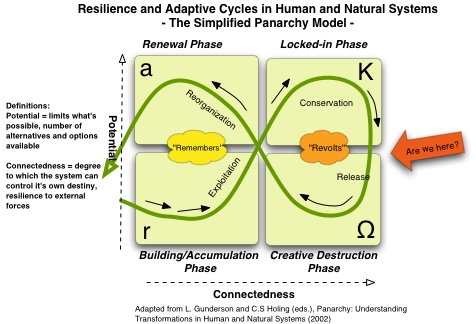
- Adaptive cycles. SES tend to move through four recurring phases: growth and conservation (resources committed, stable, slow change, predictable), release and reorganization (resources freed up, chaos, fast change, opportunity). This is the cycle of life.
- Panarchy – multiple scales and cross-scale effects. SES function at multiple scales of space, time and social organization. You must understand the cross-scale interactions to manage effectively at a specific scale. One key to this is to realize that each scale can be in a different phase of the adaptive cycle.
- Transformability. If a SES is pushed into an undesirable regime and can't be returned to it's former state, one option is to transform it into a new system with new variables, new livelihoods, and different scales of organization.
- General vs. specified resilience. Specified resilience is resilience of a specific part of a system to a specific shock. Focus on resilience of one part the system can come at the expense of other parts of the system. Balance between the two forms of resilience is important.

KEY CONCEPTS OF RESILIENCE MANAGEMENT
- Assessment: understanding the regime the system is in, where it is in the adaptive cycle, where the system thresholds are, what the key variables are, and how the cross-scale interactions either increase or decrease resilience
- Management: how to avoid an undesirable state or get from an undesirable state to a desirable one, and how to transform a system when that's the only option.
RESOURCES
- Resilience Alliance primer on resilience. The above primer is a short summary of their primer. Highly recommended.
- Check out Shareable's resilience bookstore
- Download the Community Resilience Toolkit, a free resource by Bay Localize
- The Transition Handbook, by Rob Hopkins, founder of the Transition Towns movement
- The Transition Movie
- Find people studying social ecological resilience here
- Here's a resilience assessment tool and a threshold database
Image courtesy of Tsalon.